ASELSAN and ARMELSAN to Develop NEW GENERATION MULTI-STATIC SONAR SUITE for TF-2000 Destroyers
On August 17, 2021, a protocol was signed between the Presidency of Defense Industries (SSB), ASELSAN, and ARMELSAN, at the 15th International Defense Industry Fair IDEF '21 to develop a new generation multi-static sonar suite to be used in TF-2000 Destroyers with national means.
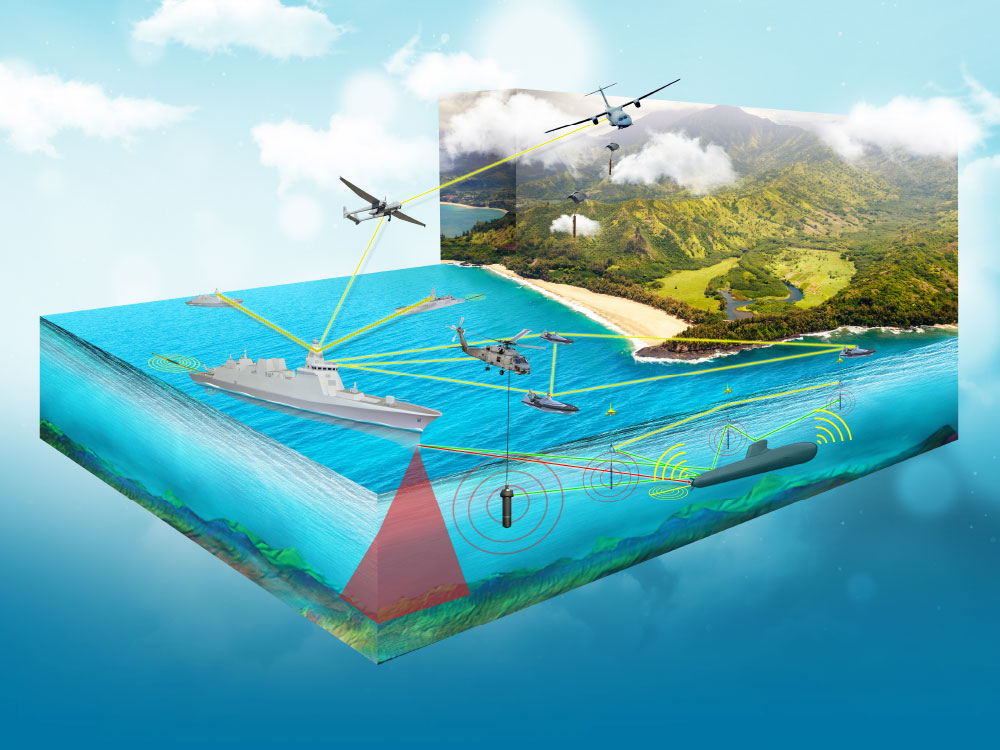
With this multi-static sonar suite, it will be possible to precisely detect underwater threats across a wide area by enabling joint operation (data fusion) of sonar systems on the same ship or other surface ships with helicopter dipping sonars and sonobuoys that are operating in a compatible frequency band (will be able to communicate with each other via the link). The term 'bi-static' refers to two simultaneous active sources working together, and 'multi-static' is when more than two simultaneous active sources work together. In this respect, the DÜFAS and TF-2000 Sonar Suite are designed with multi-static capability.
The mid-range frequency hull-mounted sonar system to be developed for the TF-2000 AAW (Anti-Air Warfare) Destroyers will utilize the know-how and infrastructure gained from the FERSAH Sonar System (Factory Acceptance Tests have been completed) developed by ASELSAN for the BARBAROS Class Mid-Life Upgrade (MLU) at the maximum level (It will be manufactured at the same frequency [3-5kHz] so that it can communicate/work together with the ORKUN-2053 Helicopter Dipping Sonar and DÜFAS). ARMELSAN will act as the Main Subcontractor in the Project to be carried out by the Main Contractor ASELSAN.
Aside from the SSB, the Ministry of National Defense also initiated a more comprehensive project for multi-static sonar technology, and in this context, issued a Request for Proposal (RFP) to the relevant domestic companies in the last week of September 2021, asking them to submit their proposals until November 10, 2021. This date was then updated to November 25, 2021.
With the emergence of indigenous and capable products and concepts in multi-static sonar technology, which changes the traditional approach to underwater acoustics, the surrounding seas and even oceans will be more transparent within the laws of physics in a very short time (not only ships, helicopters, and submarines, but also sonobuoys and Armed Unmanned Surface Vehicles [AUSV/SIDA] can be used as part of this network). In this way, since it will significantly increase the detection of underwater targets, the Turkish Navy will experience a quantum leap in Anti-Submarine Warfare (ASW) capability.
I have learned that under the TF-2000 Multi-static Sonar Suite Development Project, the first TF-2000 Multi-static Sonar Suite prototype will consist of a Hull Mounted Sonar (HMS), Towed Active & Passive Array Sonars (towed with two separate cranes, DÜFAS + HIZIR TCMS), Helicopter Dipping Sonar (ORKUN-2053, to operate in conjunction with the HMS), Small Object Detection Sonar (to detect small underwater objects like AUVs) and Sonobuoys. Operating in the lower frequency band (3-5kHz), the system prototype will be ready at the end of a 36-month calendar.
Multi-static Sonar Systems and the TF-2000 Sonar Suite
In active sonar systems, an acoustic projector generates a sound wave (ping) that spreads outward and is reflected off a target object. Then a receiver picks up and analyzes the reflected signal or echoes to determine the range, bearing, and relative motion of the target. Since the strength of the echo is related to how close the target is, it is possible to find the object's range and size by comparing graphs and determine whether the echo is coming from rocks on the seabed, sunken debris, or a potential threat through careful analysis of the echoes.
Because water absorbs sound much faster than air, an active sonar must transmit very powerful signals to receive an echo from a target within a valid range. For example, in the 1990s, the US Navy allowed the transmission of sonar signals up to 240dB. This figure is 1 million times higher than the 180dB, which causes permanent loss of hearing in humans. Active sonar emissions at levels much lower than 240dB have also raised environmental concerns, with various groups claiming that even sound levels as low as 180dB can cause death in marine mammals.
The term 'mono-static' refers to stand-alone systems, the term 'Bi-static' refers to two simultaneous active sources working together, and 'multi-static' is when more than two simultaneous active sources work together. In this context, the long-range low-frequency towed active sonar DÜFAS, which will be developed indigenously by ASELSAN-ARMELSAN as part of the TF-2000 Sonar Suite, Turkey's first active helicopter dipping sonar ORKUN-2053, and the Hull Mounted Sonar System, which will operate in the 3-5kHz band to be developed for TF-2000 Destroyers, are designed with multi-static capability.
Traditional Active Sonar designs also have some drawbacks. For example, if the sonar frequency is low enough that it can be detected by a submarine from a range where it can apply defensive measures, and the sub is small (the bow and stern of an AIP powered or diesel-electric submarine are in this class), then it is nearly impossible for the active sonar to detect the submarine. Since sending a higher frequency signal to detect the stern or bow of a submarine will reduce the detection range, the submarine could not be detected before it reaches the accepted operational firing range of 15-20 km.
Multi-statics differ from conventional sonar, both active and passive. Because instead of using a single (mono-static) active signal source and a single receiver, they use multiple active sonars and multiple receivers. This allows a much, much higher detection rate. Since there are multiple active and passive sources, a submarine cannot direct its nose or tail to a single active sonar to minimize its reflections and avoid detection as this will result in the wider side of the sub being pointed at another active sonar, eventually creating an even greater echo. In many cases, simultaneous reflections from multiple transmissions are picked up by several buoys, allowing them to triangulate the exact position of the submarine. Also, accurate tracking of the submarine is possible if all sources and receivers are equipped with a Global Positioning System (GPS). By combining all the echoes, it is possible to determine the position of a submarine and send a light torpedo to the designated location without further search.
While the main purpose of the Cold War product conventional active sonar systems was to seek and eliminate nuclear submarines from very long ranges, due to the change in the maritime mentality in the last 20 years, keeping submarines out of a certain area, instead of searching for their exact position, is now a more dominant operational concept. So, if a convoy passes between two points, it does not matter where the hostile submarines are exactly, as long as they are held at a safe distance from which they cannot launch torpedoes and do not pose a threat to the friendly forces. For example, US Navy destroyers and cruisers send a strong ping to warn submarines in the area to stay away while crossing the Strait of Gibraltar. DÜFAS was also designed with a similar concept in mind.
DÜFAS Project
ASELSAN, together with its project partner ARMELSAN, developed the Low-Frequency Active Sonar System DÜFAS solution to meet the long-range low frequency towed active sonar need of the Turkish Naval Forces. In this context, the bi-static low-frequency towed active array sonar (Acoustic Transmitter) of the HIZIR-LFAS concept, which was exhibited for the first time at the IDEF ‘17 Fair, was handled separately from the Torpedo Detection Array of the HIZIR-TCMS System. Therefore, HIZIR-LFAS, which can only send but not receive signals, was planned to be used interoperable with the Torpedo Detection Array of the HIZIR-TCMS System. Thus, the reflection of the active sonar signals sent by the HIZIR-LFAS from the target would be received by the Torpedo Detection Array (towed passive array sonar) enabling the detection and classification of hostile submarines or torpedoes. According to the product brochure, HIZIR-LFAS would have a detection range of over 50,000 yards (45.7km) using indigenous active sonar algorithms with CW, FM, and FM/CW pulse types.
ASELSAN later abandoned this concept and exhibited the new DÜFAS concept at the IDEF '19 Fair for the first time. The new system was stated to operate in the low-frequency band below 5kHz in active mode (3kHz) and incorporate piezoelectric single crystal ceramic technology materials. Unlike the previous one, the new DÜFAS array sonar and acoustic transducer (ASELSAN would develop the transducer, the onboard power unit would be an ARMELSAN product) were designed to fit inside the 10cm diameter towed torpedo detection array of the HIZIR-TCMS System that can be spooled out and retracted by the crane. Thus, the HIZIR-TCMS Torpedo Detection Array would be able to transmit both passively and actively, and in active mode, it would be able to detect targets (submarines) from much longer distances (factors such as weather, water temperature, the salinity of water directly affects the detection range) than it is now (passive only). However, at IDEF '21 and TeknoFest 2021, the company exhibited a new version of DÜFAS with a bi-static low-frequency towed active array sonar designed in line with the needs of the Turkish Naval Forces Command/TNFC (A 1/2 scale model of the DÜFAS Acoustic Transmitter was exhibited at IDEF ‘21 and TeknoFest 2021). In the new version, the Acoustic Transmitter has a different design and a larger structure.
Based on the Turkish Navy requirements, the new version will include a passive (on the left, HIZIR-TCMS) and active (on the right, DÜFAS) sonar array, which is towed by two separate cranes and spooled out behind the vessel. At first, the multi-static DÜFAS will work in an integrated manner with the HIZIR-TCMS passive sonar array (it also will be able to communicate with other sonars in the area via the onboard Combat Management System). Thanks to its multi-static feature, the powerful sonar pings sent by DÜFAS can be received not only by the passive towed array sonar on the same ship but also by friendly submarines in the region, enabling them to perform their underwater surveillance missions by passively listening to the sonar echoes reflected off any underwater object. When towed from a TF-2000 AAW Destroyer, DÜFAS will prevent hostile submarines from infiltrating the convoy under its protection, thanks to its very powerful active sonar ping (it is also planned to be installed in some of the GABYA Class Frigates).
Although the effective range of DÜFAS is not shared due to its confidentiality, it was stated that it would be "probably better than the current equivalent systems" and in response to our question whether it will have a longer range than the HELRAS Helicopter Long-Range Active Sonar in the Turkish Navy inventory, we were told "HELRAS is much smaller. Since DÜFAS is low frequency and can operate in deeper water, the sound waves can travel further, and we can receive their reflections from longer distances." Based on the 1/2 scale model, which was exhibited at the IDEF Fair and TeknoFest 2021, the acoustic transmitters (low-frequency projectors) and an electromechanical unit are located at the midsection of the DÜFAS Acoustic Transmitter, while the electronic units and the control system that powers them are located on the front. However, the central system is located on the ship. It was noted that the crane system, which will be located at the stern of the ship and carry both DÜFAS and HIZIR-TCMS arrays/Acoustic Transmitters, will use a hydraulic operating mechanism with very large dimensions.
The Low Frequency Active Sonar (DÜFAS) System will be integrated on a GABYA Class Frigate in the coming months and will be subjected to a series of sea tests before the end of 2022. According to the information I have learned, after ARMELSAN delivered the work packages (acoustic transmitters and electronics inside the DÜFAS Acoustic Transmitter Unit) under its responsibility, ASELSAN has started the final assembly and integration of the first DÜFAS System Prototype. The AN/SLQ-25 Nixie Torpedo Defense System located at the stern of a GABYA Class frigate will be dismantled and replaced with passive (left, HIZIR-TCMS' Torpedo Detection Array [towed passive array sonar]) and active (right, DÜFAS) towed by two separate winches in line with the requirements of the TNFC) sonar arrays. DÜFAS will be operated in conjunction with the HIZIR-TCMS' towed passive array sonar. In terms of operations, two towed elements are required to be in the water for full ASW functionality. Thus the GABYA Class Frigates will gain an established ASW capability consisting of a hull mounted sonar, helicopter dipping sonar (both HELRAS and ASQ-18A) and with separate active (DÜFAS) and passive (HIZIR-TCMS) towed elements.
ORKUN-2053 Helicopter Dipping Sonar
Regarding the acoustic conditions, shallow, narrow, and deep coastal waters are generally high reverberation environments (reverberation is the persistence of sound after a sound is produced. It results from a large number of reflected waves. On the other hand, an echo occurs when a sound pulse is heard twice). Acoustic sources that cause reverberation include reflections from the seabed such as islands, ridges, shores, landmasses, sea surface, and volume of water.
The primary mission of today's Anti-Submarine Warfare (ASW) is to hunt ultra-silent AIP + diesel-electric or diesel-electric only conventional submarines in shallow or mid-depth waters. New power generation and propulsion technologies allow these platforms to remain submerged for extended periods of time, listening to the noise of the surface targets without revealing their presence. If the target is searching with its hull-mounted mid-range active sonar, the submarine descends below a water layer with a steep temperature gradient (thermocline), which limits the active sonar detection range. In this way, the sub can launch an attack that will leave little time for the surface ship to evade.
In order for ASW ships to be able to fight effectively against submarines with very silent propulsion systems, submarines must be detected from longer ranges. Towed Array Sonars and Helicopter Dipping Sonars, which are seen as revolutionary advances in sonar technology, play an essential role in establishing this capability. Developing the indigenous design and production HIZIR-TCMS and DÜFAS Towed Array Sonars with national resources, Turkey has also developed the indigenous design ORKUN-2053 Helicopter Dipping Sonar to support the low-frequency HELRAS and mid-frequency AN/AQS-18A Helicopter Long-Range Active Dipping Sonars in the inventory. These sonars, which operate in the 3kHz band, can be employed in both bi-static and multi-static mode and will play a vital role in performing long-range ASW missions in a wide area.
ARMELSAN Company developed Turkey's first mid-frequency active dipping sonar ORKUN-2053 for Anti-Submarine Warfare and shared the Sonar's images and product brochure on its official website. The ORKUN-2053 Sonar, which was stated to operate at depths to 350 meters, would be able to transmit in 3 different frequencies between 8kHz-11kHz in a 360-degree coverage area. With a system weight of approximately 270kg, the ORKUN-2053 National Mid-Frequency Active Dipping Sonar was claimed to detect targets from long distances thanks to its high output power. The company shared its first information about the ORKUN-2053 during the IDEF '19 Fair.
However, according to the information I learned at IDEF '21, although the operating frequency was planned to be 8-11kHz before, a new version of ORKUN-2053 with the 3-5kHz band is being developed to allow interoperability at the same frequency (3-5kHz) with the new Hull Mounted Sonar to be developed for the DÜFAS and TF-2000 under the multi-static sonar project. The new ORKUN-2053 sonar prototype with multi-static capability is planned to be delivered in the first quarter of 2022. It was stated that the ORKUN-2053, which is aimed to operate at a depth of 400m, will have a 1.2m wide sonar wet-end, thus making it lighter and smaller compared to the HELRAS Dipping Sonar with a 2.58m wide Sonar Wet-End. It was pointed out that the ORKUN-2053 will have a similar container configuration with the ASQ-18A Dipping Sonar and thus can be easily mounted on SH-70 SeaHawk Helicopters. In response to one of our questions, ARMELSAN officials emphasized that even if the sonar wet-end gets smaller, this will not negatively affect the sonar's range.
Operating in 1.31-1.45kHz frequency bands, the detection range of the HELRAS dipping sonar can be selected as 1, 1.5, 2.5, 4, 6, 10, 16, 25, 40, and 60nm. Since HELRAS operates in the low-frequency band, it is designed to operate in deep waters such as in open seas and oceans (sonar wet-end can be submerged up to 500m). More efficient results can be obtained in shallow waters with AN/AQS-18A (total weight 264kg, wet-end weight 88.9kg) and similar dipping sonars, which operate in the mid-frequency band (9.23kHz – 10.520kHz) and have a 20nm coverage range. The HELRAS Sonar, which also provides passive search, target-clutter discrimination, and underwater communication capabilities, serves as the sharp ears of SH-70 Helicopters during ASW missions with its approximate detection range of 120,000 yards (109.7 km) and advanced technology.
While the Turkish Navy prefers AN/AQS-18A for the Aegean Sea, which is considered shallow water, it prefers and effectively uses the HELRAS sonar for missions in the Mediterranean and Black Sea, which are relatively deeper than the Aegean Sea. The main reason why HELRAS is not preferred in the Aegean is that it causes underwater reverberation due to its low frequency, thus reducing its echo selectivity. Therefore, the higher frequency AQS-18A (operating in the mid-frequency band) is preferred during missions in the Aegean Sea.
Thanks to the interoperability of the ORKUN-2053 Helicopter Dipping Sonar and DÜFAS Low-Frequency Active Sonar System, both of which have variable depth capability and the same operating frequency, it is aimed to provide detection from longer ranges in various acoustic environments than other hull-mounted or variable depth sonars.
The joint use of the ORKUN-2053 and DÜFAS will also provide several operational advantages to the user when performing ASW missions. For example, while DÜFAS is used in passive mode, the ORKUN-2053 will be operated in active mode so that only the ORKUN-2053 will be detected by underwater threats, while the ship with DÜFAS will remain undetected. Since the ORKUN-2053 is a constant transmitting source, the doppler spread due to reverberation is minimized, enhancing the ability to detect low-speed targets. The DÜFAS's highly directional and multi-channel receiver provides even better detection capability than the superior performance of the volumetric receiver array in the ORKUN-2053. As a result, each sonar can detect in their first Convergence Zone (CZ) when operating in mono-static mode, but when used jointly, they can also detect targets in the 2nd and 3rd Convergence Zones (CZ) depending on their location. From a tactical point of view, this will enable bi-static and multi-static operations to detect and track targets that are likely to be lost in environments with high background reverberation (shallow, narrow, and deep coastal waters).
Conclusion
The multi-static sonar technology allows the user to establish Distributed ASW Capability, which includes interconnecting multiple sonar sources and receivers in a network. Supporting this capability with underwater acoustic communication networks, innovative processors, and computer-based imaging techniques can make the depths more visible. ASELSAN had previously developed an ad-hoc acoustic communication network for surface/underwater platforms and autonomous underwater vehicles with the TÜBİTAK-Supported AKUSTİKA Underwater Acoustic Ad-Hoc Network Project, and achieved an approximate 16kb data transfer from a distance of 2km (sent an image). AKUSTİKA is considered as the first step towards creating an interoperable underwater acoustic communication network and multi-static communication infrastructure in the future. Furthermore, with the acquisition of multi-static sonar capability, new operational concepts will emerge, which include networked manned and unmanned surface/underwater platforms. In this context, for example, Acoustic Transmitters of the HIZIR-TCMS passive sonar, the DÜFAS active sonar (smaller version), and the ORKUN-2053 Dipping Sonar can be integrated on Armed Unmanned Surface Vehicles (USV) and can be remotely controlled by a mothership such as the TF-2000 Destroyers. Thus, an effective underwater surveillance capability will be established at a certain distance from the vessel or the convoy





