Gas Turbine Propulsion System & Ongoing TNF Surface Ship Programs
The history of the application of gas turbines in the generation of electricity dates back to 1938 however the use of gas turbines (lightweight aeroderivative gas turbines) for propelling warships dates back to July 1947, when the Royal Navy (RN) retrofitted its MGB 2009, a diesel-powered fast patrol boat, with a 2,500hp Metropolitan-Vickers (Metrovick) G.1 Gatric gas turbine. In the early 1950s gas turbine propulsion was used first in small craft and high-speed patrol boats (such as hydrofoils and hovercraft) and later during the 1960s and 1970s it spread to frigates and destroyers and replaced steam turbines as the propulsion of choice.
Converting the Propulsion System from Steam to Gas Turbine
In the early 1950s, Rolls-Royce pioneered one of the most significant advances in surface ship propulsion, the RM60 Marine Gas Turbine, derived from aero technology. In 1953, the RN converted a former steam gunboat, HMS Grey Goose, to a 100% gas turbine power by fitting it with a Rolls-Royce RM60 Marine Gas Turbine. With this conversion HMS Grey Goose became not only the world’s first marine gas turbine powered warship but also the first ship of any kind, completely powered by gas turbine.
Starting from 1956, the RN’s Type 81 Frigates used a combination of steam turbines for propulsion and gas turbines to boost power. Constructed during December 1957 - July 1964 and commissioned during April 1961 – June 1964, the Type 120 Koln Class Frigates (6x, 4 of them were later sold to the Turkish Navy in 1983, 1988 and 1989) of the German Navy were the world’s first warships to feature a Combined Diesel and Gas Turbine (CODAG) propulsion system, utilizing industrial single shaft gas turbines (2 x Brown Boveri & Company/BBC, which was later acquired by Alstom in 1999 and Alstom was acquired by GE in 2015).
In the mid 1960s, the Canadian Navy decided to adopt an all gas turbine propulsion system for its DDG 280 Tribal Class (also known as Iroquois Class, the Pratt & Whitney FT4A-2 and FT12A-3 Marine Gas Turbines were selected as their first generation engines, the FT12A-3 cruise gas turbine engines were later replaced with the Allison 570-KF cruise gas turbines under the TRUMP Program initiated in 1986) warships that entered service in 1972-73. Constructed during 1966 – 1971 the Asheville Class PG Patrol Combatant Ships (17 x 2 of them were transferred to the Turkish Navy in 1973) were fitted with Combined Diesel or Gas Turbine (CODOG) propulsion systems, featuring twin Cummins Diesel Engines for cruise speed, and the General Electric (GE) LM1500 Gas Turbine (derivative of the J79 Turbojet Engine powering F-4E Phantom aircraft) for maximum speeds.
In 1967 the UK Ministry of Defense (MoD) decided to introduce gas turbines for the main propulsion in large warships and Type 14 Class HMS Exmouth was selected for the trials of the conversion from steam to gas turbines for propulsion power. In 1968 the HMS Exmouth Frigate became the first major warship to be powered exclusively by gas turbines (comprising a single Rolls-Royce Marine Olympus for full performance, and two Proteus gas turbines for cruising).
As exemplified above, during the 1960s the major maritime nations started to convert the propulsion systems of their large warships from steam to gas turbines. Power density of a gas turbine is a principle design objective of the naval propulsion system and is one of the reasons why lightweight aeroderivative gas turbines started to displace steam turbines and boilers back in the 1960s and 1970s in volume-critical warships. Power density is characterized by providing the power needed in the smallest amount of space and weight. Reducing size is important especially in space-constrained warships, which need to balance propulsion, weapons and crew accommodations. The size and weight of the propulsion equipment is a key attribute of these volume-critical warships. Smaller equipment allows more space for crew, combat systems and mission payloads.
During the early 1970s the U.S. Navy adopted gas turbine propulsion and took the steps that would result in the construction of large gas turbine powered warships. In this context the LM2500 Marine and Industrial Gas Turbine (based on TF39 Turbofan Engine, developed to power the C-5 Galaxy aircraft) was selected for use on DD-963 (USS Spruance) Class Destroyers (31x), the first large U.S. Navy ships to use gas turbines (4xLM2500 gas turbines generating about 80.000 horsepower [60MW]), in COGAG (COmbined Gas And Gas) configuration. The ship service generator sets, providing all the electrical power for the DD-963 Spruance Class Destroyers were supplied by Rolls-Royce (Allison 501-K17 marine gas turbines, by 1989 a total of 237 engines had been sold for over 66 ships and spare engines). 2022 marks the 50th anniversary of the first Allison 501-K17 Marine Gas Turbine deliveries to the U.S. Navy, which took place in 1972. FFG-7 Oliver Hazard Perry (OHP) Class Frigates (51x, 8 are in Turkish Navy service) were the second class of surface ships (after the USS Spruance Class Destroyers) in the U.S. Navy to be built with gas turbine propulsion in COGAG configuration.
Aircraft-Derivative Marine Gas Turbines
Aircraft-derivative gas turbines consist of two basic components: an aircraft-derivative gas generator and a free-power turbine. Since 1970, most Western Navies of the world have utilized aircraft-derivative marine gas turbines as the principal power plant for their warships and in the 1980s aeroderivative gas turbines, designed to generate thrust (as a result, involve a different set of loadings to industrial and maritime turbines) and to operate for a defined running period, came to dominate the warship propulsion sector.
The use of aeroderivative gas turbines has numerous advantages for warships including: reduced weight/size (the gas turbine is in itself a relatively low-volume prime mover), reduced manning (has low operating manpower needs) and maintenance (needs little routine maintenance, a gas turbine has very low onboard maintenance requirements, but the cost of depot level maintenance is quite high compared to diesels), short startup times from a cold status, ease of control, and reduced cost. In addition to low prime mover weight and size, the aeroderivative gas turbine offers a major reduction in manning requirements by comparison with diesel or steam turbine (the complexity of boilers and the boiler feed system is avoided) propulsion machinery. The flexibility of operation, with rapid power availability from cold, is very valuable in combat and other emergencies. Current world navy marine practice includes a variety of gas turbines for propulsion and electrical power generation. The objective of using differing propulsion configurations is to optimize system design with respect to fuel efficiency (cruising range), operating flexibility and reliability. To achieve this, gas turbines are usually used in combination with diesel engines and electric drive units.
Having the highest power-to-weight ratio of any prime mover, gas turbines were easily maintained and replacing parts was straightforward; but they consumed substantial quantities of air, requiring large intakes and exhaust from the machinery space – and a large amount of expensive fuel. Gas turbines are more demanding in fuel than either diesel engines or steam turbines. Since the gas turbines are different from diesel and steam power units in several respects they need different treatment in installation and operating features to provide satisfactory performance. In this context, during the installation phase intake air and exhaust trunking must be carefully studied. A gas turbine typically uses up to three times the air-flow mass of a marine diesel engine, and competent design of intake trunking is essential for optimum operation.
Warships face a unique set of operating conditions and therefore developing gas turbines for them presents several challenges. For instance, surface combatants are subjected to the harsh salt environment (salt is conducive to unacceptable engine corrosion, particularly of the turbine blading) and have varying operational load demands. Engines also can be subjected to major shock events while the warship is in harm’s way. It is therefore of vital importance to have the gas turbine always available and operating under these very challenging conditions.
Global Gas Turbine Market
The application of aeroderivative gas turbines for propulsion of navy ships for all nations continues to increase at an accelerating rate. Today it is estimated that more than 4.300 gas turbines have been (or soon will be) installed for propulsion and over 1.000 gas turbine generator sets have been installed for onboard power generation in world navy ships.
According to the new market research report published recently by MarketsandMarkets™ the global gas turbine market was valued at US$18.9 Billion in 2021 and is projected to reach US$22.5 Billion by the end of 2026, with an expected CAGR of 3.6% during the forecast period, due to an increase in demand of gas turbines in power generation. The increase in electricity demand is expected to drive the power generation market for the gas turbines market. The Forecast International market analysis of gas turbine-powered electrical generation projects that sales over the period 2021-2030 will total US$107.705 Billion. According to the Forecast International Industrial and Marine Gas Turbine Database, in 2016 there were more than 41.000 gas turbine installations globally. The key players in the marine/naval gas turbine market are: GE Marine, Rolls-Royce, and Zorya-Mashproekt of Ukraine. Together, these three companies are projected to account for almost 90% of marine gas turbine sales by 2030.
As the world’s leading manufacturer and player of aeroderivative marine gas turbines GE controls almost 50% of the market by value. The company owes this position to its virtual monopoly of the U.S. Navy market during the 1980s and 1990s. Until 2008, every U.S. Navy warship was powered by GE LM2500 series gas turbines. This monopoly position however was challenged by Rolls-Royce with the MT30 Marine Gas Turbine, derived from the highly successful Rolls-Royce Trent 800 aero gas turbine (claimed to have 80% commonality) and entered service with the U.S. Navy’s Freedom Class Littoral Combat Ship (LCS) in 2008 and DDG-1000 Zumwalt Class all-electric destroyers in 2016. But according to recent reports the U.S. Navy seeks to decommission between 8 to 10 Freedom Class LCSs as part of its budget proposal for the 2023 Fiscal Year. It is reported that the Freedom Class has been plagued by major issues with its water jet propulsion system due to a design flaw that led to repeated failures in the combining CODAG gearbox, which connects a set of MT30 Gas Turbines (2 x) to the main diesel engines (2 x Colt Pielstick 16VPA6B). Within the scope of the Zumwalt Class Destroyer Program originally, 32 ships were planned, however, as costs overran estimates, the quantity was reduced to 24, then to 7, and finally to 3. It should be noted that while Rolls-Royce’s 40MW MT30 Marine Gas Turbines power the 3.500 ton, 47 knots Freedom Class LCSs, the 25MW GE LM2500 powers the 2.543 ton, 44 knots Independence Class LCSs. According to GE, as of 2021 95% of gas turbine propelled ships in service with the U.S. Navy and the U.S. Coast Guard are still powered by GE’s marine gas turbines.
In addition to the U.S. Navy’s Freedom-Class LCS and DDG-1000 Zumwalt Class Destroyers, the MT30 Marine Gas Turbine was selected for 9 of the world’s next generation naval programs in just over a decade, including the Royal Navy’s new Queen Elizabeth Class Aircraft Carriers and Type 26 Global Combat Ship, the Italian Navy’s new Landing Helicopter Dock (LHD) multi-purpose amphibious vessel, the Republic of Korea Navy’s FFX Batch II and Batch III Frigates and the Japanese Maritime Self Defense Force’s 30FFM/Mogami Class Frigates.
GE Marine
Providing aeroderivative marine gas turbines since the late 1950s (in 1959 the LM1500 was developed and installed on the U.S. Navy’s H.S. Denison Hydrofoil, the U.S.’s first oceangoing research hydrofoil launched in June 1962, this was also the first application of the LM1500, which can deliver up to 15.000 shaft horsepower), GE is one of the world’s leading manufacturers of marine propulsion products, systems and solutions including six highly efficient aeroderivative gas turbines (LM500, LM2500, LM2500+, LM2500+G4, LM6000PC and LM6000PG) ranging from 6.100 to 70.656shp, or 4.6 to 52.7 megawatts (MW). According to the company, these gas turbines operate reliably all over the world in some of the most arduous conditions, in temperatures ranging from -40oC to +48oC.
According to GE Marine, the LM2500 Family - the base LM2500 (25.1MW, 1,294 in marine service), LM2500+ (30.2MW, 32 in marine service) and the LM2500+G4 (35.3MW, 39 in marine service), ISO ratings - as well as the LM500 (4.6MW, 124 engines onboard over 60 ships), all offer quick start capabilities, easy on-board maintenance, and an outstanding worldwide fleet performance of greater than 99% reliability and 98% availability. These engines are ideal for military ships ranging from 200 to more than 65.000 ton displacement with applications on patrol boats, corvettes, frigates, destroyers, cruisers, aircraft carriers, amphibious warfare ships, and supply and sealift ships. GE also offers the LM6000 gas turbine that can provide up to 52.7MW for higher power needs.
The marine gas turbine family shares an extensive pedigree with GE’s reliable industrial aeroderivative turbines. According to 2021 figures there are over 5.400 aeroderivative gas turbines operating worldwide and supported by GE’s 9 worldwide depot/service locations, logging in more than 150 million hours in marine, power generation, oil and gas.
GE has the world’s most experienced marine gas turbines:
40 world navies
633 naval ships
115 naval ship programs
1,500 engines delivered or on order
>16 million operating hours
86 engines on 47 commercial vessels
GE Marine has been selected to power the U.S. Navy's new Constellation Class of Frigates and secured a contract to provide shipbuilder Fincantieri Marinette Marine with a LM2500+G4 aero-derivative marine gas turbine to power the Navy’s first frigate of the class FFG-62. With this order the LM2500+G4 engine will enter the U.S. Navy service for the first time. With the US FFG-62 award, the LM2500+G4 (rated at 37MW ISO and 30.5MW U.S Navy standard day rating - NSD) is used in 39 marine applications (mainly on FREMM frigates) and growing and with 664 industrial applications. The LM2500+G4 is >90% common to the LM2500 base model; the staging is the same but with the addition of a zero-stage compressor blisk.
GE Marine and the Turkish Naval Forces
GE Marine has long been a trusted supplier to the Turkish Naval Forces (TNF) and is very active in Turkey due in large part to the company’s relationships with local shipyards and other key in-country partners. Ongoing naval ship programs include the İSTİF Class Frigates and the TCG Derya (A-1590) Replenishment at Sea & Combat Support Ship (DİMDEG), in which the LM2500 has been selected as the gas turbine propulsion of choice. This relationship has also expanded to exports to Pakistan (4x) and Ukraine of MİLGEM (1+3) ships as well.
Having a monopoly position in the Turkish naval gas turbine market, GE has delivered, or has secured an order for a total of 31 LM2500 Gas Turbines aboard 18 TNF ships. Programs include the BARBAROS, GABYA and İSTİF Class Frigates, the ADA Class (MİLGEM) Corvettes and the TCG Derya (A-1590) DİMDEG. 24 LM2500s operate aboard the TNF’s BARBAROS (4x each has 2 gas turbines) and GABYA (8x each has 2 gas turbines) Class Frigates, MİLGEM multi-purpose corvettes (4x) are powered by a GE LM2500 Marine Gas Turbine and two diesel engines (from MTU) in a combined diesel and gas turbine (CODAG) configuration. Additionally, one LM2500 will power the TCG Istanbul, the first of the İSTİF Class Frigates and a further two LM2500 engines will power the TCG Derya DİMDEG, which was transferred to the floating dock for outfitting activities at SEFİNE Shipyard in October 2021 and the outfitting efforts on the ship are currently on-going. TCG Derya (A-1590) DİMDEG has been already fitted with the main propulsion system including 2 x LM2500 Marine Gas Turbines and is expected to be commissioned in 2023 following the completion of Sea Acceptance Tests.
The GE LM2500 and LM500 Gas Turbines are expected to be proposed for the Turkish Naval Forces’ new TF-2000 Air Defense Warfare (ADW) Destroyer and the Turkish Type Fast Attack Craft Projects, respectively.
With the Memorandum of Understanding (MoU) signed on August 18, 2021, during the IDEF ‘21 Fair, GE Marine will grant TEI a license to become an accredited and certified center for the maintenance and repair of LM2500 Marine Gas Turbines with a power capacity of 25.1MW in the inventory. The MoU will also enable the production of the LM500 Gas Turbines at TEI facilities in Turkey if it is selected for the Turkish Type Fast Attack Craft Project. In addition to the production, the LM500’s maintenance, repair and component production activities will also be carried out in Turkey under the responsibility of TEI. In this way, GE Marine has confirmed that TEI is the address of this engine in Turkey and that the TEI ecosystem is satisfactory for this engine. According to GE, as of August 2021 there are 83 LM2500 Gas Turbines in Turkey, including the new ones to enter the inventory. The LM2500 Gas Turbine is also used for land-based electrical power generation in Turkey. For example, LM2500 Gas Turbines are used in compressors on BOTAŞ and TANAP Natural Gas Pipelines.
Rolls-Royce Marine
Building on its aviation legacy to deliver marine gas turbines and gas turbine generator sets to navies worldwide, Rolls-Royce marine gas turbines are used by navies across the world, from the U.S. to Japan. With over 80 years of naval propulsion experience and equipment installed across 70 navies, Rolls-Royce has pioneered some of the most important technical advances in marine propulsion including the use of aeroderivative gas turbines for surface ship propulsion and ship service generator sets. Celebrating 50 years of delivering marine gas turbine generators in 2022 Rolls-Royce offers the world’s largest portfolio of marine products and systems ranging from gas turbines and diesel engines, through to handling systems, stabilizers, LV electrical distribution and ship automation systems, water jets, propellers, replenishment and electrical systems. Thanks to its diversified product portfolio of marine products and systems Rolls-Royce has more than 2.500 customers, including 70 navies, with equipment installed on more than 30.000 vessels worldwide.
Today, Rolls-Royce supplies marine gas turbines in the 3-40MW power-range and more than 20 Navies worldwide are currently operating Rolls-Royce’s aeroderivative marine gas turbines. As the world’s leading expert in gas turbine generator capability, providing key naval programs around the world with an efficient and vital source of on-board electrical power to meet the substantial power demands of high-tech combat and hotel systems, Rolls-Royce’s current range of marine gas turbines includesthe AG9140 (small gas turbine generator, rated at 3MW), the AG9160RF (small gas turbine generator, rated at 4MW), the RR4500 (small gas turbine generator, rated to produce over 4.1MW), the MT7 (small marine gas turbine rated at 4.6MW) and the MT30 (mighty marine gas turbine rated at 36MW and 40MW).
Since the birth of the Allison 501-K17 in 1972, Rolls-Royce has been pioneering the marine gas turbine generator market. More than 350 Rolls-Royce gas turbine generators are in active operation with navies around the world, including the British Royal Navy, the Republic of Korea Navy, the Japanese Maritime Self-Defense Force, and the U.S. Navy. Over 280 of these are in operation with the U.S. Navy alone.
Over 200 AG9140 generator sets have been delivered to the U.S. Navy’s DDG-51 Arleigh Burke Class Destroyers (three sets per ship, each delivering 3MW of power). The AG9140s are powered by the 501-K34 engine, an upgrade of the original 501-K17 model delivered to the Spruance Class. These generator sets are also in operation with the Republic of Korea Navy and the Japanese Maritime Self Defense Force. Building on the pedigree of the AG9140, Rolls-Royce has developed the AG9160RF generator set, as selected for the U.S. Navy’s DDG-51 Flight III Program. The AG9160RF offers more power at 4MW to meet future demands. Rated to produce over 4.1MW of electrical power, the RR4500 harnesses proven industrial and aero gas turbine technology installed in a compact and efficient package. The RR4500 was the auxiliary gas turbine generator for the U.S. Navy’s all-electric Zumwalt Class Destroyers. For hovercraft, fast attack craft and landing craft applications, the Rolls-Royce marine gas turbine portfolio also includes its MT7, a derivative of the T406 (company designation AE 1107) turboshaft that powers the V-22 Osprey tiltrotor aircraft.
In June 1999 work started on the design that leads to the 36MW MT30 and in September 2002 the first engine running test with MT30 Development Engine was performed in Bristol. Selected for Lockheed Martin’s Littoral Combat Ship Program in May 2004 and entered service in 2008 with the U.S. Navy’s Freedom Class LCS, the mighty MT30 Marine Gas Turbine is one of the most versatile marine gas turbines in the Rolls-Royce portfolio, illustrated by its selection for 7 ship types in 11 modern naval programs including the Royal Navy’s new Queen Elizabeth Class Aircraft Carriers and Type 26 Global Combat Ship, the Italian Navy’s new Landing Helicopter Dock (LHD) multi-purpose amphibious vessel, the Republic of Korea Navy’s FFX Batch II and Batch III Frigates, the Japanese Maritime Self Defense Force’s 30FFM/Mogami Class Frigates and the U.S. Navy’s DDG-1000 Zumwalt Class Destroyers. Designed with approximately 50% fewer parts than other aeroderivative gas turbines in its class, to minimize maintenance costs, the 36MW rated MT30 Marine Gas Turbine is claimed to be able to generate up to 43MW (depending on application) from a very small 32-ton packaged unit in ambient temperatures up to 38°C, without any power degradation throughout the life of the ship allowing the ship to operate anywhere in the world without loss of performance or power.
The MT30 is an aeroderivative gas turbine for marine propulsion, with an efficient power to weight ratio and it is being delivered with some advanced features like no operational limitations on re-starts and re-initiation of turbines any time after a normal stop or even after an emergency shutdown. The MT30 gas turbines have low vibration levels, thereby making the surface ship quieter in water and, further, this improves its own ship’s submarine detection capabilities using the onboard sonars (due to the factor of reduced self-noise).
According to Rolls-Royce, as a fourth generation engine incorporating the latest gas turbine technology to deliver efficiency with reliability ensuring ultra-low maintenance requirements, the MT30 is the world’s most power dense marine gas turbine. But GE claims that on a volumetric basis (kW/m3), the LM2500+G4 is 34% more power dense than the MT30.
Rolls-Royce & Turkish Marine and the Naval Market
Today, Turkey is seen as a strategic market by Rolls-Royce. Rolls-Royce Marine, already actively involved in Turkey as a supplier to the rapidly growing commercial ship-building industry, now has set its sights on establishing itself as a partner in naval programs. In this context Rolls-Royce is expected to offer its MT30 and MT7 Gas Turbines for the Turkish Naval Forces’ new TF-2000 Air Defense Warfare (ADW) Destroyer and Turkish Type Fast Attack Craft Projects, respectively.
Rolls-Royce Marine has been a supplier to the Turkish marine and naval market for many years, in this context the company provided Controllable Pitch Propellers (CPPs), stabilizers, bow thrusters and sonar handling equipment to the Turkish Naval Forces (TNF) and the Turkish Coast Guard (TCG) as well as powered the Turkish Merchant fleet and the Turkish Naval fleets with its power plants, with both Bergen and MTU diesel engines.
Rolls-Royce Marine has supplied over 60 sets of Controllable Pitch Propellers (CPP) to the TNF and TCG over the years including the Bird Johnson CPP (1x per ship) and the Fin Stabilizers on the GABYA Class Frigates and KaMeWa CPPs (2x per ship) on the YAVUZ and BARBAROS Class Frigates as well as the KaMeWa CPPs on the TCG’s search and rescue boats. Rolls-Royce’s systems and equipment were also installed on both TCG Işın (A-583) and TCG Akın (A-584) KURYED and TCG Alemdar (A-582) MOSHIP vessels of the TNF. Rolls-Royce also supplied Sonar Handling Systems via Sonar providers within the scope of the MİLGEM Project and bow thrusters for the TCG’s Search and Rescue (SAR) Vessels constructed at RMK Marine Shipyard. Moreover, part of Rolls-Royce Power Systems (RRPS) and celebrating its 32nd year in Turkey, MTU Turkey has a near monopoly position for the Turkish Navy and provides diesel engines to power nearly all Naval ship platforms.
In 2009 the company opened a Regional Marine Office in Tuzla, İstanbul, near several shipyards, to provide dedicated sales and support, ensuring its Turkish Naval and Coast Guard customers receive fast, effective and local support from a dedicated Rolls-Royce team, providing its customers with a local point of contact. The corporate office of Rolls-Royce in İstanbul (Rolls-Royce Türkiye Güç Çözümleri San. ve Tic. Ltd. Şti.) was established in 2012 and oversees the company’s interests in Turkey and Central Asia, which span across all of Rolls-Royce’s Civil Aerospace, Defense, Power Systems business segments.
Turkish Naval Forces & Gas Turbine Powered Ships
Gas turbines have been propelling the warships of the Turkish Naval Forces (TNF) since 1973. According to open sources the YILDIRIM Class (ex U.S. Navy Asheville Class) Patrol Combatant Ships TCG Yıldırım (P-338, ex USS Defiance/PGM-95) and TCG Bora (P-339, ex USS Surprise/PGM-97) were the first warships of the TNF to feature gas turbine propulsion systems (in CODOG configuration).
Commissioned on September 24, 1969, the USS Defiance (PGM-95) was decommissioned in İzmir, Turkey and then immediately transferred to the Turkish Navy under the Foreign Assistance Act on June 11, 1973. The vessel was commissioned into the TNF as TCG Yıldırım. Commissioned on October 17, 1969, the USS Surprise (PGM-97) trained TNF personnel in operation of the boat while in Naples, Italy during January-February 1973 and was decommissioned in İzmir on February 28, 1973. Then it was transferred to the TNF and served in the TNF as TCG Bora from 1973-2000.
The YILDIRIM Class is powered by twin Cummins/Caterpillar VT12-875 diesel engines for cruising and a General Electric LM1500 Marine Gas Turbine for high-speed operations. This arrangement was designed to deliver a maximum speed of 42 knots and a cruise speed of 15 -17 knots. The YILDIRIM Class has the ability to switch from diesel to gas turbine operations at short notice and without stopping.
The GELİBOLU Class (ex German Navy Koln Class Frigates) Destroyers were the second gas turbine ships in the TNF service. Turkey purchased four of six Koln Class Frigates, three of them were commissioned into the TNF as TCG Gelibolu (D-360 in March 1983, ex FGS Karlsruhe/F-223), TCG Gemlik I (D-361 in 1983, ex FGS Emden/F-221, destroyed in a fire) and TCG Gemlik II (D-361 in 1989, ex FGS Braunschweig/F-225) and ex FGS Lübeck (purchased in 1988) was utilized as a spare parts source.
The GELİBOLU Class Destroyers had a CODAG propulsion system featuring two industrial gas turbines (2 x Brown Boveri & Company/BBC) each generates 8.832kW (around 24.000hp in total). Cruise power was supplied by four MAN 16-cylinder diesel engines, generating around 12.000hp in total. This arrangement was designed to deliver a top speed of 32 knots and an economic speed of 12 knots.
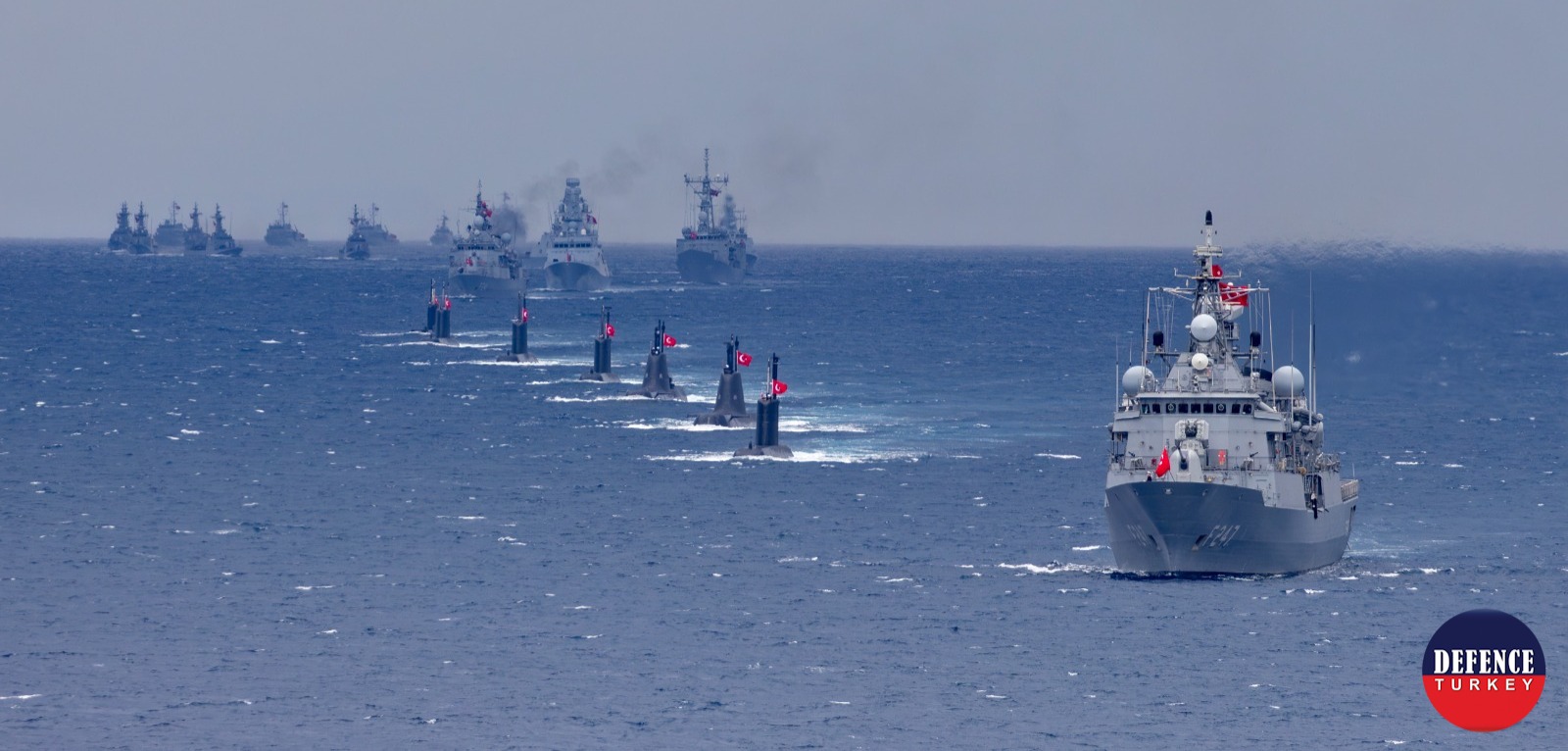
Today, Turkish Naval Forces (TNF) ships with gas turbine propulsion include the BARBAROS Class Frigates, the GABYA Class Frigates and the ADA Class Corvettes.
The BARBAROS Class is built around a Combined Diesel or Gas Turbine (CODOG) propulsion system. The cruise engines for these frigates are MTU 20V1163TB93 diesels (2x) each rated at 5.813hp with boost provided by twin GE LM2500-30 gas turbines rated at 60.000 shp in total. The 3.380 ton BARBAROS Class Frigates can achieve 18 knots cruising speed with MTU diesels and 32.5 knots with two MTU diesels and two GE LM2500 gas turbines. The employment of two gas turbines offers significant benefits, as this enables the ship to achieve greater speed and possess inherent redundancy. Should one gas turbine be lost, for whatever reason, the ship will still be able to operate at mission speeds of 70-80% of maximum speed.
The second major TNF ship class using gas turbines is the GABYA Class Frigates. They have a COGAG (COmbined Gas And Gas) configuration featuring two LM2500-30 gas turbines generating 41.000shp (31MW, each generates 20.500shp) in total through a single shaft and the Bird Johnson Controllable Pitch Propellers (CPP). The GABYA Class can achieve 20 knots cruising speed with a single gas turbine and 29+ knots with two LM2500 gas turbines.
The ADA Class Corvettes’ Main Propulsion System (MPS) is in Combined Diesel and Gas (CODAG) configuration and comprises two MTU 16V595TE90 diesel engines, each generating 4.320kW (5.875hp); one GE LM2500 gas turbine, providing 23.00kW (31.280hp); and one Renk marine gear unit, weighing 133 tons, providing 31.640kW (around 32MW) in total. The MPS also incorporates two Escher Wyss model shafts, each with a total length of 30m, and two controllable pitch propellers (CPPs). The 2.400-ton ADA Class Corvettes can achieve 15 knots cruising speed with a single diesel (MTU 16V595TE90) while driving two shafts, 22.5 knots with two diesels, 27 knots with the LM2500 gas turbine while driving two shafts and up to 31 knots with two diesel engines and a gas turbine. Thanks to its cross connection gearbox TCG Heybeliada can drive two shafts with either one diesel or gas turbine, thus the mean time between overhauls of the diesel engines is increased and the life cycle cost is decreased. The CODAG propulsion system is controlled and monitored by an MTU Callosum MC automation system.
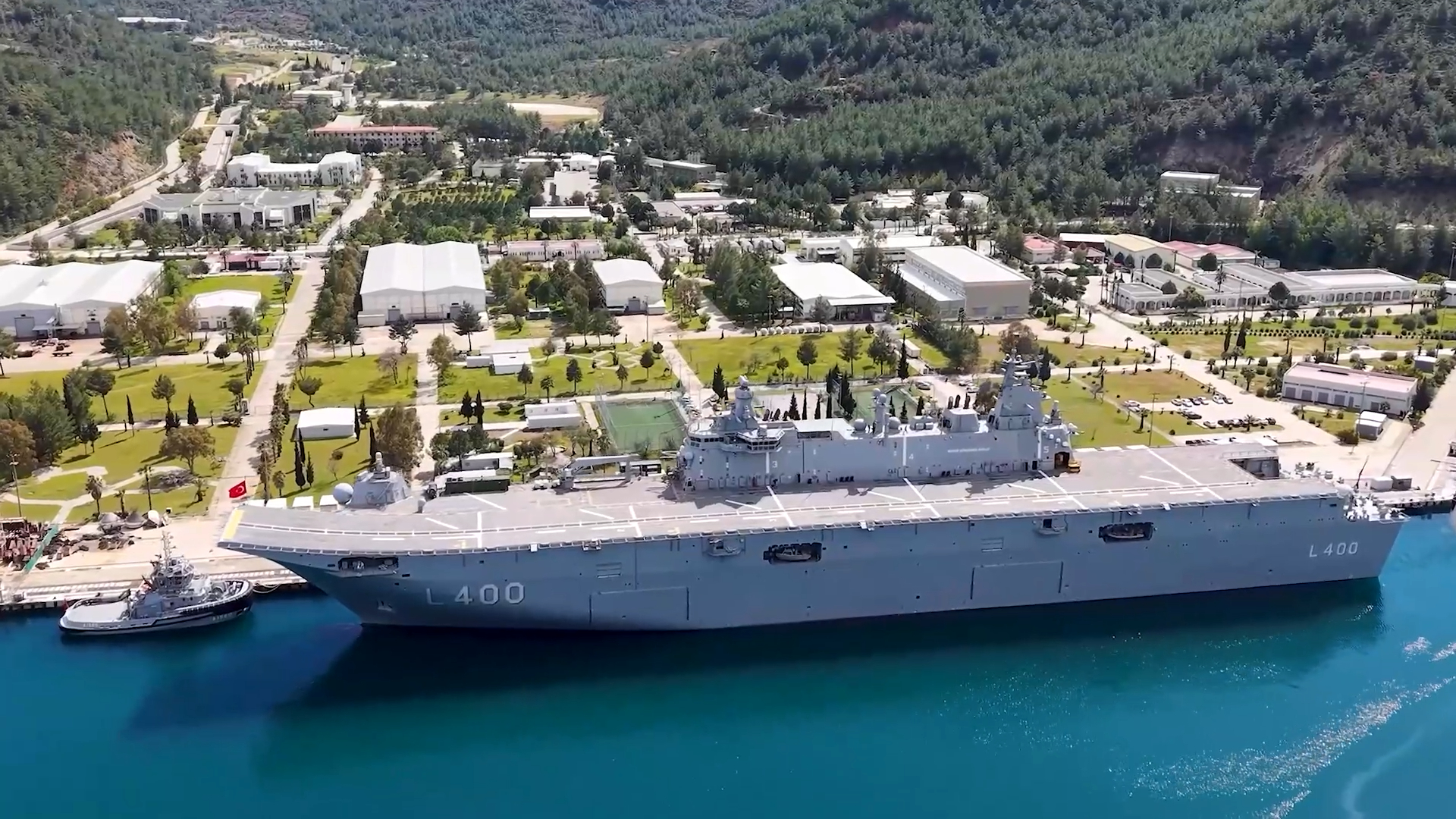
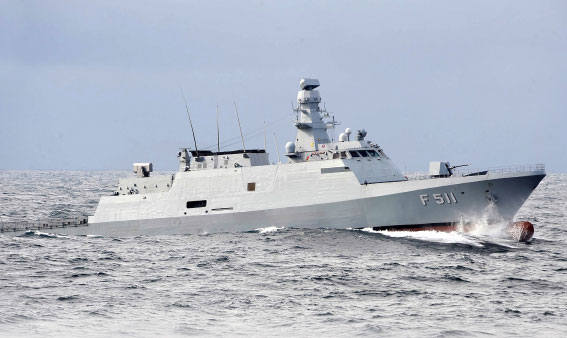
Ongoing naval ship programs with gas turbine propulsion include the İSTİF Class (also known as I Class) Frigates (1+3) and the TCG Derya (A-1590) Replenishment at Sea & Combat Support Ship (DİMDEG), in which the CODAG propulsion system with the LM2500 gas turbine has been selected as the gas turbine propulsion of choice.
The İSTİF Class Frigates will have a mono-hull, displacement-type hull form. Their overall length is 113.2 meters, waterline length is 105.2 meters, maximum beam is 14.42 meters, draft is 4.05 meters, and displacement is 2.966 tons. The İSTİF Class Frigates will have around 50% increased fuel capacity and cruising range capability compared to ADA Class Corvettes (with 170 ton fuel capacity and a range of 3.500nm with an economic speed of 15 knots, but their fuel capacity was later increased to 180 tons). The frigates will have a CODAG configuration featuring the similar machinery arrangement with ADA Class Corvettes. The İSTİF Class Frigates’ MPS will comprise two MTU 4000 Series 20V4000M93L diesel engines (instead of MTU 16V595TE90s aboard ADA Class), each generating 4.300kW (5.766hp); one GE LM2500 gas turbine, providing 23.00kW (31.280hp); and one Renk marine gear unit, providing 31.640kW (around 32MW) in total. The MPS will also incorporate two Escher Wyss model shafts and two CPPs. The propulsion system will allow a maximum speed of more than 29 knots and a cruising speed of 14 knots. The İSTİF Class Frigates will have a range of 6.570nm at an economic speed (14 knots).
Construction of the first ship of the Class, TCG İstanbul (F-515), was officially launched on January 19, 2017 at İstanbul Naval Shipyard with a steal cutting ceremony. Within the scope of the project, the contract was signed on April 12, 2019, with STM selected as the Main Contractor in 2018 by the SSB, and it entered into force on September 27, 2019. Launched on January 23, 2021 at İstanbul Naval Shipyard TCG İstanbul (F-515) is scheduled to start Sea Acceptance Tests (SATs) in January 2023 and is planned to enter TNF service on September 6, 2023. The other three sister ships (TCG İzmir, TCG İzmit and TCG İçel), are planned to be constructed in private shipyards. For the series construction of the sister ships (MİLGEM 6-8) the SSB issued an RFP document to Turkish companies and shipyards and asked the potential bidders to submit their proposals on March 15, 2022. The RFP document was purchased by STM, TAİS Shipyards, DESAN, DEARSAN and İSTANBUL DENİZCİLİK. However, the deadline for the proposal submission was first extended to April 1, 2022 and finally on April 8, 2022. MİLGEM ships 6-8, which will be constructed at the private sector shipyards with six-month intervals and the maximum participation of local industry, will have a similar weapon and sensor layout with the 5th MİLGEM ship, TCG İstanbul Frigate, excluding systems that need development, improvement, nationalization and localization. Following the Main Contractor selection phase, construction of the 6th MİLGEM ship is expected to be launched in 2023.
The Fleet Replenishment Ships, TCG Akar (A-580) and TCG Yarbay Kudret Güngör (A-595) that belong to the Turkish Logistic Support Ship Division based in Gölcük, Kocaeli supported the Turkish Naval Task Group during activation. However, due to their low constant cruising speeds (at 13kts) they could not keep pace with the frigates they escort and this caused the Turkish Naval Task Group to navigate at a slower speed. Taking a lesson from this experience, the TNF has launched the Replenishment at Sea (RAS) & Combat Support Ship (DİMDEG) Program to procure a new generation, fast Fleet Replenishment Ship that would have the speed to keep up with the TNF’s Task Groups and to ensure that fuel and water transport and supply needs of the TNF’s task forces are satisfied rapidly in the open seas around the world.
The construction and outfitting activities of the TCG Derya (A-1590) Replenishment at Sea & Combat Support Ship (DİMDEG) began at SEFİNE Shipyard during the second half of 2018 under a contract signed with the SSB on June 28, 2018. TCG Derya DİMDEG will feature F-76, F-44, fresh water and solid cargo transfer capability from 4 RAS stations, and F-76/F-44 transfer capability with an astern floating system. The vessel will have an overall length of 199.9 meters, a draught of 7.2 meters, depth of 11m, standard displacement of 22.000 tons (full load displacement of 26.115 tons) and a beam of 24.4 meters and will be able to carry 10,000 tons fuel, 800 tons of liquid (fresh water) and at least 270m3 solid cargo.
TCG Derya’s propulsion machinery (MPS) will be based on two gas turbines coupled with two diesel engines in a combined diesel or gas turbine (CODOG) arrangement to provide 30MW in total. The MPS will also incorporate two shafts and two CPPs. In June 2020 GE Marine received a contract from SEFİNE Shipyard to supply two LM2500 marine gas turbines for the TCG Derya RAS & Combat Support Ship. It will have a top speed of 24+ knots, endurance of 30 days (minimum) and a maximum range of 4.500nm.
TCG Derya DİMDEG was transferred to the floating dock for outfitting activities at SEFİNE Shipyard in October 2021 and the outfitting efforts on the ship are currently (April 2022) ongoing. TCG Derya (A-1590) is expected to be inducted into the TNF’s service in September 2023 following the completion of Sea Acceptance Tests, to be conducted during the first half of 2023.
With the experience gained from the ADA Class Corvette and İSTİF Class Frigate Programs the TNF has launched the TF-2000 Air Defense Warfare (ADW) Destroyer Project, with an aim to take its existing area (short-to-medium range) air defense warfare capability to the regional air defense warfare level by using national resources. Turkey will officially launch the TF-2000 ADW Destroyer tender in 2022 with the issue of RFPs to potential OEMs. The tender is expected to cover the construction of at least four ships.
In line with the directive of the Turkish Naval Forces Command (TNFC), the Design Project Office (DPO) of the TNFC, formerly known as the MİLGEM Project Office (MPO) and located in İstanbul Naval Shipyard, started its conceptual/preliminary design activities for the TF-2000 ADW Destroyer Project in July 2017 and pre-contract level design activities on January 14, 2019. According to the current design, the TNF’s next generation TF-2000 Air Defense Warfare Destroyer will have a length of 166m and a displacement of 8.500 tons. The TF-2000 ADW Destroyer will have a maximum speed of 28knots+ (with full load displacement), an economic speed of 18 knots and endurance of 5.000nm at 18 knots. It will have the capability to carry out missions at Sea State 5 without any limitations, to stay at sea for a period of 45 days without getting any logistic support, to operate for at least 5,000 hours per year, to maintain operational capability for a period of 180 days without main base support and to have at least 40 years hull service life. The TF-2000 ADW Destroyers will be operated by a crew of approximately 130-150 people, but they will be able to accommodate at least 200 personnel.
The Main Propulsion System (MPS) of the TF-2000 ADW Destroyers will be based on two gas turbines (GT) coupled with two diesel engines in a combined diesel or gas turbine (CODOG) arrangement with a split exhaust funnel system. You can find detailed information about the Turkish Naval Forces Command (TNFC)’s Design Project Office (DPO) and the TF-2000 ADW Destroyer Project in this issue in our coverage of Director of DPO Captain Timur DİLER’s presentation, delivered at the 10th Naval Systems Seminar.
Turkey’s other new ship program, the Turkish Type Fast Attack Craft (FAC) Project, was launched by the Presidency of Defense Industries (SSB) in 2013 to meet the TNF’s requirement for the new generation FAC with national resources. The Turkish Type FAC is expected to operate in coastal and offshore environments at high speeds.
Within the scope of the Design Contract (Term-I) awarded by the Presidency of Defense Industries (SSB) on August 31, 2020 STM Savunma Teknolojileri Mühendislik ve Tic. A.Ş. (STM), was authorized as the Design Main Contractor of the Turkish Type FAC Project. Since then STM has been working with ASELSAN, ROKETSAN, HAVELSAN and METEKSAN on the project. The Design Contract is merely for the design process and a separate contract (the 30-month Term-II Prototype Construction Contract) will be signed for the construction process. Within the scope of the contract to be executed by the Design Main Contractor STM, the identification of system requirements of the Turkish Type Fast Attack Craft, concept selection, preliminary design and contract design activities will be carried out. Throughout the project, Indigenous Design development activities (Ship Hull Form Optimization, Ship Structural Analysis, Main Propulsion System, Ship Electrical System Design and Weapon Configuration) and the relevant design package will be developed. The design phase of the project is planned to be completed at the beginning of 2023. The construction of the boat’s prototype in the Turkish Type FAC Project is expected to start in 2023 and be completed in 30 months.
Within the scope of the Turkish Type Fast Attack Craft Project, on which STM has been working for a long time and to which it attached great importance, STM has previously developed a design named FAC-55 (FAC is the abbreviation of the English initials of the Fast Attack Craft, 55 symbolizes the speed the boat can achieve) and conducted the necessary pool tests. The FAC-55 is a high-speed boat featuring a non-magnetic steel hull and superstructure with stealth design and low radar cross section (RCS) and equipped with sensors & weapons, especially to conduct surface warfare operations and it has self-defense anti-air warfare (AAW) capabilities.
The FAC-55 is believed to form the basis for the Turkish Type FAC design. In the test activities conducted by internationally recognized institutions, STM proved that it has designed a naval platform that performs effectively up to a speed of 55+ knots. For the FAC-55 design, STM preferred the COGAG propulsion system in which the gas turbines can operate simultaneously and drive three waterjets. In the pool tests, it has been shown that the FAC-55 can reach up to 60 knots with the hull form COGAG propulsion system and 55 knots in Sea State 3.
The FAC-55 design has an overall length of 62.7 meters, a draught of 1.68 meters, a beam of 9.8 meters and displacement of 535 tons (including 90 tons of fuel). The FAC-55 will have gas turbine engines generating 28MW power in total and driving 3 water jets, its maximum speed will be 55+ knots and economic speed will be 18 knots. The ship will provide a comfortable accommodation for up to 34 personnel, and it is planned to have a range of 1.000nm at 20 knots, 750nm at 50 knots and endurance of 7 days.
GE Marine is expected to offer its LM2500 and LM500 Gas Turbines and Rolls-Royce is expected to offer its MT30 and MT7 Gas Turbines for the Turkish Naval Forces’ new TF-2000 Air Defense Warfare (ADW) Destroyer and Turkish Type Fast Attack Craft Projects, respectively