ATEŞ SERBEST 2025
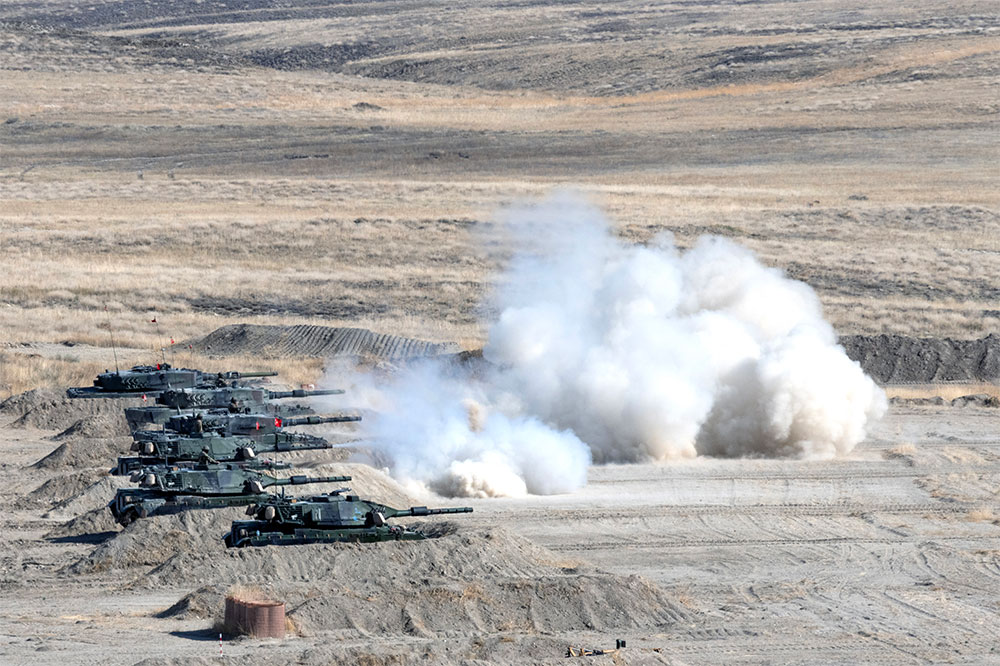
The one-day Ateş Serbest 2025 live-fire activity was held on 11 October 2025 at the General Nahit Şenoğul Shooting and Exercise Area (Zafer / Polatlı). Launched in 2014, the exercise returned this year as a Distinguished Observers’ Day: senior military leadership, press, trainees and personnel from multiple services attended the demonstrations. According to the exercise brochure, 82 systems were exhibited and 50 took part in live firing, with elements of the Land, Naval, Air and Special Forces Commands participating.
The exercise’s aim was to demonstrate the Turkish Armed Forces’ firepower and deterrent effect, familiarise personnel across services with each other’s weapons, and improve coordination of joint fire support — tasks that were underlined throughout the day’s combined-arms demonstrations.
Elements of the Turkish Land Forces Command, Naval Forces Command, Air Force Command and the General Staff Special Forces Command will took part in the exhibition and the firing activities.
One of the most important weapon systems used for the first time in this exercise was the BORAN is a 105 mm air-transportable, light towed howitzer system equipped with modern command and fire-control systems. It can determine its own position and orientation and be made ready for a fire mission in a short time.
It is light enough to be carried to the battlefield as an external load by general-purpose helicopters and is fitted with modern command and fire-control systems compatible with current technologies, providing rapid and reliable fire support. Thanks to its integrated Inertial Navigation System (INS), it can quickly obtain its own position and heading. The ballistic software running in the Fire Control Computer (FCC) can compute firing data, and the barrel can be oriented toward the target quickly and accurately. It is designed to meet the operational needs of infantry and commando units conducting air assault operations and can calculate its own fire commands, operating independently without the need for a separate fire direction system under a “single gun, single battery” concept.
The BORAN features a 105 mm, 30-calibre barrel and weighs approximately 1,745 kg including its Fire Control System. It offers a maximum range of 17 km at sea level, with an elevation range of −3° to +70° and a traverse of 8° to either side. The system can displace and be made ready to fire in under one minute. In transport terms, BORAN is suitable for carriage by Sikorsky S-70 helicopters and a variety of light vehicles, and can be carried as an external load by helicopter.
When integrated with ASELSAN’s VOLKAN 230/105 Fire Control System (FCS), BORAN provides continuous position and barrel orientation data via an Inertial Navigation System (INS), measures muzzle velocity with an Initial Velocity Measurement Radar (IVMR/İHÖR), and enables target detection and direct (day/night) fire through a laser rangefinder combined with a thermal camera. VOLKAN also allows digital map use, on-screen graphical barrel orientation display, integration with other fire-support systems, and digital radio communications. The system’s ballistic computer can perform firing calculations for all ammunition types included in the NABK ammunition database.
The power infrastructure supports up to eight hours of continuous operation and offers flexible supply options, including power from the grid or vehicles, on-board battery usage, and portable generator charging. The system includes EMI/EMC protection and Built-In Test (BIT) features. Operated by a crew of five, BORAN achieves a firing rate of six rounds per minute and is capable of sustained operation in ambient temperatures ranging from −32 °C to +44 °C. According to MKE and ASELSAN, the system’s advanced fire-control suite, integrated sensors, and compatibility with long-range ammunition enable engagements exceeding 17 km.
While the living firing part of the exercise was an important show of capability the event also gave the TLFC and some private companies to display their hardware. There was a special displace just for the Steel Dome air defence hardware including radar, command, control, communication and intelligence nodes air defence guns and missiles.
All the sensors, effectors and the command-and-control elements of the Steel Dome were to be seen.
During the event the Turkish Land Forces Command (TLFC) displayed all its major armoured vehicles and gun systems including towed and self-propelled ones. During the live firing part of the event all of these systems were used in various scenarios.
The exercise also showcased the FIRTINA and Next-Generation FIRTINA (YNS) 155 mm self-propelled howitzers, PANTER and M110A2 guns, multi-barrel rocket launchers, 81 mm and 120 mm mortars, and the ADOP-2000 Fire Support Automation System, which coordinated digital fire missions across the participating batteries.
Armoured elements demonstrated the Kornet anti-tank missile, while aerial support was provided by T-129 ATAK attack helicopters, executing combined rocket and cannon strikes.
The PUHU-2 logistics drone conducted a live ammunition resupply, underscoring the expanding role of unmanned systems in battlefield sustainment.
The aerial phase culminated with coordinated bombing runs by F-16 Fighting Falcons, dropping HGK-84 precision-guided bombs from altitude before conducting low-level fly-bys. Indigenous aircraft HÜRJET closed the event with a joint formation flight, symbolising Türkiye’s progress in domestic military aviation.
Ateş Serbest 2025 once again underscored the Turkish Armed Forces’ focus on jointness, mobility, and precision. By combining legacy platforms with new-generation systems such as BORAN and AKINCI, the exercise demonstrated a cohesive and modern approach to fire-support operations consistent with the country’s broader defence-modernisation objectives