Avante 2200 : Saudi Arabia`s Next-Generation Surface Combatant
Spain’s Navantia has delivered a new generation of corvettes to the Royal Saudi Naval Forces (RSNF) under a major naval modernization initiative. The Avante 2200 class—a heavily customized derivative of the Avante 1800 platform—was developed and constructed to meet Saudi Arabia's specific operational requirements under the Saudi Naval Expansion Program II (SNEP II).
The program began taking shape in the early 2010s, as Saudi Arabia sought to replace its aging Al Madinah-class frigates and expand its littoral and regional maritime presence. After several years of evaluations, negotiations culminated in April 2018 with the signing of a Letter of Intent, and the €1.8 billion contract was formalized in July 2018. The agreement called for the construction of five advanced corvettes at Navantia’s Cádiz shipyards, along with extensive training, logistics support, and combat system integration via the SAMI-Navantia Naval Industries joint venture, contributing to Saudi Arabia’s Vision 2030 defense industrial goals.
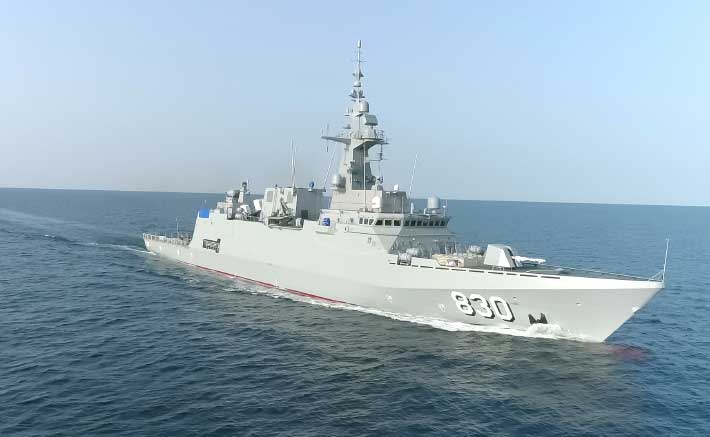
Construction of the first vessel, Al Jubail (828), began on 15 January 2019, with her keel laid at the San Fernando yard on 1 October 2019. The ship was launched in July 2020, commenced sea trials in September 2021, and was officially commissioned into the RSNF on 31 March 2022, following a successful test launch of the MBDA VL MICA surface-to-air missile. Subsequent ships followed in rapid succession: Al Diriyah (830) was launched in November 2020 and delivered in 2022; Hail (832) was commissioned in December 2022 together with Jazan (834). The last ship of the first batch Unayzah (836) was commissioned in March 2024.
Structurally, the design is an evolution of the Avante 2200-class built for Venezuela, featuring a 4-metre hull extension, enhanced combat systems, and adaptations for high-temperature operations. Technically, the Avante 2200 class reflects significant evolution from earlier Avante family members, such as the Avante 2200 corvettes built for Venezuela. Displacing around 2,200 tonnes at full load, the Saudi variant measures 104.2 meters in length, with a 14.4-meter beam and 4.3-meter draught.
Powered by a CODAD (Combined Diesel and Diesel) propulsion system comprising four Navantia-MTU 16V 1163 TB93 diesel engines delivering a total of 31,755 horsepower (23.7 MW) to two shafts with controllable-pitch propellers, these ships can reach speeds up to 27 knots and have a range of 3,500 nautical miles at 12 knots
Each vessel accommodates a complement of 102 personnel
The sensor suite is built around the Hensoldt TRS-4D G/H-band AESA radar for air and surface search, supplemented by E/F- and I-band radars for navigation and surface search roles. The TRS-4D is a rotating Active Electronically Scanned Array (AESA) radar capable of performing simultaneous air and surface surveillance. It offers high update rates, superior clutter suppression, and automatic target tracking for up to 1,000 targets, making it highly effective for fast reaction threats such as sea-skimming missiles or swarm attacks. Its AESA architecture provides enhanced electronic counter-countermeasure (ECCM) capabilities and improved resilience in dense electromagnetic environments.
Fire control is managed by the Navantia DORNA K-band director, a dual-axis stabilized optronic/electronic fire control system equipped with radar, infrared, and TV sensors. It provides rapid gun laying capabilities and allows for accurate tracking and engagement of both air and surface targets under all weather and light conditions. The K-band radar enables precise target illumination and cueing of the main and secondary guns, even in heavy electronic warfare conditions.
Combat management is handled by the SAMI Navantia Hazem CMS, a localized variant of Navantia's CATIZ system, tailored for Saudi Arabia by the SAMI-Navantia joint venture. Hazem integrates all shipboard sensors and effectors into a unified command and control environment, enabling simultaneous multi-threat processing, mission planning, and network-centric warfare operations. The system supports Link 11/16 compatibility and is scalable for future upgrades, including UAV and UUV integration.
The armament package is optimized for both littoral and blue-water engagements. Each ship is fitted with:
1 × Leonardo 76 mm/62 Super Rapid gun, one of the most versatile naval guns in the world, capable of firing programmable airburst munitions for anti-missile, anti-air, and shore bombardment roles. The gun can fire at 120 rounds per minute with ranges up to 16 km and is compatible with DART guided ammunition for improved accuracy against manoeuvring targets.
1 × Rheinmetall Oerlikon Millennium 35 mm CIWS, a high-rate-of-fire close-in weapon system using Advanced Hit Efficiency and Destruction (AHEAD) airburst munitions. Each round releases 152 tungsten sub-projectiles at a programmed distance, creating a lethal cloud against incoming missiles, drones, or small boats. The system can engage targets up to 5 km and is linked to the ship’s fire control radar for automatic tracking.
16 × MBDA VL MICA missiles in vertical launch cells, a compact surface-to-air missile system with active radar or infrared seekers and an effective range of 20 km. The VL MICA requires no rotating launcher and provides 360° defense coverage. The system is designed to counter high-speed, agile targets including aircraft, helicopters, and cruise missiles, with minimal radar exposure due to its vertical cold launch capability.
8 × MBDA Exocet MM40 Block 3 anti-ship missiles, a long-range, sea-skimming weapon with inertial and GPS mid-course guidance and active radar terminal homing. The Block 3 version has a 200 km range and features a 165 kg high-explosive warhead. It is capable of attacking both maritime and coastal targets with high survivability and precision in GPS-denied environments.
6 × 324 mm lightweight torpedoes launched from two triple mounts (likely compatible with MU90 or similar NATO-standard torpedoes), optimized for anti-submarine warfare.
2 × 12.7 mm remote weapon stations, typically stabilized and fitted with electro-optical sights for short-range asymmetric threats.
The class has a full flight deck and hangar, and is certified to operate the MH-60R Seahawk, providing anti-submarine and surface warfare capability at extended ranges.
As of early 2024, Saudi Arabia and Navantia were reported to be in advanced negotiations for a second batch of three additional Avante 2200 corvettes. This prospective contract—estimated to exceed €1 billion. Their construction started in 2024 and the last of these three ships is expected to be delivered in 2028.
The project, maximizing Navantia’s participation, incorporating proprietary products such as the HAZEM combat system, through the SAMINavantia joint venture, the HERMESYS integrated communications system, the DORNA fire control system, the Integrated Platform Control System, the MINERVA integrated bridge, propulsion engines under MTU license, diesel generator sets, and reduction gearboxes under Schelde license. Finally, Navantia Ship repairs unit will also participate in the program with the work to be carried out during the corvette dockings in San Fernando