Type 23 Frigates

The Royal Navy wanted robust warships at the height of the Cold War to hunt Soviet submarines in the North Atlantic. The Type 22 anti-submarine frigates were large and expensive to operate. The Royal Navy wanted the next generation of anti-submarine frigates to be both cheaper to build and to operate.
The Royal Navy had a bad experience with the very high cost of the mid-life upgrades performed on the Leander class frigates. Therefore, the new frigate would have a short service life of 18 years. And these upgrades would be limited to short but frequent work packages, instead of keeping the ships out of service for long periods for upgrades. The Type-23 frigates would frequently go through upgrade cycles. These rolling updates would replace the major items that had become obsolete and keep the ships and their capabilities updated with the latest possible version.
As no battle plan survives contact with the enemy, the plans of the Royal Navy for the Type-23 were received with a lot of changes. As the design development progressed, the size and capability of the frigates crept upwards. The lessons learned from the 1982 Falklands War were incorporated into the design, creating further changes. These changes were not limited to the sensors and armaments of the frigates. Important changes such as the relocation of crew living areas, modification of the fire extinction systems, redesign of ventilation zones were made internally.
The first of its class the HMS Norfolk, was laid down on 14 December 1985. She was launched on 10 July 1987 and commissioned into the Royal Navy on 1 June 1990. Fifteen more Type-23 frigates were constructed until 2000. The last one HMS St. Albans was commissioned on 6 June 2002. 12 of them were built by Yarrow Shipbuilders in Glasgow, now a part of BAE Systems, and four were constructed in the Swan Hunter Shipyard in Wallsend-on-Tyne.
The Design
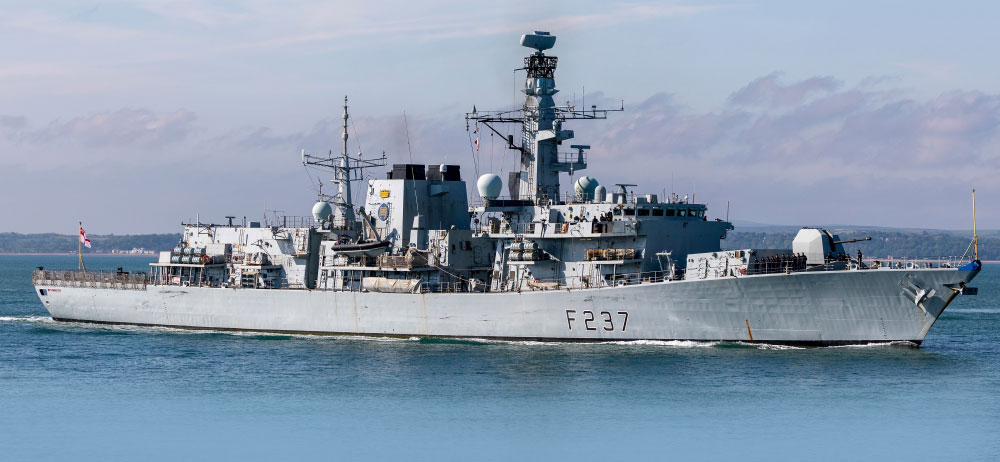
The ships have their hulls formed specially to maintain high speed in difficult weather conditions of the North Atlantic. The Type-23 frigates were the first warships of the Royal Navy and considerations were made to reduce emissions and achieve stealth on all aspects of the emissions. The superstructure of the ship was designed to minimize the radar cross section. The hull and the superstructure were formed in a way to reflect incoming radar signals away from the source. During the design of the Type-23 frigates, special attention was given to create acoustic stealth. The frigates have a combined diesel-electric and gas propulsion system. Each of the two fixed pitch propellers are connected to a 1.5MW electric motor, fed by two 1.3MW Paxman Valenta diesel generators. This configuration can propel the ship up to 15 knots with a range of 7,800 nautical miles.
The diesel electric drive makes the ship silent and hard to hear for the submarines. For higher sprint speeds the two Rolls Royce Spey SM-1A gas turbines provide 13MW of energy each. Each gas turbine is connected through a gear box to one propeller. The maximum speed is 28 knots.
The Type-23 frigates were 133 meters long, and 16.1 meters wide, with a draft of 5.5 meters. In fully loaded configuration the displacement is 4200 tons.
The superstructure of these frigates is divided into four blocks. The first block contains the vertical launcher for short ranged air defense missiles. The original Sea Wolf GWS26 Mod.1 missiles were replaced by Sea Captor missiles. The two quad Harpoon anti-ship missiles are located between the vertical launcher and the bridge. The second part of the superstructure is the bridge block. It holds the main mast and the most sensors. It also houses the bridge and the accommodation for the ship’s officers and probably the Combat information center. The bridge block is followed by the funnel block. This block contains the uptakes for the gas turbines and allows access to the machinery decks below. The last block is the hangar block. It holds the second illuminator radar for the air defense missiles on top. The hangar is large enough for a Merlin HM2 helicopter. The main anti-submarine warfare sensor for the Type-23 frigates, and the Type-2031Z towed sonar is housed below the flight deck.
The main offensive surface weapon of the Type-23 frigates are the 8 Harpoon anti-ship missiles. For defense against airborne threats the ships were initially armed with Sea Wolf missiles. These missiles had a range of around 10 kilometers. For surface and air targets the ships are fitted with one 114mm Mk8 gun and two 30mm DS30B cannons. There are two fixed 324mm torpedo launchers on each side for Stingray light torpedoes.
The original sensors were Type 996 surveillance and target indicator radars, 2 Type 911 fire control radars and navigation radars. The ships have one Type 2050 bow mounted sonar and one Type 2031Z towed array sonar.
The Upgrades
The initially planned 18-year service time for these frigates have long become history when the first ship to be commissioned, HMS Norfolk celebrated her 30 years of service in 2020. The Royal Navy intends to keep the Type-23 frigates in service until 2035. That is more than double the initial life expectancy of these frigates.
In order to keep these frigates up to date and ready to face emerging threats, The Royal Navy continuously upgrades these warships and changes systems that have become obsolete.
Since their initial commissioning until today, almost all the important systems of these frigates have been replaced by more contemporary systems, as these have become available. The list of the replaced weapons, sensors, and machinery is comprehensive. However, not all changes were made at the same time for all ships. These gradual changes resulted in different configurations of frigates throughout the years.
One of the most important upgrades these frigates received was the replacement of the original Sea Wolf air defense missiles, Type 996 surveillance and Type 911 fire control radars with the Sea Ceptor missile and Type 977 Artisan E/F band multi-function radar. The new missiles have double the range of the Sea Wolf missiles.
The now obsolete Type 2031 towed array, the main sensor to hunt enemy submarines has been replaced by the Type 2087 variable depth towed array sonar. This system is marketed as CAPTAS-4 internationally and is being used by French and Italian Naval Forces. The new bow mounted sonar Type 2150 will replace the legacy Type 2050 system. These changes will keep the Type-23’s anti-submarine warfare capabilities up to date and ready to face the challenges created by modern submarines. However not all Type-23 frigates hold their ASW systems. During the upgrade to the Type 2087 variable depth towed array sonar five frigates did not receive the new sonar system and these are now considered as general-purpose versions.
The Original Mk8 main gun was upgraded to Mod 1 version, utilizing improved ammunition. The manually controlled 30mm guns were replaced by the MSI automated small caliber gun.
The upgrades to the Type-23 class frigates are not confined to the outside of the ship. The heart of the ship is the diesel generator for the electric motors and the gas turbines are subject to changes too. Under the power generation and machinery control update project the old Paxman Valenta diesel generators are being replaced by new 1.65MW MTU 12V4000 M53B generators. The auxiliary systems needed to control the diesel generators are also subject to change.
Another important internal change is the upgrade of the combat management system. The legacy DNA1 combat management system was the first of its kind with a distributed architecture in The Royal Navy. The software, network and the workstations were ready for the 8th ship of the class, HMS Westminster. DNA1 was later installed to all the ships in class. The system could handle 1,000 tracks. The new DNA2 replaces the older version. Being a less bespoke system, DNA2 takes advantage of the commercial of the shelf equipment and software developed for Type-45 destroyers.
Operations
The primary mission of the Type-23 frigates was to hunt Soviet submarines in North Atlantic, but this did not materialize as when the first ships joined The Royal Navy the Cold War was over. The sharp decline of Russian submarine operations in the post-communist era meant that the Type-23 class frigates were used for other purposes. The Type23 frigates saw action in 2003 when HMS Marlborough and HMS Richmond provided naval gun fire support during the invasion of Iraq in 2003. The Type-23 class frigates were regularly deployed to the Indian Ocean and to the Persian Gulf.
Possible Sale to Türkiye
In mid-January, the rumor of the possibility of Türkiye buying up to 3 Type-23 frigates from the UK started when the Minister of Defense Hulusi AKAR was making a visit to the UK at the invitation of UK Defense Secretary Ben WALLACE.
According to official reports as part of the visit, bilateral and regional defense and security issues were discussed, in addition to cooperation in the defense industry field. However, the unofficial reports about the meeting of the two defense ministers draw another picture. Anonymous sources stated that during their meeting AKAR and WALLACE explored the possibility of Ankara purchasing Eurofighter jets, C-130J transport planes and Type-23 frigates, as well as engines for Türkiye’s M60 Main Battle Tanks. The estimated value of such a deal is well over $10 billion, according to sources.
Defense minister Hulusi AKAR put a temporary end to the rumors when he answered questions from journalists after the Cabinet Meeting on 24 January 2023: “There is nothing concrete or definite. We have bilateral relations with the British Minister of Defense, Mr. WALLACE, within the scope of NATO. Our last visit to London was a visit we made in this context.”
Among the possible military hardware in the discussion, the Type-23 frigates created some confusion as the last UK built major warship that served in the Turkish Navy were four M class World War II era destroyers. The
Destroyers HMS Milne, HMS Marne, and HMS Meteor were transferred to the Turkish Navy on 29.6.1959 and HMS Matchless on 16.7.1959. Renamed TCG Alparslan, TCG M. Fevzi Çakmak, TCG Piyalepaşa and TCG Kılıç Ali Paşa respectively, these destroyers served in the Turkish Navy until the early 70’s. The first pair were decommissioned in 1971 and the rest in 1972.
The big question surrounding the possible procurement of Type-23 frigates from the UK is what the Turkish Navy would do with them. In the event of such a sale, the three most likely ships to be considered are HMS Argyll, HMS Montrose and HMS Lancaster, which have the closest decommissioning dates in 2023, 2023 and 2024 respectively.
All these three frigates are configured in general purpose version meaning that they do not have the modern Type 2087 variable depth towed array sonar. HMS Argyll and HMS Lancaster were not selected for the power generation and machinery control update project thus they are not going to receive new diesel generators. The existing Paxman Valenta generators are not suitable for usage for long periods of time.
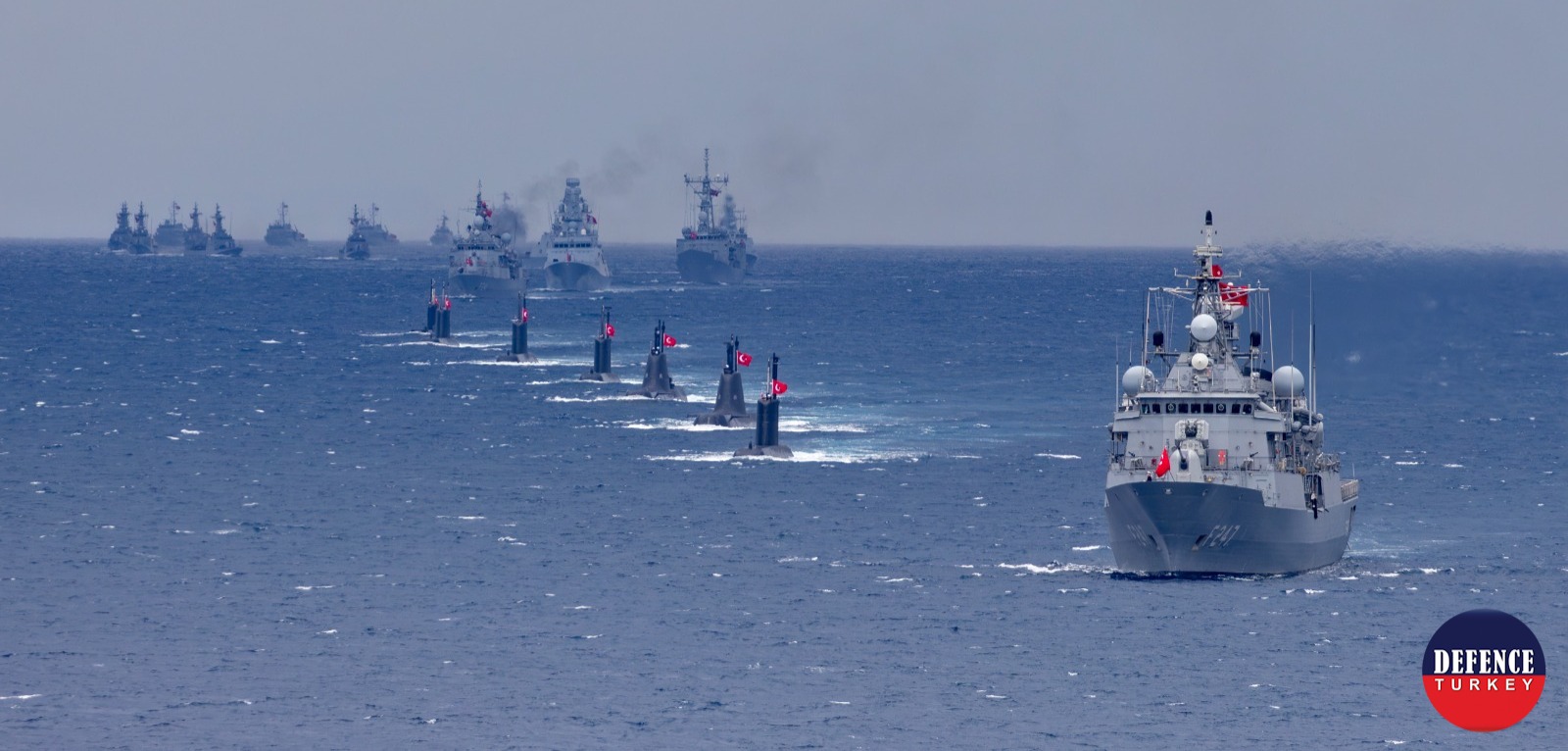
The added capability that a possible purchase of Type-23 frigates will create for the Turkish Navy is not clear. One of the possible explanations is that the Type-23s could be used as gap fillers until the ISTIF class frigates enter service.
Currently the Turkish Navy operates 4 Meko 200 TN I, 4 Meko 200 TN II and 8 Perry-class frigates. The average age of these is 35, 24 and 41 years respectively. The last frigate class warship commissioned into the Turkish Navy was TCG Kemalreis in 2000.
The increased operation tempo in the last couple of years should have taken a toll on these not-too-young ships. Furthermore, the ongoing Barbaros class mid-life modernization project means that the youngest frigates of the fleet are going to be temporarily taken out of service for a couple of years leaving the older ships with more workload .