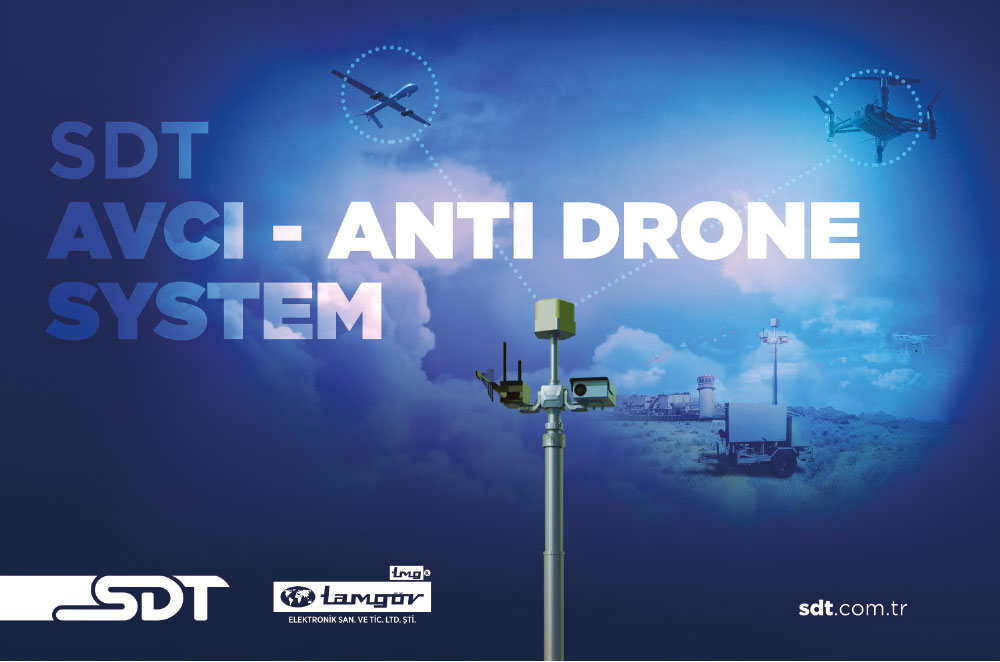
AVCI – Anti-Drone System
SDT AVCI Anti-Drone system is designed to detect, track and defeat Mini and Micro size rotary and fixed wing drones. Various sensor subsystem configurations are available based on requirements. Detection and tracking multiple threats with radar, identifying and tracking of the threats with EO and Thermal Cameras, determination of pilot direction using DF receiver are available features. The detected drones can be defeated using directional / omni-directional jamming or hard-kill solutions.
Communıcatıon Sıgnal Monıtorıng and Localızatıon Systems
SDT has developed a new generation of Communication Monitoring and Localization System to respond to all these needs in the electronic battlefield in the most efficient way. The system detects narrowband and wideband signals with high sensitivity, finds signal direction and source position and classifies and resolves those signals. All time critical operations are performed in real time automatically. The resulting processed and unprocessed data are recorded and then analyzed using smart filters. The distinguishing feature of the developed system over its opponents is that it can detect all narrowband, wideband, Direct Sequence Spread Spectrum (DSSS) and Frequency Hopping Spread Spectrum (FHSS) signals and make them ready for listening.
MiniCOMINT System
More compact and mobile system which can be used especially for detection of drone threats has been developed by using the experience and know-how obtaind from the SDT COMINT System.
The system, called as miniCOMINT, is a communication intelligence system to detect the communication signals between drone and its control unit and find the location of the signals.
The location of the emitter source can be detected by using more than one system at the same time. The system has a circular antenna array of directional antennas. The system has 4- channel phase coherent receiver structure and does the direction finding (DF) by using phase and amplitude comparison techniques. For this reason, it detection time is less and DF correctness is better than single switching systems. The stable DF is possible when there is a direct line of sight.
In case of multipath propagation, which is a common problem of DF systems, it is expected that the stable DF is still possible if the multipath propagation components is minimum 10 dB less than the main component. Besides, the DF stability and multipath propagation information or warning will be provided. The operator will be able to decide better either to use directional or omnidirectional jamming option in this way.
Distinguishing the communication signals from the others is a critical problem. It is evaluated that using deep learning techniques can increase the performance of the system. For this reason, the system is designed to allow the application of the deep learning techniques. In this way, the system will be able to learn the type of a new signal and the capabilities of the system will grow rapidly.
SDT speeds up in virtual combat training simulators!
Since its establishment in 2005, SDT provides combat training solutions for the armed forces. Among them are Embedded/Live Air Combat Training Systems and Embedded/Virtual Missile Training Simulators. SDT’s embedded and live training products are currently in use on F-4 and F-16 aircraft for the air combat training of air forces. Providing turn-key solutions for various units of naval forces for virtual combat training centers, SDT has completed internal R&D studies and has launched a new product for Turkish and international markets.
The company introduces the newly launched product, MUHAREBESIM (BATTLEFIELD SIMULATOR), at IDEF 2021.
Battlefield Simulator provides an environment for trainers which is combining of real training conditions and the advantage of simulation features according to customer needs. Main purpose of the system is to improve the training performance. Active battlefield area consists of vision system, movement tracking system, 20 dissimilar real and simulated weapon, 13 different types of simulated binoculars and moving platform. System has been designed to provide 16 trainers equipped with 32 weapons and 10 binoculars simultaneously with more than hundred scenarios. Battlefield Simulator provides editing and adding scenario functionalities for instructor with the capability of playback, success measurement and statistical data sampling to evaluate the trainers separately or as a team. System can also be integrated other simulation platforms within its HLA infrastructure.
SDT Air Combat Training (ACT) Solutions
Embedded Simulation System (ESS) ESS was SDT’s first involvement in air combat training system development back in 2007, which was successfully deployed on fighter aircraft and delivered to Turkish Air Forces (TuAF). SDT developed CGF simulations as well as high fidelity models of aircraft systems such radar, RWR, CM/ECM and missiles for ESS. The system is fully integrated to aircraft OFP and went through several ground and flight tests before final deployment. ESS provides “Constructive” elements into the “Live” environment for enhanced air combat training capabilities. ESS is now being exported to South Korea for the use of Republic of Korea Air Force (RoKAF).
Air Combat Manoeuvring Instrumentation (ACMI) SDT has successfully completed the development of ACMI, and as of today, functional flight tests are being conducted together with TAI and Turkish Air Force on F-16 aircraft. SDT’s ACMI system is ready for international market.
The serial production phase has been initiated by the Air Force Command and the Presidency of Defense Industries, and the contract is planned to be signed in August 2021. Within the scope of mass production, 60 Air Pods and an appropriate number of ground stations will be supplied by Turkish Air Force
Vehicle Type RF Jammer Systems
Vehicle Type RF Jammer Systems designed for VIP and convoy protection for Radio Frequency Controlled Improvised Explosive Devices (RCIED). These systems defuse threats activated with handheld reciever, wireless phones and remotely controlled devices using their RF protection shield. Custamizable mechanic adaptation per the host vehicle easily.
Manpack Jammer Systems
Manpack Jammer Systems designed for personal protection for Radio Frequency Controlled Improvised Explosive Devices (RCIED). These systems defuse threats activated with handheld reciever, wireless phones and remotely controlled devices using their RF protection shield. Designed and produced with 0 native opportunities. Manpack Jammer Systems can be carried easily with its push and pull kit and also adaptable for any vehicles without making differences