BAE Systems: Showcasing Exemplary Models of Cooperation, Building Collaborative Partnerships, an Experienced Competitor in the International Defence Industry

Defence Turkey magazine recently toured key BAE Systems facilities. In early July of this year the sites of BAE Systems Rochester, HUD manufacture facility and BAE Systems Warton provided our magazine readers with a unique opportunity to gain current insight into operations related to: Platforms & Services: Hawk, Typhoon, Electronic systems, Cyber & Intelligence, F-16 HUD, Q-Warrior as well as updates on new international partners.
At BAE Systems,Warton, Andy Latham Head of Business Development International Military Air & Information provided an over view of BAE System’s continuous effort to improve efficiency and competitiveness by driving value from key defence platforms and services. He discussed how they have progressed “From being a pure manufacturing and support organisation, on a factory in the NW of England, into having people being based with the operator, with the customer, on a RF basis who deploy with the aircraft when it goes overseas.” He also emphasised “there is a view that says that over the years by being involved in consortium and collaberating with partners that we might have lost some of that capability to do complete aircraft design and that is not the case, we have all the capabilities here to allow us to design and manufacture a complete aircraft.”
The tour of the sites also included informative time with Darren Earl, Head of Hawk Final Assembly and Maintenance; Roy Harrison, Typhoon Flight Development Team Product Manager - Fast jet facility; Liam Murphy, Team Leader Airframe Simulation – Senior engineer; Matt Heritage, Operations Manager Team 1, Typhoon Final Assembly and Neale Osmond, Head of Programmes, Turkey – Programme and Business Development at BAE Systems.
Sometimes a Partner, Sometimes a Competitor on Projects
BAE Systems works with customers and local partners, they develop, engineer, manufacture and support products and systems to deliver military capability, protect national security and people and keep critical information and infrastructure secure. BAE Systems provides some of the world’s most advanced, technology-led defence, aerospace and security solutions and employ a skilled workforce of some 83,400 people in over 40 countries, customers in more than 100 countries. Sales in 2014 totalled £16.6bn, they invest over £70m annually in education and skills globally, they work with universities worldwide (over 30 in the UK), and over £9bn was spent with over 33,000 suppliers globally.
Defence Budgets in the US and traditional Core markets in Europe - Constrained
BAE System consistenly ranks in the Top 3 in the Defence Industry, typically sharing 2nd place with Lockheed Martin and exceeded by Boeing.
The Group’s performance this year is in line with the plan, according to Andy Latham, Head of Business Development. He shared that defence budgets in the US and traditıonal markets in Europe are decreasing, being trimmed more and more. Their strategy is about maintaining and growing their defence business while continuing to look at opportunities in adjecent markets. Mr. Latham provided some examples “Civil aircraft business, hybrid drives for buses and trucks, electric deisel drives in London come from BAE systems. We will develop and expand our international business because our traditional core markets are under constrained budgets.”
BAE Military Air & Information has a proven track record with a 2014 turnover of approx. £4.0bn
BAE Military Air & Information includes programmes for the production of Typhoon combat and Hawk trainer aircraft, F-35 Lighting II fuselage and empennage manufacture, support for Typhoon, Tornado and Hawk aircraft, and development of next-generation Unmanned Air Systems and defence information systems, such as the Falcon secure deployable communication system
Military Air and Information has a proven track record with approximately 12,500 employees with a 2014 turnover of approx. £4.0bn, it is organised as 3 “lines of business”: Combat Air (Typhoon), Defence Information, Training & Services and F-35.
They have supplied most of the UK’s fixed wing fleet with a solid track record of partnering with the UK customer, supporting in-service aircraft, developing long established relationships with overseas customers, underpinning the performance and safety of the provided solutions. Proven capabilities include: Prime contracting, Rapid engineering, Systems integration, Manufacturing, Maintenance repair and upgrade, Military training, Information systems and services. Their mission is to work as an integral part of the team delivering information superiority and effective air power, aiming to give real advantage to their customers worldwide. Trusted to deliver – always.
Main F-35, Typhoon and Hawk manufacturing centre is Samlesbury. This facility have specialist capabilities on advanced manufacturing technology, carbon fibre composites, super plastic forming/diffusion bonding and supply chain expertise.
Warton is the main design and development site also the location of Typhoon and Hawk Final assembly facilities. Darren Earl, Head of Hawk Final Assembly and Maintenance shared that “the first 22 Typhoons for Saudi Arabia are being assembed and 28 for the UK. Oman’s order of 8 has also started.”
Hawk - Upgrade & Keep it Relevant
Mr. Latham elaborated on the history of the Hawk: “We don’t need to start again from scratch every time. The outline of the aircraft looks the same from the T1 to the T2 now. About 99% of the internal interior has changed, and there are some big changes in there, like the introduction of embedded simulation, taking an aircraft and making it provıde more training value by having computers in there that can replicate threats and other aircraft as well. The airframe for a trainer needs to be robust and strong so the students can’t break it…that’s what the Hawk is. It has a strong reputation. It is the advanced jet trainer used by pilots before they start flying Typhoons or F-35s going forward.” State of the art Flight Simulation is an important tool for training but also as a design tool for rapid protyping, enabling test pilots to check and validates new desgins quickly and efficiently.
Almost 1000 Hawk Aircraft have been sold or are on order, helping train the air forces of 25 Countries, achieving over 3 million flying hours. It has been selected as Lead-In Fighter Trainer for Typhoon and F-35. The Hawk provides a seamless transition between basic flying training and operational conversion to both current, and projected, front line combat aircraft types. Therefore, the Hawk is a critical part of an integrated training system.
BAE Systems aims to be the training partner of choice for customers in the maintenance and support of military aircraft.
The Hawk Synthetic Training Facility (HSTF) delivers high quality ground-based training at RAF Valley. Horizon Training promotes and markets products and facilities from the RAF’s ground training portfolio. Technical Academy is a specialist and extensive facility at Warton that has delivered training to more than 37,000 engineers, technicians, and maintenance and support personnel throughout the world. Hawk India Interim Flying Training (HIIFT) provided a bespoke interim advanced flying training service to the Indian Air Force over three and a half years. Typhoon Training is a prestigious facility at RAF Coningsby that supports the Operational Conversion Unit and Squadron build-up for the Typhoon fleet.
Indian collaboration – Hawk is a great Model and Catalyst, helping to Develop Industry
Mr. Latham highlighted that India is an example of a successful collaboration. He shared: “India sİgned a contract to buy 66 hawks about 10 years ago. The first 24 were made here in the UK. The next 42 were progressively built in India by Hindustan Aeronautics - HAL. Then the second batch of 57 which are all produced in India. We are in negotiation for another batch now. In terms of transferring technology, we are helping to develop the industry in India and the Hawk as been a great model and a catalyst for doing that. The Indians can now design and develop the aircraft themselves.”
Typhoon: Providing Air to Surface Capability
Mr. Latham recounted that Typhoon has been in service “for 10 years now, more and more capability is being added a the moment, particulary in terms of new weapons, Brimstone and Storm Shadow being integrated at the moment and also the new E-Scan radar being integrated. Quite exciting times on the programme particularly in terms of provding that air to surface capability that is an important feature.”
Typhoon is the world’s most advanced new generation multi-role/swing-role combat aircraft available on the market. It is on order by seven nations: UK, Germany, Italy, Spain, Austria and the Kingdom of Saudi Arabia – now including Oman. It is Europe’s largest military collaborative programme employing over 100,000 personnel in 400 companies across Europe. Eurofighter GmbH is the consortium set up to manage the development and production of the complete Typhoon.
Logistics - Cost Savings over the Lifetıme of the Aircraft – a potential model for Turkey
Typhoon Availability Service (TAS) is a long term partnering contract to support RAF Typhoon fleet. They work in partnership with customerd to ensure ongoing operational requirements are met, maximising availability in a cost-effective way. They also have engineers, pilot instructors, who can work with the RAF to provide an overall training capability, demonstrating commitment to through-life support. In addition, TAS is a successful strategic partnership with Defence Equipment & Support and the Royal Air Force. TAS delivers: Air and ground crew training, Maintenance and servicing, Technical support, Inventory and asset management, State of the art facilities at RAF bases with £2.5billion in savings identified and agreed over life of aircraft. Mr. Latham added that “Its about managing the supply chain and the repairs. The logistics element creates a savings over the lifetime of the aircraft, some significant benefits in times when budgets are tight, perhaps it can be a model that can be applied elsewhere, perhaps in Turkey, and other markets as well.”
Capacity Linked to Customer Requirements and Budgets
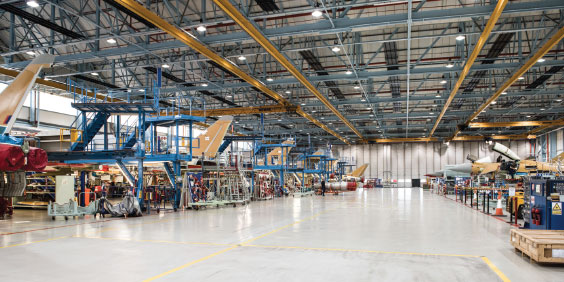
Defence Turkey was invited to tour various facilities, including the sights and sounds, for example, of 302 Hangar, where BAE Systems performs final assembly for the Typhoon aircraft – UK MOD, Royal Saudi Airforce, and soon Oman at which time 3 different customers will be coming down the build line. Matt Heritage, Operations Manager Team 1, Typhoon Final Assembly, elaborated on their current operations: “There are 17 aircraft in this building at various states. Capacity is linked to the customers requirements and the budgets. We basically make sure that we don’t build anymore than could be purchased at any one time here. If we want to increase our yield rates, we wouldn’t need more aircrafts on the ground. We would just change the shift patterns that our people work and change the manufacturing processes which will allow us to perhaps build 36 aircraft per year, for example, as opposed to last year, we built 24 aircraft.”
Ongoing programmes in Turkey: Collabration with Fotoniks on LiteHUD for Hürkuş and F-16 HUD Repair capability
BAE Systems, in partnership with local firm Fotoniks, has secured the Turkish Air Force as the launch customer for the LiteHUD system for use on its new Hurkuş trainer aircraft. BAE Systems and Turkish SME Fotoniks began co-operating on LiteHUD with a memorandum of understanding signed. This was rewarded with a contract from the prime contractor on the Hurkuş programme, Turkish Aerospace Industries (TAI), in January. Fotoniks will work to integrate BAE Systems’ LiteHUD Head-Up Display (HUD) into the HUD system for the Hürkuş basic training aircraft. Fotoniks will set up a LiteHUD production line at the company’s Ankara facility, expecting the first system to be completed within two years. In total Fotoniks and BAE Systems’ contract with TAI covers delivery of LiteHUD for the 15 Hurkus-B. The LiteHUD head-up display is designed using BAE Systems’ patented waveguide technology. This HUD is 60% smaller by volume and up to 50% lighter than a conventional HUD.
Neale Osmond, Head of Programmes, Turkey stated that they believe F16 HUD repair will be a great opportunity for BAE and Fotoniks. F16 HUD repair will be completed locally, resulting in reduced cost and time, estimated currently as a 2-year process; it is anticipated to be as quick as 6 months in the future. Neale Osmond, Head of Programmes, Turkey – Programme and Business Development at BAE Systems, shared insight that “The unique ability to provide this repair capability in Turkey is a large opportunity for the region, and an example of BAE’s partnership in helping to help companies in other countries grow indigeonously.
Q-Warrior – Not just a Helmet - The World’s First ‘Head-Up Display for Soldier’
The Company has a long heritage of firsts in the world of airborne displays — the first head-up display (HUD) introduced in 1960; the first primary flight reference display in the 1980s; and the first holographic HUD, providing wide-field-of-view displays, in the 1980s. BAE Systems’ R&D investment and innovations in technology have resulted in two significant offerings for the helmet market: the Striker, and the Q-Sight™ helmets.Developed for the Eurofighter Typhoon, the Striker helmet is the world’s first binocular helmet-mounted display for a fixed-wing aircraft. The Striker product provides a helmet solution that integrates night vision and full crew head protection.
The Q-Sight helmet uses quantum wave guide technology to directly couple the output of an LCD projector to a combining lens, eliminating the need for intermediate lenses. The benefits include improved flight safety as well as reduced neck strain and seamless transition between day and night for pilots.
The Q-Warrior system, designed to provide ordinary soldiers with the kind of heads-up display (HUD) once reserved for jet-fighter pilots. American troops, including special forces, are already testing the system, and the company hopes it could be on the battlefield in as little as three years. The helmet relies on its transparent high-definition screen, which has taken more than 10 years to develop and which displays 3D holographic images on top of the real world.
Future Opportunities to Partner with Turkey – Indigeonous Programmes
During our time with Mr. Latham, he discussed programmes that they are involved in, saying they are “all collaberative to some extent, different models of collaboration. Sometimes we work in partnership with companies, other times we are competitors. It’s a unique perspective for BAE Systems, a rather unique translatantic footprint as we are a UK based company with 1/3 based in the UK and 1/3 based in the US. In terms of Turkey, its a market that we see as an important market for us in the future. There’s some exciting opportunities there particularly in the short term with TFX and the slightly longer term the trainer requirements as well. I think the technologies that we’ve developed across the fighter programmes and the trainers, and continue to develop with things like the unmanned programmes, all have some relevance and can add something to Turkey’s industrial programmes as well.”
BAE Systems looks forward with confidence as a premiere international defence aerospace and security company, continuing to drive value from successful defence platforms and services, deriving values from the skills that are gained as a result. Mr. Latham indicated “For example, with Turkey, partnering on aircraft fighter programmes, the skills and expertise could be used to partner with Turkey on their own indigenous programmes like TFX maybe TX in the future as well.”
Mr. Latham stated that TFX needs to fly in October 2023 and the current T38 in Turkey can’t really be extended much beyond 2025. In addition he added “The TFX certainly fits our strategy well in terms of international opportunity for us to use our IPR – Intellectual Property Rights, skills and expertise and knowledge on another programme and I think Turkey is an exciting market in terms of a very capable and developed defence industry and it is geographically is quite an interesting location as well, the bridge between Europe and GCC, Middle East Gulf Region.”
BAE Systems has demonstrated adaptability through various new partnerships, leveraging their technology and engineering capabilities, creating models of cooperation through experience and gaining the expertise to be able to suggest which models best meet particular programmes depending on the requirements and drivers for the particular programmes.
Cyber and Intelligence – High Growth
Cyber & Intelligence, with 8,200 employees, covers the Group’s cyber, secure government, and commercial and financial security activities.Cyber is an identified growth area, with a few aquisitions in the UK, such as a few years ago with Detica, which is now called BAE systems Applied Intelligence. There is also an Intelligence business in the US, primarily working with the US government. This adjecent market has strong growth in government, commercial, banking, financial sectors. Cyber is the smallest sector but with the biggest growth rate last year at 30%, a high growth rate from a small starting point.
“From a security point of view, Turkey may be a bit apprehensive to have a foreign company looking after their intelligence data, understandably not partnering with any company that is not Turkish, but there’s definately things we can do from a financial security point of view regarding banks, money laundering, fraud and defence in cyber.”
Intelligence & Security is headquartered in the US and provides a full spectrum of intelligence and operational monitoring, analysis, counsel, and tools to give the intelligence community and policymakers timely and accurate information needed to predict, prevent, and protect against physical and cyber security threats.
BAE Systems Applied Intelligence is headquartered in the UK and delivers solutions which help government and commercial sector clients to protect and enhance their critical assets in the connected world. Their solutions combine large-scale data exploitation, “intelligence-grade” security and complex services and solutions integration. The business operates in four key domains of expertise: Cyber Security, Financial Crime, Communications Intelligence and Digital Transformation. Primary operational hubs are in the UK & Europe, North America, Australia, Malaysia and the Middle East.
BAE Systems Roles on F-35 Lightning II
The F-35 is the largest defence programme in the world, estimated total value >$1.5 trillion. The US Lead with 8 International Participant Nations - UK, Italy, Netherlands, Australia, Canada, Denmark, Norway and Turkey. Lockheed Martin are Aircraft Prime Contractor, with Partners Northrop Grumman and BAE Systems. Pratt and Whitney are Prime Contractor for Propulsion. There are three variants – Carrier Variant (CV), conventional Take Off and Landing (CTOL), and Short Take Off and Vertical Landing (STOVL). In addition, Israel, Japan and South Korea have selected F-35 through FMS.
The UK has funded part of the development programme and so far committed to the purchase of 3 aircraft – the only ‘Level 1’ partner. (Turkey is a level 3 partner at 3.2% investment from Turkey )
Full UK acquisition numbers will be determined as part of the next SDSR, planning assumptions remain at 100+.
A significant amount of investment has been made in automation to ensure requirements are met for Lockheed Martin and the JPO F-35 Joint programm Office.
There is a Workshare agreement between LM and BAE covering all phases of the lifecycle. BAE Systems Leadership Roles on F35 are at fuselage & empennage, Wing tips for CV variant, Fuel, Crew Escape & Life Support, CTOL Structural Test, Structural and Vehicle Systems, Prognostic Health Management, UK National Sustainment, Queen Elizabeth Class Carrier Integration Support. Supporting roles are identified as: Global Sustainment, UK Weapons Integration and STOVL Flight Test.
BAE Systems Australia is involved in Vertical Tails, Corrosion Monitoring and EW Sub-assemblies
Unmanned Aircraft Systems of BAE
Work is going on now to design and develop the technologies that will be used in the aircraft and systems of the future. With the advanced technology demonstration programmes such as Mantis and Taranis, they are leading the world in the development and application of autonomous system design for unmanned aircraft – aircraft that can quite literally fly and think for themselves.
Taranis is an Unmanned Combat Aircraft System (UCAS) advanced technology demonstrator, a £142.5 million project, rolled out on 12 July 2010, jointly funded by the UK MoD and UK industry. Successful radar cross-section test was completed – Spring 2012 and first flight in 2013.
BAE Systems is appointed as the industry lead and prime contractor, providing the UK MoD with experimental evidence on the potential capabilities and help to inform decisions on the future mix of manned and unmanned fast jet aircraft. Taranis aims to push the boundaries of technology by providing advancements in low observability capability and autonomous mission systems operations demonstrating the feasibility and utility of UAVs. It will help to inform decision on the future mix of manned and unmanned fast jet aircraft.