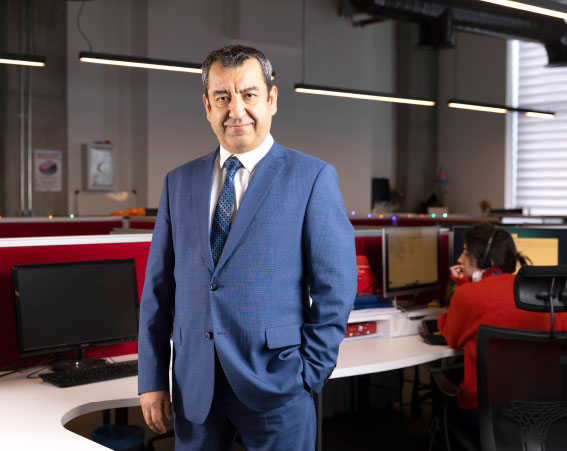
BITES Air Defense and Information Systems: `WE HAVE DELIVERED THE ATOK PROJECT AT THE END OF DECEMBER 2021`
Defence Turkey: Could you summarize the latest status of the ATOK Project?
Metin DÖNER: ATOK (Military Tactical Operation Kit) is a very special project executed by the Presidency of Defense Industries (SSB) and was targeted to be finalized in December 2021. The architecture design we made for the ATOK System was based on mobile technologies and we achieved success with the resulting product. Our main approach was to integrate and secure the wearable technologies that we use in our daily lives and not having special design, in a way that could be used in the military field. To this end, we developed the ATOK situational awareness kit. The ATOK System is actually the first step we have taken on our way towards Future Soldier technologies. In June 2021, we made the first demonstration to the SSB, the General Staff and other stakeholders. Afterwards, we exhibited the ATOK System and its capabilities at the IDEF'21 Defense Industry Fair. The system attracted great attention, more than we expected and we received positive feedback. Security personnel and defense industry experts working in the field examined the ATOK System and stated that it would be very useful in operations. There is no other domestic product that is competent enough and ready to use. There are some products covering the needs partially, and different technologies and applications are available, but there is no system other than the ATOK System, which creates end-to-end situational awareness, generates personal status information and transfers it to other stakeholders, and achieves all of this within a secure communication network.
Defence Turkey: Is it for a certain user or for the entire Turkish Armed Forces (TAF)?
Metin DÖNER: The General Staff Special Forces Command supports and is closely monitoring the project. The Gendarmerie General Command is also following the progress. We have finalized the qualification tests of the ATOK System in the field and delivered the project at the end of December 2021.
Defence Turkey: What exactly delivered? Have you equipped certain number of soldiers? Or have you provided a prototype and ask for use, then receive feedback and make necessary improvements in line with the lacking points?
Metin DÖNER: We delivered the ATOK System to SSB in order to equip a certain number of users and we will continue remain in the game after the delivery. Our actual work will begin after that. We will go to the field and review the expected benefit from the ATOK System during the operation, determine the effectiveness of the system, the elements that will facilitate its use, and the need for additional operations, if any, and make the system flawless. Afterwards, we will produce more ergonomic ATOK Systems in larger amounts with higher operational efficiency.
Defence Turkey: What will be the key features of the ATOK System? For example, as we can see in the brochure, there is an application for a 4x4 Tactical Wheeled Armored Vehicle (FNSS PARS).
Metin DÖNER: The prominent feature of the ATOK System, compared to its possible competitors, is that it comprises familiar technologies and devices that users commonly use in their daily lives. With wearable technologies, it can increase the situational awareness of the soldier and maximize the tactical effectiveness in the field without creating excessive weight on the soldier. The most important point here is “security”.
What do we produce, what do we achieve with the ATOK System? We produce the status and location information of the soldier. This system primarily produces the tactical field map, the location and health status of each personnel during the operation, as well as the intelligence information among the personnel. For this reason, critical information in the ATOK System is encrypted and stored at every level and security checks are made.
Defence Turkey: So, while doing this, does it warn personnel if they are the wrong location? Is it an audio or visual alarm/warning?
Metin DÖNER: The user is able to see visually the difference between the planned route and the defined location, and their own position. We use precision sensors so that personnel can precisely determine their own location. Today all mobile systems use GPS/GNNS signals. However, these signals may not be available in the operation field or be vulnerable to jamming. So, we thought about the things to be done. We added an additional sensor in order to compensate for this deficiency, which is likely to cause vulnerability for our personnel in the operation field. We placed this sensor on the soldier's foot. We will also work on the ergonomic design and make it wearable.
We worked with Ankara University and developed a special algorithm for this new sensor. In fact, we recently shared our test results and findings regarding the algorithm we developed as an article at NATO's international conference. It attracted intensive attention and was followed closely. Thanks to this algorithm, even if there is no GPS, we are able generate the information of our soldiers’ location, where they are, where they are going, and transfer this information to the tactical map on the mobile device of the soldier. To summarize, even if there is no GPS signal, we can generate our own location information with our own sensor. We can also track our movements. We can also generate displacement information.
What is our second capability? It is the Health Sensor/Module. We are able to constantly monitor data about the health of personnel. The system receives information from a domestically developed sensor to measure heart rate, blood pressure, body temperature and stress status. All such information is obtained from the sensor that is on the soldier. There are 2 wearable sensors in the ATOK System. One is for location, and the other is for health status. Who processes the data received from these sensors? The personnel have a mobile device. This mobile device is like a computer on a person. This is a Data Processing Center. The personnel are able to see the tactical map in the ATOK System through this mobile device. They see their location on the map and can follow other personnel.
Defence Turkey: For example, a team of soldiers is deployed to the operation field. Each member in the team knows their location and communicates. Well, as the Company Commander, will I be able to follow the personnel I directed to the field at Headquarters? Can I actively observe for example, that my Team 1 is here on the Tactical Map and Team 2 is there?
Metin DÖNER: I can share this personal information with everyone on the 4.5G/LTE base station network produced by ULAK Communications on the vehicle I just mentioned. Therefore, the company commander in that network can see the location of personnel and their health status on the tactical map. Since the single-cell communication network is generally a closed network, it provides an opportunity for secure communication to the operation team. We also added satellite communication capability so that information can be shared with the operation center or up-to-date instructions can be obtained in case of emergency. Therefore, with this capability we only provide it to the company commander, and the headquarters will be able to follow the operation with the information it receives from the operation field.
With the Augmented Reality Glasses in the system, the commander is able to see the location of personnel, their distance to the headquarters and their health status, according to their line of sight.
Defence Turkey: For example, let's say I conducted a landing operation to a undisclosed location. There is a ship behind and waiting for information from me. It will conduct shooting, but it should avoid shooting me. Is this type of communication possible not only with the headquarters on the ground, but also with the ship and even with the elements in the air?
Metin DÖNER: The modular communication infrastructure is the most significant component of the ATOK System. In fact, we have designed the ATOK System to work with all standard communication systems. We can provide communication within the team with any wireless communication infrastructure; we are able to operate the ATOK System in a satellite communication network, naval tactical radio network, LTE or mesh network. Even if there is no communication network, the ATOK System can continue to generate location and health data for each personnel.
The system has a messaging capability within the team. All personnel can message their location with each other, chat and exchange data. When it detects any intelligence data (such as sniper, explosive trap, suspicious movement, etc.), it can take a photo or video and send it to all other personnel. Other personnel will be able to see this intelligence on the tactical map. We have added all these capabilities to the ATOK System.
Satellite communication can be considered as the only door of the system opening outside. Since the satellite communication method is relatively overpriced, we evaluated that this method will be used for communication and intelligence exchange with other naval and air elements.
Since the mesh network and RF communication provides a relatively low bandwidth, the ATOK System will primarily ensure that critical data is shared within the team. On the other hand, if broadband communication such as LTE/4.5G is possible, personnel could then even make video calls among each other.
Defence Turkey: So, is there any personnel and vehicle limitation regarding the system that you will deliver in December?
Metin DÖNER: We run the ATOK System on a single vehicle. The system we will deliver in December has no limitation in terms of its capabilities. However, there will of course be a limitation in terms of hardware and communication. We can control user authorizations and tactical data on mobile devices of nearly 1,000 personnel with a single server. We can increase the number of mobile devices we can control by increasing the number of servers. The ATOK System has no user limit. However, all communication infrastructures have a limit. The important point here is if we take ATOK as a system, the capacity of the LTE communication system, in other words the base station, becomes restrictive. Currently, we have the bandwidth to enable 100 people to conduct video communication simultaneously with the base station produced by ULAK Communications. This capacity will be sufficient for a Special Task Force that is a potential user of the ATOK System.
Defence Turkey: Are there any areas of improvement that you believe are necessary or possible in the system?
Metin DÖNER: We have used the most advanced technologies available today. Regarding the system, there are some points that we have observed in the field and suggestions received when the ATOK System was demonstrated to the Presidency of Defense Industries and the end user. We considered these suggestions as the improvement areas of the system. We tried and tested them to see if they were applicable and we saw that some of them were applicable, we added some of them as additional capabilities to the system. We made plans for some of them because we didn’t want to postpone the delivery date. However, we noted the improvement areas that we could not try/test. For example, the addition of national symbology is one of them. Currently, we use the symbology defined in Mil-Std 2525 used in NATO on tactical maps in the ATOK System.
Augmented Reality Glass is one of our key capabilities in our digital soldier concept. There is a demand for the use of national symbology on these glasses, which we also agree with. We need to try/test the use of national symbology. The second issue is to acquire UAV images, and we have tried it.
Defence Turkey: Is it for Close Air Support?
Metin DÖNER: Yes. Close Air Support was also requested. In close air support, the subject matter is to transfer the coordinates of the targets to the center with categorical information. Air elements destroy the target using this information.
ATOK performs this indirectly, but there is no single function defined as "close air support". We can transfer the "Target" information to wherever we want in the ATOK System, but we were also requested to transfer the message defined as "I want close air support" together. For now, this message and target information are being sent consecutively. So, this (Close Air Support Request) is a two-step process. Well, can we send it by saying "I want air support to this point"? Of course, we can send it. We can tell the air vehicle or the operations center. Since the ATOK System has been developed domestically and with an open architecture approach, it is possible to add these capabilities to the system. This is one of the possible extensions of the open system.
Another extension area is to diversify the communication infrastructure. Operations will need to be supported even in areas where the existing communication network is out of coverage or where LTE communication is not possible. This is Mesh Networking. It is necessary to enable the exchange of critical data within the team by using the Mesh Communications network as an infrastructure. We need to be able to support diverse communication infrastructures. Security is of critical importance here. We need to maintain a layered security structure because security demands may vary depending on the purpose of use and the user. The main task of the Special Task Force is to carry out the operation quickly and safely. Information security should not cease the operation. The user should be able to set the security level if requested. Therefore, providing such facility, that is, layered security, can be one of the improvement areas of the system.
The server, modem, satellite communication, ground communication of the system, are all located in a cabin on the vehicle and therefore it works wherever the vehicle goes. In short, you don't need any operations center. So, it's a fully mobile system. Additionally, as I mentioned previously, it is a system that has been finalized, tested in the field, and is available for use with all its capabilities at the end of December. There is no other system available at this readiness level.
Another key feature that will make ATOK attractive is its cost effectiveness. No special hardware is required for this system. In the technology world, the average lifetime of electronic devices has decreased to a maximum of four years. So, any electronic device we develop today will be outdated after four years and will not be supported by almost all available software. We produced the ATOK System platform independent so that the expansion of the system is not limited to four or five years. Therefore, our perspective is to immediately adapt the ATOK System to the developing technology.
Defence Turkey: Is the input data processed over the device on the soldier or on the vehicle?
Metin DÖNER: All data is processed and can be displayed on the mobile device on the field personnel. Then the personnel send all the data about their status to the vehicle in a processed form. In this way both the team commander and the commander who is responsible for multiple teams able to see the status of all personnel and teams in the field and share the data they want with headquarters.
Defence Turkey: You mentioned that the ATOK System is limited to 1,000 users in the first stage and that the system can obtain images from different drones and UAVs. For example, let's consider a Special Task Force Battalion, which has kamikaze drones, surveillance drones/UAVs, anti-tank vehicles, etc. Do you have the capacity to include vehicles and platforms other than yours in this network? Is it possible to mount receivers or sensors on these vehicles and include them in the system/network, or is it only limited to your own vehicle?
Metin DÖNER: With the ATOK System, we have developed a “super app”. This super app has a wireless connection feature. Being wireless is another important feature of the ATOK System that receives positive feedback from its users, that is, the user does not have to tackle with cables. We use a wireless network for short distances.
All the sensors and hardware in the ATOK System are identified and connected to each other in the same kit; so, my sensor is not connecting to another soldier's sensor. The smart watch on the wrist does not share anyone else's data. This match is formulated up to the serial number of the mobile device.
Currently, our primary goal is to provide both situational awareness and intra-team communication of each personnel in the Special Task Force. This is the issue we are ultimately trying to solve for the time being. We can cover this need with the ATOK System at an optimum level and with high security. Well, can we extend this out to a battalion or an army as you mention? At that point, more communication and security infrastructures are needed, more conventional communication infrastructures are needed, and there are intensive and systematic studies in this field in our country. We are not carrying out activities at that level now.
Defence Turkey: Does the system receive data/information from outside? For example, we are in the field now. We know my own location. But let's say an hostile tank or another vehicle is getting closer from 5 km away. The Ground Surveillance Radar at Headquarters has detected that vehicle and needs to warn me. Is it able to transfer the image/data acquired by the radar to me?
Metin DÖNER: Yes. Another component of the system is the Satellite communication system. Information and instructions to be received via satellite are transferred to the vehicle commander. The vehicle commander can transfer this data to the personnel he deems necessary or to the entire team. Sometimes the team commander may find it risky to distribute the data he receives to everyone in the field, or maybe he receives bad news from the field. As everyone can see each other's health status instantly, the team commander may not want this information to be shared within the team. Therefore, the commander can monitor to what extent the data within the team will be shared, and who will share which data. The system offers flexibility to the commander regarding data distribution.
Since we have developed a super app with the ATOK System, we can add functions according to user demand. For example, if the user is going to perform a paradrop or intruder mission, we can add functions to the system related to these missions. If there is to be a deployment, we can create a safe deployment route and add functions for proceeding over the route. In other words, we offer a flexible system that takes the ease of use into account. For this reason, the user interfaces of the ATOK System are as flexible and customizable as possible.
Defence Turkey: So, what can you say about the local content rate you have achieved at this stage?
Metin DÖNER: If any domestic equivalent was available for the products we supply from abroad, we prioritized to utilize such domestic products. For example, first the mobile device itself. The mobile device used is the design and production of a domestic company. Secondly, the communication infrastructure is also a domestic production; we use the LTE Base Station produced by ULAK Communications. We always try to choose our stakeholders from domestic companies. We use a mast from MİLMAST. Again, we use an ASELSAN product Satellite Communication System (SATCOM). There is no available domestic Augmented Reality glass yet, so we cannot use domestic ones here. However, we continue to work on this issue. We conduct negotiations with ASPİLSAN on mobile batteries. Our health sensor is produced by VESTEL DEFENSE production. On the other hand, we have also been carrying out indigenization activities for foreign-origin components. I cannot give a percentage at this stage in terms of local content rate, but we used all technologies that can be developed and produced domestically.
Defence Turkey: Is the ATOK System an ITAR-free product?
Metin DÖNER: Yes exactly. The ATOK System is an entirely independent and indigenous product in terms of national and international restrictions. We have developed an independent product free from production and export restrictions. As I just mentioned, all the products used in the system are products that can be used in our daily lives. We have made them “secure” and rendered their use in the tactical field. In fact, our critical technology and engineering takes the lead here. The mobile devices and sensors in the system are devices that can be used in daily life. For example, many athletes can use the health sensor in their daily life. Therefore, the system is quite simple to use, and its related training process is also simple. Therefore, with the ATOK System, we will no longer need complex systems and training for situational awareness and intra-team communication in the tactical field.
Defence Turkey: Mr. DÖNER, thank you for your time and we wish you every success in your work