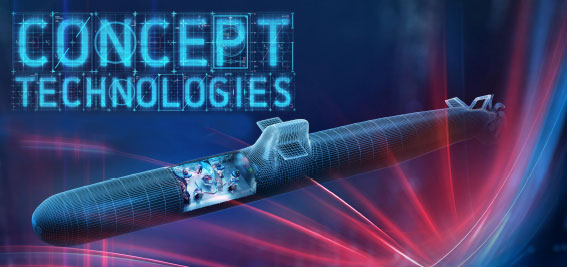
HAVELSAN CONCEPT DESIGN: SUBMARINE COMBAT INFORMATION CENTER (CIC)

The Submarine Combat Information Center (CIC) Concept, developed by HAVELSAN, was designed in a “Personnel-Oriented” manner, in line with human perception/comprehension ability and expectations, allowing face-to-face communication, increasing the commander’s control, minimizing personnel error, as well as foreseeing CIC work processes. Hence, situational awareness within the CIC can be increased with this design.
Brain of the Submarine: CIC
Command of a submarine is operated from the Combat Information Center (CIC), which is the brain of the submarine. In the Combat Information Center (CIC), there are Command Control Systems (CCS) and Combat Management Systems (CMS), where the operation is managed and navigational support is provided, and the subsystems/devices that support them.
As in many systems, “Future Submarines” will inevitably contain many interconnected technological features. The field of application is expanding every day, such as big data, artificial intelligence, machine learning, deep learning, decision support, internet of things, autonomous systems, augmented and visual reality, touch, mimic control, and similar human-computer interaction methods.
However, in system designs, it is often ignored that all these smart software applications ultimately must interact with humans in a whole of systems that contain many sub-systems especially such as the CIC.

Human-Environment Interaction
With the advancement of technology, the relationship between man and machine has gained and continues to gain more importance than in the past. The ergonomic dimension of the developed systems emphasizes human adaptation not only from the point of ergonomics of the physical environment, but also in terms of the ability of the human to perceive the systems and control and direct them easily. The inclusion of dimensions of human perception, comprehension and concentration ability in the design criteria has been an important role for the success of the systems designed.
In the vast majority of current applications, the command/combat systems in the CIC consist of a “system layout” created by combining devices with technological requirements and predominantly physical size limits in mind.
However, when the whole CIC system is considered in the “Eye of the Commander”, systems that work perfectly by themselves can become obstacles that create difficulties such as: the operators sitting with their back towards the commander, the commander's inability to see the operator screens due to the operator's seats, the commander's obligation to be on the move between the consoles etc., in communication with the personnel.
Even though working as a team in need of high coordination and being physically so close in the CIC, having limited face-to-face communication is another area of conflict with human perception.
That is where the human-environment interaction, which is as important as the human-machine interaction, manifests itself.
The Personnel-Oriented Submarine CIC Concept was designed by HAVELSAN by bringing human-environment interaction to the forefront, in a manner to meet all kinds of combat management, machinery and internal management needs of the submarine.
Given the average 40-50 years from the design of a submarine to its being out of order, it is expected that the design will meet personnel, operational and logistical needs over the next 50 years. Therefore, a farsighted vision is needed without straying from realism when deciding on the technology and design to be used.
In the creation of the concept design, “Designing the Future” with a “Realistic-Futuristic” perspective has been adopted as the basic approach.
The realistic part of the submarine CIC design approach is based on human-environment interaction, the futuristic part is based on the human-machine relationship, taking account of current/near future technology.

Increased Commander Control and Personnel Communication
Prior to the design, the location of the CIC in the submarine and the difficulties encountered in the current situation within the scope of CIC Internal Settlement were evaluated in submarines of different types and classes, and the problems were identified, and design principles consisting of solutions to overcome these identified problems were developed.
In the design, it is aimed to create a working atmosphere that is compatible with the physical and conceptual needs that will enable personnel to perform their duties effectively by minimizing their errors.
The CIC has been given a separate and isolated structure so that the activities in other parts of the submarine do not disturb the concentration of CIC personnel.
The submarine commander, just as an orchestra conductor, is located at the center of the consoles which are placed in a circular layout and facing towards the center to increase his/her dominance over the CIC.
More specifically, the design aims to increase the awareness of personnel, by maximizing the communication allowing face-to-face interaction and establishing eye contact with each other, minimizing possible errors and mistakes, and facilitating the commander’s control over the whole CIC. The design is based on an orchestra layout.
Physical space on submarines is a limited resource that needs to be managed. It is ensured that the area is used with maximum efficiency by optimizing the layout in the design.
Taking advantage of the technology, console structures are modified to allow face-to-face communication. Multifunctional Consoles have simple, basic, user friendly and space saving design. Consoles are compatible with personnel requirements, including reflectable two-sided console screens and safety/physical conveniences.
Another limited resource is submarine personnel. Considering that the supply of submarine personnel is a difficult, risky and costly process to maintain, fulfilling tasks with the least possible personnel by using all the possibilities brought by technology has also been considered a design constraint.

Readiness in Unmanned Submarines
The design also demonstrates a hybrid submarine design with a minimum number of personnel, offering a mix of today's submarines and autonomous technologies, and provides maximum infrastructure readiness for unmanned submarines.
Especially in the future given that acoustic communication technology develops in a way that makes unmanned submarines operationally possible, the designed CIC will be able to command the submarine by deploying it on the appropriate platform/land.
Structure Applicable to All Information/Crisis Centers
The design is applicable to operation/crisis centers located on different platforms and on land, apart from submarines, as it implements a physical layout compatible with human perception/comprehension ability and expectations.
Similarities Between Submarines and Spaceships
When the images of the design are first seen, the common reaction is that it resembles a “spaceship”. While the main goal of the design is to increase the communication of all personnel in the CIC, with each other especially with the commander and their surroundings, and to provide increased situational awareness within the CIC, it is also true that it resembles a typical “spaceship” that one is used to seeing in science fiction movies.
Submarines are among the leading platforms capable of performing long-term missions in a 3-dimensional and dark environment in today's operations area. Submarines are platforms with a wide range of missions and systems/devices that can perform these tasks and can greatly meet the logistical and social needs of personnel.
“Submarines” do indeed have similarities with “Spaceships/Stations” considering that they can perform long-term missions and meet operational and personnel needs in a 3-dimensional environment.
A common reaction given at first glance to the submarine design is that “it looks like a spaceship” and here it should be noted that as submarines began to be used much earlier than spaceships, it should be the other way around…that “spaceships look like submarines.”
Gains Obtained by Design
The CIC has a separate and isolated structure so that the activities in other parts of the submarine do not disturb the concentration of CIC personnel.
The submarine commander, just as an orchestra conductor, is located at the center of the console/device/systems placed in a circular shape, which increases his/her dominance over the CIC.
The layout is compatible with the duties/responsibilities and business processes of CIC personnel.
The commander and personnel have face-to-face interaction, and they can easily establish unobstructed and continuous eye contact with each other.
Three large multi-functional screens are used where the required data such as the Tactical Maritime Picture (TMP), periscope image, damage status etc. in the console/device/systems can be displayed separately.
The large screens have a wide viewing angle and are easily visible to a maximum number of personnel.
Screen selections can be made that are suitable for the most effective access to the data/information needed.
A horizontal console integrated with the Command Console is used in the center of the operator, where the Tactical Maritime Picture (TMP) is displayed, around which planning and briefing activities can be carried out.
The horizontal console is also designed in an ergonomic way where the Electronic Map (WECDIS) layers can be displayed, allowing both the commander and the relevant CIC personnel to use it jointly.
Control functions of console, device and systems, warnings and notifications have a lean and basic design.
Easy access to information is provided with the Double-Sided Console Screen Display that can be Projected to the Rear Side.
Data entry tools such as joystick, roll ball, touch/push buttons, etc. are designed in an ergonomic and user-friendly way.
In the design of the consoles, safety issues such as seat belts/handles, physical facilities like drinking tea and coffee during the shift and eating rations when necessary were taken into consideration.
It is aimed to optimize the layout with the design and to use the area with maximum efficiency.
The design offers maximum infrastructure readiness for controlling unmanned submarines.
It can also be applied to operation/crisis centers located on different platforms and on land.
HAVELSAN DOES NOT WAIT FOR THE FUTURE... HAVELSAN DESIGNS THE FUTURE!