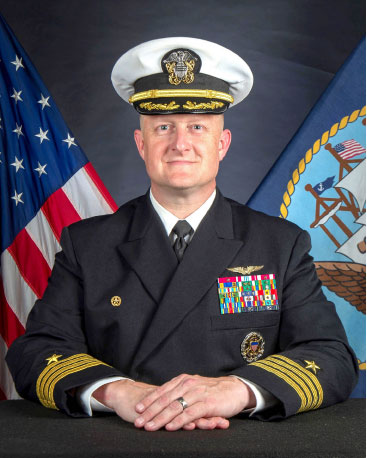
Capt. Rick BURGESS- CO OF the USS Gerald R. Ford:
Q: What are the new capabilities of this new FORD carrier class and what the new FORD class will bring to US naval aviation power?
Capt Rick BURGESS : As the Navy’s next generation aircraft carrier, Gerald R. Ford is defining the future of naval aviation during the present era of strategic competition where we can no longer assume that geography provides the protection and stand-off range it once did. Ford-class aircraft carriers upgrade Nimitz-class legacy systems to take advantage of automation and improvements to system design to reduce maintenance and improve warfighting effectiveness. Because of the technologies on Gerald R. Ford, the crew can load and launch aircraft faster than ever before. With its electromagnetic aircraft launch system (EMALS) and advanced arresting gear (AAG), Gerald R. Ford is designed to offer an increased sortie generation rate over the Nimitz-class. Gerald R. Ford’s in-deck refueling and island placement also opens up more “real estate” on the flight deck to move, stage and refuel aircraft. These technologies foster the interoperability and high-end skill sets required by today’s strategic realities.
Q: How does the USS Ford compare to the Nimitz-class carriers?
Capt Rick BURGESS : USS Gerald R. Ford (CVN 78) is the U.S. Navy’s newest aircraft carrier, and is the flagship of the Gerald R. Ford Carrier Strike Group. As the first-in-class ship for the next generation of aircraft carriers, Ford introduces 23 technologies to deliver greater lethality, survivability and joint interoperability while reducing operating and maintenance costs. The capital ship CVN 78 is the first new carrier designed in over 40 years, and it was designed to have the flexibility to operate with future generations of aircraft.
New technologies introduced to Gerald R. Ford compared to Nimitz-class include electromagnetic aircraft launch system (EMALS), advanced arresting gear (AAG), advanced weapons elevators (AWE), plasma arc waste destruction system (PAWDS), dual band radar (DBR), and in-deck aircraft refueling stations.
Gerald R. Ford is the most adaptable and lethal combat platform in the world. Ford-class carriers are designed to generate a higher sortie rate with a 20 percent smaller crew than a Nimitz-class carrier. This translates into savings of approximately $4 billion per ship in life-cycle operations and support costs, compared to the earlier Nimitz class.
Q: The missions the USS Ford is doing in this first big deployment (like BALTOPS, a CVW-8 detachment participating in AirDefender23 in Germany, Neptune Strike, etc)
Capt Rick BURGESS : Gerald R. Ford’s operations since deploying from Norfolk, Virginia May 2 include:
Operating in the Arctic region and High North
Neptune Strike: The U.S. Navy's Sixth Fleet and NATO's Naval Striking and Support Forces NATO (STRIKFORNATO) commenced Neptune Strike 2023-2 (NEST 23.2), the latest iteration of the Project Neptune series of enhanced vigilance activity, July 10, 2023. As in previous editions of Neptune Strike, including NEST 23.1 in February 2023, NEST 23.2 involved the transfer of authority (TOA) of assigned national forces, including USS Gerald R. Ford, to STRIKFORNATO and NATO command and control. Allied forces executed a variety of evolutions in support of enhanced vigilance activity objectives throughout European airspace, waterways, and territory.
Arctic Challenge: ØRLAND AIR BASE, Norway -- U.S. Air Force B-1B Lancer supersonic strategic bombers executing Bomber Task Force 2023-3 joined NATO aircraft, June 5, during Arctic Challenge Exercise 2023 in a counter-maritime mission involving the USS Gerald R. Ford (CVN 78) Carrier Strike Group and embarked Carrier Air Wing (CVW) 8 in the High North. As a first during Arctic Challenge, the two bombers from Dyess Air Force Base’s 9th Bomb Wing, were joined by U.S. Air Force and Royal Norwegian Air Force F-35A Lightning II fifth-generation fighters, U.S. Navy F/A-18 Super Hornet, EA-18 Growler, and P-8A Poseidon aircraft, and Allied naval assets throughout the North Sea.
BALTOPS/Air Defender 23, supported Carrier Air Wing (CVW) 8: NATO, Portugal - The 52nd iteration of Baltic Operations 2023 (BALTOPS 23), NATO’s premier maritime-focused exercise in the Baltic Region, is set to begin from Tallinn, Estonia, June 4-16. Nineteen NATO nations, one NATO partner nations, 50 ships, more than 45 aircraft, and 6,000 personnel will participate in BALTOPS 23.
Sage Wolverine series of multi-lateral, high-end maritime training events
Numerous multi-domain interoperability training events and exercises with Allies and partners, to include Standing NATO Maritime Groups 1 and 2.
Q: The shakedown cruise of last year, when the USS Ford was at sea for a few months in preparation for the current cruise; what was discovered during the shakedown cruise and what was improved before the current cruise?
Capt Rick BURGESS : Last year, the Gerald R. Ford Carrier Strike Group was underway for two months, integrating with Allies and partners to conduct a range of maritime operations interchangeably, demonstrating the shared commitment to a peaceful, stable and conflict-free Atlantic region. Gerald R. Ford’s operations during this time demonstrated Ford-class aircraft carriers as the most adaptable and lethal combat platform in the world. The underway also provided an opportunity for the carrier strike group to fully integrate on its flagship, Gerald R. Ford, prior to its 2023 deployment to the U.S. Sixth Fleet area of operations.
Q: The Enhanced Carrier Presence of Comptuex-Deploy-Deploy-Standdown. What will be the benefits and will the USS Ford participate in the ECP? And was the shakedown cruise of last year part of the first deployment in the new ECP cycle?
Capt Rick BURGESS :We defer questions regarding Enhanced Carrier Presence to Commander, Naval Air Force Atlantic, and Commander, U.S. Fleet Forces Command. Nuclear-powered aircraft carriers remain crucial to fielding a fleet that controls the high-end fight. The Carrier Strike Group remains the cornerstone of the Navy’s forward presence through sea control and power projection capabilities.The U.S. and its NATO Allies and Partners are answering the call of today’s maritime environment by increasing our naval presence across the theater and exercising the broad range of our capabilities to encourage responsible behavior by all. Deployments like GRFCSG’s foster the interoperability and high-end skillsets required by today’s strategic realities.
Q: His general opinion about the USS Ford and its newer/better/faster capacities?
Capt Rick BURGESS :USS Gerald R. Ford represents a generational leap in our Navy’s capacity to project power on a global scale. The ship truly is the most sophisticated warship of this time. Because of the technologies on Ford, the crew can load and launch aircraft faster than ever before, improving our warfighting effectiveness and defining the future of naval aviation.
Q: Do you have anything else to tell about your cruise on the USS Ford? – Attribute to Capt. Rick BURGESS, commanding officer of USS Gerald R. Ford (CVN 78)?
Capt Rick BURGESS :"Gerald R. Ford is, in every way, bigger, faster, and more capable than any other warship in the world. Our Sailors have invested years of their service to make this dream come true for the American people, and I am so proud of them for their achievements. Like our ship’s namesake, the crew is humble and hardworking, and rarely brags about their contributions to the future of the Navy.
It takes incredible teamwork between the ship’s crew and Air Wing Sailors to conduct flight operations at a high level. In just 44 fly days, Gerald R. Ford Sailors safely launched and recovered 3,761 aircraft. After leaving the Arctic, Carrier Air Wing (CVW) 8 aircrew flew more than 400 Air Combat Training Curriculum (ACTC) sorties to hone the tactical skills and awareness needed to defend our country and allies when necessary.
Together, we’ve participated in several high-end military exercises and operations, ranging from the Arctic and High North down to and across the entirety of the Med, and we’ve supported 10 allied and partner nations along the way. Our Air Wing is the most efficient and tactical in the Fleet, and the finest of the six I’ve served with in my career. Our Air Wing has four Super Hornet squadrons: VFA-37 (Ragin’ Bulls), VFA-213 (Blacklions), VFA-31 (Tomcatters), and VFA-87 (Golden Warriors). Our EA-18G Growler squadron, VAQ-142 (Gray Wolves), flies the most technologically advanced aircraft in the world and our E-2D Hawkeye squadron, VAW-124 (Bear Aces), is redefining carrier-borne command and control. Our two helicopter squadrons, HSC-9 (Tridents) and HSM-70 (Spartans), fly or stand alert around the clock. The Tridents move people, parts, cargo, and mail from ship to ship and ship to shore, and the Spartans defend our ship from encounters at sea by other ships and aircraft, and they comprise our primary defense against adversary submarines. VRC-40 (Rawhides) flies the C-2 or “COD” (Carrier Onboard Delivery), ferrying parts, people, and mail to and from regional shore bases. Operating from a FORD class carrier is drastically different from that of NIMITZ class ships, and together, CVW-8 and Gerald R. Ford are establishing the standard for maximizing the combat capabilities of our nation’s capital ships."