Defence Cuts Open new Opportunities for Industry Support
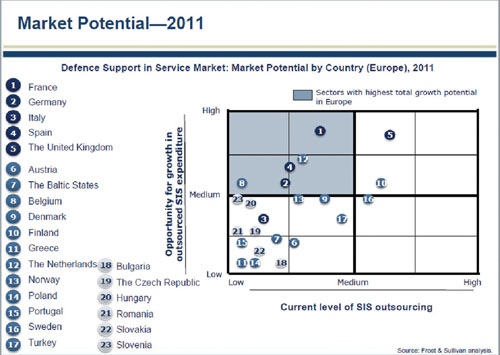
Total support in service outsource spend will grow significantly in Europe from almost $14bn in 2011 to $22bn in 2020
Many European countries have implemented significant cuts to defence spending to contain budget deficits. Measures applied through retiring platforms, cancelling procurement and reducing military personnel are having a significant effect on the support in service of equipment. Outsourcing support to industry will help improve efficiency and create long term savings, allowing the armed forces to focus on combat related activities.
Frost & Sullivan in the recent "European Defence Support in Service Market Assessment" forecasts the total support in service outsource spend in Europe will increase from $13.77bn in 2011 to $22.07bn in 2020. Modernization, Training and Heavy Maintenance support for platforms are areas that are most likely to be outsourced.
"More Ministries of Defence (MoDs) are now considering or employing a multi-source level of support which includes an amalgamation of the different segments to suit their needs," says Anthony Leather, Research Analyst for Frost & Sullivan Aerospace, Defence & Security group.
Traditionally air platforms have been the first to be outsourced. They are more complex, the costs of maintenance are high and this is where most benefit and cost saving can occur from industry involvement. Frost & Sullivan believes that around 52 per cent of outsourced spend over the next ten years will be on air platforms.
The level of industry integration in support in service differs throughout Europe. The UK has led the way, incorporating industry into their support model. Many Western European and Nordic countries are following this approach with France and Spain likely to be the next countries to outsource more of their support.
"Many armed forces have built up large in house capabilities, like Germany and Italy, to maintain their equipment. This has required substantial investment and time, making them reluctant to change their support model and turn to industry. Nevertheless, budget pressures are forcing countries to be more efficient and explore new support models," comments Anthony Leather.
The concept of outsourcing support to industry is growing in Eastern Europe, however not to the extent of other regions. There are still many Russian made platforms in the Eastern European market which limits support opportunity.
Creating strategic partnerships with industry can provide opportunities to achieve cost savings and maintain capability. This arrangement has proven to be successful; especially in the role that industry has played alongside military support personnel in Afghanistan.
"Companies that provide support in service must highlight cost saving opportunities to MoD’s. Flexibility within these support contracts is vital to allow armed forces to adapt to emerging or unforeseen threat," advices Anthony Leather.
"Further industry integration in support is inevitable for armed forces throughout Europe, however the extent of this involvement remains under the control of the MoD, for now," concludes Mr. Leather.
The sheer volume of equipment that Turkey has to maintain keeps SIS spending high. Frost & Sullivan predicts this will rise as they continue to procure new equipment.
It is likely that Turkey will look to industry to support some of the newer platforms. Outsourced expenditure will rise from approximately 2013, and will have grown by more than $400 million by the end of the study period
Turkey has planned an extensive procurement programme on a range of platforms will entail significant support opportunities. Air platforms will provide the greatest SIS opportunities, with the procurement of the JSF, F-16 and a range of helicopters planned. As land and maritime platforms near the end of their lifecycles, it is likely Turkey will look to outsource some of these support costs. Turkey has a clear strategic aim to build its own industry capability. Partnering with a company with local presence will be vital to enter the market. Targeting support solutions for new equipment should be a priority.





