Deliveries of Upgraded ACV-15s and an Unprecedented Air Defense Test & Integration Facility

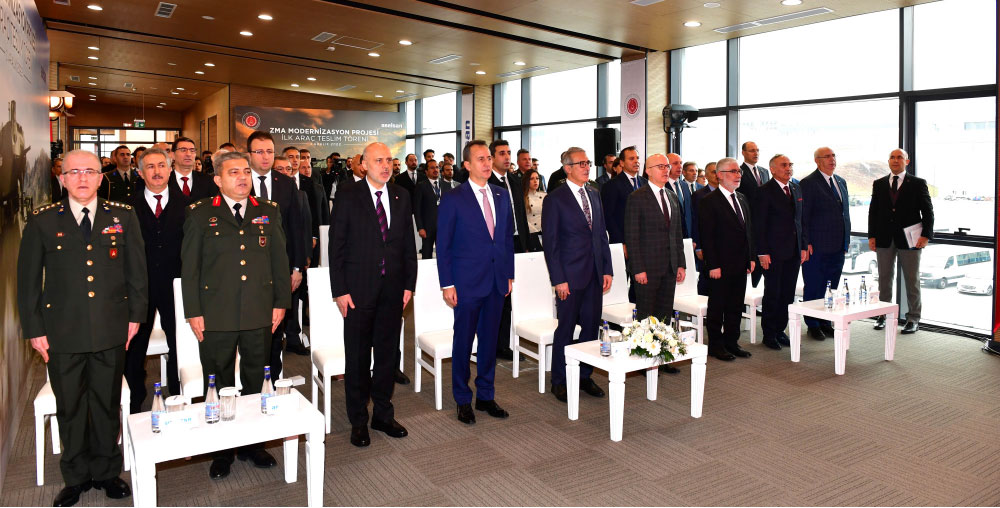
President of the Defense Industry Agency Prof. Dr. İsmail DEMİR, Vice President of the Defense Industry Agency Celal Sami TÜFEKÇİ, ASELSAN Chairman of the Board of Directors & CEO Prof. Dr. Haluk GÖRGÜN and several military and defense officials, as well as members of the press, attended the ceremony.
In his speech, ASELSAN CEO Haluk GÖRGÜN stated that he is pleased to deliver the first five vehicles in the modernization project, which was initiated to increase the survivability and firepower of the 134 Armored Combat Vehicles in the inventory of the Turkish Land Forces Command, and shared important information about the details of the project: "With this project, Armored Combat Vehicles produced by FNSS and delivered to the Turkish Land Forces nearly 30 years ago will be equipped with various capabilities to meet the battlefield conditions of today and the future. The most distinctive of these systems and capabilities is our "NEFER" weapon system, which will be the first 25mm Unmanned Turret in the Turkish Armed Forces inventory and make a difference with its superior firepower on the battlefield. While the NEFER Weapon System is an off-the-shelf product developed by ASELSAN, it was redesigned and manufactured specifically for the project in line with the needs of the Turkish Land Forces and proved itself in tough tests. In this way, both user satisfaction has been achieved at a high level, and a new product has emerged with superior features to its counterparts. The NEFER Unmanned Turret System can detect, identify, and destroy hostile targets with high accuracy on the move, thanks to its stabilization feature. Thanks to its electro-optical layout design, it can also provide independent surveillance capability without rotating the whole turret. The laser warning system on NEFER warns the crew against anti-tank threats and automatically directs the turret to the threat. It will also increase the crew's survivability with additional capabilities such as launching smoke grenade dischargers and creating a smoke screen. Another feature provided by the modernization is increasing the crew's situational awareness. Thanks to our "Örümcek (Spider)" Close-Range Surveillance System and Driver's Vision System (ADIS), 360-degree images of the vehicle's surroundings can be displayed to the crew both day and night. The armor and mine protection levels of the vehicle were also increased to increase survivability and improve the crew's comfort. The interior walls of the vehicle were fitted with a spall liner to protect the crew from the fragments, and an automatic fire extinguishing system was integrated. The CBRN system was upgraded, and HVAC (Heating, Ventilation, and Air conditioning) system was also added to the vehicle.
Within the scope of the project, unit-level logistics support for all these systems, as well as simulators and all other training aids and infrastructure for the team-level tactical training of four ACV personnel at the same time, were provided to the Turkish Armed Forces. We aim to utilize the know-how we gained from this project in the Unmanned Armored Combat Vehicle in the future. With the Unmanned ACV, we aim to provide an operational capability that minimizes the personnel risks for our Land Forces. In addition to these systems, the capabilities of the General Directorate of Military Factories have also been employed as part of the project thanks to the support of the Turkish Land Forces Command. The 2nd Main Maintenance Center and the 45th Maintenance Factory Directorate are important partners in the project for the depot-level maintenance/repair of the engine/transmission and weapon systems. I want to express my gratitude to the Turkish Land Forces Command and the General Directorate of Military Factories for their unwavering support in utilizing the capabilities of military factories in the project. I also want to thank once again the President of the Defense Industry Agency and his staff, the Turkish Land Forces Command and all its units involved in the project, our subcontractor FNSS and all ASELSAN employees for their efforts, trust and support for the successful continuation of all processes in this project."
President of the Defense Industry Agency Prof. Dr. İsmail DEMİR said in his speech: "Having an agile, fast, and strong weapon system with sustainable mobility is an essential capability for ground forces. Armored combat vehicles are designed as versatile vehicles that combine firepower and maneuverability to transport personnel in high-risk areas under armor protection. By using advanced technology and our country's resources, the capabilities of these vehicles are further increased. The Armored Combat Vehicles of the Turkish Land Forces have been supplied under the most comprehensive contract signed after the establishment of our Agency and have been operating successfully for many years. While our efforts to design and produce new-generation armored combat vehicles that will serve on the battlefield of the future continue at full speed, we also continue our activities to increase the capabilities of our current vehicles. With the ACV Modernization Project, we have maximized the firepower and situational awareness of 134 ACVs with old-generation turrets by integrating modern unmanned turrets and increased survivability and mobility to the highest level by improving the power and transmission systems of the vehicles. We aim to complete deliveries in 2024."
Türkiye Builds-up Air Defense Test Infrastructure with ROBOSIM
Following the opening speeches, President of the Defense Industry Agency Prof. İsmail DEMİR and the accompanying delegation went to the ROBOSIM Dynamic Target Test Infrastructure where testing and verifications of air defense systems under challenging scenarios are carried out and attended the live demonstration.
The scenario was prepared to demonstrate the effectiveness of the HISAR-O KALKAN radar, located 40-50 meters from the ROBOSIM Open Field Dynamic Target Test Infastructure against a maneuvering air target. According to the generic scenario, the simulated target is approaching from an altitude of 2 kilometers (appx. 6500ft.) and 30 kilometers by performing an S-maneuver. The red target device (payload) is equipped with an electro-optical system and radar reflectors to simulate air threats. The device is connected to the ROBOSIM carrier towers at 75 meters with a synthetic cable, 30-40 meters across from the HISAR-O KALKAN Radar and moves on the horizontal axis with a mechanical system. According to the scenario, the target threat approaches by maneuvering 2 kilometers to the right and 2 kilometers to the left in this 30-kilometer test field. In the scenario, the radar information of the threat is displayed to the participants through the monitors with the data received from ROBOSIM (Speed, RCS, Target Position) and the KALKAN Radar (target track and location information). The threat, which is detected and tracked by KALKAN radar, is then engaged by the KORKUT SPAAG (Self-Propelled Anti-Aircraft Gun), as per the scenario. The live demonstration was completed after KORKUT SPAAG returned to its initial position while continuously tracking the target with its stabilized turret.
With this test site, which is the only one in the world, various simulations previously conducted with F-16 jets or target drones will be performed cost-effectively at distances from minimum kilometers up to +100 kilometers. The tests of the SIPER Air Defense System are also planned to be carried out at this test site.
About ROBOSIM
ROBOSIM, which became operational on March 22, 2022, is used for simulating targets that air and missile defense systems may encounter in real life. In this infrastructure, challenging engagement scenarios with single/multiple targets are simulated in the open field using cable-robot technology to enable the target simulator devices, which are equipped with an electro-optic system and radar reflectors, to move in the horizontal and vertical axis. With the ROBOSIM infrastructure, performance tests such as target detection, tracking, and verification of systems are carried out in a controlled, repeatable, and reliable test environment. ROBOSIM, which requires very demanding technical features (accurate positioning, speed, acceleration, etc.), includes various software and hardware components, and all components have been developed nationally.
The tower is integrated with the electromechanical structure and is specially designed. Even in strong winds, the system provides accurate simulations with only a few cm deviations at the top of the 75 m high towers. In addition, ROBOSIM features special software for planning and coordinating all test activities, real-time remote control of various subsystems according to the scenario, and recording, analysis, and evaluation of the data obtained during/after the tests.
Air Defense Scenario Simulation, Target Motion Simulation (2-axis), Radar Target Simulation, IR Target Simulation, Radar Jammer Simulation, Radar Target Detection & Tracking Classification Performance Tests and Verifications, "Man-in-the-loop" Simulation, EO Target Detection/Tracking Functional Testing and Verifications, and RF Data Link Tests and Verifications can be performed at the ROBOSIM Dynamic Target Test Infrastructure established in ASELSAN's BOSB campus.
The ROBOSIM Open Field Dynamic Target Test Infrastructure is one of crucial parts of the Air Defense Test and Integration Center (HSTEM), which consists of various advanced infrastructures for the effective performance of system/subsystem production, integration, testing and verification activities during the development and serial production periods of Air and Missile Defense Projects, was established on 391 decares between 2017-2022 in the ASELSAN-based Başkent Organized Industrial Zone (BOSB) and became operational in April,2022. HSTEM consists of the System Production and Integration Building (SUEB), Test Control Center, Indoor Shooting Range, System Test, Adjustment Calibration Infrastructure (SAKA) and Test Tower.
134 Vehicles to be Modernized by 2024 with the ACV Modernization Project
After the live demonstration at the ROBOSIM open field test site, the President of the Defense Industry Agency, Prof. İsmail DEMİR, examined the upgraded ACV-15 vehicles. Then President Prof.DEMİR visited the indoor shooting range, one of the few ranges in the world where larger 35mm or 40mm rounds can be used up to 200 meters; ACV-15 and KORKUT SPAAG vehicles performed live firing with 25mm and 35mm Airburst munitions.
The Armored Combat Vehicle (ACV) Modernization Project was launched by the Turkish Defense Industry Agency (SSB) to upgrade ACV-15s in the Turkish Armed Forces inventory. In this context, the SSB and ASELSAN signed a contract worth 900 million Turkish Liras on December 31, 2019. A separate contract was also signed between FNSS and ASELSAN on December 31, 2019, for prototyping, qualification activities, integration of all mission equipment, serial production, and logistics support, in addition to all modernization activities.
The vehicles will be fitted with a NEFER Unmanned Turret designed and manufactured by ASELSAN, which is armed with one 25 mm automatic cannon and a 7.62 mm coaxial machine gun, Laser Warning Receiver (LWR), Close Range Surveillance System, Driver's Vision System (ADIS), Direction Finding and Navigation System, Commander-Gunner, and Driver Display Panels.
The subcontractor FNSS will carry out maintenance and repair activities and integrate HVAC (Heating, Ventilation, and Air conditioning), Fire Extinguishing, and Explosion Suppression Systems into the ACV platforms. In addition to the modern weapon systems and high-tech mission equipment, the ACV's armor and mine protection levels will also be upgraded and fitted with advanced mine-resistant seats and spall liner, significantly increasing their survivability and combat capabilities platforms on the battlefield.
The NEFER 25mm Weapon System is also the first unmanned turret that was delivered to the Turkish Armed Forces.
Under the project, ASELSAN and FNSS delivered the pre-prototype of the upgraded ACV-15 for testing and evaluation in October 2020, and the driving and firing tests were carried out in May 2021. After the delivery of the first 5 vehicles, rest of vehicles will be upgraded by 2024 in batches of 5-10 vehicles.
Between 1989 and 2004, a total of 2249 ACV-15 vehicles in several configurations were produced by FNSS under two different contracts (1,698 + 551) and delivered to the Turkish Armed Forces. It is stated that there are more than 2,000 ACV-15s in the inventory of the Turkish Land Forces. Used extensively by the Turkish Armed Forces in numerous operations, the comprehensive modernization will ensure that these vehicles can be used actively for another 15-20 years