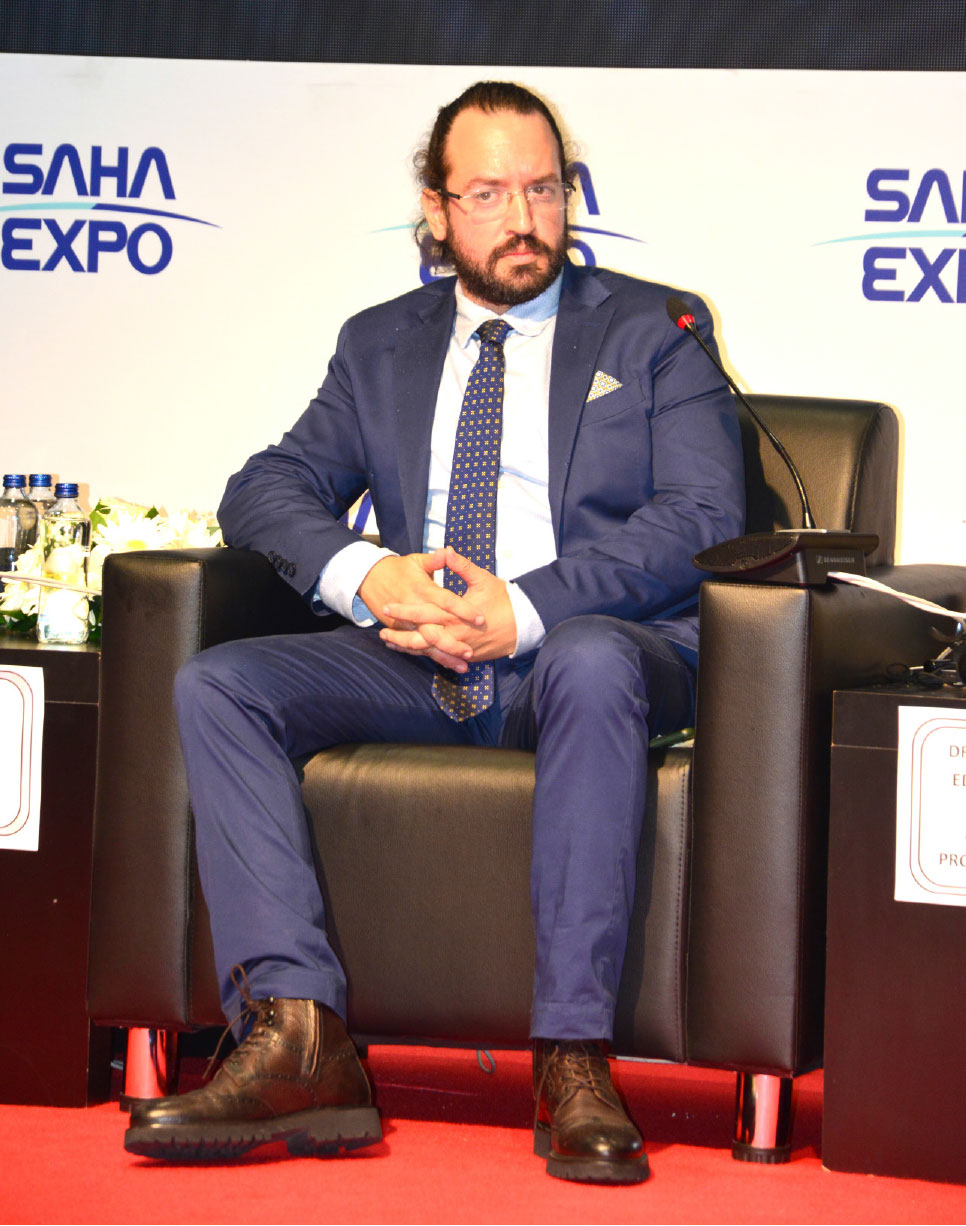
Dr. Can KASAPOĞLU: “We have learned a lot from the Russia-Ukraine War in terms of the defense industry”
On day 2 of SAHA EXPO 2022 International Defense and Aerospace Exhibition, a panel discussion was held on the "Impact of the Russia-Ukraine War on the Global Defense Industry. " Pavlo RIABIKIN, Minister of Strategic Industries of Ukraine, Cengiz KARAAĞAÇ, Director of Engineering and Consultancy at STM, Dr. Can KASAPOĞLU, Program Director of Security and Defense Studies at EDAM, Sine ÖZKARAŞAHİN, Security and Defense Analyst at EDAM, and Elisabeth Gosselin-MALO, Defense Reporter, participated in the panel moderated by Major General (Rtd) Tayyar SÜNGÜ.
Starting his speech on the impact of the systems employed in the Russia-Ukraine War on the battlefield and the lessons learned by the global industry, Dr. KASAPOĞLU first emphasized that there has been a paradigm shift in the modern battlefield within the framework of digital open-source intelligence. "We have learned a lot from the Russia-Ukraine War in terms of the defense industry, particularly with regard to strategic issues. First, we see that digital open-source intelligence is experiencing its golden age. For example, consider how could we have detected a weapon system deployed by the Soviet Union in Syria in the 1970s-80s, and how would we have evaluated the technical features of this weapon system. This would have necessitated a crucial human intelligence effort and likely included a high level of secrecy. However, we can now see that there is a distinction between the bureaucratic and practical expressions of the concept of top secret in the Ukrainian battlefield. We get information about Russian butterfly mines, the use of thermobaric weapons, the movements of large Russian maneuvering units from UCAV imagery, from commercial satellite imagery, from monitoring of social media apps like Telegram, Twitter by data harvesting. Over time, we have come to an understanding that this open-source intelligence is both an intellectual and an operational effort. For instance, utilizing Telegram data, the Ukrainian Armed Forces can respond immediately with fire support vehicles. Therefore, there is a paradigm change, similar to what happened to the dinosaurs. This is the first lesson about who will survive, who won't, who will stay in the previous paradigm and the annals of history, and who will adapt to the digital battlefield.”
Dr. KASAPOĞLU emphasized that operational doctrines of countries' armed forces have undergone substantial changes over time in response to advancements in defense technologies, and that the Russia-Ukraine War marked a new turning point in military history and warfare technology. “Ukraine is not the first instance of this paradigm shift that we have observed. Defense doctrine, technologies, and operational design are all based on two different paradigms. When two entities have come face to face, the result was often a catastrophe, a disaster for the outdated archaic side. This is what has consistently happened in conflicts throughout history when one side had access to gunpowder and rifles while the other did not, or when one side had highly developed artillery technology, as in the conquest of Constantinople, or when one side had long time ago domesticated the horse. As we saw in the Second Karabakh War, one side (the Azerbaijani Armed Forces), especially with the Turkish UCAV capability, fought like the Armed Forces of the 21st century and faced Armenian occupation forces acting with a Soviet entity. We now see the same in Ukraine. Similar to the Azerbaijani Armed Forces during the Karabakh War, the Ukrainian Armed Forces do not fight like a former Soviet army. We see another paradigm that uses robotic technologies at NATO standards, that uses Turkish BAYRAKTAR TB-2s to disrupt the logistics of a very serious Russian buildup in Kiev, that uses a technology business like Terran Orbital for intelligence, and that uses Starlink for electronic warfare. This is, of course, the collision of two paradigms. Is this only the case for defense technologies? No, it is not. Throughout the course of warfare, this has happened frequently.”
Drawing attention to the role that UCAVs play in this paradigm shift we face today, Dr. KASAPOĞLU continued as follows: "What is UCAV? Is UCAV a reconnaissance, surveillance, and intelligence vehicle? Yes. Is UCAV a target detection and instant intelligence element for ground fire support vehicles? Yes. Is it a platform used to suppress enemy’s air defense? Yes. Is it a component of psychological warfare and information warfare? Yes, and it is not only the industry that gives the system this meaning. It is the staff intelligence closely collaborating with the industry. Because let's remember the report prepared after the September 11 attacks - Failure of imagination. If you cannot imagine, you reach the limits of what you can do. What’s important, in my opinion, is that the limits of imagination, which we have seen in the Ukrainian Armed Forces, in the industry that supports it, and in Türkiye's UCAV success, are brought to a different paradigm in terms of both defense technologies and doctrine and operational design. Therefore, we will continue to see this. We will keep witnessing this in the former Soviet geography and in Asia. We are at a turning point in terms of the history of warfare and warfare technologies. After a long time, we will see that this paradigm difference emerges when these entities collide.”
In the second part of the panel, Dr. Can KASAPOĞLU responded to the questions about the type of transformation the defense industry will go through with the Russia-Ukraine War and the type of strategic vision that should be developed, and firstly touched upon the impact of new technologies on current military doctrines within the context of the Revolution in Military Affairs (RMA) concept. “Let's try to be, in Anglo-American terms, 'thought-provocative.' How would you have felt if I had predicted before the start of the conflict that Ukraine would sink the cruiser Moscow, the flagship of the Russian Black Sea fleet? General Jahar DUDAYEV, the first Muslim to hold the position of major general in the strategic force of the Soviet Air Force, demonstrated a thorough understanding of air power during the Russian-Chechen War in 1994–1996. Suppose that we are in a time machine, you look at the skies over Grozny during the 1994–1996 Russian-Chechen War. What would have happened if General DUDAYEV had a system like BAYRAKTAR TB-2? In particular, the fact that Russia's tactical use of nuclear weapons is on the table and being discussed, is technically what the Russian military side fears will happen. Let's go back to the 1980s. Marshal Ogarkov draws attention to a concept known as Revolution in Military Affairs (RMA). There is a growing gap between us and NATO. And this gap is the Reconnaissance Strike Complex, an army with an advantage in intelligence, as it is known in the Anglo-American literature. In other words, what happens if an army can combine its reconnaissance information superiority capabilities with precision strike capability in an acceptable doctrine and has a better, earlier, and more accurate understanding of the overall picture on the battlefield than the enemy? This is what happened in the Karabakh War. This is what happened in Operation Spring Shield when the Syrian Arab Armed Forces and the Turkish Armed Forces collided. This is what happened to the Russian Federation's buildup north of Kiev. Combining information superiority and precision strike capability with a broad algorithmic understanding, having more information than the enemy, more accurate information faster, and ability to process this information quickly in such a way that it becomes operational. At some point, artificial intelligence must be involved. This, in my opinion, is the first aspect of lessons learned.”
Dr. KASAPOĞLU emphasized the emergence of offensive dominant systems especially with the extensive use of unmanned systems and said it is impossible to balance offensive dominant systems with current defense capabilities. “Second, the emergence of offensive dominant systems. This is not entirely good news for us. For example, in the Karabakh War, there were discussions that BAYRAKTAR TB-2s could be shot down. There is no indestructible system in the world, if you are seeking for such a weapon system, you need to look at Harry Potter's magic wand. What matters most in this situation is how much harm this BAYRAKTAR TB-2 would have caused you prior to its fall. What level of harm would it cause you, not only in terms of the platform but also in terms of the military industry? How many millions of dollars of damage would it have? This is where offensive dominant regimes come into play. The most noteworthy example is the use of Iranian kamikaze drones, Shahid-136s, by the Armed Forces of the Russian Federation against Ukraine. The Ukrainian Defense Ministry stated that the figure was getting close to 300 the last time I heard them. 80 percent of them were shot down, according to the figures. Actually, an interception rate of 80 percent is a remarkable rate. The critical infrastructure of Ukraine was hit by the remaining 20 percent, which resulted in damaging 30 percent of the country's electricity distribution system. Have we seen this movie before? We have, indeed. In the United Arab Emirates, in Yemen, especially in threats where missiles, drones, and loitering munitions are part of the same strike package. Let's say your defense systems have an 80 percent success rate, that means there is 20 percent penetration, and it is impossible to create a balance with defense capabilities against these offensive dominant systems. It is like buying a bulletproof vest when your neighbor buys a gun to shoot you. It's comparable to Western countries providing the Middle East air and missile defense systems for billions of dollars, especially in the face of Iranian missile modernization. This is not sustainable. What actually happened was that the People's Republic of China swept away the ballistic missile market in Saudi Arabia. With drone sales in both Saudi Arabia and the United Arab Emirates, we saw market share increases of almost 300 percent in Saudi Arabia and more than 150 percent in the United Arab Emirates, because the United States did not do so, and because the Abraham Accords with Israel had not yet been signed because Türkiye was not on good terms with Israel at the time. Another point is that it will be impossible to maintain market share by selling only air and missile defense systems and electronic warfare systems to nations that perceive these offensive dominant systems—be they the Turkish BAYRAKTAR TB-2, AKINCI, the American Gray Eagle, or the Iranian SHAHIT-136—as a threat. This has a wide-ranging impact: such as the United States' commitment to the MTCR missile technology control regime, congressional restrictions on drone sales, and why Türkiye stands out as a supplier. Because there are no formal procedures or barriers when you put forward issues like technology transfer and co-production. The industry is highly innovative and futuristic. Therefore, this, in my opinion, is the third problem that surfaced.”
Dr. Can KASAPOĞLU stressed at the conclusion of his speech that there had been a severe intelligence failure regarding the course of the Russia-Ukraine War. "Let me end with this, a serious intelligence misread was made. In order to forecast the outcomes of the Russian Federation Armed Forces' operation in Ukraine, the operation in Syria and the 2008 conflicts in Georgia, which lasted less than a week, were used as a basis. However, the forces that the Russian Federation faced in Syria lacked air power, a reliable air defense system, and the capability to damage Russian logistics deeply. Therefore, we at the EDAM Defense Program believed from the start that if the war was to be prolonged, the main decisive factor would be the Russian-Chechen Wars of 1994–1996. In fact, we have revealed biographical information showing that the current commands of the Armed Forces of the Russian Federation began their careers with these wars. Before I wrap up my remarks, let me review once more. One, poor logistics. A lack of supply planning of the Russian-Chechen Wars in 1994–1996. Does this take place on the battlefield? Yes, it does. Two, lack of morale and motivation, and high level of desertion. Do we observe this? Yes, indeed. We witness critical weaknesses of Russian armored platforms, especially in urban areas, due to their design philosophy, and much more. When things get tough, massive firepower is used disregarding civilians and serial war crimes are committed. We also observe this. This expresses the incapacity to achieve the paradigmatic shift we are discussing quite clearly. Almost every issue that the Russian Federation's Armed Forces encountered during the 1994–1996 Russian–Chechen War is being experienced right now on Ukrainian battlefields. As lessons learned are not an automatic process, I believe that in the future, modernization initiatives, R&D and innovation efforts that can take advantage of this vulnerability will come to the forefront in the direction the industry will move forward. If you are unable to learn, you will remain in the 1994-96 paradigm, and the Armed Forces of the Russian Federation will not be the only ones”