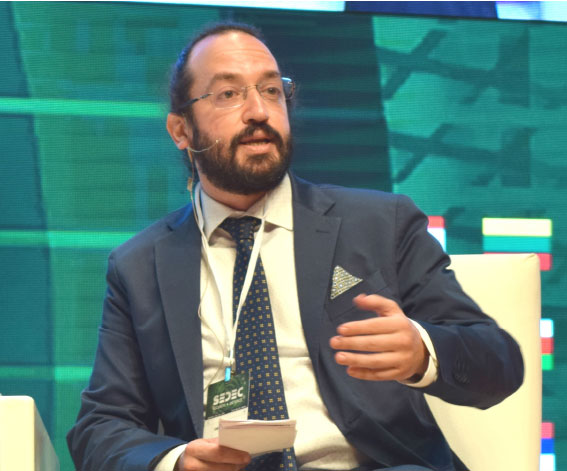
Dr. Can KASAPOĞLU: “We Need to be Geopolitically Vigilant and Responsible”
Defence Turkey: First off, thank you for giving us your time for this interview. Dr. KASAPOĞLU, let's start our interview by analyzing the current situation of the Russia-Ukraine war, which has now passed the 4th month. Many anticipated that it would end quickly, but it has been going on for a long time with no sign of an end on the horizon. Do you think that this war will drag on even longer? We are curious about your views on the opening of new fronts in the war and its spread to other regions?
Dr.Can KASAPOĞLU: Thank you very much. Now, frankly speaking, all the projections we have made in the Russia-Ukraine War show that this war is evolving towards a chronic conflict that may last for months or even years. And we have to state that this war is not a frozen conflict, but a conflict that continues at different intervals, at different tempos. There are several reasons for this. Firstly, the Armed Forces of the Russian Federation essentially implemented several operational plans in Ukraine, one after the other, and these operational plans did not bring solid results. The first one was "Armies Prepare to Fight Their Last Battle". The beginning of the operation was actually, a replica of Crimea 2014. It was for the 31st VDV Airborne Brigade, -which also intervened in Kazakhstan, - to arrive at the Hostomel or Antonov Airport Base. The plot was to move from there to the city center of Kiev which is 7-8 km away. The next step would be eventually using this airbase as a portal for follow-on operations. The master plan for the Armed Forces of the Russian Federation was to establish a pro-Russian puppet administration of their own in Ukraine through a hybrid intervention similar to the 2014 annexation of Crimea. However, that did not happen. There are several reasons behind this, why it did not occur, and definitely it is a lesson to learn for military intelligence. Firstly, we see that the Russians miscalculated and underestimated the unity of command of the Ukrainian Armed Forces’ discipline, the contribution of the Ukrainian people’s will to the mobilization efforts, and the political will of the Ukrainian leadership’s political prowess. This, of course, shows how successful the Ukrainian military reforms have been in such a short period of time between 2014 and 2022, not only in terms of equipment, but also in terms of doctrine and mobilization -especially the mobilization of the auxiliary elements called Territorial Defense Forces. In fact, we saw the aftershocks of this in Russian intelligence circles, both in the FSB and in the GRU. In both, there were very significant dismissals with the recent reshuffle.
Having failed in the Hostomel coup de main, the Russians tried something else during in the second round of operations. I prefer calling it the ‘Slavic Yom Kippur War’. It was a military geopolitical repetition of 1973. The 1973 war had the Golan Heights on one side and the Sinai Front on the other. From a technical viewpoint, it was theoretically the same war, but when you look at the operational parameters, we saw two conflicts that were moving apart from each other. The Syrian-Arab Armed Forces on one side and the Egyptian-Arab Armed Forces on the other. This is exactly how the Ukrainian war played out. The Russians failed to establish a unity of command, or rather a joint operational discipline. The Southern front and the Northern front moved on separate paths. The two fronts had their different, own destinies, with the latter failing embarrassingly.
There were various factors that contributed to the failure of the Northern Front, but let’s briefly highlight the key issues and the environment that interests the readers. We have seen that late Soviet-era armored platforms, especially due to their design philosophy, showed serious weaknesses against guided anti-tank systems. These especially included systems with top-attack features such as the Javelin, which attack the tank at a very steep angle. Drones were another challenge for the Russian main battle tanks. The combination of the lack of a separator between the autoloader and the tank’s crew and placing this autoloader right under the turret, serious vulnerabilities emerge against ammunition and top-attack weaponry. In the 1970s and 1980s, there was no Spike, no Javelin, no TB-2, but now they are all realities of the battle space. In fact, we also see that the Russians are well aware of these changes. For example, when we look at the think-tanks in Russia, their assessment regarding the Karabakh War is noteworthy. In fact, there is an assessment they made regarding the Karabakh War. They argue that the material and territorial losses of the Armenian Forces in Karabakh did not go parallel to each other. At the outset of the war, there were very serious material losses, but no serious territorial losses inflicted on the Armenian side. This was alarming for the Russians. Because we saw that the Armenian occupation elements, which used the Soviet inventory, showed serious vulnerabilities against the new generation elements’ capabilities of the Azerbaijani Armed Forces. These included sophisticated technologies such as the Israeli Spike missiles and loitering munitions, as well as the Turkish Bayraktar TB-2. This is a chronic design problem that cannot be addressed by alterations in operational art.
Some analysts claim that elements such as new generation solutions like the T-14 Armata, could be a silver bullet solution in this respect. I disagree. Along with the Armata’s design, the number of Armatas the Russians can produce in a year is also significant. Another important question is how many Armatas they can provide to their Armed Forces.
In the end, all these factors are not the only cause of the armored platform weaknesses. The Russian Aerospace Forces failed to achieve the necessary air superiority in Ukraine. Russian ground forces also suffered chronic weaknesses in urban warfare since the bitter experience in Chechnya in 1990. These all contributed to their defeat in the northern front. All in all, the northern sector finally collapsed, and the Russians had to withdraw from the northern sector to concentrate on the east. This marked a step back from the Kremlin’s irredentist Siloviki ambitions.
Of course, there are the wildcard intelligence questions that we closely monitor. That's why I characterize the northern operation as Yom Kippur. But on the other hand, the war continues in the south and east. We saw the Chief of the General Staff of the Russian Federation suddenly downsizing the target of operations. The choice to sustain the operation with the separatist regions in the east and south is important. The Russians also announced that they opened the Kiev front out of necessity. In fact, there are two critical elements we need to monitor here and that is what we also follow in the EDAM Defense Research Program. The first question is whether there will there be an amphibious operation assault against Odessa. Ukraine’s access to the Sea of Azov has been cut with the loss of Mariupol. Odessa’s fall would turn Ukraine into a de facto landlocked state. This would result in very serious consequences. Such a development would have drastic implications on the Black Sea military landscape, as well as the global food security agenda.
The Ukrainian anti-ship missile program turned out to be much more sophisticated than expected. In fact, it was a major obstacle for the Russians in Odessa. If we were doing this interview before the war, me telling you that the Black Sea Fleet losing its flagship to Ukraine would sound ludicrous. But it actually happened. Besides, there are unconfirmed reports that the Russian Federation's amphibious troop formations have serious disciplinary problems. These include an alleged mutiny in the 810th Marine Infantry Brigade of the 810th Crimean Garrison. If true, these are serious developments, and they render the prospects of a landing slim… Of course, the naval mines remain another important telltale indicator, supporting the long list of caveats.
Therefore, I do not think that such a conclusive operation against Odessa is likely in the near future. However, if there is one front where the Russian operation campaign has been successful, albeit at a slow tempo, it is the Eastern sector. In areas like Severodonetsk and Popsaasna, we see that the Russians are gradually making gains one after the other. They are progressing, even though it was not at the expected pace.
Mr. Selçuk BAYRAKTAR once tweeted, "All wars come to an end, this one will also come to an end". This is very true, since there is no endless war. But the Russians would want to start the negotiations only after maximizing their military gains on the battlefield. They would prefer sitting at the negotiation table with the best possible outcome. This means that it will be a long campaign in operational tempo, with the Eastern front being the most promising sector. Of course, for the Armed Forces of the Russian Federation, this is a big disappointment. It changes the whole picture and has both positive and negative aspects. The negative side is the Soviet Intelligence Elite that ruled the Russian Federation could easily cross the threshold of inter-state war. Up until today, we assumed that Siloviki, namely the Soviet intelligence elite ruling contemporary Russia, would keep hybrid interventions in the gray area below the threshold of war. Yet the war proved to us that they can recklessly cross it. However, given the Russian military’s performance against the Ukrainian defensive, the RAND Corporation projections are also noteworthy. Initially, they estimated that the Baltic capitals could be occupied in 72 hours, those estimates will have to be recalculated. Likewise, the war also proved that the Armed Forces of the Russian Federation are not the undefeatable monsters they are portrayed to be.
Defence Turkey: At the current stage, can we say that Russia is going to make a regional gain?
Dr.Can KASAPOĞLU: It already has.
Defence Turkey: Over the past decade, Ukraine has shown some skill in the military industry, securing extensive partnerships with countries including Türkiye. The intensive bombing devastated the city of Mariupol, one of the centers of the iron-steel and defense industries. The Ukrainian sector is now scattered, with a significant loss of human capital. No war is everlasting, as you said. The war will end. Can Türkiye help Ukraine’s defense economy recover?
Dr.Can KASAPOĞLU: Excellent question. Türkiye and Ukraine have a perfect defense industry relationship. Why? There are several reasons. First, although Türkiye was on the losing side of the industrial revolution, it did well in the emerging technologies era. Its endeavors in robotic warfare, UCAV systems, and smart solutions segments are telling examples in this respect. Tanks have been on the battlefield for 100 years, yet the Turkish Main Battle Tank is still in progress. But Türkiye's robotic warfare changed the trajectory of the Karabakh war. This is fascinating. You can't create a Main Battle Tank, but your robotic systems can help end a frozen conflict for your geopolitical partner.
The Ukraine Türkiye match marks a perfect marriage with Türkiye having the UCAVs edge, and Ukraine inherited the late Soviet-era engine technology. If Ankara tried to build such a partnership with a Western European country, it would have encountered heavy bureaucratic processes. Other challenges would include a government uninterested in cooperative technology ventures, and a defense sector protective of technological transfer. Non-NATO but Western relationships have traditionally been more helpful to Türkiye in terms of technology transfer and co-production. Some prominent examples in this regard are South Korea, Israel (the latter in the 1990s) and, finally Ukraine. So, the magic recipe for the ideal partner is: Western-oriented, but not Western continental European. Ukraine is the pattern's last example link.
In terms of (sub)systems, political will, and defense industry culture, the marriage is going well. Türkiye and Ukraine are open to production and technology collaboration. Neither side has bureaucratic impediments or a congress-like organization. Neither side has Western European sensibilities. When Türkiye sold Ukraine UCAVs, there was no guarantee they wouldn't be used in anti-terrorist operations. Turkish UCAVs were first employed in Donbass. When Ukraine sells Türkiye engine technology, it doesn't limit Türkiye's operations. You can't utilize such a pledge here. We've had the opposite experience with NATO allies. The future of this perfect union hinges on how successfully the Ukrainian military sector survives this war, but that's not the only factor. Mariupol was a heavy-industry hub. As a think tanker, I'd love to see it recover, but it's not feasible to expect that it will fully recover. Ukraine's Dnieper valley also boasts a defense industry. There were also signals of a possible invasion along the Dnieper valley, but these did not materialize, and the Ukrainian Armed Forces resisted. Besides, Ukraine's human resources are disintegrating. This is essential for Türkiye; thus, I'd like to address political decision-makers here. The Turkish state thinking mind absorbed and utilized the high-level human resources that left Nazi Germany and Nazi-influenced Europe. So, I'm sure Ukraine is being supported. Systematizing these efforts and Turkiye's ability to use human resources is highly vital, thus this will be another criterion of this perfect marriage's future. If you ask me whether I predict a total invasion of Ukraine that disrupts the Ukrainian military industry's infrastructure, I'll say no. Yes, the Ukrainian defense sector has been hurt, and we're assessing the damage. But the Ukrainian military industry will retain certain capabilities after the war.
Defence Turkey: Ukraine and Russia are important grain and wheat producers. The suspension of Black Sea ships and trade channels has caused a food crisis. The gas supply has been cut. Gas prices are rising. How would a protracted war affect the world and vulnerable economies like ours in the fall and winter? How should Türkiye prioritize its interests?
Dr.Can KASAPOĞLU: Valid question. Our EDAM defense program puts a special emphasis on this. There are several important insights. First, wheat's share of global calorie intake differs by country. Wheat per caloric intake is particularly high in weak Middle Eastern economies. Second, what I'm saying about bread and wheat goods may sound surprising, but in Türkiye, bread prices are an important political factor, especially in countries where wheat is a major caloric source, the economy is unstable, and purchasing power is low. Let me give you an illustration. This was the case after Mubarak was overthrown and replaced by the Muslim Brotherhood in the Arab Spring. The Muslim Brotherhood was overthrown by an intervention led by Sisi, and the current Egyptian regime was established. Throughout this whole process, the price of bread has never been absent from individual and family-level political discussions. Many countries, from Lebanon to North Africa, face regime change if food prices double. The social agreement collapsed. Countries where wheat intake is up to 40% per calorie have very limited purchasing power. The state's subsidy margin is shrinking due to the food crisis. Unlike Europe, this has geopolitical repercussions. Analyzing intelligence requires examining analytical factors. Türkiye also excels in this area. Nearly every day, I get asked if Ukrainian wheat can be exported through Türkiye. Since the start of the war, Türkiye has played its cards well, which is a credit to its foreign policy and politics. No other NATO member sells UCAVs to Ukraine and gives them for free under certain conditions while talking to Russia. Türkiye is the only NATO member with S-400 sanctions. Türkiye is the biggest supporter of the Ukrainian military. It's a thin line, and it's a triumph of Turkish foreign policy thus far. Wheat transportation is complicated. First of all, it is political. Russia uses this as leverage. Due to their nature, the Russian elite is skilled and prosperous. This stick won't go easily. The second issue is technical. Even if Russia doesn't provide a green signal, all sides must share intelligence concerning sea mine clearance, position, and condition during a battle. It's tough. In addition, the fact that Ukrainian anti-ship missiles are in the region is also significant. We know Ukraine has received a variety of systems, from the Harpoon to the RS-17 from Sweden. The commander has rules of engagement, even if there is a political consensus. The battleground is continuously changing, the Russian Black Sea Fleet is in the area, and cruise missiles are falling on Odessa as we speak. Even if an agreement is reached, the commanders can alter the situation due to rules of engagement. There may also be people in the Russian or Ukraine Armed Forces who aim to disrupt this work.
Defence Turkey: Do you think it is possible to open a trade corridor?
Dr.Can KASAPOĞLU: Technically, opening a corridor is possible; the primary issue is maintaining the safety of its operations. First, the Russians must promise not to launch an amphibious operation. But even in this case, this reassurance would come from an aggressor. Besides, how much General Dvornikov is bound by Lavrov's pledge is another issue. This strategic distraction, or "maskirovka", has been part of Russia's operational architecture since the Soviet Union. Technically, the corridor can be opened. Can mine-clearance operations continue? They can. Can an agreement be established with the Ukrainian Armed Forces to equip anti-ship missiles in this route and investigate the Black Sea Navy? Theoretically, yes. So technically, there's no impediment. Can these ships be escorted to British ports? Our Navy can do this. All things can be done theoretically, but all of them have their risks. One error by a Russian corvette or frigate captain might change everything. Another major concern is opening this passage without a ceasefire. So, in theory, opening a corridor is possible, but several major risks threaten its operation.
Defence Turkey: Doesn't this also apply to airspace?
Dr.Can KASAPOĞLU: Because Ukraine’s major assault revolves around air campaigns, airspace is more important. Ukraine is fleetless. As we speak, Ukrainian submarines and frigates aren't fighting Russian ones. Kiev uses its anti-ship missiles to attack the Russian navy’s assets.
Defence Turkey: While receiving over 5 million Ukrainian refugees, Western European countries are also changing their arms policies due to security concerns. Germany has a huge 100-billion-euro armament budget. We also track new European acquisitions. Where will the European armament strategy go in the future, and where will Türkiye fit?
Dr.Can KASAPOĞLU: If I had done this interview with you a few years ago, I would have said incidents like the sinking of the Moskva ship were impossible. The same would apply to me saying that the German Air Force would buy F-35s for nuclear operations. In fact, you probably wouldn't have published this interview and would have thought I was foolish. If I dreamed this, even I would probably think it was a dream. Likewise, if you told me that the NATO Response Force, the Very High Readiness Joint Task Force (VJTF), would be mobilized for the first time in a defensive and deterrence role, I would not have believed you. The German 100-billion-euro defense modernization special fund was unimaginable even for the few proponents in Berlin. The F-35 procurement issue cost the German Air Force Commander's career. So, what's next? The Ukraine war is surely an alarm. Europe's combat readiness, military presence, and defense budget plummeted after the Cold War. Ukraine's war ended that. In addition, the paradigms of practically all open-source white papers seemed problematic. Their main principle, which is characterizing the risk of war between states as low and terrorism as the principal threat, have collapsed with the Russia-Ukraine war. Geographically speaking, Russia currently occupies Europe's largest country. So, we expect an increase in defense spending and NATO to gain an identity closer to the Cold War era. Besides, let's not forget that the founding fathers of NATO probably never thought Article 5 would be implemented against a deterritorial terrorist threat after the September 11 Al-Qaeda attacks. NATO is or will be more stubborn. By the time this interview is released, the Madrid Summit will have happened. This is a "litmus test" for us too, but I think NATO will emerge from Madrid looking more like the Cold War NATO than ever. This is Europe's security situation now.
Defence Turkey: What are your opinions on the establishment of a European army, which has been on the agenda for a while, but has always remained on paper? Could a process start again with Germany taking the lead?
Dr.Can KASAPOĞLU: I'll repeat what I said in an Anadolu Agency article, because I still hold the same opinion. EU bureaucrats will continue talking about this army. You'll find French and German publications speaking about it. It will be a hot topic in critical discussions, think-tank meetings, and cocktails. But this army won't parade during your journalistic life, nor during my think tank career. Even the official language of this army, the language of correspondence is a matter of serious dispute. I am sure that many European states will not agree on this matter. I say this as someone who has worked in a few European research centers.
Besides, what can this army's nuclear deterrence capacity be? For example, whether France would be transparent about its nuclear capacities to its European allies is still the subject of boring European think-tank meetings followed by cocktails and hours of debate.
Defence Turkey: If we look back at our region, from the Sea of Islands to the Eastern Mediterranean, we discover that Greece has been arming and militarizing its islands. Recently, they've engaged Türkiye more. Greece is buying Rafale fighter jets from France and has requested F-16 Vipers and F-35s from the US. While Greece's Western-backed armament policy accelerates, NATO member Türkiye strives to fulfill national initiatives despite US and EU embargoes. We rely on imported essential technology until national projects reach a certain stage. We can't buy many important foreign technologies, it's hard to access platforms, and numerous practices slow down initiatives. After we leave the F-35 program, the Turkish Air Force's urgent aircraft need will persist until the TF-X arrives. In this scenario, the procurement of F-16 Block 70 from the US and its considerable upgrade are back on the menu. Recent months have seen the lifting of embargoes on 32 commodities with the UK, strengthening Turkish-English relations. Warmth returns. Eurofighters participated in Anatolian Eagle. There are pressing needs and national initiatives to complete. How should we proceed rationally? What should Türkiye undertake to assure the success of unmanned fighter jet projects like the Turkish Fighter and MIUS?
Dr.Can KASAPOĞLU: Greece-France connections and Greece's defense modernization is a crucial topic here. France and Greece have a myopic 'casus foederis' towards Türkiye, specifically articulated in Article 2 of this defense treaty. They act like two unreliable NATO members. The deal they signed duplicates NATO's Article 5. Türkiye and Greece share the Aegean Sea according to Article 5 of the Washington Treaty to both NATO members. When you build a 'casus foederis' in the Aegean, you jeopardize NATO’s unity in general. Presenting this 'casus foederis' within the framework of European autonomy indirectly brands Türkiye as enemies of European autonomy. This approach divides NATO. If the Russian service had requested Vladimir PUTIN to demolish this France-Greece accord, he probably would have said no since it affects NATO unity and integrity. My message to our French and Greek friends, and I emphasize the word "friends," is fundamentally different from the irresponsible rhetoric of Türkiye's mainstream war supporters. France and Greece should act properly as NATO members. Their current approach can damage the transatlantic security architecture by framing European sovereignty in an undesirable way. It also acts in a myopic anti-Türkiye manner. This is a different warning to our friends than the narratives they hear every day on Turkish TV. I'll repeat it. Article 5 of the Washington Treaty, which guarantees international military alliance in the Aegean, should be enough. Another relevant aspect here is Greece’s defense modernization. Currently, we see a breakthrough in Greece's defense modernization, especially in platforms and systems. Buying the F-35 will provide Greece with a 5th-generation system. I constantly emphasize that the F-35 is not only a 5th generation aircraft. It means 5th generation air operation capabilities. In Türkiye, the debate on this issue is focused on kinematic benefits, but the 5th generation air operation extends much beyond that. It's about data fusion, command and control. Kinematic benefits are less significant than command-and-control capabilities and software lines. Putting the emphasis on the right aspects is important. Greece has purchased the F-35 and equipped the Air Force with the F-16 Viper. Similarly, it has delivered various and extremely versatile aspects like as the 4.5-generation Rafale, and I think the weapon system configuration is as significant as the Rafale, from the Exocet missile to the Meteor missile. This is a huge technological advantage. But is it a parameter on its own? If technological advantage was a standalone criterion, the Saudi Armed Forces could have swept Yemen's Houthis. So, it is not a game changer, but definitely an input. Greece's Armed Forces are not Saudi Arabia's. They are a NATO-trained army. We have very dear friends in Greece, but this can equally be expressed to the Turkish public and to those hammering the war drums populistically in Türkiye. War between Türkiye and Greece would be a global calamity and a geopolitical disaster. Why? Because this war would be multifrontal and its extent and ramifications are unknown. Once it begins, it's uncontrollable. Imagine two armies are at war in Thrace. Air-sea battle is raging in the Aegean. Both countries have advanced forces in Cyprus, where there is no peace treaty, and a ceasefire is in progress. We haven't forgotten prior tragedies. Also, two NATO members fighting will have wider repercussions that go beyond the Aegean. If two NATO countries go to war in the Aegean, an Estonian newspaper will carry this story the next day. A Polish commander will read it in the following morning. It would be a transatlantic disaster where each party is accountable. The people who blast the war drums are not the friends of Ankara or Athens. I say this as someone who leads a defense program at a think tank that works closely with the defense industry and believes in using military force when necessary. I'm not a peace activist. I'm a realist. I believe that, when necessary, military power cures problems like cortisone. If done correctly, it saves the patient's life; but on the contrary, it costs the patient's life. Just like a competent, reasonable, well-educated doctor should prescribe cortisone, responsibly, well-educated brains who know the world and literature should formulate the use of military action. Mustafa Kemal Atatürk, the hero, creator, and commander of the Turkish War of Independence, called war murder, unless it was absolutely necessary.
Defence Turkey: So, do you think Türkiye needs an interim solution now in terms of military doctrines?
Dr.Can KASAPOĞLU: Türkiye definitely needs an interim solution. Unfortunately, the Turkish Air Force cannot continue to spend the next decade with 4th generation capabilities. If I have to be realistic, my colleagues, especially the ones in the US, tell me that the current congress will not be willing to give Türkiye even a pin. In my opinion, following Türkiye’s F-16V request, there is a demand for a package that includes guided air-to-air beyond-line-of-sight munitions. I think this is a 'tell-tale indicator'. This refers to a military diplomatic intelligence indication that can be used diplomatically to test the waters. But I see that anti-Türkiye sentiment is making a lot of money in the political environment in Congress. The Eurofighter Typhoon option came to the forefront here. Frankly, I don't want to be too precise about this. If you ask whether it is right in terms of defense economy, it is always very expensive to operate dual fighter jets. So, in terms of defense economy, it is a disadvantage. Therefore, it is a burden on the taxpayer. The Eurofighter Typhoon Variant Tranche 1s to be retired. Their flight hours are not over yet, but they are being retired early. They are retired before they have completed even half of their flight hours. So, you are not getting logistical garbage. But if you look at the weapon system configuration, it is not possible to say that it will satisfy the Turkish Air Force. Moreover, the national munitions that Türkiye has integrated / plans to integrate into the F-16s, and whether or not this is possible, is up to Türkiye's military diplomatic capability. Remember that the Turkish Air Force is a combat Air Force. I know that the Turkish Air Force is an air force that simultaneously bombs both PKK and ISIS targets, while flying combat air patrol missions in other sectors. Besides, while it performs interception missions, it is also sent to NATO Air Policing missions. There are very few air forces in the world that can do this. So, the weapon system configuration must satisfy the Turkish Air Force in the case of war. This should be the case, even if our allies might have politically motivated criticisms against it in some cases. On paper, assurances and technical considerations are not enough. Therefore, the ideal situation for Türkiye would be to carry out the F-16 V modernization as an interim solution and return to the F-35 program. Let's explain this situation with a medical analogy. When starting a treatment, the first principle is not to harm the patient. So, for example, buying the Su-35s as an interim solution would trigger the second round of CAATSA sanctions in a very severe way. This would mean harming the patient. While the Eurofighter Typhoon is not an ideal solution, it relatively better than the Su-35 purchase in terms of defense economics. Here, we should note that the implications of Türkiye’s S-400 purchase were probably ill-calculated from the beginning.
Defence Turkey: How do you rate the S-400 acquisition process? After the first system arrived, the second was optional, and no decision has been made. What will this process necessarily involve? A Türkiye that balances and reapproaches with the West, or one that buys new systems?
Dr.Can KASAPOĞLU: This may offend some individuals, but it shouldn't because I have Türkiye's national interests in mind while saying this. I know people who took this incorrect decision love Türkiye as much as I do. So, I suppose that their action was solely guided by a flawed analytical framework. I am the head of a think tank's defense program. I was raised in this country's military institutes, where I received my academic title. Whoever loves their country most executes his job best. My responsibility is to offer an objective image to decision-makers. First, constructing a SAM-based air defense architecture for a country of Türkiye's size makes no sense. It does not make sense even if this air defense system is perfectly compatible with Türkiye's radar infrastructure. Türkiye is not Singapore or Taiwan. SAM systems are necessary, but a SAM-dominated air defense architecture can't be installed everywhere. Türkiye's topographical and geographical limitations render a SAM-centric air defense architecture not feasible. This is not my assertion; the most authoritative people in Türkiye have indicated the S-400 would be stand-alone. A stand-alone strategic SAM system is like hot ice and cool sun in military literature. I've seen statements concerning the S-400 in the Aegean. These statements raise one inquiry. Over which data link will the S-400 batteries communicate information with the F-16s performing combat air patrol missions in the vicinity? In which circumstances will the Peace Eagle and AWACS planes be used, that will carry out intelligence duties in the event of a war or escalation? These questions have nothing to do with Türkiye's political views. Will AWACS planes deployed in the region for combat air patrol missions or interceptor flights communicate information with the S-400 in real time? If not, you'll foster friendly-fire incidents. What will you do? Will you construct kill boxes without combat air patrol missions? How much risk will you take by flying our planes in this region? What will the SAM configuration be for S-400 batteries? What measures will you employ to protect S-400 batteries from adversary SEAD/DEAD actions if there is no SAM configuration? How will S-400 systems communicate with other units? This is also a simple and valid question. All of these are non-political questions. When I asked these questions, I didn't mention anti-imperialism, NATO, or US Data connectivity and SAM configuration. They are free from political appropriations. If you would provide me with a scenario where Türkiye buys Sa-17s, Pantsirs or the Nebo-M anti-stealth radar from Russia with the S-400, I would again pose questions related to logistics and defense economics. Even though it would make a meaningful configuration, the economics question still would persist.
You'll buy a second battery, all my questions will still be relevant, and you'll trigger CAATSA sanctions round two. So, an accurate cost-benefit analysis is needed.
Defence Turkey: Let me ask one more question here about the S-400. What do you think the resolution will eventually look like?
Dr.Can KASAPOĞLU: As you know, the Defense Minister referred to the Cretan model. What Türkiye is proposing is a semi-Cretan model, because Greek S-300s are held in Crete at a low combat readiness level, or storage level. The Cretan model’s first pillar is low combat readiness and no active deployment. Secondly, it would require keeping S-300s at a non-functional NATO base, like the Greek – Israeli exercises. Keeping the S-400 on a NATO-defined base or allowing NATO drills would cause a problem like CAATSA in Türkiye-Russia ties. The semi-Cretan model refers to storing the S-400 in a warehouse without combat deployment. A solution? A time machine could help. Because it was a time sensitive decision. It was a decision to be taken before the National Defense Authorization Act, the precise and irrevocable wording on the S-400 and the CAATSA sanctions. If Türkiye had kept the S-400s in storage in the way Greece kept its S-300 in Crete, it may have been a solution. The proper measure must be taken at the right moment.
Defence Turkey: We've had disputes with Greece and the Greek Cypriot Administration of Southern Cyprus over natural gas and oil drilling in the Eastern Mediterranean. Recent rapprochement and friendly communication with Israel are also seen. How can this reconciliation help Türkiye? Talks with Egypt are also progressing. What's the plan?
Dr.Can KASAPOĞLU: We shouldn't blindly criticize Türkiye’s foreign policy. When certain actions are right, they are right. Turkish foreign policy should follow the steps that you have just mentioned. Besides, Türkiye-UAE and Türkiye-Saudi Arabia ties are also making progress. Turkiye will suffer more from battling these countries than from making peace. We need to be geopolitically vigilant and responsible. Israel was a very important defense partner of Türkiye in the 1990s, with collaborations ranging from the F-4 modernization to, -if I remember correctly-, a Turkish M-60T tank. When ISIS struck this tank in Bashiqa in Northern Iraq, the tank personnel, thank God, these sons, these very precious sons of our country were not martyred. They are alive because this tank had a reactive armor on it, made possible through this joint modernization.
Türkiye also reached an agreement with Israel to co-produce the ARROW ballistic missile defense system. If this co-production deal existed, Türkiye would have gotten a non-NATO, western system. The tech transfer would have surpassed the American-European systems, Patriot and Eurosam. It would have exo-atmospheric intercept capabilities that Patriot and Eurosam lack, which is essential for a military giant with WMD programs. Even if the warhead or missile is intercepted 100% in endo-atmospheric interception, you cannot avoid fallout if the warhead contains WMD. This isn't science fiction. We have seen incidents of chemical warfare right at our doorstep, in the Syrian Civil War for years. Türkiye now has another major battle tank project. They weren't off the shelf purchases. For Türkiye, this was a crucial development. But will Türkiye-Israel defense ties return to their honeymoon phase in the 90s? We're not there yet.
The history and developments in these relations affect both sides, and I don't think the political-military relationship will immediately return to the 1990s. Yet, the improvements are a positive development that should be supported. In Saudi Arabia and the UAE, I see a defense export opportunity: US weaponry dominated the Saudi market, with a market share of 70-80%. Yet because of the hardships and bureaucracy involved with purchasing US drones, the Chinese have taken over the market. Even with the Ibrahim Accords, Saudi Arabia has trouble buying weaponry from Israel. If Türkiye-Saudi Arabia relations were on good terms, Türkiye's systems would have been superior to Chinese ones. Türkiye also offers a wide portfolio. For example, for maritime patrol missions, you can purchase the AKSUNGUR drone. Additionally, you can opt for the combat proven UAV asset, the BAYRAKTAR TB-2. AKINCI would also offer a strategic alternative. But China offered Saudi Arabia joint production and facilitated regional trade. China also has a big influence on the UAE drone business, as you know. Türkiye would have offered better terms. If the bilateral relations weren’t sour, these things would be conceivable.
I still think these reconciliations will open a market because the UAE has never stopped defense imports from Türkiye, even under harsh circumstances. I see substantial market prospects with a wide range of solutions, as we saw on display at SEDEC.
Defence Turkey Sweden and Finland applied to join NATO in response to the Ukraine-Russia war, but Türkiye vetoed. Türkiye will block Finland and Sweden's NATO membership applications because of their pro-terrorist stance and arms embargoes. Europe and America also maintain embargoes. There’s a NATO summit coming up in Madrid. Do you anticipate that parties will make policy concessions soon? Do you expect a smooth campaign? Can the NATO summit provide some quick results?
Dr.Can KASAPOĞLU: I'll do something unusual here, because I know that Defence Turkey will publish what I say word-for-word. Let’s remember the 23-year-old Necmettin Yılmaz, 23-year-old Aybüke Yalçın and 15-year-old Eren Bülbül. The cumulative age of these three children is 61. This is less than the average life expectancy in Sweden, which is 82. I make this statement as someone who worked as a scholar at two NATO institutions. I say it as someone who believes in NATO's mission and its importance to Türkiye's national security, and as someone who is supportive of it. So long as Eren, Aybüke, and Necmettin's ages stay 20 years below the average life expectancy in Sweden, which won't improve since they were murdered by the PKK-YPG, you can't convince any Turkish family to send their son to the army to defend Sweden under Article 5. No Turkish officer, NCO, or sergeant will risk their lives for Sweden's security under these circumstances. Through you, I’d especially like to address Sweden and its diplomatic mission. It’s you who will have to change, not Türkiye. This is my answer; I won't elaborate on the technical details and conclude here.
Defence Turkey: Dr. KASAPOĞLU, thanks again for your detailed analysis and in-depth conversation. We look forward to talking with you again. Your insight on unfolding complex geopolitical decisions is appreciated, and we’ll be here to share how it all trickles-down through the Turkish defense industry and its global implications.