Anti-Ship Cruise Missile Systems
This article is based on the presentations of ROKETSAN Naval & Cruise Missile Systems Manager Dr. Yiğit Koray GENÇ at the 10th Naval Systems Seminar held in Ankara on November 15-16, 2021, and the 9th Air and Avionic Systems Seminar held in Ankara on June 2-3, 2022.
“Cruise missiles are guided systems that sustain flight by using aerodynamic lift over most of their flight path and thus can reach extended ranges. In other words, they fly with the "lift force" generated by their wings, just like airplanes. They also feature a propulsion system. Cruise missiles are equipped with multiple advanced navigation systems enabling them to follow a preprogrammed path and altitude determined before firing. In other words, you can plan waypoints on the map for the cruise missile to pass through until it reaches its target before launching the missile. Cruise missiles also can carry large warheads. The fact that they use aerodynamic lift force is a plus in this sense. They can navigate over long distances. One of the most important features of cruise missiles is that they can cruise at low altitudes. The main reason for flying at low altitudes is not to be captured by the radars. By using the topographic elevation changes and remaining outside the detection range, it can bypass certain areas, and thus its detection can be avoided with your mission planning. If you make an appropriate route and altitude plan, enemy elements will not be able to detect them easily. Therefore, such systems are quite difficult to detect and defend against.
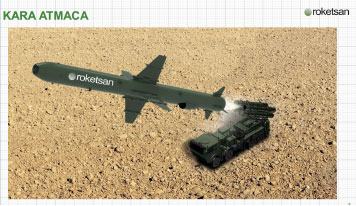
When we say cruise missiles, it is possible to make a categorization according to the platforms they are launched from. They also have versions which are launched from a ground platform. There are also versions launched from the air platform, the sea platform or from the submarine. What you see in the slide is the Stand-Off Missile (SOM), one of the cruise missiles in ROKETSAN's product range, an example of a cruise missile launched from an aircraft or from an air platform. ATMACA Cruise Missile is an anti-ship missile. It can be launched from naval platforms and there is also the KARA ATMACA Missile System, which is designed to be launched from ground platforms and used against land targets.
As you can see in the picture, there are versions of the SOM Missile suitable for use in F-16s and F-35s. The ATMACA Missile has recently been tested successfully and has become a well-known system. As you know, this is a qualified system and attracts great interest not only in Türkiye but also abroad. Currently, the serial production activities are in progress. The system we call KARA ATMACA Missile is also a system that has been developed suitable for launch from the ground by using some of the technologies of the ATMACA Cruise Missile and is equipped to perform its role by identifying the geography on the land. It is suitable for launching from both mobile tactical wheeled vehicles and stationary platforms. If we classify cruise missile systems according to their speed, we can basically classify them under three groups; subsonic, supersonic and hypersonic, apart from the platform they are launched from. Subsonic systems are slower than the speed of sound. They fly at speeds below Mach 1. Supersonic systems are the ones that fly at the speed of sound, between Mach 1 and 5, and hypersonic systems fly at speeds above Mach 5. On the left of the slide, there is the Brahmos Missile, which is a Ramjet-powered cruise missile; on the right the Brahmos II Missile, which is a Scramjet-powered system and can be shown as an example of the supersonic and hypersonic systems.
Cruise missiles first started to be used during World War II, and the German V-1 Cruise Missile is known as their ancestor is. The V-1 missile, also known as the first operational cruise missile, did not have the ability to fly at low altitudes due to the technological possibilities at that time. The V-1 Missile, which could not fly at low altitudes, was nearing its target by following a fixed flight path, and you know, the pilots of the British Army approached these V-1 missiles and touched the tip of the wings of the missile, destabilizing it and causing it to fall to an undesignated point. Therefore, if the cruise missiles of that period were capable of flying at lower altitudes, of course the technology of that day did not allow this, the results could have been different in terms of effectiveness.
The most important feature of cruise missiles is the ability to operate under all weather conditions. They can be used against stationary/moving ground and surface targets. They are suitable for carrying nuclear, chemical, and biological warheads. As I previously mentioned, their carrying capacity, useful load carrying capacity, is quite high. They allow for mission planning. In other words, three-dimensional mission plans with all parameters can be made with such missiles, not only by firing from one point to another, but also by planning the route through which you want it to reach its target and at what altitude. They have high maneuverability because they are aerodynamic-controlled systems. You can plan the trajectory of a cruise missile, as you can see in the slide, when fired from a point, the missile can reach its target by passing through certain points we define as "waypoints". Between these points, it can make plans in areas where there are enemy air defence elements, in a way that it will bypass them without passing over them or over the area of influence. Through Data Link communication, you can change the missile's target during or after its launch. If you have detected a higher priority target, if you have received such target information, you can direct it to target B instead of target A while the missile is still in the air, and you can change its route. You can abort the mission, and you can even destroy your missile in mid-air if there is such a need. With the autonomous navigation feature, there is now a process that takes place as autopilot in accordance with the mission you initially planned. Thanks to its autonomous navigation feature, the missile reaches its target by flying as per the identifications you have made. They also have low radar cross-sections. Although they fly at low altitudes, it is possible to reduce the radar cross-section of missiles by coating certain areas with radar absorbing materials, and to reduce their detectability by radars with material technologies. These are the solutions implemented on cruise missiles.
These systems are generally capable of flying over long ranges, as they have a liquid-fueled turbojet or turbofan engine. You already know about their fly at low altitudes. Thanks to their high navigation and precision engagement, they can reach their targets with high accuracy (a few meters) and destroy them with a high level of precision.
Let me detail the "operational use" that I previously mentioned. In mission planning, it is possible to plan outside the enemy's territory. As you can see in the slide, we have the launcher platform at the top. There is the Archipelago and an area with a certain radar element in the back and targets behind it. When you look at alternative routes here, there are green lines or they may be diversified, these are just examples, you have the opportunity to plan a mission similar to the one here. If you want, you can direct your missile behind the islands, which is preferable as it will provide an advantage in terms of not being captured by the radars. Or you can also direct them over an island, over a land area. While navigating at low altitude, if you want the missile to pass over the island ahead of it, it can scan the island surface and, when it reaches the sea again, it can redescend and navigate. Prior to the terminal phase, that is, before reaching the target, the cruise missile conducts its midcourse phase. Here, it cruises from surface to high range. If it is a sea-like environment, these systems are capable of navigating at the height of 5 meters above the surface of the sea. While passing over the land "hit zones" (areas at risk of collision due to altitude), you can pass over the land area with a precision of 100m – 200m as you can identify. You can control it too. This is a matter of having the area map and elevation map.
I mentioned earlier the target update and mission update capabilities with Data Link. Cruise missiles have a re-target feature. When the missile approaches the target, if it cannot detect its target in its first round, that is, if it cannot detect its target at the time of the first approach, the missile completes a turn after passing over the target coordinates, thanks to the re-target capability that you will define in the mission planning, and performs its search again to reach the target you have defined in the same region. In other words, there is no such thing as "missed" and "passed". If such a situation occurs, it can turn from a point ahead and start searching the same target again. So, this gives you a chance to hit the target again. Mission abort is also always possible. If you have a data link, you can do this anytime you want. When we look at the cruise missiles in terms of their technological level, if we want to make a correct classification of the propulsion systems known in the literature, they can be classified as shown here. Basically, as you can see on the left, it is possible to group them as air-breathing engines and rocket engines. The rocket engines, on the right side of the slide, are chemical-fueled engines, among which there is a categorization as solid fuel engines, liquid fuel engines, and hybrid engines. There are also the engines with nuclear fuels, fusion reactors and radioactive isotopes, and electric engines. It is possible to group them as electrothermal, electrostatic and electromagnetic engines.
Cruise missiles mainly use the engines in the group called air-breathing engines, which are seen on the left side, and in the group called ram type. Solid fuel engines, on the other hand, are needed only for "boost" to be used in terms of initial acceleration. In cruise missiles, solid fuel engines are generally used at the time of first launch. The first group in air-breathing engines is gas turbine engines. Engine types such as Turbojet, Turbofan, Turboprop, and Turboshaft are all in the gas turbine engines category. Ram-type engines can be grouped as more advanced technology-type engines, and technology is evolving towards this point. Ramjet and Scramjet type engines, which allow flying at very high speeds, are also in the group of air-breathing engines.
In cruise missiles, as I mentioned earlier, solid and liquid-fueled engines are used together. Examples of the most used propulsion systems are shown on the slide. Ramjet, Turbojet and Turbofan engines. The working principle of these engines is that the atmospheric air taken from the inlet in the front of the engine is compressed and squeezed with a compressor, then it is sent to the combustion chamber and mixed with the fuel in the combustion chamber, where a kind of high pressure is obtained by the explosion of the high pressure. The high pressure is sent to the rear from the nozzle, causing the turbine blades to rotate and high-pressure hot gases are released from the nozzle at the back. Here, by driving the turbine, the shaft in between is driven and the energy required for the use of the compressor is obtained.
In addition to Turbojet engines, there are also Turbofan engines used in cruise missiles. These are the engines used in passenger aircraft. It has a mechanism with a large fan in front of the air intake and a combustion chamber, turbine, and exhaust part at the rear, similar to the Turbojet engine. The difference is that it will allow the air coming from the air intake to be pressurized a little more in advance by means of a fan. In other words, it increases the pressurization of the air coming from the air intake, but it also has some disadvantages. The front part where the air intake is located is larger than the Turbojet engines. Therefore, as you want to minimize the drag coefficients in systems that you want to fly at very high speeds, the preference is a bit more in favor of Turbojet engines. When you look at the air density at altitudes where only cruise missiles will be used, it can be said that Turbofan engines are more advantageous at higher altitudes. Because at high altitudes where the atmospheric pressure drops, they provide additional pressurization of the air coming from the outside compared to the Turbojets. Turbojet engines are generally used in systems with ranges up to 500 km. They can also be used in Transonic and Supersonic systems. They have relatively higher fuel consumption than Turbofans. Turbofans, on the other hand, are mostly used in subsonic systems. The Ramjet engines, which we have just mentioned, have a different working principle. As you can see here, there are no rotating or moving parts in ramjet engines. Ramjet or air-breathing jet engines do not operate with moving components such as compressors or turbines. They use a specially shaped intake passage called 'diffuser' to compress the air drawn from the forward motion for combustion. Ramjets ignite the fuel at subsonic speeds. This creates self-sustaining combustion, and supersonic flight is achieved. Since Ramjets rely on the forward motion of the craft to produce thrust by converting the high-velocity air (ram air) into static pressure, they produce no thrust when stationary. Thus they require an assisted take-off like a rocket assist to accelerate them to a speed where they can produce thrust. It is possible to call Scramjets as a slightly more advanced version of Ramjets. It is possible to reach Hypersonic speeds with Scramjets. Also, fuel ignition occurs at supersonic speeds in these systems.
If we talk about guidance technologies, cruise missiles can use several guidance methods together. One of the main features of cruise missiles is that they can use not just INS, GPS, or just terrain reference but almost all of today's navigation technologies together. Therefore, they are equipped with an Inertial Measurement Unit (IMU) and an Inertial Navigation System (INS), which, as you know, consists of gyroscopes and accelerometers that are used to estimate a platform's current position as long as the initial position is known. These systems try to find their altitude by constantly measuring their distance from the Earth with the altimeter on them.
To fly at low altitudes (such as 50m-100m), the cruise altitude must be calculated precisely, and radar and barometric altimeters are used for this. The barometric altimeter determines the altitude by measuring the air pressure. The radar altimeter sends RF waves toward the ground and measures the distance from the reflected signals. The time lapse between transmitted and received signals is then used to calculate the height above ground level. The autopilot is active from the very beginning to the end of the flight. It collects all this navigational data throughout the flight, compares it with its mission planning data, and adjusts its speed and altitude according to when and where it needs to be. They can also benefit from all known satellite navigation systems such as GPS, GLONASS, and Galileo. Cruise missiles receive data from the satellite with the help of a GPS (Global Positioning System) receiver and try to detect the differences by calculating their own position instantly. They also compare topographic contours. TERCOM (Terrain Contour Matching) and DSMAC (Digital Scene-Matching Area Correlation) are the two most known methods. As you can see in the picture, TERCOM uses a pre-recorded contour map of the terrain that is compared with measurements made during the flight by an on-board radar altimeter. Therefore, cruise missiles can still navigate by using these measurements. As you can see in the slide here, you can load a digital elevation model of the area, like a DTED (Digital Terrain Elevation Data) file, to the missile before firing. Therefore, the missile can determine its flight path by taking into account the pre-recorded waypoints it will follow, and the elevation changes it will encounter during the flight. In the DSMAC method, you upload the satellite photos of specific points or the region where the missile will navigate to the missile beforehand. During the flight, the missile constantly tries to find its own position by comparing the images it takes with the camera on it with these uploaded photos. This method is used in the terminal phase. Similarly, you can also upload pictures of the target to the missile. Of course, cruise missiles use the DSMAC method in addition to all other navigation methods/equipment they have. Therefore, cruise missiles can use all these guidance methods, which include different technologies, at a very high level.
Each cruise missile features a seeker head. When they approach the target, the seeker, which we call "Homing Guidance," is activated during the terminal phase. Basically, seeker systems detect possible targets based on their main characteristics. These can be radio frequency, infrared, laser reflections, and different energy sources such as sound or visible light. Seekers detect different sources and characteristics such as these to orient the munitions to the target. You can see examples of radar seekers in the picture. They can be grouped as active, passive, or semi-active seekers. If you ask what these are, active radar homing means that the missile transmits radar waves with the active radar seeker in its nose. The radar waves hit and reflect from the target. Then the missile continuously tracks the target's position by picking up the reflecting frequencies. Therefore, there is an active transmission. In passive guidance, on the other hand, the missile does not broadcast but only receives radio frequencies. Passive seekers feature only a receiver but not a transmitter. Therefore, when the passive homing missile approaches the target area, it listens to the radio waves emitted by the target and heads towards it. Passive Seekers do not emit radio waves. Thus, they are harder to be detected by hostile elements than active ones. Since passive seekers do not transmit, they only listen to the radio waves emitted by other sources. But of course, they have their advantages and disadvantages. If you want to destroy a non-emitting source, then you have to use RF (Radio Frequency) yourself. In that case, active seekers are more advantageous. There are also the semi-active guided seekers. In semi-active homing, your missile still does not have a transmitter, only a receiver, but one of your other platforms uses active radar to illuminate a target, and your missile follows the radar echoes from the illuminated target.
If we talk about the ATMACA Cruise Missile System in terms of previously mentioned technologies and components, the ATMACA is a naval cruise missile with a range of over 220km. It features high precision, fire-and-forget, fire-and-update, simultaneous time-on-target, designated time-on-target from different platforms, or salvo firing. ATMACA Missile consists of an RF seeker in the nose, the warhead behind it, guidance section, fuel system, turbojet engine, Control Actuation Systems CAS), and the booster. ATMACA uses our own active seeker. It is designed to find naval targets, can work in all weather conditions, and resist countermeasures. The warhead contains 88 kilograms of TNT equivalent high-explosive charge (the total weight of the warhead was declared as 220kg). Therefore, its destructive power is extremely high. When the warhead detonates, it disperses metal fragments with explosive force and causes massive damage to the targets, thanks to the penetrating effect of these fragments. The warhead is insensitive; it can withstand inadvertent/accidental combustion, ignition, and explosion. It also features delayed or non-delayed detonation modes. In other words, you can choose whether it should explode as soon as it hits the target or later after the missile has penetrated the target. If we want to hit a surface target, the missile can be set to explode as soon as it hits the vessel or after traveling a little further inside after piercing its deck. The Guidance Section consists of an inertial navigation system, global positioning system, barometric altimeter, and radar altimeter. In this way, ATMACA can navigate with high accuracy. It has a fuel system and liquid fuel tanks on it. These fuel tanks are filled during the production of the missile. It can be preserved in its current form throughout its shelf life. Liquid fuel provides the energy needed for long-range flight.
ÇAKIR New Generation Mini Cruise Missile Family was developed with ROKETSAN's own resources. It includes almost all of the technologies I mentioned before. ÇAKIR can be launched from all types of aircraft, as well as land and naval platforms, and offers operational versatility against land and surface targets. ÇAKIR can engage targets with high precision under all weather conditions and has a modular structure that allows carrying multiple payloads. It can also perform swarm attacks. The swarm concept enables multiple missiles to share information with each other throughout the flight during a coordinated attack/engagement scenario. Considering that we achieve this with an 'M' number of missiles, it is possible to consider them smart attack systems. The ÇAKIR New Generation Cruise Missile Family consists of the ship-based anti-ship ÇAKIR AS (Anti-Ship), the ÇAKIR SW (Swarm) with swarm attack capability, the conventional air-launched cruise missile version ÇAKIR CR (Cruise), and the ÇAKIR LIR version carrying the Electronic Warfare (Signature Augmentation Subsystem/SAS) payload. The ÇAKIR cruise missile is 3.3m long, weighs approximately 275kg, has a diameter of 275mm, and has a range of 150km+. It features almost all navigational capabilities for mid-course guidance, including Inertial Navigation (INS), Anti-Jamming GNSS, Radar Altimeter, Barometric Altimeter, and Terrain Referenced Navigation (TRN). In terminal guidance, ÇAKIR uses Imaging Infrared (IIR), Radio Frequency (RF), and Hybrid (IIR+RF) Seeker.
The ÇAKIR Missile has 'super sea-skimming' capability (flying very close to the surface) and high hit accuracy (CEP <3m). In this way, the missile can fly at 5m above the water surface and even descend up to 3m while flying over the sea. As you know, our ATMACA Cruise Missile already has this capability.
We have just talked about the working principles of Turbojet Engines, which is also used in ATMACA. A turbojet engine works by compressing air with an inlet and a compressor, mixing fuel with the compressed air, burning the mixture in the combustor, and then passing the hot, high-pressure air through a turbine and a nozzle. Before the liquid-fueled turbojet engine is ignited, the missile is first launched with a booster. A booster is a solid-propellant rocket that helps the missile to reach very high speeds in a very short time during launch. After the turbojet engine is activated, the booster motor is dropped with the 'Stage Separation System' and falls back to sea. The missile continues its flight with the turbojet engine after the booster is separated. The Aerodynamic Control Actuation System allows the missile to move up, down, or sideways inside the desired trajectory during the flight by controlling the wings according to the movement commands sent by the autopilot.
Today's technologies are using such features to the fullest. However, there are several points where these will evolve in the future. The concept of swarm attack is in question. You know, this is the subject of several domains, it is also a subject in drones. It is also on the agenda for cruise missiles. It is about sending more than one missile to a region by dispersing it to undertake certain tasks. They will be able to fly at much higher speeds. Systems such as the Ramjet and Scramjet we talked over are now systems that have evolved to support flight at much higher speeds, at hypersonic speeds. Thanks to their much lower radar cross-sections (RCA/RCS) and high speed, their detection will take longer, and they will not be captured by air defence systems. If you can reach speeds below the reaction times of the air defence systems, you can reach the target before the air defence system acts against you. For delayed detection, you must either follow a trajectory that will allow this, or the missile must have such an aerodynamic structure that it can be captured by enemy radar elements only in the final stages of flight. If you are captured at that point, the response times of the systems will not prevent you from meeting the target.
These systems I mention here are hypersonic systems. We can define them as systems that combine the high-speed capability of ballistic missiles with the high maneuverability of cruise missiles. Therefore, they are called "game-changing systems". Hypersonic systems are systems that can perform agile maneuvers at altitudes and speeds unpredicted by traditional defence systems. It gives you an asymmetrical attack advantage over targets at very long ranges, threats that require quick reaction. As I mentioned earlier, the speed of hypersonic systems is faster than five times that of sound. They are categorized under two main groups. Air-Breathing Hypersonic Vehicles and Glide Vehicles. According to their mission profiles, these are systems that can be launched from the surface or from an air platform.
Air-Breathing Hypersonic Systems have features such as high speed, high maneuverability, using a Scramjet type engine, reaching strategic targets in very long distances in a short time, and being launched from the surface or from the air. As you can see in the image, there is an Air-Breathing Hypersonic System dropped from a combat aircraft. The missile is released at supersonic speeds, accelerated by the external booster; when it reaches the separation point, the booster is dropped, the missile performs hypersonic flight, and finally, the missile dives into the target during the terminal phase with a steep maneuver. If we count all the steps, there is target detection, reaching the required speed and altitude (I mentioned that this is necessary for the engine to run), separation of the missile from the launch system, Scramjet ignition, hypersonic flight, mid-course guidance and terminal phase dive to the target. This is also the same case with the other Hypersonic Systems, which we call the Gliding Vehicles. High speed and maneuverability are the main features of these systems. They can also be launched from the surface, land, or air. Their speed can reach around 1,500m/s, and some systems are believed to reach up to 7,000m/s, which means between Mach 5 and Mach 23. As you know, reacting to these speeds by an air defence system is extremely difficult in today's technologies. We are talking about extraordinary speeds like Mach 23. If you ask how these systems achieve this, they are actually transported out of the Earth's atmosphere on a rocket such as ICBM (Intercontinental Ballistic Missiles). These Gliding Vehicles reach extremely high speeds while entering the atmosphere. They are also exposed to extreme temperatures during reentry. Thus Gliding Vehicles feature heat shields that prevent them from burning when entering the atmosphere. These systems can change their altitude by gliding at hypersonic speeds to make it harder for air defence systems to predict their flight path and intercept them. If we look at the main operational steps of Hypersonic Systems, they can be grouped as target detection, reaching the desired speed and altitude, separation of the missile from the launcher system, orientation correction, atmospheric entry and ascending maneuvers, gliding, trajectory control, and terminal phase.
In summary, Cruise Missiles -their history goes back to the Second World War- continue to advance by incorporating new technologies every day, and they will be among the vital needs of armies in the future. The main features and concepts that we will see in the upcoming period in Cruise Missiles, as I have just explained in detail, will be the higher speed, higher maneuverability, lower detectability and swarm attack.
Q&A Session
In the Q&A session held after the presentation, ROKETSAN Naval & Cruise Missile Systems Manager Dr. Yiğit Koray GENÇ, in response to a question about whether the Supersonic Cruise Missiles are on ROKETSAN's agenda, he said, "Due to the course of such systems, in fact, similar concepts should be on the agenda in our country. There are studies on the roadmap related to this."
GENÇ answered a question about whether the Cruise Missiles could be launched from the National Vertical Launch System (VLS), which ROKETSAN continues to develop, as follows: "In fact, we always have a compelling interest in bringing together both, that is, both missile and launchers. Therefore, we are trying to advance the design studies in this direction by considering all necessary interface adaptations for use on these systems as well."
GENÇ, in response to a question, stated that they are working on versions of ATMACA launched from submarines and that in this concept, the missile will be released from a capsule.
GENÇ also answered a question about the range of the Cruise Missiles developed with national resources and whether they are subject to regulations such as ITAR and MTCR: "There are limitations in international regulations such as ITAR and MTCR. In fact, we follow the same course as the other countries that are subject to the conventions. The long ranges we are talking about are 250 km – 280 km. The important thing here is to have high accuracy and, more importantly, make the missile less detectable and harder to intercept (low observable). In fact, when we look at the road maps, we see that the capabilities of the missiles have been developed in this direction in accordance with the agreements. Therefore, many of the systems I mentioned earlier as long-range systems actually have similar ranges, such as 250 km – 280 km