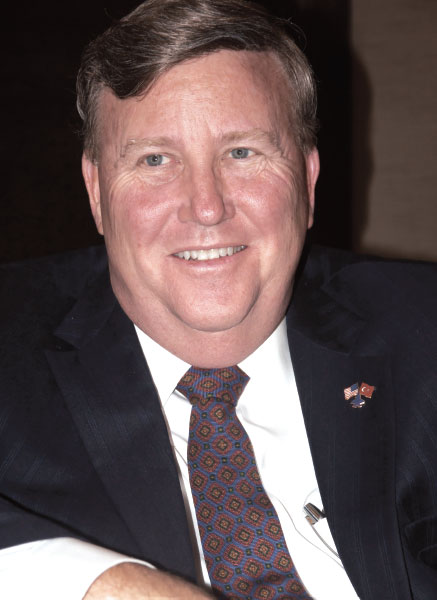
Edwards: “MEADS Could also be an Excellent Solution for Turkey’s T-LORAMIDS Requirement”
Defence Turkey: As the Executive Vice President and most senior leader of Lockheed Martin’s Missiles and Fire Control (MFC) business area, what is the most challenging task you face in your assignment?
Missiles and Fire Control is an organization of more than 16,000 people who work in locations around the world and who have a very diverse set of talents and skills. What they have in common is that they are all very dedicated to our customers’ missions, regardless of where they work or what they do. One of my most important responsibilities is to provide our employees with clear objectives that align to our customers’ priorities. Our company is known for performance excellence and it is my responsibility is to ensure that our programs and people continue their record of meeting all commitments for the products and services of Lockheed Martin Missiles and Fire Control.
Defence Turkey: The Medium Extended Air Defence System (MEADS) is conducted by responsibility of Lockheed Martin (US), MBDA (Germany), MBDA (Italy). Within the scope of development program, what is the latest status of test phases?
MEADS has successfully completed a demanding series of demonstrations and tests and has completed three successful flight tests. In July, MEADS demonstrated unique capabilities to network with other systems and radars, share a common integrated air picture, dynamically match interceptors to targets, and to move workload among battle managers. During a radar demonstration in August, MEADS demonstrated capabilities to track and cancel jammer signals; performed search, cue and track in ground clutter; and successfully classified targets.
We expect MEADS to transition into planned follow-on programs in Germany and Italy that will move it into production. Only MEADS fully addresses Germany’s stated requirements.
As a demonstrated system entering a new contract phase, MEADS could also be an excellent solution for Turkey’s T-LORAMIDS requirement. MEADS is a transatlantic development planned with participation of national industries, and it offers tremendous export potential as nations look to a new generation of air and missile defence systems.
Defence Turkey: The Undersecretariat of Defence Industries (SSM) have extended the deadline for proposals for the T-LORAMIDS programme to the end of 31 December 2014. Do you have revised a proposal covering joint production, technology transfer and cost-effective options?
Team USA extended our bid until 31 December 2014. Our offer contains substantial industrial cooperation, to include co-development projects.
Defence Turkey: Turkey has been preparing to commence indigenous Long Range Air and Defence Missile Program under the responsibility of Aselsan and Roketsan on coming period. What is the Lockheed Martin approach to this program?
If the Turkish indigenous effort does proceed and is open to participation by foreign firms, Lockheed Martin would be interested in exploring a partnership role with Aselsan and Roketsan. We have experience in similar programs and can offer technical expertise that will help reduce risk in the program.
Defence Turkey: The Undersecretariat for Defence Industries (SSM) was given the authority to reorder the first two F-35A aircraft with a Block 3F configuration within the coverage of the Low Rate Initial Production (LRIP 10) on May 2013. Roketsan, SSM and Lockheed Martin work on modifications to the integration of the Stand-off Missile (SOM) for the internal carriage F-35 weapon bays under SOM-J program. Could you please inform us about the program schedule of modifications for the integration of the SOM cruise missile to F-35 JSF?
Certification efforts have already begun to enable the SOM missile to be integrated onto both Turkish Air Force F-35 Lightning II and NATO allied F-35 aircraft. Integration is expected to be completed in 2018, in line with the F-35 Block 4A schedule.
Defence Turkey: Do you have any plan about marketing of SOM (export version) cruise missile with Roketsan to 3rd Countries and potential clients?
At this time, we are focusing our development efforts on the Turkish F-35 aircraft. As our partnership announcement stated, there may be opportunities for the system with other customers and aircraft types in the future.
Defence Turkey: Your missile defence systems seem to be in great demand around the world. Can you elaborate on the interest shown by various countries?
We can’t discuss specifics but there is growing interest in the Middle East and in Asia for the Terminal High Altitude Area Defence (THAAD) system. Lockheed Martin received the first Foreign Military Sales (FMS) contract for THAAD in December 2011, providing for two systems for the UAE. Recently Qatar announced plans to procure PAC-3 missiles. A growing number of nations are recognizing the importance of having these proven hit-to-kill missile defence systems in their inventory to protect their cities and people.
Defence Turkey: Is there anything you would like to add in closing?
Lockheed Martin values its long relationship with the government and industry of Turkey and we’re excited about the prospects to achieve new milestones in this relationship.





