Embraer Media Day 2024 Takeaways from Day 1
Founded in 1969, the Brazilian aviation company Embraer is preparing itself for the next 50 years with the pride of providing more than 9,000 aircraft in more than 20 models for both civil and military purposes to the world aviation in the past 55 years.
The first day of Embraer’s 2-Day Media Day 2024 program, hosted at Ozires Silva Facility in São José dos Campos, has kicked off on June 18, with a welcome speech delivered by Andreza ALBERTO, Vice President of People, ESG and Corporate Communications at Embraer. Then Embraer President and CEO Francisco Gomes NETO took the floor and delivered a comprehensive speech under the title ‘Embraer Growth Strategy’.
Speaking to assembled reporters, Embraer President and CEO Francisco Gomes NETO said that: “It's my pleasure to share with you some updates on Embraer and in preparation for the Farnborough Air Show that we believe will be, I can say, maybe the best show ever for Embraer.” In his speech, NETO pointed out that with 19.000+ employees Embraer completes 55 years in a very good shape, back to 2019 levels and in 55 years Embraer completed delivery of over 9,000 aircraft to more than 2,000 customers across all the business units to more than 60 different governments and military forces.
“We have a very comprehensive portfolio of products in other business units, commercial jets, executive jets, defense and security and more recently the E-VTOLs. All of those developments had one very important point that is our world class engineering. We have in our engineering team more than 3,700 engineering people, 1,400+ employees have master’s degrees, PhDs or post-graduate qualifications. And this team has generated more than 800 patents in 7 different countries. This team is the best when it comes to designing, certifying in manufacturing new airplanes… The foundation of our culture of excellence is Safety First and Quality Always in everything we do, from designing supply chain to manufacturing and customer support.” NETO added.
At his address talking about Embraer’s products, NETO underlined that they have positive sales momentum in different business units and the company has seen increased demand for its commercial E-Jets, either the E1s, the E175, and the E2 Family in key markets. And according to NETO, because of the constraints in the delivery of narrow bodies, for the next few years, Embraer has positioned itself as a “great solution” for the airlines to add capacity more quickly to their fleets amid constraints to big narrowbody deliveries in the industry. Embraer has production slots available from 2026, meaning it can deliver on new jet sales before larger rivals Boeing and Airbus, the latter having sold out its production of single-aisle jets until the end of the decade.
NETO continued his speech and shared the following information about Embraer’s products: “Now, talking about the two products, E-175 is the workhorse in the region of aviation in the United States. It is a very robust, robust and mature product. More than 5 million passengers flown every month with our E175s in airports. At the La Guardia Airport in New York, one of four flights is performed/flown with our E175. And since the entry into service (EIS), our teams have been able to improve the fuel burn by 6.4%. We were very happy with the new and big order in March 2024 from American Airlines to buy 90 firm E175 plus 43 purchase rights. We will start deliveries in next year. The E2 is the best example of Embraer's engineering excellence and the most efficient single aisle aircraft. Because it is trip cost is more than 20% lower than the big narrow bodies. It is a perfect solution to complement the bigger narrow bodies and help the airlines to open new routes to improve connectivity between small cities and hubs. It's the best solution to offer a higher frequency of flights that passengers appreciate very much, with a higher load factor and a very attractive cost benefit and profitability for the airlines. We have now 18 customers (for E190-E2 and E195-E2) globally for the E2 Family, you see the flags of customer airlines and we see now the interest in these aircraft growing. We are working in a lot of sales campaigns that we hope to conclude in the next month. And again, E2 is the best complement to larger narrowbodies.”
“The C-390 also has a very, very good sales momentum. We have sold already about 40 units. And the C-390 is a tactical military aircraft designed to be a multi-mission aircraft. We can reconfigure this aircraft from one mission to another in a matter of a few hours. Which helps a lot the air force to improve profitability and efficiency of the fleets. It is faster, much faster with a higher payload than the competition. We are very excited about the opportunities with the C-390 in the next years.”
“In Executive Jets, we have a very modern portfolio of products starting with the Phenom 100 EX. This new version EX was launched in Q4 of last year and is the most popular entry level aircraft in the category. The Phenom 300 E is the most sold light jet in the world for 12 years in a row. The PRAETOR Family (PRAETOR 500 and PRAETOR 600) is very modern, very comfortable, technologically advanced aircraft in the market. Also gaining market share year after year.”
Having more than 5,700 products and over 2,000 customers in more than 100 countries Embraer attaches great importance to Services & Support business, which is defined as “great business for Embraer” by President and CEO NETO. Regarding Embraer’s capabilities in Services & Support area NETO shared following information: “We have 7 Warehouses, 9 Owned MROs, more than 80 Authorized MROs in the world, more than 90 Full Flight Simulators to support our customers and more than 200 Field Support representatives also to support our customers in the different activities. And this has been a great business for Embraer. We expect to more than double the revenues of our in Services & Support area by the year 2030. We are doubling our service capacity in the US to support Executive Jets. And recently we approved important investment to also increase a lot the capacity of MRO for commercial jets in the US. And we will inaugurate the Pratt & Whitney GTF Engine Shop in OGMA, Portugal in July. And this business will bring a multibillion contract for OGMA that will help augment to triple the revenues in the next years.”
In 2020, OGMA was announced as a Pratt & Whitney Authorized Maintenance Center for the support of the PW1100G-JM engine. Since 2020, OGMA invested €74 Million in new facilities and training of employees to start the support services of GTF engines. By 2027, the company expects to begin servicing the PW1900G as used on Embraer’s E-Jets Gen2 regional airliners. OGMA sees this as a very lucrative endeavor for its authorized maintenance center, worth a potential of €500 Million a year once the facility (Embraer’s OGMA MRO subsidiary) is up to full capacity.
Underlining that Embraer’s backlog has reached to US$21.1 Billion level at 2024 Q1, “the highest level in the company’s history, NETO reminded that this figure was US$16.8 Billion level in 2019 Q4 and US$18.7 Billion in 2023 Q4. “We have a lot of sales campaigns that I mentioned before for commercial aviation and also for defense. This might help us to beat the historical level of backlog still this year. And this will support us to deliver our plan for 2030 that is to be a US$10 Billion company in terms of revenue” NETO added.
During his address he also outlined Embraer’s ‘Production Leveling’ plan, which is referred by him as an “another important initiative that will take the operational and financial performance of Embraer to a next level” and covers the steps the OEM company plans to take in order to increase efficiency, productivity and improve its cash flow. “We are working very hard in this new initiative since end of last year. We see improvements already for this year, but we expect much better results from 2025 onwards, helping us to really level the production and delivery in a weekly basis,” NETO said.
At his address NETO also underlined that in the past years they were suffering because of supply chain and the ramp up of products but nevertheless they continued investing heavily on innovation. Embraer has defined 7 Innovation Verticals, such as Airframe Competitiveness, Industry 4.0, Cyber Security, Passenger Experience and Autonomous Flight. According to Embraer President and CEO NETO, those innovations are being applied already in existing products, also in the eVTOL, and will help Embraer to accelerate the launch of a low emission carbon aircraft as the Energia Family, comprising Energia LH2 or dual Fuel and Energia Hybrid-Electric
During his speech NETO shared Embraer’s roadmap of products launched for the future to help the industry to achieve net zero carbon emission by the year 2050. According to NETO this roadmap starts today with E2s which provides 25% reduction in emissions per pax is the most efficient single-aisle aircraft. “One single action that the airlines can do to reduce the carbon emission is to replace older aircraft. There is no other more fuel-efficient aircraft in the market than the E2,” NETO said.
In the last part of his speech, Embraer President and CEO Francisco Gomes NETO shared the following information about their 2050 road map and eVTOL Program under the title of Sustainability-Technology Applicability: “We are planning to enter into service with our eVTOL (“flying car”) full electric aircraft until the end of 2026. Then before 2030, we expect to certify our E2s to fly with 100% SAF and then the Energia Family members, and finally the E2 flying powered by gas turbine hydrogen (H2 Gas Turbine) after the year 2045. The EVE’s (Embraer’s subsidiary) eVTOL Project is advancing very well. Johann BORDAIS will share more details about the eVTOL s with you, we are very excited about this new product. When I told you about the US$10 Billion by the end of the decade, this does not include the eVTOLs. The eVTOL can boost even further this growth of Embraer.”
According to slide on eVTOL and Urban Air Traffic Management Deals, that shared by NETO during his address, Embraer has 30 eVTOL customers in 13 countries and 16 UATM customers & partners in 4 continents and the total value of 2,900 Letters of Intents (LoIs) that secured so far for eVTOLs is around US$14.5 Billion. “We have the eVTOL Program with the highest number of letters of intent of purchasing. We have customers everywhere in the globe with a lot of intent. We are starting investments in the industrialization and we are working now to convert these LoIs into firm orders, to guarantee the production ramp up of the eVTOL from 2026 onwards,” NETO said.
Delivering a speech on financial highlights of Embraer, Antonio Carlos GARCIA, Embraer’s Chief Financial Officer (CFO), underlined that the company has been investing around 30-40% of its cash flow in research and development (R&D) projects. According to Embraer’s Q1 2024 results, shared by Embraer CFO GARCIA, 53% of the order backlog, which amounted to US$21.1 Billion, is registered by Commercial Aviation business segment, 22% by Executive Aviation business segment, 15% by Services & Support business segment and 11% by Defense & Security business segment. Talking about the split of revenue (US$5.4 Billion, 1Q24 figure) by region Embraer CFO GARCIA said, “We are highly concentrated at 62% in North America. Then following by Europe with 20%, then Brazil with 9%. Then you have also Asia Pacific with 4%, but it is going to increase soon. In other types of regions like Middle East, Africa, we are going to see a nice movement in the future.” Regarding the split of the EBIT US$440 Million, 1Q24 figure) by Business Segments (GARCIA said, “50% of the pie goes to Services and Support. And we do believe investors capital market did not see that before. Now they are paying more attention and Services and Support is one of our fast-growing businesses. They are followed by Executive Aviation with 41%, then by Commercial Aviation with 7% and by Defense & Security with 3%.
Embraer CFO GARCIA pointed out that during 2024 Q1 Embraer has registered net revenue of US$5.448 Billion, up US$180 Million from 2023 and estimated to register US$6 to US$6.4 Billion net revenue by the end of 2024, which would be far beyond compared to before COVID figure (US$5.463 Billion in 2019).
According to Embraer’s Q1 2024 results, there is a strong growth for the Embraer, with an overall backlog of US$21.1 Billion – the highest level in the past 7 years, up US$2.4 Billion or 13%, from Q4 2023. The biggest increase in this backlog is generated by Commercial Aviation business segment, which posted a US$11.1 Billion backlog, representing a jump of US$2.3 Billion from Q4 2023. Overall, the Commercial Aviation business segment has a firm order backlog of 381 aircraft: 179 E195-E2s, 15 E190-E2s, and 187 E175s. Notable airlines with a large backlog include Porter Airlines, which is awaiting 43 E195-E2 jets, and Republic Airlines, which has 47 E175 jets. Embraer Commercial Aviation delivered 868 aircraft out of 1.249 firm orders. Embraer currently estimates deliveries of executive jets between 125 and 135 this year, compared with 115 in 2023. Deliveries from its commercial aviation segment are expected to be between 72 and 80 planes, up from 64 aircraft it delivered last year. The only business segment that saw a dip in growth quarter-on-quarter was its Defense & Security segment, decreasing by 4%.
At his address GARCIA described Embraer’s current market share across all its business segments, with 62% in North America, 20% in Europe and 9% in Brazil. Other areas such as APAC are emerging, with India, Saudi Arabia and African markets are also targeted by Embraer.
Q&A Session
After the speeches/presentations, a Questions and Answers Session was held with the participation of Embraer President and CEO Francisco Gomes NETO, Embraer’s Chief Financial Officer (CFO) Antonio Carlos GARCIA and Embraer Defense & Security President & CEO Bosco da Costa Junior.
Responding a reporter’s question on whether the Embraer has ongoing plan and studies to develop a larger narrow-body airliner Embraer President and CEO Francisco Gomes NETO underlined that Embraer is not working on a larger narrow-body aircraft to rival that of Airbus and from Boeing.
During Q&A Session I have also asked three questions and get my answers;
Ibrahim SUNNETCI: Sir, during your presentation you said that Brazilian Air Force (FAB) will receive 19 KC-390 Millennium aircraft. The original figure was 28 and it was later on decreased to 22 with a contract amendment. Do you expect any further decrease in number of the aircraft to be delivered Brazilian Air Force?
Embraer Defense & Security President & CEO Bosco da Costa Junior: Let me explain this. Thanks for the question. Good question. By the way, we have discussed it since the beginning with Brazilian Air Force. We have signed a contract with them for 28 units and we started a discussion with them to decrease this number in 2021. And in the end of the negotiations, we achieved a common agreement to reduce the contract for 19. That's what we have signed with them. There is no discussion to reduce anymore.
So, the Brazilian Air Force did their own study what the number of airplanes that they need and they conclude that 19 is a good number. And we have agreed with that. We have signed this amendment in the contract. It's done. We did this in 2021 and no discussions anymore about any new reduction.
Ibrahim SUNNETCI: I heard that a high-level Embraer delegation will pay a visit to TUSAS Turkish Aerospace facilities either on June 30th, or on July 30th. Within the scope of this high level visit a new contract, kind of a cooperation agreement, is expected to be signed between Embraer and TUSAS. Is this true? Can you confirm this? Can you say anything about this visit or on agreement that expected to be inked?
Embraer President & CEO Francisco Gomes NETO: As our production demand for aircraft is increasing, we are always looking for new partnerships that can help us with the parts, the production and also strategic partnerships that can open opportunities for us to sell our aircraft in certain markets. So yes, we are working with different companies in different parts of the world.
Ibrahim SUNNETCI: Does Embraer has any plan to sell C-390 to Turkish Air Force? If yes, are you open to perform such sale via barter system? Brazilian Air Force is also looking for a new generation Advanced Jet Trainers and Light Combat Aircraft to replace its aging F-5EM/FM Tiger II and AMX fleets. And Brazilian Government has already declared its interest not only to HURJET, but also to KAAN and T129 ATAK produced by TUSAS. So, as Embraer, do you have any plan or do you have any such discussions with Turkish authorities about such barter option?
Embraer Defense & Security President & CEO Bosco da Costa Junior: Of course. As Francisco said, we are facing a very special moment in a sales perspective about C-390. We have been selected by several nations in the NATO community, and more recently by South Korea. And we have a sales campaign spread about the world in a global perspective. Türkiye is a country that we are exploring. Of course, we don't have any sales campaign open there, but we know that C-390 could add some capabilities for Turkish Air Force. We have our connections there, but we are in an early stage. So that's what I can share with you now.
And by the way, just to complement the first question, our senior famous engineer Luis told me Brazilian Air force did their study to reduce the contract, considering the operational availability and mission accomplished of the KC/C-390. So the KC/C-390 is achieving some rates that have never been seen in this industry. So that's the reason they decided to reduce their KC-390 requirement from 28 to 19.
Shuttle flight to the GPX Factory onboard the C-390 Millennium
Participating at Embraer Media Day 2024, featuring a 2-day program full of information and networking, Defence Turkey had the privilege to take part at a shuttle flight to the Gavião Peixoto Unit (GPX) Factory onboard the C-390 Millennium Medium Military Transport Aircraft on June 18, 2024. As one of Embraer’s main industrial complexes in Brazil and located 236 miles away from Sao Jose dos Campos,the GPX plant manufactures C-390 Millennium Medium Military Transport Aircraft and EMB 314/A-29 Super Tucano turboprop light attack aircraft, as well as the wings of the E-190 and E-195 narrow body, short- to medium-range, twin-engined airliners, the refurbishing of the F-5EM/FM Tiger II aircraft of the Brazilian Air Force and since 2008 the final assembly of Phenom 100 and Phenom 300 light business jets.
Performing roundtrip flights, which lasted around 2 hours, onboard the KC-390 Millennium aircraft of the Brazilian Air Force (FAB) from Sao Jose dos Campo to the GPX plant was a great opportunity for me to get first-hand information and personal experience of the KC-390’s capabilities.
During the flights, which took place at an average altitude of 1,800m (approximately 6,000ft), the noise and vibration of the turbofan engines were noticeably lower than those of the C-160D and C-130B/E turboprop military transport aircraft I had previously flown, even at high cruise speed and despite the engines being mounted close to the fuselage. Although the aircraft was carrying a relatively light load in the cargo compartment, it was impressive to see it accelerate quickly from the runway with the power provided by the turbofan engines, lifting off in less than 3,000ft and climbing at a steep angle.
Embraer announced the KC/C-390 Program in 2007, with work commencing in 2009. The first flight of the initial prototype under this program took place on February 3, 2015, followed by a second flight on October 26, 2015, at the GPX facilities. At that time, the Brazilian Air Force (Força Aérea Brasileira - FAB) announced plans to purchase 28 aircraft. The first delivery to the Brazilian Air Force was made on September 4, 2019. As of today, seven different countries, including four NATO member countries, have placed firm orders for a total of 40 C-390/KC-390 Millennium Medium Military Transport Aircraft. These orders include Brazil (19), Portugal (5 with 1 optional), Hungary (2), Netherlands (5), Austria (4), Czech Republic (2), and South Korea (?). Final assembly and production activities are being carried out at Embraer's Gavião Peixoto (GPX) facilities. On June 18, during Embraer Media Day 2024, I visited the KC/C-390 Millennium Final Assembly Line (FAL) at the GPX facilities. Inside, I saw the Portuguese Air Force's third KC-390 Millennium aircraft, the Hungarian Air Force's second KC-390 Millennium aircraft, and two KC-390 Millennium aircraft for the Brazilian Air Force (In FAB’s inventory, these aircraft are coded as KC-390). Next to one of the aircraft were two Cobham 912E Series external fuel pods, each with a fuel transfer capacity of 400 gallons. In front of the Final Assembly Line was another KC-390 Millennium, tail number 2859, which had completed final assembly and was undergoing final checks before transfer to the flight line. The first C-390 Millennium in NATO configuration for the Hungarian Air Force was in the parking lot, awaiting ongoing ground and flight tests before delivery.
The C-390 Millennium Medium Military Transport Aircraft achieved Full Operational Capability (FOC) in March 2023 and has been delivered with this capability since June 2023. By June 2024, a total of 7 aircraft had been delivered—6 to Brazil and 1 to Portugal—with these aircraft collectively logging more than 13,000 flight hours. Currently, Embraer is in negotiations with five European countries for the sale of the KC/C-390 Millennium aircraft. Bosco Da Costa Junior, President and CEO of Embraer Defense & Space, stated their current annual production capacity is 18 KC/C-390s in response to my question. He outlined their delivery schedule, aiming for 4 aircraft in 2024, 6 in 2025, 7 in 2027, and 12 in 2030. In the short term, Embraer estimates a market potential for an additional 80 to 120 KC/C-390 aircraft, considering ongoing tenders in India and Saudi Arabia, as well as requirements from the US.
Portuguese Air Force Receives Second C-390 Millennium Aircraft in Ceremony
The Portuguese Air Force (FAP/Força Aérea Portuguesa), the first international customer for the new generation C-390 Millennium Medium Military Transport Aircraft, received its second aircraft from Embraer during a ceremony held on June 26, 2024. The remaining three aircraft are scheduled for delivery by March 2027, one aircraft per year.
This brings the number of KC/C-390 Millennium aircraft in service with the Brazilian Air Force and Portuguese Air Force to eight. Embraer will deliver additional KC/C-390 Millennium aircraft to the Hungarian Air Force (1x) and Brazilian Air Force (2x) by the end of 2024, increasing the total number of aircraft in service to 11. The first test flight of the first C-390 Millennium NATO Configuration Medium Military Transport Aircraft for the Hungarian Air Force took place on February 8, 2024, at GPX facilities. Hungary is the third customer of the C-390, having ordered two aircraft in November 2020.
Under the €827 Million ($873.27 Million) contract signed between Embraer and the Portuguese Government on August 22, 2019, five C-390 Millennium NATO Configuration Medium Military Transport Aircraft and one flight simulator for training flight crews will replace the aging C-130H and C-130H-30 Hercules Medium Military Transport Aircraft in the Portuguese Air Force inventory. The contract also includes an option for a sixth C-390 Millennium NATO Configuration aircraft. On November 18, 2019 during the Dubai Airshow, Embraer announced the aircraft’s new name for the global market, C-390 Millennium.
Embraer delivered the first C-390 Millennium NATO Configuration aircraft to the Portuguese Air Force on May 20, 2023, coinciding with the activation ceremony of the newly formed 506th Squadron. Following the completion of acceptance and testing activities, the aircraft was officially commissioned in October 2023. The 506th Squadron of the Portuguese Air Force, known by its call sign 'Rhinoceros,' conducted its inaugural operational mission with the C-390 Millennium New Generation Medium Military Transport Aircraft on October 18, 2023. In the first six months, the Portuguese Air Force logged over 650 flight hours with the C-390 Millennium NATO Configuration aircraft.
The C-390 Millennium Aircraft delivered to the Portuguese Air Force, a NATO member, are equipped with various advanced systems and equipment, including NATO-standard encrypted communication systems, such as the software-based AN/ARC-210 VHF/UHF radio set of Rockwell Collins procured from the US through the FMS (Foreign Military Sales) channel, as well as the Link-16 Tactical Data Link System and Terminal (MIDS JTRS Terminal by Viasat), Mode-5 IFF System, and EW Self-Defense System, resulting in the designation of the C-390 Millennium as C-390 Millennium NATO. Embraer is currently negotiating with 5 European countries for the sale of the C-390 Millennium.
According to information shared during the two-day press tour event organized by Embraer at Embraer Media Day 2024 on June 18-19, 2024, in São José dos Campos, São Paulo state, Southeastern Brazil, over 13,000 flight hours have been logged with the 7 KC/C-390 Millennium aircraft previously delivered to FAB and FAP. During this period, the KC/C-390 fleet achieved an operational reliability performance of 99.2%, with 80% mission readiness. Embraer Defense & Space officials highlighted that the Brazilian Air Force's decision to reduce its KC-390 Millennium Aircraft order from 22 to 19 was influenced by the fleet's impressive 80% mission readiness rate, largely supported by Embraer's effective logistic support services. The Portuguese Air Force's ability to maintain similarly high readiness levels with their C-390 Millennium NATO Configuration aircraft is attributed to Embraer's 65% ownership of OGMA, a longstanding Portuguese aerospace company specializing in the repair, modernization, and production of airframe components, including the C-390 Millennium’s midframe.
The C-390 Millennium Medium Military Transport Aircraft can operate on temporary or unpaved runways such as filled soil, soil, and gravel. It measures 35.20m in length, 11.84m in height, and has a wingspan of 35.05m. The maximum payload capacity is 26 tons for single-piece cargo and 23 tons for distributed cargo. The cargo compartment has a volume of 169m³ with a floor length of 12.70m, extending to a total length of 18.50m including the ramp. It is 3.45m wide and averages 2.95m in height, increasing to 3.20m between the rear ramp and wing attachment point. The KC/C-390 Millennium Aircraft is powered by two IAE V2500-E5 Turbofan Engines, each capable of producing 31,330 lb of thrust, with a fuel capacity of 23.9 tons (users have expressed high satisfaction with the engine, which is capable of 13-14,000 Total Accumulated Cycles (TAC)). This aircraft achieves a cruise speed of Mach 0.80 (871 km/h), with a stall speed of 193 km/h when the flaps are fully deployed at an angle of 40 degrees and can climb to an altitude of 36,000 feet. The KC/C-390 Millennium Medium Military Transport Aircraft, which holds both civilian and military certifications, is capable of taking off from runways as short as 1,524 meters with a 23-ton payload and landing on runways as short as 1,000 meters with a 26-ton payload.
The C-390 is establishing a position for itself in the market as the next generation multi-mission/multi-role transport-tanker aircraft. In comparison to other medium-sized military transport aircraft, the C-390 Millennium is a powerhouse. It flies faster (470 knots), carries more (max payload 26 tons), and goes further (1,470 nm for 23 tons). In terms of range, speed, and payload it is claimed to be 40% more effective than a medium lift turboprop. When compared to the C-130J, the C-390 is faster (with a maximum speed of 988 km/h it is 47% faster than C-130J which only has a maximum speed of 670 km/h), carries an heavier cargo (26 tons vs 19 tons), and it is also reportedly cheaper to buy. Moreover, the KC/C-390 includes aerial refueling as a standard feature (only a few specialized sub-variants of the C-130 feature an aerial refueling capability. Since the KC/C-390 flies at Mach 0.80 it could therefore finish missions in two thirds the time of the C-130 Hercules (which has a maximum cruise speed of Mach 0.59 at 22,000 ft). This will also result in more missions flown per day i.e. more airlift capacity.
Embraer is designing the KC/C-390 to have a mission reliability of 95%. Service strategy is similar to the company’s E-Jets with A-Checks every 600 Flight Hours or 12 months and C-Checks at 6,000 Flight Hours, 3,000 Flight Cycles or 60 months, whichever comes first. A C-Check shall take 10 days to perform.
Pilot conversion from C-130 to KC-390 takes 18 months and within the scope of their training pilots also use KC-390 Full-Flight Simulator at the Embraer Academy, located at the Eugênio de Mello unit in São José dos Campos. Developed by Embraer in partnership with Rheinmetall, the KC-390 FFS, with D-level qualification, includes operation under normal and emergency conditions, a package to support military operations, and more than 350 failure simulations.
The jet-powered Embraer C-390 Millennium Medium Military Transport Aircraft, equipped with a fly-by-wire control system, stands out as one of today's most modern military tactical transport aircraft, renowned for its superior speed, range, and carrying capacity compared to others in its category. The KC/C-390 Millennium can be rapidly configured (in a matter of hours) for a diverse range of operations, including cargo and troop transportation, aerial refueling, medical evacuation, search and rescue missions, firefighting, and humanitarian aid.
Equipped with aerial refueling capabilities, the KC-390 Millennium in the FAB's inventory has demonstrated its ability to perform both as a tanker and a receiver. In this context, aerial refueling tests were conducted using a fuel probe located just above the cockpit on both F-5EM Tiger II and AMX Fighters in the FAB inventory, as well as on another KC-390. These tests utilized Cobham 912E Series external fuel pods carried under the wing, each capable of transferring 400 gallons of fuel.
Meanwhile, the Zeus Squadron (First Troop Transport Group/1st GTT) of the Brazilian Air Force (FAB) carried out it’s first ever real firefighting mission using the KC-390 Millennium multi-role aircraft, in the Pantanal region in June 2024. The multi-role KC-390 Millennium aircraft has the capacity to carry out a safe operation and is equipped with the Modular Airborne Fire Fighting System (MAFFS), which provides the aircraft with the necessary functionality to carry out the firefighting action.
KC-390 Tanker Role
This multi-role aircraft can be quickly configured for aerial refueling as both a tanker and a receiver aircraft. The refueling version of the C-390 has been titled KC-390. Thanks to its air-to-air refueling capability the KC-390 can refuel in flight other aircraft and helicopters through two wing-mounted probe and drogue pods.
Indeed, the aircraft’s impressive operating envelope and impressive range of more than 4,500 nautical miles with fuselage tanks allow KC-390 to perform tanker role for both fixed and rotary wing aircraft properly. The KC-390 can accommodate the speed and altitude requirements of both fixed and rotary wing aircraft flying at speeds from 120 knots to 300 knots from 2,000ft to 32,000ft. This is largely achieved thanks to its highly reliable twin IAE V2500-E5 military turbofan engines that give it a cruising speed of 0.8 Mach. Produced by Cobham plc each of the Cobham 912E Series Wing Air Refueling Pod is able to deliver up to 1,500 L (400 US gallons) per minute from a 35 tons (77,000 lb) total fuel capacity, between 120 to 140 knots for helicopters and between 180 to 300 knots for aircraft and from 2,000 ft up to 10,000 ft for helicopters and from 2,000 ft to 32,000 ft (610 m to 9,750 m) for aircraft. Removable auxiliary fuel tanks can be also installed in the cargo compartment to expand the aircraft fuel offload capacity or range performance. Up to 3 Palletized Auxiliary Fuel Tanks, 8,800lb/4,000kg each can be installed in the KC-390 cargo compartment. The multi-role KC-390 aircraft can be quickly configured for aerial refueling as both a tanker as well as a receiver aircraft. The refueling version of the C-390 has been titled KC-390. According to Embraer, it would take around 4 hours to convert a standard KC-390 into a tanker with pods and a 4,000 kg (8,800-lb) auxiliary tank.
In February 2017, Embraer started testing the KC-390 air-refueling capabilities with dry contacts with FAB F-5EM Tiger IIs. Later on similar tests also performed with AMX fighter jets of the FAB. In April 2021, Embraer reached another important milestone in the development of the C-390 Millennium multi-role military freighter program with the successful conclusion of the aerial refueling qualification between two KC/C-390 Millennium, proving this new operational capacity of the aircraft.
The aircraft is built in aluminum in a high wing two-engine layout, using the IAE V2500-E5 military turbofan engines positioned closer to the aircraft fuselage, which in turn produces less turbulence when compared with a turboprop (A400M). Thus, the A330 MRTTs are not certified to refuel A400M aircraft with Cobham's Wing Air Refueling Pods. Due to aerodynamics and airflow, the basket from the Cobham 905E underwing air-refueling pods tends to sway when approaching the A400M and risks hitting the receiver aircraft. Tanking between the two aircraft is only possible on the UK Royal Air Force’s MRTT, which uses the centerline Fuselage Refueling Unit.
Meanwhile in September 2022, Embraer and US-based L3Harris Technologies have announced that they will be partnering to develop an ‘agile tanker’ equipped with a boom refueling system based on the Embraer’s multi-role KC-390, which would also thereby able to offer KC-390 Agile Tanker concept to the U.S. Air Force, which is analyzing options for a next-generation aerial refueling fleet. The KC-390 Agile Tanker would provide a significantly smaller footprint than that of a traditional boom-equipped tankers, allowing it to work out of tighter airfields. The KC-390 Agile Tanker will have a boom receptacle above the cockpit instead of the standard type’s refueling probe.
Can the C-390 Millennium NATO Configuration Replace the Veteran C-160D Transall Aircraft?
I would like to see the new generation KC/C-390 Millennium Medium Military Transport Aircraft, Embraer's largest aircraft developed to date, replace the veteran C-160D Transall Aircraft in the Turkish Air Force's inventory. Since 2020, the Turkish Air Force has been phasing out the C-160D Transall Aircraft, leaving only one aircraft in service. Despite their similar external dimensions, cargo capacity, and carrying capacity, the KC/C-390 Millennium and C-160D Transall differ significantly in their ability to transport heavier loads over longer distances in shorter times, thanks to the power provided by the KC/C-390's turbofan engines. The C-160D Transall Medium Transport Aircraft measures 32.4 m in length, 11.65 m in height, with a wingspan of 40 m, and can carry payloads weighing up to 16 tons. It achieves a top speed of 513 km/h and a stall speed of 177 km/h. The cargo compartment of the C-160D Transall is 17.20 m long, 3.15 m wide, and 2.98 m high, with a maximum range of 1,853 km when carrying a load weighing 16 tons.
The C-160D Transall Medium Transport Aircraft, a joint German-British-French production, were acquired from Germany as surplus materials from the German Air Force in the 1970s, costing DM8 million. The arrival of second-hand C-160D Transall aircraft in Türkiye began on May 18, 1971, starting with aircraft tail number 029. A total of 20 aircraft joined the Turkish Air Force inventory. The first C-160D, tail number 029, brought to Türkiye in May 1971, currently remains the last C-160D in service with the 221st Squadron Command and is expected to be decommissioned in 2024.
When the C-160D Transall Aircraft were delivered, they did not come equipped with an air dropping system. The 12th Air Transportation Main Base Command developed a dropping system for these aircraft using its own resources and conducted training with it until 1974, enhancing their operational capability. This effort culminated in the successful execution of Türkiye's first airborne operation during the Cyprus Peace Operation.
During the Cyprus Peace Operation (July 20-22, 1974), over 2,000 paratroopers and approximately 250 tons of material were air-dropped onto Cyprus using 20 C-47s, 12 C-160D Transall aircraft, and six C-130E transport aircraft. The 221st Squadron Command flew a total of 37 sorties with their 12 C-160D aircraft, logging 83.45 flight hours and delivering 1,400 personnel and 95,000 kg of material to the island. During the İkizce (Kardak) Crisis Troop Relocations (January 27-31, 1996), the 221st Squadron Command swiftly completed all deployment missions within 24 hours using 10 C-160D aircraft. They conducted 21 sorties, transporting 274 personnel and 195,250 kg of material over 85 flight hours.
Of the 20 C-160D Transall aircraft operated by the 221st Air Transport Squadron Command, three underwent modernization for Intelligence, Surveillance, and Reconnaissance (ISR) under the GÖREN Project, while two were upgraded for Electronic Countermeasures (ECM), IMINT, and COMINT missions as part of the MilKar-2U Project.
As of January 2024, a significant portion of the veteran C-160D Transall Medium Transport Aircraft in the inventory of the Air Force Command had been decommissioned, leaving only two aircraft in the inventory of the 221st Air Transport Squadron Command, one of which was a transport aircraft and the other in the “MilKar” configuration (equipped with the JAMINT-2U Electronic Jammer System). On January 25, 2024, the C-160D was damaged during a forced landing due to a left engine failure shortly after take-off. Despite the engine stall, the crew safely returned the aircraft to base without incident and exited safely after the forced landing. Due to the extent of the damage, the C-160D was subsequently decommissioned. Earlier, one of the two MilKar-configured aircraft in the fleet was also retired, and the dismantling of these retired aircraft is currently underway. Now, only one C-160D Medium Transport Aircraft (69-029) remains in the inventory of the 221st Air Transport Squadron Command, which operates both C-160D and A400M.
In previous years, Turkish Aerospace (TUSAŞ) developed a modernization package for the C-160D Transall Aircraft, focusing on upgrades to their engines and avionics systems. TUSAŞ's solution involved outfitting the C-160D with a digital cockpit architecture similar to that currently used on the C-130B/E Aircraft under the ERCİYES Project. Additionally, the package included replacing the existing 6,100 shp (4,549 kW) Rolls Royce Tyne RTY 20 Mk22 Turboprop Engines with the 5,100 shp Rolls Royce/Allison T56-A-427A Turboprop Engines, also utilized on the E-2D Hawkeye AWACS Aircraft.
In the early 1990s, when the Turkish Air Force became interested in acquiring AC-130 Gunship Aircraft but faced challenges in procuring them from the United States, ASELSAN initiated Türkiye's first indigenous Gunship Aircraft project in 2010. This effort preceded the GÖREN-I Project contract and involved mounting the AselFLIR-300T FLIR System, operator console, and a 25mm STOP Automatic Cannon on the left rear of a C-160D Transall Aircraft. ASELSAN conducted a concept demonstration in 2011, including ground firing and flight tests, and briefed senior Air Force officials on these capabilities. However, since the concept was not fully developed at that time, the project was not continued.
Within the scope of the Turkish Fighter KAAN/TF-X Project, there was a proposal to use one of the decommissioned C-160Ds as a radar test platform (test bed). This would have enabled radar engineers to conduct airborne radar tests using the aircraft. However, the proposal did not proceed due to insufficient support.
So, is it feasible for the Turkish Air Force to acquire C-390 Millennium NATO Configuration aircraft? Given the current budgetary constraints, purchasing these aircraft outright does not seem viable. However, exploring a sale or supply arrangement that benefits both Türkiye and Brazil through a barter system, similar to ongoing discussions for the sale of a TUSAŞ-produced aircraft to another NATO member country, remains under consideration. It has been previously reported in the press that Brazil is interested in TUSAŞ's T129B ATAK Helicopter and HÜRJET Jet Trainer and Light Attack Aircraft, aiming to replace their veteran F-5EM/FM Tiger II and AMX fighter jets currently in inventory. Brazil is also closely monitoring the Turkish Fighter KAAN/TF-X Project. Therefore, should the Brazilian Armed Forces finalize their requirements for these platforms, I believe the option of acquiring a certain number of C-390 Millennium Medium Military Transport Aircraft from Brazil in exchange for the sale of TUSAŞ-produced aircraft may be considered in the coming years. A similar business model has been discussed previously regarding the sale of a TUSAŞ-produced aircraft to another NATO member country.
So, does the Turkish Air Force currently need a transport aircraft like the C-390 Millennium? Given the existing inventory, which includes 13 C-130E and six C-130B versions, plans to acquire second-hand C-130Js from 2025 onwards, and the procurement of 6 additional A400Ms, there doesn't appear to be an urgent necessity. However, the earthquakes in Kahramanmaraş last year highlighted the critical need for swift airborne responses to natural disasters. Equipped with turbofan engines, the C-390 Millennium can reach disaster areas much faster than the CN235, C-160D, C-130B/E, and even the A400M currently in service. Its ability to take off and land on temporary or unpaved runways, such as filled soil or gravel, is critical when conventional airfields are unavailable. Moreover, while there is currently no urgent need for an aircraft like the C-390 Millennium, looking ahead to the 2030s, Turkey's air transportation fleet is expected to include 25 CN235T1s, 25 C-295s or C-27Js, 10-13 C-130Es (with plans to decommission six C-130Bs starting from 2030), 10-12 C-130Js, 8-10 C-390 Millenniums, and 16 A400Ms. This comprehensive fleet will significantly enhance the Turkish Air Force's capability, ensuring robust airborne response capabilities for natural disasters and meeting air transportation needs well into the 2050s.
• You can read our comprehensive coverage on the second day of Embraer Media Day 2024 in our next issue
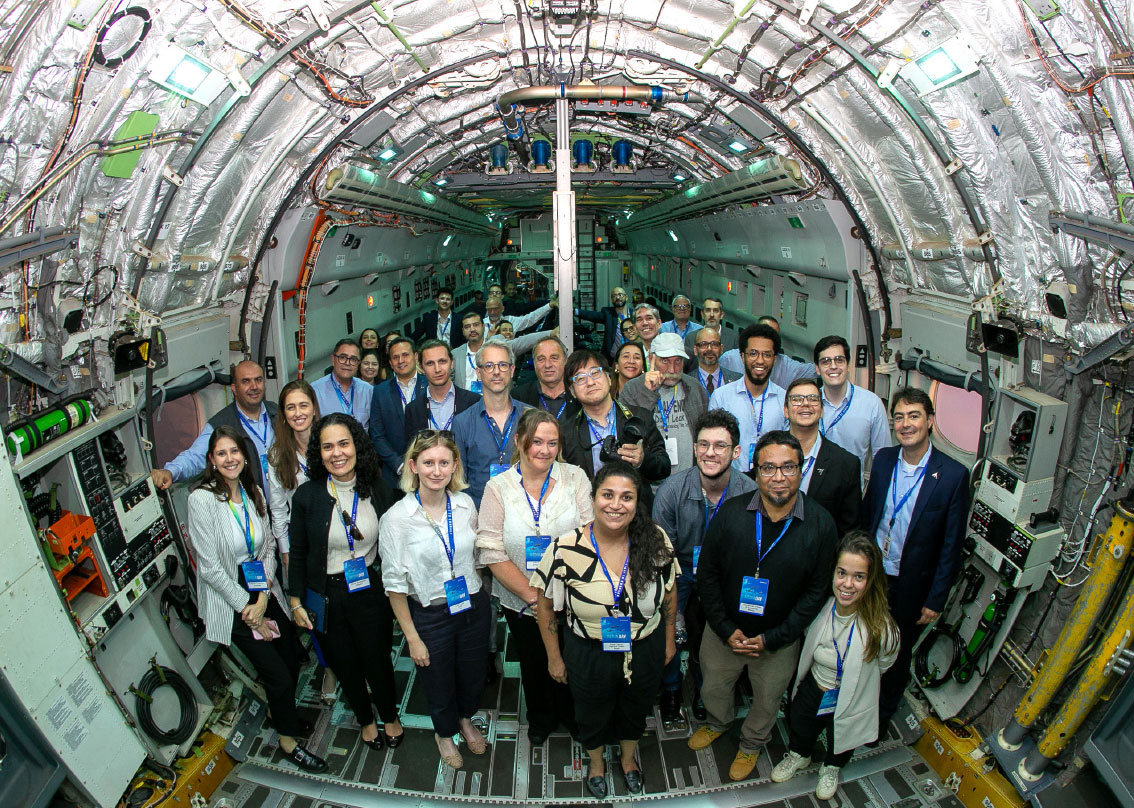
Ahead of Farnborough Airshow 2024 (FIA24) to be held in July, Embraer welcomed around 30 journalists from over 12 countries including the Austria, Australia, Brazil, France, Japan, Mexico, Netherlands, Türkiye, the UK, and the USA, in the city of São José dos Campos located in the state of São Paulo in Southeastern Brazil, on 18-19 June 2024 to provide information about the latest situation in military (C-390 Millennium Medium Military Transport Aircraft) and civil aviation (E2 Series narrow-body commercial jets) projects and to give clues about what new surprises will be presented to world aviation at FIA24.
Founded in 1969, the Brazilian aviation company Embraer is preparing itself for the next 50 years with the pride of providing more than 9,000 aircraft in more than 20 models for both civil and military purposes to the world aviation in the past 55 years.
The first day of Embraer’s 2-Day Media Day 2024 program, hosted at Ozires Silva Facility in São José dos Campos, has kicked off on June 18, with a welcome speech delivered by Andreza ALBERTO, Vice President of People, ESG and Corporate Communications at Embraer. Then Embraer President and CEO Francisco Gomes NETO took the floor and delivered a comprehensive speech under the title ‘Embraer Growth Strategy’.
Speaking to assembled reporters, Embraer President and CEO Francisco Gomes NETO said that: “It's my pleasure to share with you some updates on Embraer and in preparation for the Farnborough Air Show that we believe will be, I can say, maybe the best show ever for Embraer.” In his speech, NETO pointed out that with 19.000+ employees Embraer completes 55 years in a very good shape, back to 2019 levels and in 55 years Embraer completed delivery of over 9,000 aircraft to more than 2,000 customers across all the business units to more than 60 different governments and military forces.
“We have a very comprehensive portfolio of products in other business units, commercial jets, executive jets, defense and security and more recently the E-VTOLs. All of those developments had one very important point that is our world class engineering. We have in our engineering team more than 3,700 engineering people, 1,400+ employees have master’s degrees, PhDs or post-graduate qualifications. And this team has generated more than 800 patents in 7 different countries. This team is the best when it comes to designing, certifying in manufacturing new airplanes… The foundation of our culture of excellence is Safety First and Quality Always in everything we do, from designing supply chain to manufacturing and customer support.” NETO added.
At his address talking about Embraer’s products, NETO underlined that they have positive sales momentum in different business units and the company has seen increased demand for its commercial E-Jets, either the E1s, the E175, and the E2 Family in key markets. And according to NETO, because of the constraints in the delivery of narrow bodies, for the next few years, Embraer has positioned itself as a “great solution” for the airlines to add capacity more quickly to their fleets amid constraints to big narrowbody deliveries in the industry. Embraer has production slots available from 2026, meaning it can deliver on new jet sales before larger rivals Boeing and Airbus, the latter having sold out its production of single-aisle jets until the end of the decade.
NETO continued his speech and shared the following information about Embraer’s products: “Now, talking about the two products, E-175 is the workhorse in the region of aviation in the United States. It is a very robust, robust and mature product. More than 5 million passengers flown every month with our E175s in airports. At the La Guardia Airport in New York, one of four flights is performed/flown with our E175. And since the entry into service (EIS), our teams have been able to improve the fuel burn by 6.4%. We were very happy with the new and big order in March 2024 from American Airlines to buy 90 firm E175 plus 43 purchase rights. We will start deliveries in next year. The E2 is the best example of Embraer's engineering excellence and the most efficient single aisle aircraft. Because it is trip cost is more than 20% lower than the big narrow bodies. It is a perfect solution to complement the bigger narrow bodies and help the airlines to open new routes to improve connectivity between small cities and hubs. It's the best solution to offer a higher frequency of flights that passengers appreciate very much, with a higher load factor and a very attractive cost benefit and profitability for the airlines. We have now 18 customers (for E190-E2 and E195-E2) globally for the E2 Family, you see the flags of customer airlines and we see now the interest in these aircraft growing. We are working in a lot of sales campaigns that we hope to conclude in the next month. And again, E2 is the best complement to larger narrowbodies.”
“The C-390 also has a very, very good sales momentum. We have sold already about 40 units. And the C-390 is a tactical military aircraft designed to be a multi-mission aircraft. We can reconfigure this aircraft from one mission to another in a matter of a few hours. Which helps a lot the air force to improve profitability and efficiency of the fleets. It is faster, much faster with a higher payload than the competition. We are very excited about the opportunities with the C-390 in the next years.”
“In Executive Jets, we have a very modern portfolio of products starting with the Phenom 100 EX. This new version EX was launched in Q4 of last year and is the most popular entry level aircraft in the category. The Phenom 300 E is the most sold light jet in the world for 12 years in a row. The PRAETOR Family (PRAETOR 500 and PRAETOR 600) is very modern, very comfortable, technologically advanced aircraft in the market. Also gaining market share year after year.”
Having more than 5,700 products and over 2,000 customers in more than 100 countries Embraer attaches great importance to Services & Support business, which is defined as “great business for Embraer” by President and CEO NETO. Regarding Embraer’s capabilities in Services & Support area NETO shared following information: “We have 7 Warehouses, 9 Owned MROs, more than 80 Authorized MROs in the world, more than 90 Full Flight Simulators to support our customers and more than 200 Field Support representatives also to support our customers in the different activities. And this has been a great business for Embraer. We expect to more than double the revenues of our in Services & Support area by the year 2030. We are doubling our service capacity in the US to support Executive Jets. And recently we approved important investment to also increase a lot the capacity of MRO for commercial jets in the US. And we will inaugurate the Pratt & Whitney GTF Engine Shop in OGMA, Portugal in July. And this business will bring a multibillion contract for OGMA that will help augment to triple the revenues in the next years.”
In 2020, OGMA was announced as a Pratt & Whitney Authorized Maintenance Center for the support of the PW1100G-JM engine. Since 2020, OGMA invested €74 Million in new facilities and training of employees to start the support services of GTF engines. By 2027, the company expects to begin servicing the PW1900G as used on Embraer’s E-Jets Gen2 regional airliners. OGMA sees this as a very lucrative endeavor for its authorized maintenance center, worth a potential of €500 Million a year once the facility (Embraer’s OGMA MRO subsidiary) is up to full capacity.
Underlining that Embraer’s backlog has reached to US$21.1 Billion level at 2024 Q1, “the highest level in the company’s history, NETO reminded that this figure was US$16.8 Billion level in 2019 Q4 and US$18.7 Billion in 2023 Q4. “We have a lot of sales campaigns that I mentioned before for commercial aviation and also for defense. This might help us to beat the historical level of backlog still this year. And this will support us to deliver our plan for 2030 that is to be a US$10 Billion company in terms of revenue” NETO added.
During his address he also outlined Embraer’s ‘Production Leveling’ plan, which is referred by him as an “another important initiative that will take the operational and financial performance of Embraer to a next level” and covers the steps the OEM company plans to take in order to increase efficiency, productivity and improve its cash flow. “We are working very hard in this new initiative since end of last year. We see improvements already for this year, but we expect much better results from 2025 onwards, helping us to really level the production and delivery in a weekly basis,” NETO said.
At his address NETO also underlined that in the past years they were suffering because of supply chain and the ramp up of products but nevertheless they continued investing heavily on innovation. Embraer has defined 7 Innovation Verticals, such as Airframe Competitiveness, Industry 4.0, Cyber Security, Passenger Experience and Autonomous Flight. According to Embraer President and CEO NETO, those innovations are being applied already in existing products, also in the eVTOL, and will help Embraer to accelerate the launch of a low emission carbon aircraft as the Energia Family, comprising Energia LH2 or dual Fuel and Energia Hybrid-Electric
During his speech NETO shared Embraer’s roadmap of products launched for the future to help the industry to achieve net zero carbon emission by the year 2050. According to NETO this roadmap starts today with E2s which provides 25% reduction in emissions per pax is the most efficient single-aisle aircraft. “One single action that the airlines can do to reduce the carbon emission is to replace older aircraft. There is no other more fuel-efficient aircraft in the market than the E2,” NETO said.
In the last part of his speech, Embraer President and CEO Francisco Gomes NETO shared the following information about their 2050 road map and eVTOL Program under the title of Sustainability-Technology Applicability: “We are planning to enter into service with our eVTOL (“flying car”) full electric aircraft until the end of 2026. Then before 2030, we expect to certify our E2s to fly with 100% SAF and then the Energia Family members, and finally the E2 flying powered by gas turbine hydrogen (H2 Gas Turbine) after the year 2045. The EVE’s (Embraer’s subsidiary) eVTOL Project is advancing very well. Johann BORDAIS will share more details about the eVTOL s with you, we are very excited about this new product. When I told you about the US$10 Billion by the end of the decade, this does not include the eVTOLs. The eVTOL can boost even further this growth of Embraer.”
According to slide on eVTOL and Urban Air Traffic Management Deals, that shared by NETO during his address, Embraer has 30 eVTOL customers in 13 countries and 16 UATM customers & partners in 4 continents and the total value of 2,900 Letters of Intents (LoIs) that secured so far for eVTOLs is around US$14.5 Billion. “We have the eVTOL Program with the highest number of letters of intent of purchasing. We have customers everywhere in the globe with a lot of intent. We are starting investments in the industrialization and we are working now to convert these LoIs into firm orders, to guarantee the production ramp up of the eVTOL from 2026 onwards,” NETO said.
Delivering a speech on financial highlights of Embraer, Antonio Carlos GARCIA, Embraer’s Chief Financial Officer (CFO), underlined that the company has been investing around 30-40% of its cash flow in research and development (R&D) projects. According to Embraer’s Q1 2024 results, shared by Embraer CFO GARCIA, 53% of the order backlog, which amounted to US$21.1 Billion, is registered by Commercial Aviation business segment, 22% by Executive Aviation business segment, 15% by Services & Support business segment and 11% by Defense & Security business segment. Talking about the split of revenue (US$5.4 Billion, 1Q24 figure) by region Embraer CFO GARCIA said, “We are highly concentrated at 62% in North America. Then following by Europe with 20%, then Brazil with 9%. Then you have also Asia Pacific with 4%, but it is going to increase soon. In other types of regions like Middle East, Africa, we are going to see a nice movement in the future.” Regarding the split of the EBIT US$440 Million, 1Q24 figure) by Business Segments (GARCIA said, “50% of the pie goes to Services and Support. And we do believe investors capital market did not see that before. Now they are paying more attention and Services and Support is one of our fast-growing businesses. They are followed by Executive Aviation with 41%, then by Commercial Aviation with 7% and by Defense & Security with 3%.
Embraer CFO GARCIA pointed out that during 2024 Q1 Embraer has registered net revenue of US$5.448 Billion, up US$180 Million from 2023 and estimated to register US$6 to US$6.4 Billion net revenue by the end of 2024, which would be far beyond compared to before COVID figure (US$5.463 Billion in 2019).
According to Embraer’s Q1 2024 results, there is a strong growth for the Embraer, with an overall backlog of US$21.1 Billion – the highest level in the past 7 years, up US$2.4 Billion or 13%, from Q4 2023. The biggest increase in this backlog is generated by Commercial Aviation business segment, which posted a US$11.1 Billion backlog, representing a jump of US$2.3 Billion from Q4 2023. Overall, the Commercial Aviation business segment has a firm order backlog of 381 aircraft: 179 E195-E2s, 15 E190-E2s, and 187 E175s. Notable airlines with a large backlog include Porter Airlines, which is awaiting 43 E195-E2 jets, and Republic Airlines, which has 47 E175 jets. Embraer Commercial Aviation delivered 868 aircraft out of 1.249 firm orders. Embraer currently estimates deliveries of executive jets between 125 and 135 this year, compared with 115 in 2023. Deliveries from its commercial aviation segment are expected to be between 72 and 80 planes, up from 64 aircraft it delivered last year. The only business segment that saw a dip in growth quarter-on-quarter was its Defense & Security segment, decreasing by 4%.
At his address GARCIA described Embraer’s current market share across all its business segments, with 62% in North America, 20% in Europe and 9% in Brazil. Other areas such as APAC are emerging, with India, Saudi Arabia and African markets are also targeted by Embraer.
Q&A Session
After the speeches/presentations, a Questions and Answers Session was held with the participation of Embraer President and CEO Francisco Gomes NETO, Embraer’s Chief Financial Officer (CFO) Antonio Carlos GARCIA and Embraer Defense & Security President & CEO Bosco da Costa Junior.
Responding a reporter’s question on whether the Embraer has ongoing plan and studies to develop a larger narrow-body airliner Embraer President and CEO Francisco Gomes NETO underlined that Embraer is not working on a larger narrow-body aircraft to rival that of Airbus and from Boeing.
During Q&A Session I have also asked three questions and get my answers;
Ibrahim SUNNETCI: Sir, during your presentation you said that Brazilian Air Force (FAB) will receive 19 KC-390 Millennium aircraft. The original figure was 28 and it was later on decreased to 22 with a contract amendment. Do you expect any further decrease in number of the aircraft to be delivered Brazilian Air Force?
Embraer Defense & Security President & CEO Bosco da Costa Junior: Let me explain this. Thanks for the question. Good question. By the way, we have discussed it since the beginning with Brazilian Air Force. We have signed a contract with them for 28 units and we started a discussion with them to decrease this number in 2021. And in the end of the negotiations, we achieved a common agreement to reduce the contract for 19. That's what we have signed with them. There is no discussion to reduce anymore.
So, the Brazilian Air Force did their own study what the number of airplanes that they need and they conclude that 19 is a good number. And we have agreed with that. We have signed this amendment in the contract. It's done. We did this in 2021 and no discussions anymore about any new reduction.
Ibrahim SUNNETCI: I heard that a high-level Embraer delegation will pay a visit to TUSAS Turkish Aerospace facilities either on June 30th, or on July 30th. Within the scope of this high level visit a new contract, kind of a cooperation agreement, is expected to be signed between Embraer and TUSAS. Is this true? Can you confirm this? Can you say anything about this visit or on agreement that expected to be inked?
Embraer President & CEO Francisco Gomes NETO: As our production demand for aircraft is increasing, we are always looking for new partnerships that can help us with the parts, the production and also strategic partnerships that can open opportunities for us to sell our aircraft in certain markets. So yes, we are working with different companies in different parts of the world.
Ibrahim SUNNETCI: Does Embraer has any plan to sell C-390 to Turkish Air Force? If yes, are you open to perform such sale via barter system? Brazilian Air Force is also looking for a new generation Advanced Jet Trainers and Light Combat Aircraft to replace its aging F-5EM/FM Tiger II and AMX fleets. And Brazilian Government has already declared its interest not only to HURJET, but also to KAAN and T129 ATAK produced by TUSAS. So, as Embraer, do you have any plan or do you have any such discussions with Turkish authorities about such barter option?
Embraer Defense & Security President & CEO Bosco da Costa Junior: Of course. As Francisco said, we are facing a very special moment in a sales perspective about C-390. We have been selected by several nations in the NATO community, and more recently by South Korea. And we have a sales campaign spread about the world in a global perspective. Türkiye is a country that we are exploring. Of course, we don't have any sales campaign open there, but we know that C-390 could add some capabilities for Turkish Air Force. We have our connections there, but we are in an early stage. So that's what I can share with you now.
And by the way, just to complement the first question, our senior famous engineer Luis told me Brazilian Air force did their study to reduce the contract, considering the operational availability and mission accomplished of the KC/C-390. So the KC/C-390 is achieving some rates that have never been seen in this industry. So that's the reason they decided to reduce their KC-390 requirement from 28 to 19.
Shuttle flight to the GPX Factory onboard the C-390 Millennium
Participating at Embraer Media Day 2024, featuring a 2-day program full of information and networking, Defence Turkey had the privilege to take part at a shuttle flight to the Gavião Peixoto Unit (GPX) Factory onboard the C-390 Millennium Medium Military Transport Aircraft on June 18, 2024. As one of Embraer’s main industrial complexes in Brazil and located 236 miles away from Sao Jose dos Campos,the GPX plant manufactures C-390 Millennium Medium Military Transport Aircraft and EMB 314/A-29 Super Tucano turboprop light attack aircraft, as well as the wings of the E-190 and E-195 narrow body, short- to medium-range, twin-engined airliners, the refurbishing of the F-5EM/FM Tiger II aircraft of the Brazilian Air Force and since 2008 the final assembly of Phenom 100 and Phenom 300 light business jets.
Performing roundtrip flights, which lasted around 2 hours, onboard the KC-390 Millennium aircraft of the Brazilian Air Force (FAB) from Sao Jose dos Campo to the GPX plant was a great opportunity for me to get first-hand information and personal experience of the KC-390’s capabilities.
During the flights, which took place at an average altitude of 1,800m (approximately 6,000ft), the noise and vibration of the turbofan engines were noticeably lower than those of the C-160D and C-130B/E turboprop military transport aircraft I had previously flown, even at high cruise speed and despite the engines being mounted close to the fuselage. Although the aircraft was carrying a relatively light load in the cargo compartment, it was impressive to see it accelerate quickly from the runway with the power provided by the turbofan engines, lifting off in less than 3,000ft and climbing at a steep angle.
Embraer announced the KC/C-390 Program in 2007, with work commencing in 2009. The first flight of the initial prototype under this program took place on February 3, 2015, followed by a second flight on October 26, 2015, at the GPX facilities. At that time, the Brazilian Air Force (Força Aérea Brasileira - FAB) announced plans to purchase 28 aircraft. The first delivery to the Brazilian Air Force was made on September 4, 2019. As of today, seven different countries, including four NATO member countries, have placed firm orders for a total of 40 C-390/KC-390 Millennium Medium Military Transport Aircraft. These orders include Brazil (19), Portugal (5 with 1 optional), Hungary (2), Netherlands (5), Austria (4), Czech Republic (2), and South Korea (?). Final assembly and production activities are being carried out at Embraer's Gavião Peixoto (GPX) facilities. On June 18, during Embraer Media Day 2024, I visited the KC/C-390 Millennium Final Assembly Line (FAL) at the GPX facilities. Inside, I saw the Portuguese Air Force's third KC-390 Millennium aircraft, the Hungarian Air Force's second KC-390 Millennium aircraft, and two KC-390 Millennium aircraft for the Brazilian Air Force (In FAB’s inventory, these aircraft are coded as KC-390). Next to one of the aircraft were two Cobham 912E Series external fuel pods, each with a fuel transfer capacity of 400 gallons. In front of the Final Assembly Line was another KC-390 Millennium, tail number 2859, which had completed final assembly and was undergoing final checks before transfer to the flight line. The first C-390 Millennium in NATO configuration for the Hungarian Air Force was in the parking lot, awaiting ongoing ground and flight tests before delivery.
The C-390 Millennium Medium Military Transport Aircraft achieved Full Operational Capability (FOC) in March 2023 and has been delivered with this capability since June 2023. By June 2024, a total of 7 aircraft had been delivered—6 to Brazil and 1 to Portugal—with these aircraft collectively logging more than 13,000 flight hours. Currently, Embraer is in negotiations with five European countries for the sale of the KC/C-390 Millennium aircraft. Bosco Da Costa Junior, President and CEO of Embraer Defense & Space, stated their current annual production capacity is 18 KC/C-390s in response to my question. He outlined their delivery schedule, aiming for 4 aircraft in 2024, 6 in 2025, 7 in 2027, and 12 in 2030. In the short term, Embraer estimates a market potential for an additional 80 to 120 KC/C-390 aircraft, considering ongoing tenders in India and Saudi Arabia, as well as requirements from the US.
Portuguese Air Force Receives Second C-390 Millennium Aircraft in Ceremony
The Portuguese Air Force (FAP/Força Aérea Portuguesa), the first international customer for the new generation C-390 Millennium Medium Military Transport Aircraft, received its second aircraft from Embraer during a ceremony held on June 26, 2024. The remaining three aircraft are scheduled for delivery by March 2027, one aircraft per year.
This brings the number of KC/C-390 Millennium aircraft in service with the Brazilian Air Force and Portuguese Air Force to eight. Embraer will deliver additional KC/C-390 Millennium aircraft to the Hungarian Air Force (1x) and Brazilian Air Force (2x) by the end of 2024, increasing the total number of aircraft in service to 11. The first test flight of the first C-390 Millennium NATO Configuration Medium Military Transport Aircraft for the Hungarian Air Force took place on February 8, 2024, at GPX facilities. Hungary is the third customer of the C-390, having ordered two aircraft in November 2020.
Under the €827 Million ($873.27 Million) contract signed between Embraer and the Portuguese Government on August 22, 2019, five C-390 Millennium NATO Configuration Medium Military Transport Aircraft and one flight simulator for training flight crews will replace the aging C-130H and C-130H-30 Hercules Medium Military Transport Aircraft in the Portuguese Air Force inventory. The contract also includes an option for a sixth C-390 Millennium NATO Configuration aircraft. On November 18, 2019 during the Dubai Airshow, Embraer announced the aircraft’s new name for the global market, C-390 Millennium.
Embraer delivered the first C-390 Millennium NATO Configuration aircraft to the Portuguese Air Force on May 20, 2023, coinciding with the activation ceremony of the newly formed 506th Squadron. Following the completion of acceptance and testing activities, the aircraft was officially commissioned in October 2023. The 506th Squadron of the Portuguese Air Force, known by its call sign 'Rhinoceros,' conducted its inaugural operational mission with the C-390 Millennium New Generation Medium Military Transport Aircraft on October 18, 2023. In the first six months, the Portuguese Air Force logged over 650 flight hours with the C-390 Millennium NATO Configuration aircraft.
The C-390 Millennium Aircraft delivered to the Portuguese Air Force, a NATO member, are equipped with various advanced systems and equipment, including NATO-standard encrypted communication systems, such as the software-based AN/ARC-210 VHF/UHF radio set of Rockwell Collins procured from the US through the FMS (Foreign Military Sales) channel, as well as the Link-16 Tactical Data Link System and Terminal (MIDS JTRS Terminal by Viasat), Mode-5 IFF System, and EW Self-Defense System, resulting in the designation of the C-390 Millennium as C-390 Millennium NATO. Embraer is currently negotiating with 5 European countries for the sale of the C-390 Millennium.
According to information shared during the two-day press tour event organized by Embraer at Embraer Media Day 2024 on June 18-19, 2024, in São José dos Campos, São Paulo state, Southeastern Brazil, over 13,000 flight hours have been logged with the 7 KC/C-390 Millennium aircraft previously delivered to FAB and FAP. During this period, the KC/C-390 fleet achieved an operational reliability performance of 99.2%, with 80% mission readiness. Embraer Defense & Space officials highlighted that the Brazilian Air Force's decision to reduce its KC-390 Millennium Aircraft order from 22 to 19 was influenced by the fleet's impressive 80% mission readiness rate, largely supported by Embraer's effective logistic support services. The Portuguese Air Force's ability to maintain similarly high readiness levels with their C-390 Millennium NATO Configuration aircraft is attributed to Embraer's 65% ownership of OGMA, a longstanding Portuguese aerospace company specializing in the repair, modernization, and production of airframe components, including the C-390 Millennium’s midframe.
The C-390 Millennium Medium Military Transport Aircraft can operate on temporary or unpaved runways such as filled soil, soil, and gravel. It measures 35.20m in length, 11.84m in height, and has a wingspan of 35.05m. The maximum payload capacity is 26 tons for single-piece cargo and 23 tons for distributed cargo. The cargo compartment has a volume of 169m³ with a floor length of 12.70m, extending to a total length of 18.50m including the ramp. It is 3.45m wide and averages 2.95m in height, increasing to 3.20m between the rear ramp and wing attachment point. The KC/C-390 Millennium Aircraft is powered by two IAE V2500-E5 Turbofan Engines, each capable of producing 31,330 lb of thrust, with a fuel capacity of 23.9 tons (users have expressed high satisfaction with the engine, which is capable of 13-14,000 Total Accumulated Cycles (TAC)). This aircraft achieves a cruise speed of Mach 0.80 (871 km/h), with a stall speed of 193 km/h when the flaps are fully deployed at an angle of 40 degrees and can climb to an altitude of 36,000 feet. The KC/C-390 Millennium Medium Military Transport Aircraft, which holds both civilian and military certifications, is capable of taking off from runways as short as 1,524 meters with a 23-ton payload and landing on runways as short as 1,000 meters with a 26-ton payload.
The C-390 is establishing a position for itself in the market as the next generation multi-mission/multi-role transport-tanker aircraft. In comparison to other medium-sized military transport aircraft, the C-390 Millennium is a powerhouse. It flies faster (470 knots), carries more (max payload 26 tons), and goes further (1,470 nm for 23 tons). In terms of range, speed, and payload it is claimed to be 40% more effective than a medium lift turboprop. When compared to the C-130J, the C-390 is faster (with a maximum speed of 988 km/h it is 47% faster than C-130J which only has a maximum speed of 670 km/h), carries an heavier cargo (26 tons vs 19 tons), and it is also reportedly cheaper to buy. Moreover, the KC/C-390 includes aerial refueling as a standard feature (only a few specialized sub-variants of the C-130 feature an aerial refueling capability. Since the KC/C-390 flies at Mach 0.80 it could therefore finish missions in two thirds the time of the C-130 Hercules (which has a maximum cruise speed of Mach 0.59 at 22,000 ft). This will also result in more missions flown per day i.e. more airlift capacity.
Embraer is designing the KC/C-390 to have a mission reliability of 95%. Service strategy is similar to the company’s E-Jets with A-Checks every 600 Flight Hours or 12 months and C-Checks at 6,000 Flight Hours, 3,000 Flight Cycles or 60 months, whichever comes first. A C-Check shall take 10 days to perform.
Pilot conversion from C-130 to KC-390 takes 18 months and within the scope of their training pilots also use KC-390 Full-Flight Simulator at the Embraer Academy, located at the Eugênio de Mello unit in São José dos Campos. Developed by Embraer in partnership with Rheinmetall, the KC-390 FFS, with D-level qualification, includes operation under normal and emergency conditions, a package to support military operations, and more than 350 failure simulations.
The jet-powered Embraer C-390 Millennium Medium Military Transport Aircraft, equipped with a fly-by-wire control system, stands out as one of today's most modern military tactical transport aircraft, renowned for its superior speed, range, and carrying capacity compared to others in its category. The KC/C-390 Millennium can be rapidly configured (in a matter of hours) for a diverse range of operations, including cargo and troop transportation, aerial refueling, medical evacuation, search and rescue missions, firefighting, and humanitarian aid.
Equipped with aerial refueling capabilities, the KC-390 Millennium in the FAB's inventory has demonstrated its ability to perform both as a tanker and a receiver. In this context, aerial refueling tests were conducted using a fuel probe located just above the cockpit on both F-5EM Tiger II and AMX Fighters in the FAB inventory, as well as on another KC-390. These tests utilized Cobham 912E Series external fuel pods carried under the wing, each capable of transferring 400 gallons of fuel.
Meanwhile, the Zeus Squadron (First Troop Transport Group/1st GTT) of the Brazilian Air Force (FAB) carried out it’s first ever real firefighting mission using the KC-390 Millennium multi-role aircraft, in the Pantanal region in June 2024. The multi-role KC-390 Millennium aircraft has the capacity to carry out a safe operation and is equipped with the Modular Airborne Fire Fighting System (MAFFS), which provides the aircraft with the necessary functionality to carry out the firefighting action.
KC-390 Tanker Role
This multi-role aircraft can be quickly configured for aerial refueling as both a tanker and a receiver aircraft. The refueling version of the C-390 has been titled KC-390. Thanks to its air-to-air refueling capability the KC-390 can refuel in flight other aircraft and helicopters through two wing-mounted probe and drogue pods.
Indeed, the aircraft’s impressive operating envelope and impressive range of more than 4,500 nautical miles with fuselage tanks allow KC-390 to perform tanker role for both fixed and rotary wing aircraft properly. The KC-390 can accommodate the speed and altitude requirements of both fixed and rotary wing aircraft flying at speeds from 120 knots to 300 knots from 2,000ft to 32,000ft. This is largely achieved thanks to its highly reliable twin IAE V2500-E5 military turbofan engines that give it a cruising speed of 0.8 Mach. Produced by Cobham plc each of the Cobham 912E Series Wing Air Refueling Pod is able to deliver up to 1,500 L (400 US gallons) per minute from a 35 tons (77,000 lb) total fuel capacity, between 120 to 140 knots for helicopters and between 180 to 300 knots for aircraft and from 2,000 ft up to 10,000 ft for helicopters and from 2,000 ft to 32,000 ft (610 m to 9,750 m) for aircraft. Removable auxiliary fuel tanks can be also installed in the cargo compartment to expand the aircraft fuel offload capacity or range performance. Up to 3 Palletized Auxiliary Fuel Tanks, 8,800lb/4,000kg each can be installed in the KC-390 cargo compartment. The multi-role KC-390 aircraft can be quickly configured for aerial refueling as both a tanker as well as a receiver aircraft. The refueling version of the C-390 has been titled KC-390. According to Embraer, it would take around 4 hours to convert a standard KC-390 into a tanker with pods and a 4,000 kg (8,800-lb) auxiliary tank.
In February 2017, Embraer started testing the KC-390 air-refueling capabilities with dry contacts with FAB F-5EM Tiger IIs. Later on similar tests also performed with AMX fighter jets of the FAB. In April 2021, Embraer reached another important milestone in the development of the C-390 Millennium multi-role military freighter program with the successful conclusion of the aerial refueling qualification between two KC/C-390 Millennium, proving this new operational capacity of the aircraft.
The aircraft is built in aluminum in a high wing two-engine layout, using the IAE V2500-E5 military turbofan engines positioned closer to the aircraft fuselage, which in turn produces less turbulence when compared with a turboprop (A400M). Thus, the A330 MRTTs are not certified to refuel A400M aircraft with Cobham's Wing Air Refueling Pods. Due to aerodynamics and airflow, the basket from the Cobham 905E underwing air-refueling pods tends to sway when approaching the A400M and risks hitting the receiver aircraft. Tanking between the two aircraft is only possible on the UK Royal Air Force’s MRTT, which uses the centerline Fuselage Refueling Unit.
Meanwhile in September 2022, Embraer and US-based L3Harris Technologies have announced that they will be partnering to develop an ‘agile tanker’ equipped with a boom refueling system based on the Embraer’s multi-role KC-390, which would also thereby able to offer KC-390 Agile Tanker concept to the U.S. Air Force, which is analyzing options for a next-generation aerial refueling fleet. The KC-390 Agile Tanker would provide a significantly smaller footprint than that of a traditional boom-equipped tankers, allowing it to work out of tighter airfields. The KC-390 Agile Tanker will have a boom receptacle above the cockpit instead of the standard type’s refueling probe.
Can the C-390 Millennium NATO Configuration Replace the Veteran C-160D Transall Aircraft?
I would like to see the new generation KC/C-390 Millennium Medium Military Transport Aircraft, Embraer's largest aircraft developed to date, replace the veteran C-160D Transall Aircraft in the Turkish Air Force's inventory. Since 2020, the Turkish Air Force has been phasing out the C-160D Transall Aircraft, leaving only one aircraft in service. Despite their similar external dimensions, cargo capacity, and carrying capacity, the KC/C-390 Millennium and C-160D Transall differ significantly in their ability to transport heavier loads over longer distances in shorter times, thanks to the power provided by the KC/C-390's turbofan engines. The C-160D Transall Medium Transport Aircraft measures 32.4 m in length, 11.65 m in height, with a wingspan of 40 m, and can carry payloads weighing up to 16 tons. It achieves a top speed of 513 km/h and a stall speed of 177 km/h. The cargo compartment of the C-160D Transall is 17.20 m long, 3.15 m wide, and 2.98 m high, with a maximum range of 1,853 km when carrying a load weighing 16 tons.
The C-160D Transall Medium Transport Aircraft, a joint German-British-French production, were acquired from Germany as surplus materials from the German Air Force in the 1970s, costing DM8 million. The arrival of second-hand C-160D Transall aircraft in Türkiye began on May 18, 1971, starting with aircraft tail number 029. A total of 20 aircraft joined the Turkish Air Force inventory. The first C-160D, tail number 029, brought to Türkiye in May 1971, currently remains the last C-160D in service with the 221st Squadron Command and is expected to be decommissioned in 2024.
When the C-160D Transall Aircraft were delivered, they did not come equipped with an air dropping system. The 12th Air Transportation Main Base Command developed a dropping system for these aircraft using its own resources and conducted training with it until 1974, enhancing their operational capability. This effort culminated in the successful execution of Türkiye's first airborne operation during the Cyprus Peace Operation.
During the Cyprus Peace Operation (July 20-22, 1974), over 2,000 paratroopers and approximately 250 tons of material were air-dropped onto Cyprus using 20 C-47s, 12 C-160D Transall aircraft, and six C-130E transport aircraft. The 221st Squadron Command flew a total of 37 sorties with their 12 C-160D aircraft, logging 83.45 flight hours and delivering 1,400 personnel and 95,000 kg of material to the island. During the İkizce (Kardak) Crisis Troop Relocations (January 27-31, 1996), the 221st Squadron Command swiftly completed all deployment missions within 24 hours using 10 C-160D aircraft. They conducted 21 sorties, transporting 274 personnel and 195,250 kg of material over 85 flight hours.
Of the 20 C-160D Transall aircraft operated by the 221st Air Transport Squadron Command, three underwent modernization for Intelligence, Surveillance, and Reconnaissance (ISR) under the GÖREN Project, while two were upgraded for Electronic Countermeasures (ECM), IMINT, and COMINT missions as part of the MilKar-2U Project.
As of January 2024, a significant portion of the veteran C-160D Transall Medium Transport Aircraft in the inventory of the Air Force Command had been decommissioned, leaving only two aircraft in the inventory of the 221st Air Transport Squadron Command, one of which was a transport aircraft and the other in the “MilKar” configuration (equipped with the JAMINT-2U Electronic Jammer System). On January 25, 2024, the C-160D was damaged during a forced landing due to a left engine failure shortly after take-off. Despite the engine stall, the crew safely returned the aircraft to base without incident and exited safely after the forced landing. Due to the extent of the damage, the C-160D was subsequently decommissioned. Earlier, one of the two MilKar-configured aircraft in the fleet was also retired, and the dismantling of these retired aircraft is currently underway. Now, only one C-160D Medium Transport Aircraft (69-029) remains in the inventory of the 221st Air Transport Squadron Command, which operates both C-160D and A400M.
In previous years, Turkish Aerospace (TUSAŞ) developed a modernization package for the C-160D Transall Aircraft, focusing on upgrades to their engines and avionics systems. TUSAŞ's solution involved outfitting the C-160D with a digital cockpit architecture similar to that currently used on the C-130B/E Aircraft under the ERCİYES Project. Additionally, the package included replacing the existing 6,100 shp (4,549 kW) Rolls Royce Tyne RTY 20 Mk22 Turboprop Engines with the 5,100 shp Rolls Royce/Allison T56-A-427A Turboprop Engines, also utilized on the E-2D Hawkeye AWACS Aircraft.
In the early 1990s, when the Turkish Air Force became interested in acquiring AC-130 Gunship Aircraft but faced challenges in procuring them from the United States, ASELSAN initiated Türkiye's first indigenous Gunship Aircraft project in 2010. This effort preceded the GÖREN-I Project contract and involved mounting the AselFLIR-300T FLIR System, operator console, and a 25mm STOP Automatic Cannon on the left rear of a C-160D Transall Aircraft. ASELSAN conducted a concept demonstration in 2011, including ground firing and flight tests, and briefed senior Air Force officials on these capabilities. However, since the concept was not fully developed at that time, the project was not continued.
Within the scope of the Turkish Fighter KAAN/TF-X Project, there was a proposal to use one of the decommissioned C-160Ds as a radar test platform (test bed). This would have enabled radar engineers to conduct airborne radar tests using the aircraft. However, the proposal did not proceed due to insufficient support.
So, is it feasible for the Turkish Air Force to acquire C-390 Millennium NATO Configuration aircraft? Given the current budgetary constraints, purchasing these aircraft outright does not seem viable. However, exploring a sale or supply arrangement that benefits both Türkiye and Brazil through a barter system, similar to ongoing discussions for the sale of a TUSAŞ-produced aircraft to another NATO member country, remains under consideration. It has been previously reported in the press that Brazil is interested in TUSAŞ's T129B ATAK Helicopter and HÜRJET Jet Trainer and Light Attack Aircraft, aiming to replace their veteran F-5EM/FM Tiger II and AMX fighter jets currently in inventory. Brazil is also closely monitoring the Turkish Fighter KAAN/TF-X Project. Therefore, should the Brazilian Armed Forces finalize their requirements for these platforms, I believe the option of acquiring a certain number of C-390 Millennium Medium Military Transport Aircraft from Brazil in exchange for the sale of TUSAŞ-produced aircraft may be considered in the coming years. A similar business model has been discussed previously regarding the sale of a TUSAŞ-produced aircraft to another NATO member country.
So, does the Turkish Air Force currently need a transport aircraft like the C-390 Millennium? Given the existing inventory, which includes 13 C-130E and six C-130B versions, plans to acquire second-hand C-130Js from 2025 onwards, and the procurement of 6 additional A400Ms, there doesn't appear to be an urgent necessity. However, the earthquakes in Kahramanmaraş last year highlighted the critical need for swift airborne responses to natural disasters. Equipped with turbofan engines, the C-390 Millennium can reach disaster areas much faster than the CN235, C-160D, C-130B/E, and even the A400M currently in service. Its ability to take off and land on temporary or unpaved runways, such as filled soil or gravel, is critical when conventional airfields are unavailable. Moreover, while there is currently no urgent need for an aircraft like the C-390 Millennium, looking ahead to the 2030s, Turkey's air transportation fleet is expected to include 25 CN235T1s, 25 C-295s or C-27Js, 10-13 C-130Es (with plans to decommission six C-130Bs starting from 2030), 10-12 C-130Js, 8-10 C-390 Millenniums, and 16 A400Ms. This comprehensive fleet will significantly enhance the Turkish Air Force's capability, ensuring robust airborne response capabilities for natural disasters and meeting air transportation needs well into the 2050s.
• You can read our comprehensive coverage on the second day of Embraer Media Day 2024 in our next issue





