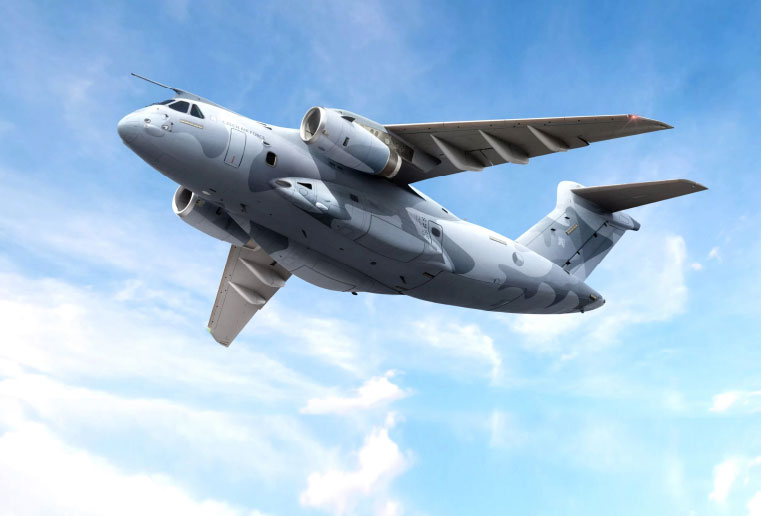
``The C-390 is a Real Swiss Knife in the Air``

As the third largest Commercial Aircraft manufacturer worldwide, behind Airbus and Boeing, and a driving force in Defense & Security and Business Aviation, Brazilian aviation company Embraer disclosed its earning results for the second-quarter (from April to June) of 2024 on August 8.
According to Q2 2024 results, Embraer has registered net revenue of $1,49 Billion, up 15.6% from a year earlier and represents an increase of 67% compared to the previous quarter. The revenue increase was driven by the Commercial Aviation ($553.5 Million +17% vs the same period of 2023) as well as the Services and Support division ($403.6 Million, +19% over the Q2 2023). In Executive Jets, Embraer saw an 11% decrease to $335.5 Million. Whereas, Defense and Security division saw the largest proportional growth +130% (from $87 to $187 Million).
Embraer’s Q2 2024 results show strong growth for the regional jet manufacturer, with an overall backlog of $21.1 Billion, marking a seven-year high and up more than 20% annually. The Services and Support division of Embraer continue to be a key driver of the company’s growth with the backlog ending the last quarter unchanged at $3,1 Billion. However, the backlog in Defense & Security division decreased 10% quarter-on-quarter.
Embraer’s Q2 2024 results also show 88% increase in deliveries in Q2 compared to first-quarter (Q1, from January to March) of 2024. In the April–June period, Embraer delivered 47 jets, an increase of 88% compared to the 25 aircraft delivered in the first quarter of 2024. According to Embraer, Commercial Aviation division was the highlight of the period April to June with 19 jet deliveries (around 170% more than in the first quarter) totalling $227 Million. Executive Jets division also delivered a solid performance in the April–June period with 27 aircraft (20 light and 7 medium), a 50% increase on the previous quarter, while the Defense and Security division delivered only one multi-mission airlift C-390 Millennium military transporter to the Portuguese Air Force (FAP).
A highlight in Embraer’s Commercial Aviation division was an order for 20 E2 jets from Mexico’s state-owned airline, Mexicana de Aviación. The order includes 10 E190-E2 jets and a further 10 E195-E2 jets, with deliveries scheduled to start in 2025. Other highlights include the delivery and start of operations of the first E190-E2 for Scoot, Singapore Airlines’ low-cost subsidiary. Another milestone was marked in May 2024, with the delivery of Embraer’s 1.800th E-Jet to leasing company Azorra. The aircraft will be operated by Royal Jordanian Airlines.
By registering positive Q2 financial results, the company has also reaffirmed its outlook for 2024, which includes the delivery of 72 to 80 commercial aircraft, up from 64 last year, as well as 125 to 135 executive jets, up from 115 in 2023, and bringing in revenue of $6,0 to $6,4 Billion range, which would be far beyond compared to before COVID figure ($5,463 Billion in 2019).
Embraer has been experiencing strong demand for its next generation single-aisle (narrow-body) E2 Family as carriers face a shortage of larger single-aisle planes from Airbus and Boeing, and has also managed to convert business jet purchase options into firm orders. In June 2024, it was reported that the world’s largest private jet flight provider NetJets, which has nearly 2.000 options for private jets, has begun converting the first five of 250 Embraer Praetor 500 options announced in 2023 to firm orders. The deliveries will start in 2025.
In response to the increased aircraft production and anticipated future growth, Embraer is investing in initiatives such as the development of new technologies, expansion of aeronautical services, and projects aimed at improving and expanding industrial activity. As Brazil's largest exporter of high technology, the company is well-positioned across all its operational segments: commercial aviation, business aviation, defense, and services.
Since it was founded in 1969, Embraer, the leading manufacturer of commercial jets with up to 150 seats, has delivered more than 9.000 aircraft. On average, about every 10 seconds, an aircraft manufactured by Embraer takes off somewhere worldwide, transporting over 145 million passengers a year.
FIA24 & Embraer
As a global aerospace company headquartered in Brazil and manufactures aircraft for Commercial and Executive aviation, Defense & Security, and Agricultural customers, Embraer made a strong presence at the Farnborough International Airshow (FIA24), the most significant aviation and aerospace event of the year.
Embraer’s brand-new E-Freighter, the E190F, made its first public appearance at FIA24. Embraer launched the E-Jet freighters (E190F and E195F) in 2022 to meet the changing demands of e-commerce and modern trade, which require fast delivery and decentralized operations. The E190F E-Freighter has been certified by the National Civil Aviation Agency of Brazil (ANAC) in July 2024. The aircraft, was developed to fill a gap in the air cargo market and to replace older less efficient models. The E-Freighter is due to receive EASA and FAA certification later this year and for the Cargo Loading System shortly after. According to Embraer, E-Jets converted to freighters will have over 40% more volume capacity, three times the range of large cargo turboprops, and up to 30% lower operating costs than larger narrow-bodies. If combining capacity under the floor and main deck, the maximum structural payload is 13.500 kg for the E190F.
Embraer’s lineup at the Farnborough International Airshow (FIA24) highlighted its leading portfolio of aircraft for both commercial aviation and defense, which included the E195-E2, the world’s most efficient and quietest narrowbody; the aforementioned E190F; the C-390 Millennium multi-mission military tactical transport; and the A-29 Super Tucano a multi-role defense aircraft. The C-390 Millennium and the E195-E2 also took part in the flight display. Powered by two Pratt & Whitney PW1900G Geared Turbofans providing up to 23.000 pounds of thrust, the E195-E2 comes in a trio of two-by-two seating configurations: three-class with 120 seats, single-class with 132 seats, or single-class with 146 seats, the latter of which has 28 inches of pitch between seat rows. A fully loaded E195-E2 has a range of 2.600 nm with a 41.000 ft ceiling, maximum cruise speed of Mach 0.82, and Maximum Take-off Weight (MTOW) of 61.500 kg (135.584 lb).
Inside the Embraer chalet (#C-105), visitors had the chance to take a closer look at multiple activities related to innovation, new technologies and the company’s roadmap to sustainable aviation, such as the Energia Family concept aircraft. Also, EVE Air Mobility presented updates on the development of its electric vertical take-off and landing vehicle (eVTOL) and the Urban Air Traffic Management Software VECTOR, including a full-size eVTOL cabin mock-up and a unique virtual reality (VR) flight experience.
Despite celebrating 9 C-390 Millennium (ordered in a joint deal between the Netherlands [5x] and Austria [4x] and under a contract signed by the Dutch Ministry of Defense during a ceremony at FIA24 on July 22, 2024) and the purchase of 6 A-29 Super Tucano by Paraguay (on July 23, 2024 Embraer announced that it has sold 6 A-29 Super Tucano aircraft to the Paraguayan Air Force [FAP]), Embraer did not announce any commercial aircraft deals during FIA24; instead the company unveiled a range of enhancements intended to improve the E-Jet’s appeal.
In a world-first for any aircraft, an Embraer-developed autonomous landing system (E2TS) will help enable an optimum takeoff and landing profile, offering an approximately 350 miles of additional range. With an anticipated entry into service date of the end of 2025, Embraer has already been offering the option to customers, citing interest in the product’s ability to “extract more value out of the ecosystem”.
Meanwhile, the E-175 will benefit from new luggage storage (facilitating one bag per passenger), mood lighting, Ka/Ku-Band satellite connectivity and enhanced avionics (including next-generation weather radar). Recaro seating will also be available as a supplier-furnished item from Q4 2024. From 2026, a cabin optimization initiative will see an extra row of seats included; taking a single-class configuration from 13 to 14 rows, and a two-class layout from 11 to 12 rows. However, the E175-E2 is described as being “on pause,” with its primary US market preferring the E1.
Notes from Embraer Media Day 2024
Ahead of Farnborough International Airshow 2024 (FIA24), which was held during July 22-26, Embraer welcomed around 30 journalists from over 12 countries including; Austria, Australia, Brazil, France, Japan, Mexico, Netherlands, Türkiye, the UK, and the USA, in the city of São José dos Campos located in the state of São Paulo in Southeastern Brazil, on 18-19 June 2024 to provide information about the latest situation in military (C-390 Millennium Medium Military Transport Aircraft) and civil aviation (E2 Series narrow-body commercial jets) projects and to give clues about what new surprizes to be presented to world aviation at FIA24.
On the first day of Embraer’s 2-Day Media Day 2024 program, following the speeches delivered by Andreza ALBERTO, Vice President of People, ESG and Corporate Communications at Embraer, Embraer President and CEO Francisco Gomes NETO and Antonio Carlos GARCIA, Embraer’s Chief Financial Officer (CFO), Johann BORDAIS, President and CEO of EVE Air Mobility took the floor and delivered a comprehensive presentation on EVE Air Mobility, the eVTOL (electric vertical take-off and landing) company in which Embraer holds a controlling stake.
At his address delivered on June 18, 2024 Johann BORDAIS, President and CEO of EVE Air Mobility, underlined that with EVE, they were really offering not only the eVTOL development, but also the service and support solution to make sure that they will have the reliability. “We're talking about 14 flights a day and it needs to be reliable. Otherwise, we're going to be delivering vehicles that are going to be sitting on the ground or flying like helicopter with not as reliability that helicopter is,” BORDIAS said. According to BORDIAS, EVE’s eVTOL features one pilot, four packs and fully electrical. He stressed that technology allows us today to fly fully electrical. Pointing out that they would be able to deliver 120 eVTOLs per year, BORDIAS said, “We want to democratize the access, give access to the sky. We'll start to fly just like helicopters and the same, the same routes. For example, instead of the sightseeing with a helicopter, you'll have an option to go with purely 100% electrical eVTOL.” BORDIAS revealed that at the beginning of the operation, they would use the existing flight and the traffic management system. But when they are going to be delivering dozens and hundreds and thousands of eVTOLs, VECTOR, the Urban Air Traffic Management Software that EVE is developing together with strong knowledge of Embraer, will be utilized. BORDIAS was confident that EVE would be able to get the certification by 2026.
During FIA24, in addition to presenting updates on the development of its electric vertical take-off and landing vehicle (eVTOL) and the Urban Air Traffic Management Software VECTOR, and displaying a full-size eVTOL cabin mock-up EVE Air Mobility also used mixed reality to walk attendees through its first full-scale, non-conforming prototype at Embraer’s plant in Gaviao Peixoto (GPX). The full-scale eVTOL prototype will undergo several tests, including ground tests, hover tests, and partial and full transition to cruise flight. The uncrewed engineering vehicle will increase the team’s knowledge of physical phenomena and validate technical solutions, leading to more mature conforming prototype testing and certification.
Meanwhile EVE Air Mobility, the subsidiary of the Brazilian aircraft manufacturer Embraer, closed the second-quarter of 2024 with a loss of $36.4 Million. The company’s order book closed the Q2, 2024 worth $14,5 Billion, with 30 customers ordering a total of 2.900 units. The bulk of orders, 44% of the total, came from customers in North America. In early October 2024 EVE Air Mobility welcomed United Airlines to tour its facility to advance their partnership in developing 100% electric urban flights. United Airlines has invested $15 Million in EVE and pre-ordered up to 400 eVTOLs.
Following the speech by BORDIAS, lunch was served, and then a shuttle flight to Embraer’s Gavião Peixoto Unit (GPX) Factory was conducted onboard the KC-390 Millennium Medium Military Transport Aircraft. As one of Embraer’s main industrial complexes in Brazil and located 236 miles away from Sao Jose dos Campos, the Gavião Peixoto Unit is a production powerhouse. It is there that the KC-390 Millennium Medium Military Transport Aircraft and EMB 314/A-29 Super Tucano turboprop light attack aircraft, as well as the wings of the E-190 and E-195 narrow body, short- to medium-range, twin-engine airliners are manufactured. The production line of the Gripen E in Brazil, at GPX was inaugurated on May 9, 2023. In addition to aircraft production, Embraer also performs the refurbishing and upgrade of the F-5EM/FM Tiger II aircraft of the Brazilian Air Force at the GPX plant. With many operations on land and in the air, a large runway was needed for landings, takeoffs and the testing of new aircraft. It comes as no surprise that Gavião Peixoto's runway, with 4.967 meters long, is the fourth largest in the world and the largest in the Americas and the entire southern hemisphere. Embraer has more than 2.800 employees in Gavião Peixoto, representing more than half of the city's 4.500 inhabitants.
Before the facility tour, João Bosco COSTA Junior (Jr) President and CEO of Embraer Defense & Security took the floor and delivered a comprehensive presentation to provide an overview of Embraer’s Defense and Security Division’s existing capabilities and ongoing projects. The first day of Embraer’s 2-Day Media Day 2024 program concluded with the GPX facility tour.
Speaking to assembled reporters, President and CEO of Embraer Defense & Security, COSTA underlined that founded in 1969 Embraer has started as a success of a Brazilian Government project and as a whole was born as defense. “It was a result of a success project of Brazilian Government and Brazilian Air Force. We are so proud about our history. This is the picture of the first airplane of Embraer (C-95 Bandeirante [EMB-110]). Along of this history, we have developed more than 20 aircraft for defense. We got a lot of knowledge coming from those defense developments,” COSTA added. He also underlined that since 1979 Embraer has beeen expanding its presence around the globe and keeping growing and increasing this presence. “More recently we have launched our office in South Korea. Singapore is very new as well. We are expanding our footprint and that's one strategy of Defense & Security. We would like to turn our brand into a global brand. We would like to turn Embraer Defense & Security into an international player inside of defense market,” COSTA said.
At his address COSTA also talked about the C-390 Millennium Medium Military Transport Aircraft for which they use slogans of ‘Unbeatable Combination’ and ‘Ready for the Next 50 Years’. COSTA stressed that the C-390 Millennium is an airplane with jet speed in the air and fast turnarounds, is an airplane very rapid to configure, featuring state of the art technology providing the highest level of safety and a very efficient airplane with a very low life cycle cost. “So, the C-390 is ready for the future and for the coming customers,” COSTA added.
The C-390 Millennium represents an unbeatable combination of innovation, cutting edge technology and extraordinary performance. It is a new generation multi mission aircraft that is redefining the limits of aviation. With a unique combination of unrivaled speed and faster turnarounds, the C-390 redefines the concept of operational efficiency. The C-390 not only leads the present, but also shapes the future. Equipped with state-of-the-art technology, it can be quickly reconfigured and adapted to multiple missions. Incorporating the latest technology available in the market, featuring superior performance and reduced operating costs, the C-390 Millennium exceeds expectations, making it the transport aircraft of choice of many air forces. Brazil, Portugal, Hungary, the Netherlands, Austria,the Czech Republic and the Republic of Korea have already embraced its value. Soon, new countries will join the select group, raising the bar for excellence in military aviation and strengthening the C-390 Millennium's global presence.
At his address COSTA referred the C-390 Millennium as “a real Swiss Knife in the air and shared following information with assembled reporters;
“The airplane got a civilian type certificate in 2018, its Entry Into Service (EIS) in Brazilian Air Force took place in 2019, four years after the EIS we got the Full Operational Capability (FOC). We know that some competitors of the C-390 is not in a position to say that they achieved the FOC until now. So, we are so proud about this. And as I said, we have started the operation in the NATO environment in October 2023. It's the only multi-mission platform. All the C/KC-390s that came out from our production line are capable to do all the missions. It means that you don't need to buy one airplane to do air-to-air refuelling, and another one to do cargo, for example. So, the C-390 Millennium entered into service, as I said, with Brazilian Air Force in 2019. We have 6 units already operating in Brazilian Air Force, 1 in Portuguese, and we are about to deliver 3 additional units, 1 for Portugal, another 1 for Hungary, I think you could see this airplane outside and another 1 to Brazilian Air Force. So, we are expecting to end 2024 with 10 units of C-390 already operating around the globe. We are forecasting 500 aircraft, close to $6 Billion in the next 20 years. And again, I used to say that we are quite conservative in this number, because we are forecasting this number just using replacement of legacy platform, not only C-130, but some platform, Russia platform as well. Antonov 12 (An-12), for example, is one of them. And you can see here that we have some airplanes that was delivered in fifties, sixties, that is still operating and they need to be replaced. So again, just doing the math of these airplanes, we are concluding that the demand of 260 airplanes will appear in a very short way. I think the C-390 is ready to capture a good portion of this. And that's the reason we are so optimistic about the future of this airplane. So, as I said, currently we have a Brazilian Air Force with 19 units, Portugal with five, Hungary with two, and we have been selected by Netherlands, Austrian, Czech Republic, and more recently we signed a contract with South Korea, and we are not allowed to disclose the number of airplanes involved in this contract.”
Embraer Defense & Security division will deliver a total of 4 KC/C-390 aircraft in 2024, 6 in 2025, 7 in 2027, and 12 in 2030. In the short term, Embraer estimates a market potential for an additional 80 to 120 KC/C-390 aircraft. Apart from FAP’s second C-390 Millennium that delivered on June 26, 2024 Defense and Security division also delivered an additional C-390 Millennium aircraft to the Hungarian Air Force on September 5, 2024. The Brazilian Air Force (FAB), which is scheduled to receive 2 KC-390 Millennium multi-mission airlift this year, took delivery of its first aircraft (7th aircraft in total) on September 27, 2024. This milestone comes as the FAB celebrates five years of service with the KC-390 after the first one was delivered on September 4, 2019 and the sixth one on June 16, 2023. The delivered KC-390 with the registration 2859, will be operated by the First Squadron of the First Transport Group (1º/1º GT) at Galeão Air Force Base in Rio de Janeiro. According to Embraer the current fleet of C-390 Millennium multi-mission airlift worldwide has accumulated more than 14.000 flight hours, achieving a mission capability rate of 93% and mission completion rates above 99%. Embraer also is eyeing multiple other sales opportunities around the globe, including with the Czech Republic – which has stated its intention to acquire two aircraft – and additional nations such as India, Saudi Arabia, South Africa and Sweden. The Czech Republic aims to finalize a contract (expected to cost $492 Million) for 2 C-390 Millenniums before the end of November 2024 and took delivery of the first aircraft in 2025. C-390 Millennium participated at the Africa Aerospace and Defence (AAD) exhibition, held at Waterkloof Air Force Base, September 18-22 to demonstrate its exceptional capabilities to a global audience of defense, aviation experts and political authorities. During AAD 2024, Embraer presented all the capabilities of the C-390 Millennium to the President of South Africa, Matamela Cyril RAMAPHOSA and the Minister of Defense, Mrs. Angie MOTSHEKGA. The C-390 Millennium aircraft also attracted great interest from the South African National Defence Force (SANDF), which had the opportunity to evaluate it.
In the last part of his speech, COSTA mentioned about ongoing programs and campaigns that they follow in their strategic markets. In this context regarding the Indian Air Force’s MTA (Medium Transport Aircraft) Program, COSTA said, “They would like to replace the aging An-32 fleet. So, they are targeting to buy between 40 to up to 80 units of airlift. The time frame for this decision is between two and four years. We have a strong localization plan as a requirement in this campaign. That's the reason why we have chosen Mahindra as our partner. So, we are shaping the campaign together with our partner Mahindra in India. We are expecting to have if needed a Final Assembly Line in India to deliver their units.”
Following the visit of a high-level Embraer delegation to India, on September 13, 2024 it was reported that Embraer has proposed to set up an assembly line for the C-390 Millennium in India in partnership with Mahindra Group, very reputed Indian company, for meeting Indian Air Force’s MTA Program requirement. Embraer and Mahindra have anounced their partnership in February 2024. More than 44 Embraer-manufactured aircraft, including Indian Air Force’s 3 EMB-145 AEW “Netra” early warning aircraft and 5 VIP business jets, operate in India.
Saudi Arabia is another strategi market for the Embraer. In November 2023 Embraer and its local partner SAMI have presented a deal for the Royal Saudi Air Force to procure the KC/C-390 as a replacement for the C-130H fleet comprising 33 aircraft. The offer includes the possible establishment of Final Assembly Line in Saudi Arabia. Regarding the C-390 Campaign in Saudi Arabia, COSTA said; “They don't have an open tender but they need to replace their old C-130s. We did a lot of studies together with Saudis. And we conclude that C-390 could deliver additional capability in this replacement process with them. We are in an early engagement with them and we are expecting a time frame for decision between two to four years as well. We are expecting to have if needed a Final Assembly Line in Saudi Arabia to deliver their units.”
On November 29, 2023 SAMI and Embraer signed a MoU to begin cooperation between Saudi Arabia and Brazil in the Defense and Security Sector. The agreement marks the first step in the collaboration of the two countries’ aerospace industry, with a focus on promoting the capabilities of the C-390 Millennium aircraft and delivering support to the Kingdom’s Ministry of Defense. In early October 2024, Saudi General Authority for Military Industries (GAMI) Governor Ahmad Al-OHALI visited the Embraer facilities in Gavião Peixoto and São José dos Campos. The visit focused on exploring opportunities for collaboration with Saudi companies in localizing military industries. According to Embraer they are committed to exploring opportunities to foster collaboration with the KSA authorities to significantly enhance the Saudi aerospace industry.
The US is another strategic region to Embraer. Regarding Embraer Defense & Security Division’s activities in the US, COSTA said, “We have started a strategic project in the second semester of 2023. We are expanding the number of employees of a Embraer Defense & Security in the US. We already have a Final Assembly Line of Super Tucano in the US. But, we do believe that C-390 could play an important role in US market and we are trying to promote and pitch the C-390 for US Marines, US Air Force, Special Ops. Because we do believe that C-390 could add additional value to those entities in the US.”
At his address João Bosco COSTA Junior (Jr) President and CEO of Embraer Defense & Security also shared some information on A-29 Super Tucano. According to COSTA, the A-29 is already a proven platform and they have received more than 260 orders of this airplane. “It's already flying in 16 Air Forces around the globe. More than 550.000 flight hours, including over 60.000 combat hours, have been accumulated,” COSTA added. Embraer is forecasting a market for this airplane for the next 20 years and estimates a market potential for an additional around 500 aircraft with an estimated value of around 6,5$ Billion.
On the second day of Embraer’s 2-Day Media Day 2024 program, hosted at Ozires Silva Facility in São José dos Campos, Rodrigo Silva E SOUZA, Vice President of Strategy and Marketing took the floor and delivered a comprehensive presentation on Commercial Aviation. Referring COVID era as, “not an easy time for commercial aviation”, SOUZA pointed out that for commercial aviation industry, in terms of passenger demand, he saw the business stronger than ever, above 2019 levels. Talking about the demands on E175, the most successful and reliable regional jet, SOUZA underlined that even there was a moment where the demand was reduced a bit because of pilot shortage in the United States, the main market for E175, today there is a strong demand for the aircraft. “We see that being more or less addressed by the regional carriers and the larger carriers. So, we see the demand back, and we had this big order from American Airlines earlier this year (in March 2024, Embraer secured a major order for 133 aircraft [90 firm order for E175s + purchase rights for 43 additional E175s] from American Airlines to meet domestic demand in the United States). Even a stronger demand, because there is a general lack of aircraft in the narrow-body market, and we see more and more customers looking at E2 to complement larger narrow-bodies. So, we never saw a such a stronger demand for this size of aircraft as we are seeing today” SOUZA said. Embraer estimates that 300+ 76-seater aircraft to be retired in the United States until 2030.
Reminding that since 1999, for the E1 and E2 Families Embraer has accumulated net order of 2.200 aircraft, SOUZA underlined that E-Jets are very successful family and they continue to grow those orders. “With E-Jets, we really have a global presence, as you can see customers operating the aircraft all over the world, right in the Americas, Europe and Africa, Middle East, China, other places in Asia, Pacific, Australia. So, it's really a family that has expanded all over the world. We have nowadays over 90 airlines operating the aircraft in with a fleet of close to 1.500 aircraft flight today,” SOUZA added.
At his address talking about E2 Family, SOUZA stressed that E2 is actually the only platform with customers in all continents of the world and added, “So really becoming more and more successful and reinforcing the global presence of Embraer.” Regarding the E2 applications/roles SOUZA shared following information with assembled reporters, “We see two main roles for the E2. First, our airlines that are growing from their regional fleet. Case of order, for instance that we just saw growing from the Q400 and also Swiss, for instance. But the major parts of customers are actually using the aircraft to complement larger narrow-bodies. They use the E2 together with larger narrow-bodies, either to increase frequency or to expand the network towards to feed the hub, for instance. So, complementing narrow-body is actually the main role of E2, and as we see, there is strong demand for narrow-bodies in the market. We see more and more customers being added in this role here of complementing larger narrow-bodies.” He underlined that E2s are operating in 80% of the markets operated by large narrow-bodies and when comparing E2 with A220 in terms of engine issue (PW1900G vs PW1500G), the E2 is the best fit for GTF Engine. Regarding the GTF engine issue, SOUZA said, “What I wanted to emphasize is that most of the issues have the solutions addressed this year. Until the end of this year, we will have addressed them all for their normal operation. The number four compartment leak. We have this solution in place that extends the time on winging by 75% so that addresses most part of the issue as well. So, for all the current operators, all the solutions are in place, and then they should be experiencing longer and longer time on link from now on. The other removal drivers that we have solutions farther down the road in only 2026. They are more focused, more relevant for hard and harsh operations. So, for a smaller set of segments is that these really affect. But for most part of the customers now, end of 2024, we have most part of the solutions already in place. So, we should see less and less engine problems going forward.”
At his address SOUZA provided further information on the comparison of E2 versus its direct competitor (A220). “They both use, actually, the same engine, the same core. However, we choose a lighter aircraft, also has less drag, because we work with a lot on the aerodynamics of the aircraft. So, the aircraft is up to 9 tones lighter than the competing aircraft. We use less thrust and also to climb, which is an important driver for the engine maintenance cost nowadays, we climb faster than our competitor, so we use less of the engine in that phase of flight. The result is that, in terms of events due to engines like rejected takeoffs or diversions, we have half of what our competitors have. So actually, they have two times more events than what we have, and in terms of in-flight shutdown (IFSD), which is a critical issue, we have 15 times less events (such as Air Turn Backs, Rejected Take-offs and Diversions) than our competitor’s. So, the experience of issues on the E2 is a lot less impactful than it is in other platforms.”
According to SOUZA, the E2 is also the most environmentally-friendly jet in in single-aisle. He underlined that Embraer will announce improvements for the E2. “We are all not only making the E175 better, but also the E190/E195. We will be announcing far more fuel burn improvements, maintenance cost, takeoff performance improvements and interior improvements as well. So, it's a significant package of improvements added to the aircraft that is very, very efficient,” SOUZA added.
In the last part of his speech, SOUZA shared the following information about Embraer’s Energia Family: “We keep studying the Energia Family. Until last year we were focused on the aircraft between 19 and 30 seats with two different concepts. One is hybrid electric for entry to service around 2030 and the other one is hydrogen for entry to service a bit later 2035. This was until last year, but we have been interacting a lot with customers. We had an advisory board later last year, when the feedback from customers was mainly that very nice, very exciting, but ideally, they would like to see bigger aircraft. So, the news for you here is actually we are taking those concepts one step further to 50 seats. So, now we are studying not 19 to 30, but 50 seaters aircraft with those new propulsion with three different options. We keep the hybrid electric option, but as we increase the number of seats, that should happen a little bit later than we were anticipating. So should be between something between 2030 and 2035. There is the Energia fuel cell with technology readiness for 2035 and this would have a range of 600 nautical miles. We are talking about all 600 nautical miles except the last one, which would be a hydrogen dual fuel gas turbine. This we see the technology happening a bit later, 2038, but on the other hand, the range could be up to 900 nautical miles. We see reductions here in CO2 emissions for up to 90% if we consider SAF, or 25% real efficiency gains. In the case of a hydrogen variant, really going to a zero-emission aircraft. So, we keep studying those and talking to customers. Because one key element for bringing this aircraft to life is actually to understand how airlines would deploy these new aircraft. Those are different machines with different characteristics. So, we needed to interact with the airlines to understand how they would use those aircraft. We really want to bring those to life as early as possible.”
The second presentation of the morning session of the second day of Embraer Media Day 2024 event was given by Alvadi SERPA Junior, Director of Market & Product Intelligence for Executive Jets Division at Embraer. The Executive Aviation division of Embraer is based in United States, Melbourne, Florida. At the beginning of his comprehensive presentation SERPA emphasized that Embraer's great success and its high volume of sales and deliveries were not by chance or by accident. He summarized the key reasons behind this success as follows: “It's because we've built and continue building our products, our strategy, on top of 55 years of Embraer know-how efforts and so on, and more specifically, engineering excellence, enterprise efficiency and customer support, or customer centric philosophy. Yesterday, you heard about how we develop many, many aircraft throughout our history. That requires a lot of engineering passion and excellence. All these products wouldn't be more than a dream if we're not able to bring them to life. That requires a lot of enterprise efficiency. These aircraft were developed on time, they were certified on time, on budget, and with quality. So, when it's true enterprise efficiency the dream comes true.” SERPA underlined that either in commercial defense and also in business aviation customers are coming to Embraer because their products have a fit in their businesses, their portfolios, their operations and their products. “They have this fit because we build them for the customer. We listen to the customer before putting together a new aircraft, before improving an aircraft. They are part of the development. They are the focus. We have this customer centric philosophy. And the testimony that this is working is we keep seeing customers coming over and over,” SERPA added. He pointed out that the ultimate target set for the Executive Jets division is “To Deliver Ultimate Experience in Business Aviation” and they have been delivering this value through four important pillars; Performance, Technology, Comfort and Support & Services. “But when we talk about performance is not just a flat performance. We're talking about unmatched performance. So, think for a second. Who in this world would expect a super midsize aircraft to fly from London to New York against all winds efficiently, with a very small carbon footprint nowadays, that's the PRAETOR 600 that we have in our portfolio. It's the only aircraft there that's able to do that. Who in this world would imagine you could afford or buy a $20 Million jet that has full fly-by-wire flight controls? That's the Praetor 500. Otherwise, you would have to spend $50 to $80 Million for an ultra-long-range aircraft in order to have access to that technology. That, by the way, makes the flight smoother, the workload on the cockpit smaller. And with that, you have an increase in safety,” SERPA said.
At his address SERPA also shared the following information regarding Embraer Executive Jets division's current product portfolio: “We currently have four business jets in our portfolio and we call them the phenomenal PHENOMs and the disruptive PRAETORs. So, if we start with the phenomenal PHENOMs and more specifically the PHENOM 100, the PHENOM 100EX is the last or the latest interaction of the PHENOM 100 platform. It received back in 2023, a new interior and a new avionics features which made the airplane more in line with the rest of the platform when it comes to comfort and technology. On the interior we redesigned the seats, we redesigned the table, we improved the overall cabin experience, we reduced weight. And on the cockpit we had features related to safety such as turbulence detection, volumetric weather, and the industry first Runway Overrun Awareness and Alerting System (ROAAS), which is something that was developed by Embraer for the PHENOM 300. No other light jets or entry level jets have this feature. The ROAAS enhances a lot the awareness and consequently the safety on a very critical phase of the flight, which is the landing. We have about 400 PHENOM 100s in service nowadays and the airplane is capable of flying something around 1.200 nautical miles, which is about 2.200 kilometers.
Now moving up into the PHENOM 300, the PHENOM 300E is the latest interaction on the PHENOM 300 platform. It is a light jet. But it's not only that, it's the most delivered light jet in the world 12 years in a row. So, it's a very successful product. We are reaching 800 units in service. And this airplane is flown by lots of retail, as we call them, charter private owners, corporate flight departments. But more importantly, this airplane is flown by the two biggest fractional operators in the world, NetJets and FlexJet. So that's a testimonial of the reliability of the airplane, the ability of the airplane to withstand high utilization environments. And that ability is a heritage again of the experience that we have with commercial aviation and so on and so forth.
Moving up into the disruptive PRAETORs, brand new family of midsize and super midsize aircraft. The PRAETOR 500 has a transcontinental range which allows the airplane to fly coast to coast from New York to Los Angeles, for instance, or Seattle to Miami, just as an example. The PRAETOR 600 is a super midsize aircraft that can fly, as I mentioned, from London to New York nonstop, making it again the smallest aircraft capable of crossing the Atlantic with a very small carbon footprint, which is something very important nowadays. Otherwise, you would have to get a bigger airplane that would burn a lot more fuel and leave a much bigger CO2 trail behind it. Both airplanes, in terms of performance, still have very good performance characteristics. We have seen a good traction on the PRAETOR 500 in the fractional market. You probably remember about the order that was announced last year from NetJet's 250 airplanes worth about $5 Billion. Those are options, but they are being converted into firm orders. (In June 2024, it was reported that the world’s largest private jet flight provider NetJets, which has nearly 2,000 options for private jets, has begun converting the first five of 250 Embraer PRAETOR 500 options to firm orders. The deliveries will start next year.) If we add up the PRAETOR 500 and PRAETOR 600, we have about 300 units each in operation now.”
Regarding Embraer Executive Jets division's global presence SERPA shared the following information with the assembled reporters: “We have the biggest portion of our fleet in North America & Caribbean as you could expect, with a little over a thousand aircraft. This is followed by Europe & Africa with around 350 airplanes. And very close to Europe & Africa, we have Latin America with some 300 aircraft. We have a very strong presence in Latin America in a proportion much higher than those of our competitors. One of the reasons, as you could imagine, is because we are based in Brazil or originated in Brazil and we have a strong population here in the country and so on. And then last but not least, we have a little over 100 aircraft in Asia Pacific & Middle East. And as you know, the Asia Pacific market is mostly a large aircraft market because they have more distance to over. So, we have a total of almost 1.800 aircraft, with a little over 1.000 customers in over 70 countries and with a record of over 5 million flight hours. Let's say this presence is then supported by 70 authorized service centers. These are part partners that are spread around the globe, you know, guaranteeing that our aircraft, our customers are going to be up in the air flying on a daily basis whenever they need. We have 5, soon to be 8, owned service centers. Three of them currently are in the United States. And we have one in Brazil and one in Europe. As we add a the other three, these are going to be mostly in the United States because again, that's where we have our biggest presence.
According to SERPA, Embraer delivered about 80 executive jets in 2020, 90 jets in 2021, a little over 100 jets in 2022 and 115 jets in 2023. “So, we are increasing our deliveries and customers continue buying our airplanes on a rate higher than the one we managed to deliver” SERPA added. At the end of his presentation SERPA shared some information on their market forecast for the 2023-2030. According to SERPA, Executive Jets division has an average market share of 27% on the segments they play, meaning the light and mid-cabin segments. The PHENOM 100 has a market share of 19%. The PHENOM 300, the best-selling light jet has almost 34%. The PRAETOR 500 has 33% and the PRAETOR 600 has 18%. “We have the potential to grow to 30%,” SERPA said without setting a deadline for the new percentage. Embraer’s 2023-2030 market forecast predicts a global market for 7.000 jets (with a total value of $216 Billion) in the coming years, with 3.880 in the Embraer’s segment in operation by 2030. “Again, the majority of them are going to go to North America & Caribbean (4.770 units, 68%), followed by Europe & Africa (1.370 units, 19.5%), Latin America (400 units, 6%) and Asia Pacific & Middle East (460 units, 6.5%). But as you can see, again, because of the size of the airplanes that go to the Asia Pacific ($28 Billion) region, then we have a higher revenue coming from that region, which is three, four times almost bigger than that in the Latin America ($8 Billion),” SERPA said





