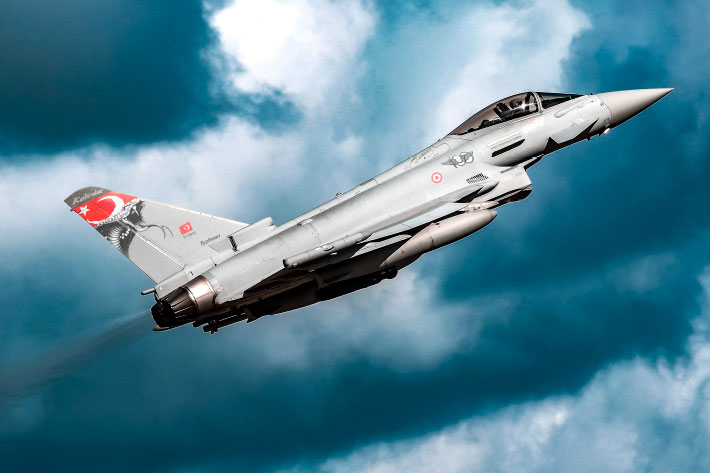
“Eurofighter is the Technology Bridge to Sixth Generation Aircraft”
To address the interim fighter jet requirement of the Turkish Air Force (TurAF) until the first squadron of the indigenously developed KAAN National Combat Aircraft becomes fully operational in the mid-2030s, the Turkish Ministry of National Defence (MoND) has initiated three parallel procurement programs. These include acquisitions of 40 F-16 Block 70s, 40 Eurofighter Typhoons, and 40 F-35A Lightning IIs. These efforts aim to bolster TurAF’s operational capabilities and enhance its air superiority, particularly in response to the Greek Air Force’s procurement of Dassault Rafale F3Rs and F-35As, which will allow Greek Air Force to maintain a technological edge over TurAF.
A major milestone in the procurement process occurred on July 23 during IDEF 2025, the 17th International Defence Industry Fair held in Istanbul, when Turkish Minister of National Defence Yaşar GÜLER and UK Secretary of State for Defence John HEALEY signed a Memorandum of Understanding (MoU). This agreement marks a critical step forward in enabling Türkiye’s potential acquisition of the Eurofighter Typhoon.
Previously, on March 13, 2025, the Turkish MoND had announced that the UK Ministry of Defence had submitted an official proposal from BAE Systems for the sale of 40 Eurofighter Typhoons. Since then, negotiations have been ongoing, primarily focusing on pricing and technical specifications. The recently signed MoU at IDEF 2025 now paves the way for final contract talks, with a potential deal expected to be finalized as early as this fall.
Speaking exclusively to Defence Turkey following the signing of the Memorandum of Understanding (MoU) at IDEF 2025, Simon BARNES, Managing Director, BAE Systems' Air Sector, said: "The signing of the MoU is an important step forward and we are now looking forward to the discussions which follow. Until now it has been a government-to-government discussion with us supporting the UK, now with the MoU in place we can get closer to those conversations and play our part." Asked about opportunities for working with Turkish Industry, he added: "BAE Systems has been working in Türkiye for around 30 years including working with TUSAŞ and ROKETSAN, so we know Türkiye has a highly capable defence and aerospace industry. We see the signing of the MoU as the beginning of something. Eurofighter is one part of this and it is a very important part, but it is the beginning of what we hope will be a wide-ranging relationship. Whether that is in uncrewed systems, whether it is in other technologies, all these things we are keen to explore with Turkish Industry and this MoU is the framework to be able to do Eurofighter, Meteor and lots, lots more, it is really exciting."
On the occasion of IDEF ‘25, the 17th International Defence Industry Fair, Defence Turkey had the opportunity to conduct an exclusive interview with Simon BARNES, Managing Director of BAE Systems’ Air Sector. The discussion focused on the Eurofighter Typhoon Program, planned technological upgrades for the aircraft, BAE Systems’ role within the program, and the share of each Eurofighter sold to Türkiye that would be manufactured in the UK.
Defence Turkey: Can you elaborate on the current status of Eurofighter Program? How many Eurofighter Typhoons have been ordered by partner nations and international customers as of July 2025 and how many of them have been delivered so far?
Simon BARNES:Today, 721 Typhoon aircraft have been ordered by air forces across the world with 609 delivered to nine air forces worldwide (Germany, Italy, Spain, United Kingdom, Austria, Saudi Arabia, Qatar, Kuwait and Oman). There are more than 480 aircraft in service across Europe with over 120 in service in the Middle East.
Defence Turkey: Eurofighter Typhoon was introduced into service across the four partner nations’ Air Forces between 2003 and 2005. How has Eurofighter Typhoon survived over the years and sustained its evolution to stay ahead of the threat? What technological upgrades are planned for the Eurofighter jets to keep them operational into the 2060s?
Simon BARNES: Eurofighter Typhoon is an aircraft which was designed with constant evolution in mind, enabling the Europe’s leading defence industry partners to constantly stay ahead of the threat. Examples range from the initial incremental improvements focusing on immediate operational needs at its entry in to service and Typhoon’s evolution into a truly swing role aircraft, capable of switching between air-to-air and air-to-surface missions. This began with Project Centurion, a UK-led initiative driven by BAE Systems, to ensure the seamless transition of key capabilities from retiring RAF Tornado GR4 aircraft in 2018, and involved the integration of three weapons – Meteor, Brimstone and Storm Shadow. A number of other Typhoon operators have benefited from this integration work including Germany (Meteor, Brimstone), Italy (Meteor, Storm Shadow), Spain (Meteor, Brimstone), Saudi Arabia (Meteor) and Qatar (Meteor, Brimstone).
As an aircraft which will continue to fly with air forces across Europe and the Middle East into the 2060s, Typhoon is constantly evolving. Today, the aircraft continues to see significant advancements in sensors, avionics and weapons systems with the evolution of its ECRS (European Common Radar System) radar and helmet technology through Striker II continuing at pace supported by funding from the Eurofighter partner nations. BAE Systems is continuing to invest in future ground-breaking capability which will provide our customers with options for their future fleets. These include a new Large Area Display (LAD) cockpit which will simplify the vast volumes of data coming in through Typhoon’s enhanced sensors, new mission systems capable of handling data 200 times faster, crewed-uncrewed teaming which would enable Typhoon to operate alongside uncrewed aircraft, and the use of artificial intelligence to support the pilots of the future.
Defence Turkey: Given the ongoing conflict in Ukraine and supply chain problems, how might the operational tempo of Eurofighter fleets in Europe affect their readiness and maintenance needs?
Simon BARNES: Across Europe, BAE Systems and our Eurofighter industry partners, Airbus and Leonardo, continue to support our partner nations air forces through our maintenance and availability support services. In the UK, BAE Systems works shoulder-to-shoulder alongside the RAF and UK Ministry of Defence to ensure Eurofighter aircraft are available when they are needed, where they are needed. This work is undertaken through the Typhoon Total Availability Enterprise (TyTAN) which has delivered new ways of working between to drive supply chain improvements while delivering the greatest value for money. This approach has delivered more than 154,000 flying hours since the contract began in 2017, including a major ramp up in demand since 2022. Across Europe, Eurofighter’s industrial base continues to innovate using new technologies and ways of working to ensure we meet the needs of our customers every day.
Defence Turkey: How is Eurofighter adapting its electronic systems to integrate with future fifth and sixth-generation fighters?
Simon BARNES: Eurofighter is regularly operating alongside fifth generation aircraft with air forces across the globe, notably the F-35 which is operated by both Italy and the United Kingdom. This mixed force is a response to the changing threats faced by air forces which today see an entirely different threat to 20 years ago when Eurofighter was entering service, and we expect to see these threats and mission sets change again over the next five, ten and 20 years. Typhoon’s ability to be interoperable with fifth generation, uncrewed and sixth generation will see it retain its critical role as the backbone of NATO’s combat air fleet. With BAE Systems and Airbus taking leading roles in Europe’s sixth generation combat air programs, Eurofighter is well positioned to ensure interoperability as part of a future force mix.
Defence Turkey: How does the Eurofighter fit into Europe’s broader air defence strategy compared to next-generation fighter programs like FCAS?
Simon BARNES: Eurofighter is the technology bridge to sixth generation aircraft. From its role in service with Europe’s leading air forces, it is uniquely placed to evolve and mature technologies which will be at the heart of future combat air programs. This ensures capability is ready to deliver when required and that Typhoon is fully interoperable as part of this future fleet.
Defence Turkey: What challenges does Eurofighter face in updating the avionics and computing hardware of the Typhoon? What are the goals of the Mid-Life Upgrade (MLU) Program for the Eurofighter?
Simon BARNES: Eurofighter is an aircraft designed with constant evolution to meet the threat in mind. The latest upgrade to the aircraft, the Phase 4 Enhancements (P4E), includes updates to its radar, avionics, flight control systems, electronic warfare and weapons integration. The Eurofighter Long Term Evolution Program will continue to deliver further upgrades boosting the growth capacity of the aircraft’s weapons system. In December 2024, the Eurofighter partner nations signed the first phase of a Technology Maturation Phase of this program, underlining their confidence and the significance in its delivery.
Defence Turkey: Which countries are identified as key potential buyers of the Eurofighter Typhoon in current campaigns?
Simon BARNES: It would not be appropriate for us to comment on individual nations, however, the exceptionally strong level of interest, commitment and investment in Typhoon, from current and new customers in Europe and the Middle East underlines the confidence of our partner nations that Typhoon will remain the backbone of combat air fleets into the 2060s and beyond.
Defence Turkey: What role does BAE Systems play in the Eurofighter program?
Simon BARNES: BAE Systems is one of three Eurofighter Partner Companies alongside Airbus (Germany and Spain) and Leonardo (Italy) which made up the industry partners of the four Eurofighter core nations. We hold a 37.5% workshare within the consortium with a wide range of responsibilities including as lead industry partner for the aircraft’s avionics and cockpit. From a production perspective, the manufacture of components including the aircraft front fuselage, spine tank and tail section is undertaken by our teams in Samlesbury, UK.
Defence Turkey: What percentage of each Eurofighter aircraft sold to Türkiye will be manufactured in the UK?
Simon BARNES: BAE Systems, as the UK’s industry lead, manufactures major unit components of all Typhoon aircraft including the aircraft’s front fuselage, spine tank and tail section from our site in Samlesbury, with final assembly of all UK-led program undertaken at our facility in Warton, UK.
Defence Turkey: Thank you for sparing your time for our readers





