``Export-Oriented Growth is at the Core of ASELSAN`s 2030 Goals!``
ASELSAN, who had previously attended Farnborough as a visitor, participated as an exhibitor for the first time this year with a 250 square-meter booth. The company showcased scale models of more than 50 indigenous products across six different technology areas: Electronic Warfare Systems, Radar Systems, Avionics Systems, Guidance Kits, Communication Systems, and Electro-Optical Systems. As one of the few companies in the world capable of providing end-to-end solutions for Land, Sea, and Air Platforms, ASELSAN achieved a revenue of $3,186 Billion in 2023 (94% of which came from defense product sales). This achievement led to ASELSAN rising five places on the world’s top 100 defense companies list, securing the 42nd position (it was ranked 47th based on 2022 sales). Currently operating in 18 countries globally, ASELSAN is set to expand its international presence to 22 countries soon.
Thanks to its dedicated efforts, ASELSAN has become one of the world's top 10 fastest growing defense companies. On September 10, 2024, the company released its "2024 First Half-Year Financial Results Note," which included inflation-adjusted financial outcomes for the first six months of 2024. According to the data, ASELSAN's revenue in the first half of 2024 grew by 8% compared to the same period last year, reaching TRY 35,7 Billion. The company's net profit also increased significantly, rising by 133% compared to the same period last year, reaching TRY 3,6 Billion. In addition, the value of new contracts signed in the first half of 2024 increased by 124% compared to the same period last year, reaching $2,6 Billion. As a result, ASELSAN's backlog, which was $11 Billion at the end of 2023, increased by 11%, reaching $12,3 Billion. When we look at the customer distribution of the 2024 First Half-Year Backlog, we see that 37% of the orders come from the Secretariat of Defense Industries (SSB), 5.8% from the Ministry of National Defense (MSB), 23.3% from TUSAŞ, 11.1% from BMC, 6.1% from the TAIS OG and STM Partnership, 4.5% from other sources, and 12.2% from international orders. Regarding the distribution of international orders, 4.7% of these come from the Middle East and Asian countries, 3.8% from Europe and the Americas, 0.8% from African countries, and 2.9% from Turkic Republics.
Defence Turkey: Can we start our interview by discussing ASELSAN's participation in the Farnborough Airshow?
Ahmet AKYOL: This is our first time participating in Farnborough with a booth. ASELSAN has set up a booth for the first time, approximately 250 square meters. In previous years, we attended as 'Visitors,' but this year, for the first time, we participated in the Airshow as an 'Exhibitor.'
Defence Turkey: So, which markets are you targeting with ASELSAN's participation here? What goals and expectations do you have for the European and UK markets?
Ahmet AKYOL: Actually, I can summarize it. As you know, technology advances step by step. In general, ASELSAN is a defense electronics company. However, within this field, we have products for land platforms. For example, when we look at radars, electro-optics, or communication systems, we can implement something on land. Then, applying it in a naval environment is a different case; taking it underwater is another case, and when you go to the air, it becomes a different case for UAVs, aircraft, and, ultimately, satellites. What has driven us to participate in this year’s airshow is the fact that, in Türkiye, we are part of electronic systems for platforms developed by TUSAŞ, BAYKAR, and other projects. These systems are not only delivered to the Turkish Armed Forces but also to allied and friendly nations. These systems are now being used operationally in the field, supporting various air platforms. We believe it is now the right time to bring these systems to the international market.
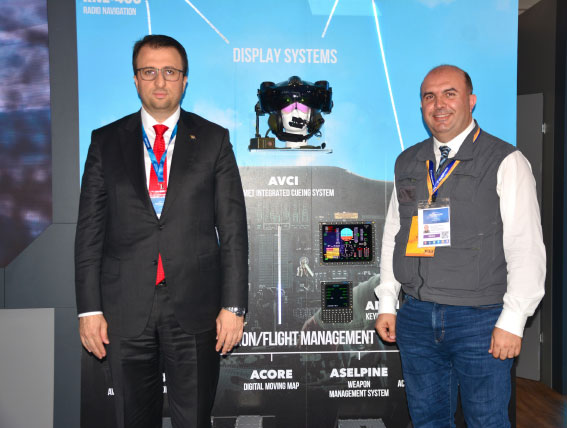
As you can appreciate, Türkiye has only recently begun exporting helicopters, particularly in the last 3-4 years. You have seen the exports of ATAK helicopters, HÜRKUŞ, BAYRAKTAR, AKINCI, and ANKA platforms. In the last 4-5 years, we have witnessed significant activity in the domain of exporting air platforms. What does this mean? ASELSAN's electronic systems are integrated into all these platforms. Now, when I showcase one of our products, I can confidently say that not only the Turkish Armed Forces but also several other countries are using it. And we have now opened these systems up to international collaboration. In terms of our booth, we have grouped our products as follows: electronic warfare systems, particularly self-protection systems, are on display. Right next to them, we have radars for all air platforms. Then there are avionics systems, with some of the systems currently operational on the GÖKBEY helicopter also on display here. In another section, we showcase guidance kits, electronics, and communication systems. When you look at it, you can see all the electronic functionalities of an air platform represented here. In total, we have over 50 products on display. The main idea is to increase our international collaborations. We have established ASELSAN's plans and programs for the upcoming period, spanning 2024 to 2030. We are executing a comprehensive program that includes the transformation of ASELSAN's internal processes, digitization, enhancing serial production capabilities, new initiatives in human resources, along with roadmaps for products and technology.
We are executing all these initiatives under the ASELSAN 2030 Program. At the core of this program is our aim to always develop the best product in its field, as demanded by our end-users, to deliver game-changing systems, and to focus on growth through international collaboration and exports. All of ASELSAN’s teams are currently aligned with this vision. What are we discussing today? We are talking about the AESA Nose Radar. When we design this radar, we aim to ensure that it can compete with and even outperform its counterparts. If there is an area of activity that we cannot offer competitively in the export market, we prefer not to pursue it. Our main idea is to focus on developing competitive, high-performance solutions that we can offer internationally, driving ASELSAN’s growth through international collaboration and exports. This is our primary mission.
Defence Turkey: You mentioned the MURAD AESA Nose Radar. There are high expectations for it, both manned and unmanned platforms. The first flight was conducted on the ÖZGÜR prototype, and preliminary work is being done for its integration on AKINCI, with some modifications being made for that platform. Is there an operational timeline for MURAD? How long is the testing phase expected to last?
Ahmet AKYOL: Our target is as follows. Flight tests are currently ongoing, and at the same time, production has already begun.
Defence Turkey: For MURAD?
Ahmet AKYOL: Yes, exactly. So, at this stage, we are mainly focused on optimization. All of the critical functions have been implemented. From what I can see, though some aspects depend on the end user’s feedback and their experiences, we believe that MURAD could be operational on fighter jets in about two years.
Defence Turkey: One of the factors that facilitate the development process and increase the effectiveness of such new avionics is the testbed aircraft. The need for a test aircraft has been a topic of discussion for TUSAŞ, ASELSAN, and SAGE. Most recently, TUSAŞ acquired a second-hand Bombardier Global 6000 business jet last year. Will the MURAD AESA Nose Radar be tested on this aircraft, or will we only see it on AKINCI and the ÖZGÜR prototype?
Ahmet AKYOL: Testbed aircraft will be used in all the steps of the National Combat Aircraft Project for all payloads. However, Türkiye has a significant advantage in owning a world-leading UAV company. Today, all the products you see on these air platforms are tested on our own AKINCI, BAYRAKTAR, and sometimes on AKSUNGUR and ANKA, but primarily, AKINCI provides a great opportunity. We can address most of the requirements using AKINCI. If there are any gaps, they have already been implemented on fighter jets, and right now, it is also flying on fighters. But the main advantage is being able to fly for long hours on something we own and getting feedback from our own Turkish engineers. It is a huge opportunity. To put it this way, there is a test happening on AKINCI every single day. That’s how we view it—a massive opportunity. BAYKAR’s infrastructure and agile, proactive approach in advancing technologies is highly appreciated by our engineers. We are very pleased with it. It provides us with flexibility to test any of our products in the air, in any case we need, which gives us great flexibility. This has made a major contribution to the development of these payloads and the industry. Additionally, the Turkish Armed Forces provide immense support. Whenever and under whichever conditions we need to test a system, our heroic Armed Forces always offer us those opportunities. If the Turkish Defense Industry has reached this level today, there has been a lot of effort, but the Turkish Armed Forces also play a big part by using, testing, and applying these systems in real field conditions. I would like to express my gratitude to them individually.
Defence Turkey: When we look at ASELSAN's product range for 2024, there are many significant projects. For example, in the Hava SOJ project, we are expecting the delivery schedule for the first aircraft. MURAD has made its first flight on the ÖZGÜR prototype, and there are developments related to MURAD. In the field of Electronic Warfare, we also have UAV SOJ and HEDET. Could you mention the key milestones expected in the second half of 2024?
Ahmet AKYOL: First of all, as I mentioned earlier, we have developed ASELSAN's Technology and Product Roadmaps for 2024-2030. During this process, we have eliminated some projects that wouldn't allow us to be competitive or that we felt were not suitable for a company of our size. This process is still ongoing, it's a continuous, dynamic process. The main idea is to focus on and invest in more challenging, forward-looking products and fields that Türkiye needs. So, we are focusing our efforts, and there are some areas we've completely closed off. At the same time, I'd like to draw a comparison by saying that ASELSAN operates internally according to private-sector principles. While it is a company of the Turkish Armed Forces Foundation and thus an asset of the Turkish people, our internal operations—such as recruitment criteria, performance systems, and year-end evaluations—are managed like an international company. This approach makes the structure highly efficiently focused and dynamic. Of course, there is still a long way to go. We will continue to streamline our internal processes to improve efficiency, enhance our digital transformation, and refine our performance system, among other things. We also have a supply chain of over 3,000 SMEs in Türkiye. But we don't just view them as suppliers. We support some at the entrepreneurship stage and involve others in design, production, or consultancy. We are consolidating the strength of Türkiye. Additionally, we have an operational army in the field driving us to get systems into service as soon as possible, which keeps the system dynamic. We stay focused on our objectives and regularly measure our progress every three months, asking where we should be, where we are, and where we need to go. Now, looking at the activities for this year, you mentioned Hava SOJ. We've completed the first payload, and after the implementation at TUSAŞ, it will proceed to flight. This year, for instance, we introduced the YILDIRIM DIRCM product, which took part in NATO trials. This is a significant milestone as Türkiye participated in NATO trials with its Electronic Warfare Self-Protection System for the first time. We participated with a real product in real demo engagements. Only countries capable of producing DIRCM can join these trials, and we have a new product in that field this year. In the radar domain, we conducted flight tests of the AESA Nose Radar. We delivered the ALP Radar (ALP-300G Portable Early Warning Radar System), and by the end of the year, we will have the ALP-100G Low Altitude Radar in inventory. Looking at avionics, the RNE (Radio Navigation Equipment) entered inventory this year with helicopters. The Mission Data Recorder, known to the public as the "black box," had its first delivery to TUSAŞ. All of these are products that Türkiye used to import. Additionally, you can see ASELFLIR-500, which was exported to its fourth country last week, and it has only been three months since it entered our inventory.
Defence Turkey: While attending the WDS 2024 Fair, Saudi Arabia was also showcasing its stand. At that time, they mentioned that production would take place in their own facilities in Saudi Arabia. Is that still the case?
Ahmet AKYOL: We are still working on the Saudi Arabia case. But on our side, we've already exported to a fourth country. I've mentioned a few times how good our camera technology is. This year, we showcased our Tactical Datalink (T-Link) for the first time. It's a product that only a few countries in the world can produce, and it is now just days away from entering inventory. If you look at it, we add at least one or two products to the inventory in every area of activity. Last year, we brought GÖKDENİZ into the air defense inventory, and now the fourth export contract has been signed with the fourth country.
Defence Turkey: Speaking of GÖKDENİZ, there were many systems produced by Turkish firms on the first PN MILGEM Corvette, PNS BABUR, built for the Pakistan Navy, but the GÖKDENİZ Close-In Weapon System hadn't been installed yet. Can you explain the reason for this?
Ahmet AKYOL: Some products were added to the project timelines later. It's just a reflection of things that happen in the timeline.
Defence Turkey: Seeing that it wasn't installed raised questions about whether they had canceled the order.
Ahmet AKYOL: No. Pakistan is our closest ally, and our relationship with them is very strong.
Defence Turkey: You also mentioned the aviation. Which ASELSAN equipment and avionics are used in HÜRJET?
Ahmet AKYOL: Many of the avionics you see here. To give specific names, I'd need to look at the list, but most of the systems found on other platforms are also on HÜRJET and even more. Fighter versions are also being discussed. It's a highly capable aircraft. Compared to the standard HÜRKUŞ, for example, you can install the ASELPOD or convert it to an armed version. So, it has a broader range, but generally speaking, the avionics equipment is similar to what's on other platforms.
Defence Turkey: Could you provide an update on ASELPOD exports?
Ahmet AKYOL: We've exported it to three countries: Pakistan, Nigeria, and Iraq.
Defence Turkey: What's the current status of ASELPOD-II?
Ahmet AKYOL: It's currently under development.
Defence Turkey: What differences will there be between the two products? Will different sensors be used, for instance?
Ahmet AKYOL: That's a very technical question. In aviation, there's a golden rule that never changes: consume less power, fit into a smaller space, reduce weight, and increase range. Each new development improves on these characteristics. These features will certainly be enhanced, but I don't want to give incorrect information by guessing the specific technical differences off the top of my head.
Defence Turkey: You mentioned space earlier. Recently, you signed a contract for the SAR antenna for the GÖKTÜRK III Project. Can you elaborate on the technology that will be used there? Will it be electronically scanned or mechanically steered?
Ahmet AKYOL: For the GÖKTÜRK III (Earth Observation Satellite), we are not just delivering the SAR antenna but the complete SAR Payload. You may have seen the SAR pod at our stand, and we are showcasing it here. SAR is a radar technology that provides operational advantages under certain conditions. We are also displaying the version for UAVs here. As you know, SAR has various modes, particularly in the image processing phase after imaging. We are developing a version for space that is equipped with advanced image processing algorithms and various SAR modes. Of course, there is a whole discipline shift when moving into space, but ultimately, we have already developed SARPER, and now we are showcasing the SAR pod. We have this technology. Our next goal is to take this capability to space and adapt it, in scale and functionality, for satellite use.
Defence Turkey: You mentioned earlier that ASELSAN has developed its Technology and Product Roadmaps for 2024-2030. What kind of ASELSAN will we see in 2030? You talked about downsizing and shortening production processes…
Ahmet AKYOL: Actually, we are not downsizing. We are shedding unnecessary tasks that don't align with our vision. We grow by 10% each year. There's no such thing as shrinking. We are simply becoming more focused, targeting more challenging technologies that are more fitting for ASELSAN. We've managed to achieve an average growth of 10% annually, and within our program, we aim to rise from 47th to 30th place on the Defense 100 Top List by the end of 2030.
Defence Turkey: One of the areas where ASELSAN has been most criticized or seen as lacking is its export figures. What are your thoughts on this?
Ahmet AKYOL: We still have a lot to do in terms of increasing exports, but ASELSAN’s products are present in all of Türkiye’s platforms. These are recorded in our systems. For example, let’s take Pakistan as a case—it’s a good example. We provide all the sensors on that ship, and ASELSAN equipped nearly the entire vessel. There are about 48 different ASELSAN systems on one MILGEM. We equipped the ship, and it went to Pakistan. What do the customs records show? The sale was made by ASFAT. Does that mean ASELSAN didn’t export anything? Of course not. ASELSAN sits at the heart of the system. Whether it’s on ships, land vehicles, tanks, aircraft, satellites, or submarines, ASELSAN provides high-value-added products in all these areas. That being said, we still have a long way to go in terms of making direct exports. Additionally, as I mentioned earlier, export-driven growth is at the core of ASELSAN’s 2030 objectives.
Defence Turkey: Export-driven growth also means staying close to the customer and being able to offer on-site services. When a customer buys a product from you, they often want local maintenance support as well. Does your 2030 plan include setting up centers in target markets for maintenance, training, and logistical support?
Ahmet AKYOL: ASELSAN is currently active in 18 countries, and soon we will expand to 22. This is fundamental to our approach. We aim to have direct relationships with our customers in each country at every level—whether it’s marketing, logistics, or project management. We’ve adopted local management at every stage. It’s a long-term investment. Every country expects to see your presence within its borders. In the defense industry, these relationships typically last 3, 4, 5, or even 6 years, involving long-term collaborations. We are structuring ourselves accordingly to meet those expectations.
Defence Turkey: Thank you, Mr. AKYOL, for taking the time. On behalf of our readers, we wish you success in your future endeavors