FIA24 Closed with Record-Breaking Participation and Total Value of Signed Contracts
Boasting a 33% increase in visitors, a 57% increase on delegation attendance, and commercial deals valued at $105.8 Billion the Farnborough International Airshow 2024 (FIA24) concluded with unprecedented results, setting records in both the number of participants and the total value of contracts signed during the event.
As one of the world’s largest Airshows, FIA24 attracted top industry players, including commercial aircraft manufacturers, defense contractors, and suppliers, marking a major milestone for the aviation and aerospace sectors. The high level of participation and the volume of business deals signed underscored the recovering strength and growth potential of the industry, particularly in light of recent global economic challenges. This year’s airshow showcased cutting-edge technologies, next-generation aircraft, and innovative defense systems, further fueling the optimism around the sector's future.
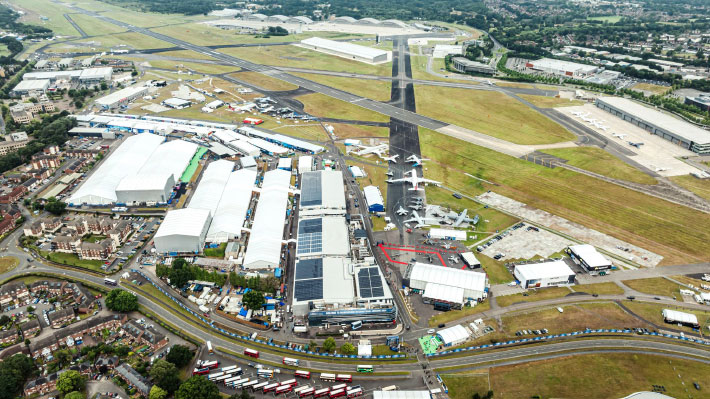
Since 1948, the Farnborough International Airshow has been held every two years. It is organized by Farnborough International, which is a wholly owned subsidiary company of ADS Group, the UK trade organization representing the aerospace, defense, security and space sectors, and hosted at Farnborough International Exhibition & Conference Center sitting alongside Farnborough Airport, Europe’s leading business airport, located approximately 48 km (30 miles) southwest of London. The event derives its name from this airport, which has long been associated with aerospace innovation and aviation history. As one of the world's largest aerospace exhibitions, Farnborough serves as a hub for showcasing the latest advancements in both commercial and military aviation, as well as related industries.
Inaugurated by the United Kingdom (UK)’s new Prime Minister, Sir Keir STARMER, the 45th edition of the Farnborough International Airshows, FIA24, was held from July 22 to 26 and saw unprecedented participation, setting new benchmarks for the aviation industry. The event welcomed 100.358 visitors from 114 countries, 1.716 media/press members, including Defence Turkey & Aviation Turkey Magazines, from 56 countries and 1.427 exhibitors (of which 190 were new exhibitors) from 41 countries, as well as showcased 103 civil and military aircraft (both in the static and flying displays). Additionally, it attracted 423 civil, military, and space delegations from 59 countries.
The show’s platform, divided up into 6 themes (space, defense, sustainability, innovation, future flight and workforce) provides a comprehensive look at the technologies of tomorrow. As a biennial, world-class exhibition for the aviation and aerospace sectors and is recognized as the must-attend event in the aerospace calendar that continues to build on its successes year-on-year, the FIA24 has hosted 21 international pavilions. Australia, Austria, Canada, France, Italy, Japan, Norway, Mexico, Malaysia, Spain, Portugal, South Korea, Türkiye (with 16 companies), the USA and the UK are among the countries that participated the event with national pavilions.
According to organizer company Farnborough International, the FIA24 generated deals at list prices worth £39,3 Billion ($50,8 Billion) on its first day, and a total of $105.8 Billion across the show’s first four days. In this context, 260 firm commercial aircraft orders from Airbus and Boeing and more than 1.000 engine orders from GE Aerospace, CFM International, Pratt & Whitney, and Rolls-Royce were made across the show’s first four days. The commercial aircraft and engine orders announced during FIA24 are estimated to worth £13 Billion to the UK economy. During FIA24, the European aircraft manufacturer Airbus received a total of 164 aircraft orders, while its arch-rival the US aircraft manufacturer Boeing took only 96 orders and commitments plus 22 options. However, both Airbus’ and Boeing’s orders are significantly below from the orders placed during Paris Air Show 2023. During Paris Air Show, Airbus took 846 orders, and Boeing secured 356 aircraft orders.
As in previous years, the main theme of the Farnborough International Airshow 2024 was sustainability and zero carbon emissions. As expected, a large number of startups working across electric vertical take-off and landing (eVTOL) aircraft, hydrogen-powered planes and other next-generation projects were prominent at the FIA24. Advancements in hydrogen, hybrid-electric technology, and Sustainable Aviation Fuel (SAF) were showcased to achieve net-zero carbon goals. While visitors saw numerous eVTOL prototypes and mockups, including Embraer’s EVE, Joby Electric Air Taxi, and Boeing-backed Wisk V6, no flying platform that had completed the certification process for passenger transportation was exhibited. However, the progress in these projects was quite fascinating.
Military technology continues to be one of the biggest components at Farnborough, with aircraft including; the Airbus A400M and C-295MW, Embraer’s KC-390 Millennium and A-29 Super Tucano, Leonardo’s M-346-FA, AW139, AW149 and H160 (scale model), Royal Navy’s Leonardo AW159 Wildcat HMA2, USAF’s Lockheed Martin F-35A Lightning II and F-16CJ Fighting Falcons and Boeing F-15E Strike Eagle, US National Guard’s C-130J and MQ-9 Reaper, US Army’s Boeing AH-64E Apache Guardian, Sikorsky UH-60V Black Hawk and Boeing CH-47F Chinook, US Navy’s P-8A Poseidon MPA, Italian Air Force’s Eurofighter Typhoons, RAF Typhoon FGR4 and Chinook HC6A, Royal Danish Air Force’s F-16AM Fighting Falcon, Qatar Emiri Air Force’s Boeing F-15QA Ababil and TUSAŞ’ T625 GÖKBEY.
Compared to the last two Farnborough Airshows, the flying displays has a more defense related focus. The Daily flying displays at FIA24 changed day by day with only a few core displays that appeared everyday. In addition to T625 GÖKBEY, KC-390 Millennium, Qatar Emiri Air Force’s F-15QA Ababil, RAF’s F-35B (performed flypass) and Chinook HC6A, US Navy’s P-8A Poseidon, Royal Danish Air Force’s F-16AM Fighting Falcon and USAF B-52 Stratofortress (performed flypass) performed flight demonstrations, while the British Army’s world-famous Red Devils Parachute Display Team took part in the opening of Tuesday’s flying displays. Meanwhile, the Global Combat Air Program (GCAP) partners (UK, Italy, and Japan) have unveiled the new concept model of their next-generation combat aircraft at the BAE Systems Hall (Hall 5) during the Farnborough International Airshow 2024 at Farnborough International Exhibition and Conference Centre in Farnborough, England. The GCAP combat aircraft, set to be in service in 2035, will be one of the world’s most advanced, interoperable, adaptable and connected fighter jets in service, boasting an intelligent weapons system, a software-driven interactive cockpit, integrated sensors and a powerful next generation radar capable of providing 10.000 times more data than current systems, giving it a battle-winning advantage.
According to organizer company Farnborough International, more than 100 companies have already rebooked for the 46th edition of the Farnborough International Airshow, FIA26, scheduled for July 20-24 at Farnborough International’s Exhibition & Conference Centre.
Participation of Turkish Defense and Aerospace Industry in the FIA24
Under the auspices of the Secretariat of Defense Industries (SSB) and with the support of the Defense and Aerospace Industry Exporters' Association (SSİ), 16 Turkish Defense and Aerospace Industry companies represented Türkiye at FIA24 in the Turkish Pavilion in Hall 4. ALP AVIATION, ASELSAN, C2 Tech, EMGE ELEKTRO MEKANİK, EPSILON COMPOSITE, Kale ArGe, OSSA, SASAD, SAHA İSTANBUL, SAVRONİK, TEI, TUSAŞ and Turkish Airlines were among the companies representing Türkiye in the Turkish Pavilion in Hall 4. Turkish Airlines (THY) and TUSAŞ also hosted their guests in separate chalets. At the static display area TUSAŞ displayed full-scale mock-ups of the T625 GÖKBEY Turkish Light Utility Helicopter (TLUH) and the HÜRJET Next Generation Advanced Jet Trainer (AJT). TUSAŞ also made an eye-catching contribution to the flying display with the six-ton class twin-engine T625 GÖKBEY Light Utility Helicopter.
The most important agreement for Türkiye during the FIA24 was the cooperation protocol signed between TUSAŞ, TEI, and GE Aerospace covering HÜRJET engine assembly, testing, control, maintenance, repair, and overhaul. Within the scope of the agreement TEI would assemble, inspect, and test GE Aerospace’s F404-GE-102 Turbofan Engines integrated into the HÜRJET Next Generation AJT. On July 22, 2024, GE Aerospace announced that it has signed a Memorandum of Understanding (MoU) with Turkish Aerospace and TUSAŞ Engine Industries Inc. (TEI) to evaluate and collaborate on integrating GE Aerospace’s F404 engine into new HÜRJET aircraft variants, an extension of the companies’ current relationship on the HÜRJET Program.
The prior agreement among the three companies saw the F404 engine successfully incorporated into the Turkish Air Force’s HÜRJET AJT, which is currently undergoing qualification. The HÜRJET is expected to be highly competitive in the global training jet market. “This aircraft fulfils a critical role in modern pilot training by delivering excellent performance in a single-engine, tandem-seat configuration, alongside modern avionics and high-performance features. We believe this MOU will bring success to all parties,” said Dr. Mehmet DEMİROĞLU, President and CEO of Turkish Aerospace (TUSAŞ).
The HÜRJET is a twin-seat, single-engine supersonic Next Generation Advanced Jet Trainer (AJT) and Light Combat Aircraft (LCA). Powered by a General Electric F404-GE-102 Turbofan Engine generating 17,600 lb of thrust, the HÜRJET is designed to have a maximum speed of Mach 1.4, G-limit of +8G/-3G, a service ceiling of 13,716 m (45,000 ft), a climb rate of 39,000 ft/minute, a range of 2,222 km (1,200 nm) and a payload capacity of 2,721 kg. With its advanced human-machine interface (HMI), glass cockpit design, digital flight control system (fly-by-wire), and internal tactical and virtual training systems, HÜRJET will offer a new-generation aircraft flight experience. Following the production of four flight prototypes for the Trainer version, TUSAŞ plans to produce a new prototype for the Light Combat Aircraft (LCA) version.
HÜRJET’s FIA24 Participation & SASF’s AJT Procurement Program
HÜRJET’s first flying prototype (P1) was planned to participate in the FIA24, but the decision was made to withdraw at the last minute due to a technical issue related to the avionics system that occurred during a test flight conducted a few days before the airshow. After the technical issue was resolved, the aircraft was flown from Ankara, Türkiye to Torrejón Air Base in Madrid, Spain, for evaluation by the Spanish Air and Space Force (SASF). On the afternoon of July 28, 2024, accompanied by a Turkish Air Force (TurAF)’s A400M, the first prototype of the HÜRJET arrived at the Torrejón Air Base.
The Spanish Air and Space Force (SASF) has been in search of a new generation jet trainer aircraft since 2023 to replace the SF-5Ms (license-produced by CASA). They plan to have new aircraft in 2028 in Spain for the training of fighter and attack pilots. Turkish Aerospace’s HÜRJET is one of 4 candidates (including Boeing T-7, KAI T-50 and Leonardo M-346) of the SASF to replace its aged SF-5M Freedom Fighter Advanced Jet Trainers (designated as AE.9). If selected, the HÜRJET Next Generation AJT would replace the SASF’s 19 Northrop SF-5Ms operated by Ala 23 (23rd Wing) based in Talavera La Real (Badajoz) airbase, which gives advanced flight training to SASF pilot candidates to fly EF-18M Hornets and Eurofighter Typhoons.
If SASF select the HÜRJET, which promises innovative technologies and functionalities, the total number of aircraft has the potential to increase from 24, for which negotiations are currently ongoing, to 40. According to sources, Spain offered Türkiye to pay for the purchase of 24 HÜRJETs through the sale of 6 A400Ms to the Turkish Air Force over Airbus (i.e. through barter method). TurAF has been working for a while to increase the number of A400Ms in its inventory, which is 10, but could not make additional purchases due to budget constraints. Sources revealed to Defence Turkey that, the President and CEO of Turkish Aerospace requested a meeting with the Commander of the SASF to discuss HÜRJET Next Generation AJT and SASF’s new generation jet trainer aircraft requirement, and the meeting has been approved. New developments regarding the potential sale of HÜRJET to Spain are expected to be made public in October. According to our sources, within the scope of the Spanish Air and Space Force (SASF)'s next-generation AJT Pogram, In lieu of direct procurement of HÜRJET from Türkiye, it is asserted that an alternative option is under consideration, whereby Spanish companies will also have local technological participation.This collaboration could transform HÜRJET into a next-generation European Advanced Jet Trainer (AJT) Project, developed through the partnership of TUSAŞ, Spanish Companies. As a result, HÜRJET could attract further demand from other European countries seeking next-generation AJT.
During Egypt International Airshow, HÜRJET’s flying prototype (P1) was also showcased by Turkish aerospace at the El Alamein International Airport near Alexandria, where the event took place. and performed a demonstration flight over the pyramids of Egypt on September 4, 2024. As of July 11, 2024 the HÜRJET P1 had conducted a total of 79 sorties during which a total of over 70 flight hours had been accumulated. And, as of October 8, the number of sorties conducted by the HÜRJET P1’s has increased to 130.
On January 12, 2022, at the Defense Industry Executive Committee Meeting, a decision was taken for Serial Production for HÜRJET, and in the first phase, and in December 2022 orders were placed for the first batch of 4 aircraft (in Block 0 configuration + 12 options) for the TurAF. According to this contract by the end of 2026 TUSAŞ will deliver 4 HÜRJETs in Block 0 configuration (HÜRJET P1, P2, P3 and P4 prototypes) to the TurAF and the deliveries of other 12 aircraft in Block 1 configuration will be completed by the end of 2028. With the contract signed on April 18, 2024, between TUSAŞ and the SSB a firm order for 12 additional HÜRJET Block 1, which was included as an option in the agreement signed in December 2022, was placed. The new Block 1 HÜRJETs will supplement Block 0 aircraft ordered in December 2022. HÜRJET Block 1 aircraft will first serve in the Turkish Stars Squadron (134th Acroteam Squadron Command), an acroteam of the Turkish Air Force Command, based in Konya, at 3rd MJB and will replace NF-5A/B 2000 aircraft currently in the service.
The HÜRJET Project is aimed at the development of an indigenous next generation Advanced Jet Trainer (AJT), able to perform supersonic flight to replace the T-38M AJTs and NF-5A/B 2000 aircraft in the service of the TurAF in 2030s, and a Light Combat Aircraft (LCA) able to perform a Close Air Support (CAS) role to assist and release the load off the TurAF’s F-16C/Ds shoulders. TUSAŞ also envisions a Naval variant of the HÜRJET capable of operations on aircraft carriers, expanding its utility into naval aviation for strategic maritime missions. The indigenous advanced jet trainer HÜRJET will be utilized to train and prepare pilots for the next generation KAAN National Combat Aircraft (NCA) in the 2030s. Currently the TurAF operates 68 T-38M Advanced Jet Trainers in Advanced Jet Training and Combat Readiness Transition Training at Çiğli Air Base (2nd Main Jet Base Command) in İzmir.
Airbus Unveiled New Version of A330 MRTT, MRTT Evolution, at FIA24
Airbus launched the new version of the A330 Multi Role Tanker Transport (MRTT), called MRTT Evolution, also known as MRTT+, at the FIA24 on July 23, 2024. Airbus plans to bring the MRTT+, to the market later this year and hopes to have full certification of the MRTT+ in 2025. The CEO of Airbus Defense and Space, Michael SCHOELLHORN, said that the program will be officially launched before the end of 2024, with customer deliveries to commence by 2030.
The A330 MRTT Evolution is based on the A330neo (A330-800) airframe and features three key improvements compared to earlier models: new-generation wings, optimizing aerodynamics and an innovative “sharklet” wingtip design, new-generation Rolls Royce Trent 7000 engines, and an 8% fuel efficiency gain. The transition from the existing airframe, A330-200, to the A330neo will be seamless, using the same fuselage and MRTT capacity, same training for crews, 95% commonality in parts, and same maintenance procedures.
The A330 MRTT+ also features patented nacelle and pylon design to reduce drag, a modernized cabin interior and furnishings. Airbus chose the A330-800 model over the A330-900 with the aim of increasing cargo capacity. Thus, the MRTT+ will increase range by 8% and provides more offload capacity than any tanker in the world. According to Maria Angeles MARTI, Head of Tanker and Derivatives at Airbus Defense and Space (ADS), the MRTT+ would deliver a significant capability edge over the Boeing KC-46 tanker, equivalent to 33 percent greater range than the competitor platform.
Since the first delivery of an A330 MRTT tanker aircraft to the UK Royal Air Force in 2011, Airbus has received a total of 82 confirmed MRTT orders from 10 operators in 15 user nations. Of these, 60 have been delivered, securing Airbus a 90% share of the tanker aircraft market over the past decade. The A330 MRTT has been ordered by launch customer Australia, France, NATO’s Multinational MRTT Fleet (MMF, which includes countries such as Germany, Belgium, the Czech Republic, the Netherlands, Luxembourg, and Norway), Saudi Arabia, Singapore, South Korea, the United Arab Emirates, the United Kingdom, Spain and Canada.
The MRTT fleet has accumulated a total of 300,000 flight hours to date. Among the aircraft, the UK Royal Air Force’s MSN-1046 stands out with over 18,000 flight hours, making it the aircraft with the most flight hours. The longest continuous flight was recorded by the United Arab Emirates Air Force’s A330 MRTT, staying airborne for 16 hours.
Previously, in 2018, Airbus introduced a more advanced version of the A330 called the “Enhanced MRTT”, with the Singapore Air Force being its first customer. In 2019, Airbus added the “Smart MRTT” capability to this configuration, which allows for fully automated in-flight refueling. The Smart MRTT was developed in line with Singapore Air Force’s requirements.
To meet the evolving needs of the tanker aircraft market, Airbus is now introducing the MRTT Evolution or MRTT+, the latest version of the A330 MRTT. Customers can still choose the previous version of the MRTT or, as in the case of recent interest from the Turkish Air Force, opt for the integration of MRTT systems onto a second-hand A330-200 airframe