Feels Like a Fighter
Technical Background
The G 120TP is a development of the G 120A and retains the same massive bubble canopy, retractable gear and carbon fibre fuselage/wings/tail but with a new nose section to house the Rolls-Royce turbo-prop engine and a completely new, digital, cockpit. The all carbon fibre construction endows the aircraft with light weight, exceptional strength, no corrosion, exceptionally smooth aerodynamic surfaces, easy repair and a quoted structural service life of 15,000 flying hours. Max Take off Weight (MTOW) is 1515 kg (utility)/1440 kg (aerobatic); Max Landing Weight (MLW) is 1440 kg; Basic Empty Weight is 1140 kg. Full fuel capacity is 275 kg which, when combined with an assumed combined instructor + student weight of 200kg, means that the G120TP should not be weight restricted when readied at the start of an ‘instructional day’. Aerobatic limits are +6G/-4G, max operating altitude is 25,000 ft (crew oxygen/unpressurised) with an initial quoted rate of climb of 2855 ft/min at MTOW/MSL/ISA. The aircraft will be cleared for VFR/IFR/Day/Night operations in non-icing conditions.
The new G120TP engine is a Rolls-Royce 250-B17F TP rated at 380 SHP (max continuous power) or 456 SHP (max power/5 min limit). The RR 250-B17F is already widely used in helicopters. The use of Jetfuel eliminates the complexity and expense of using AVGAS. The engine drives a short span, 5 bladed, MT propeller that features reverse thrust (propeller in beta range). Vmo is now increased up to 238 KIAS (0-12,500ft) and Mmo is M0.45 (above 12,500ft). Max range at 10,000 ft is 725 NM. The take off distance to 50 ft is just less than 380 m and the landing distance from 50 ft is just less than 450 m. These are outstanding performance figures for this class of aircraft.
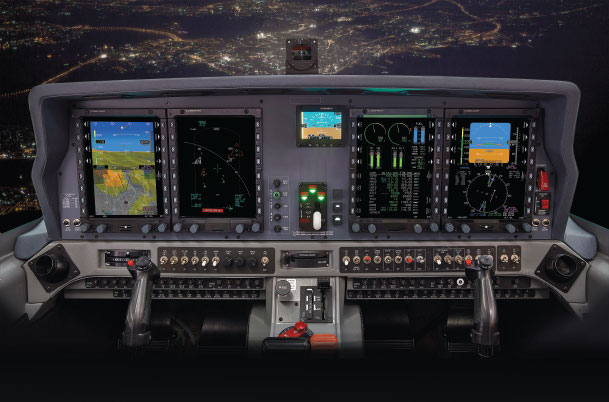
Even more impressive is the digital G 120TP cockpit. These upgrades will include:
an instrument console that will feature four Cobham Avionics 8x6in electronic flight information system (EFIS) multi-functional displays and a digital (standby) combined flight display, giving a fully ‘glass’ cockpit.
left and centre EFIS displays will be multi-functional and programmable to display ground moving tactical map, aircraft systems synoptic pages and electronic checklists.
an individual power lever (to left side of each seat) acting as a single ‘jet like’ lever.
The quoted performance envelope and the above cockpit upgrades grant the G 120TP a level of tactical sophistication and training potential that is little short of revolutionary in this type of ‘elementary/basic’ training aircraft. The G 120TP is certified to EASA CS-23 regulations.
Evaluation
On strap in, the cockpit immediately felt spacious with the canopy offering an almost 360 deg field of view (FOV) including rearwards over the horizontal stabiliser and fin. The Grob target is to accommodate a 3%-97% pilot percentile range.
Engine power is controlled by %torque (TQ) with approx 90%TQ equating to max continuous power (MCP).
Power response and acceleration on take off was jet like and I noticed virtually no ground swing. With 120 KIAS achieved by the end of the short runway, I banked the aircraft over sharply in a 70-80 deg wingover whilst maintaining 120 KIAS and climbing at approx 3000 ft/min. My impression during the wingover was that this aircraft immediately felt like a mini-fighter because it was so powerful and yet the power was so linear and jet like in its delivery.
Several 3 turn spins were then conducted from FL90, starting from 80 KIAS. Standard spin recovery showed the aircraft taking one turn to recovery. With recovery from the dive to level flight, a complete 3-turn spin event used just 2500 ft of altitude. I continued to marvel at the power and smoothness of the engine/propeller combination. If height was needed to be regained at medium level for a training event, the aircraft was simply zoomed effortlessly back to the starting altitude, like a jet.
At 500 ft AGL, 90%TQ gave a 210 KIAS cruise with a large power margin in hand and a fuel flow rate of just 2 kg/min!! The low level performance of this aircraft was amazing.
Returning to the airfield, several tight visual circuits were flown to both overshoot and to roll. Typical downwind was 120 KIAS with take off flap and gear selected, turning finals at 100 KIAS with full flap selected for an 80 KIAS final approach. The aircraft exhibits excellent speed stability and maintaining approach angle/airspeed, very accurately, seemed almost effortless. Going deliberately low on approach could be instantly corrected with a 1 sec burst of power without yaw, power lag or TQ over-swing.
Both sorties were one hour each in flight duration and each used just 80 kg of Jet fuel.
Conclusion
In my opinion, the G 120TP now renders all of its current single engine propeller competitors in the ‘elementary/basic’ category virtually obsolete. The exquisite matching of the Rolls Royce 250-B17F turbo-prop to its 5-bladed MT propeller and to the Grob G120 airframe is an undeniable success. However, much more than this, I believe the G 120TP represents a ‘systems of systems’ training concept that will revolutionise future military training standards beginning from a student pilot’s first day. The G 120TP concept offers a level of ‘embedded front line simulation’ training capability and sophistication that many front line Air Forces currently do not possess, even at the present ‘advanced/tactical’ stages. The advantages of introducing initial student pilots to a 21st century configured trainer, when they are selected to fly 21st century front line types in a 21st century Air Force are, to my mind, immense.
I feel that the G 120TP is a natural complement to the higher performance (but more expensive) Pilatus PC-21/Aermacchi M311 FAST (Flight, Attack and Systems Trainer) types and the Aermacchi M346/KAI T-50/Hawk 128 LIFT (Lead-In Fighter Trainer) types. The G 120TP comes with such a low purchase price and minimal direct operating costs (DOCs) but with such high performance and massive training potential for its size, that the complete ‘package’ seems to me, to be simply incredible value for money.