Fire and Damage Control Training Simulators Delivered to Naval Forces
Commander of the Naval Forces Full Admiral Bülent Bostanoğlu, Fleet Commander Full Admiral Veysel Kösele, and Deputy Undersecretary for Defense Industries Mr. Mustafa Şeker, Defense Industry Department Head Mr. Süreyya Yiğit, Meteksan Defense President Mr.Tunç Batum and many senior military and defense representatives attended the ceremony held at the Yıldızlar Surface Training Center Command at Gölcük.
In his speech at the ceremony, Commander of the Naval Forces Full Admiral Bülent Bostanoğlu stated that as they directly influence the stopping power, the fire and damage control platforms which are among the floating, dipping and air-mobile platforms’ internal combats’ critical issues are as important as the exterior combat categories and therefore all the unit personnel from the unit commander to the lowly enlisted private soldiers should always remain trained and prepared on “fire and damage control” issues.
Bostanoğlu underlined that the Turkish Naval Forces - fully aware of the importance of this issue - had always prioritized the fire and damage control subject and the establishment of Turkey’s first Fire Training Center under the name of the “Fire Defense School” in 1949 should be perceived as an indicator of this understanding. “Since that day, the Turkish Naval Forces continue to play the lead in these issues by offering training to many civil institutions as well. Our launch of Turkey’s first modern Fire Simulator and Fire Control Simulator in such scale at the Yıldızlar Surface Training Center here today is a concrete indicator of this”, said Bostanoğlu.
Full Admiral Bostanoğlu: “We will promote and support such projects at all types of platforms”
Full Admiral Bostanoğlu drew the attention to the fact that these simulators such as the Damage Control Training Simulator accomplished by Meteksan company and put into service in Oman in 2013 were the projects with export potentials and continued, “As the Turkish Naval Forces, we will introduce and support such projects in all types of platforms for the realization of this potential”.
Bostanoğlu said, “Making correct and rapid decisions under heavy stress and being strong while doing this is the main principle for people like ourselves working under the challenging conditions of the seas” and added, “In order to gain such capabilities, creating the environment in which the theoretical training received could be executed physically, offering safe training and seizing the aimed level of performance may not always be easy. Simulators are quite advantageous and cost effective tools for overcoming such obstacles. The Fire and Damage Control Training Simulators which we will receive here today will contribute to the improvement and sustainability of the fire and damage control know-how of our personnel with the safe and real like training environment under the control of the trainers”.
Full Admiral Bostanoğlu: “The aim is to keep the simulators active 7/24”
Bostanoğlu pointed that they were aiming to keep the simulators active 7 days and 24 hours in order to avoid them becoming idle when not used by the Naval Forces and added, “We are continuing our negotiations with the Meteksan Defense on the operation and maintenance and sustainment contract. Through this contract, we will launch a new implementation in the Naval Forces”.
Thanking all those who contributed to the realization of the Fire and Damage Control Simulators Project within which science and technology forces came into existence with the efforts of Turkish engineers and workers, Bostanoğlu wished these simulators to be fruitful for the Naval Forces Command and for the country in general.
Following the speeches Meteksan Defense Vice President of the Executive Board Mr. Bahadır Güngenci presented plaques to Commander of the Naval Forces Full Admiral Bülent Bostanoğlu and Fleet Commander Full Admiral Veysel Kösele.
The ceremony ended with the ribbon cutting by Naval Forces Commander Bostanoğlu, Fleet Commander Kösele, Deputy Undersecretary for Defense Industries Mustafa Şeker and other members of the protocol.
Fire and Damage Control Simulators
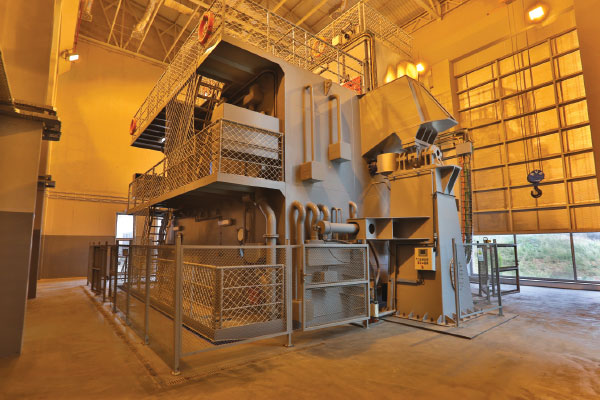
Fire and Damage Control Simulators which are integrated systems located into three separate buildings within the body of Yıldızlar Surface Training Center Command will allow the training which will render the Naval Forces Command Personnel more prepared and equipped for responding to cases of fire and damage in a more cost efficient manner.
With their cutting edge high technology capabilities, the Fire and Damage Control Training Simulators will be gaining critical capacities to the Naval Forces Command.
The Fire Training Simulator was developed to cover the training demands of the Naval Forces Command personnel operating at surface, underwater, air platforms and coastal facilities on fire – fighting and putting off the fire through suitable methods. With the Fire Simulator, initially preventing the loss of life and property during highly dangerous and destructive platforms and rendering the personnel prepared for all types of scenarios in such dangerous cases are the aim. The Fire Training Simulator located in the facility where compartments and equipment of surface and underwater vessels are simulated and effort test track is built offers training opportunity for real fire cases with the fire scenarios of different flame heights and with the feature of spreading the fire to different places within the same location or from one compartment to another.
The staff is prepared for all types of challenging conditions with various scenarios with the Fire Training Simulators
Fire Training Simulator’s compartments such as engine room, chambers, dining hall, radio chamber, combat operation center, infirmary, and damage control center that offer training facilities for various types of fire at the training center are equipped and prepared in a true to life manner. Moreover, a mockup similar to the helicopter platform stationed at the “Barbaros” Class (MEKO Track – II) in the Naval Forces inventory exists in the simulator. According to this, different types of training are offered as well for the fighting cockpit, cabin and engine fires and various fires that may be caused by fuel pellets at the platforms.
With the help of the Fire Training Simulator various types of training composed of basic fire - fighting training, advanced level fire - fighting training, personal and team training, electricity/ fuel isolation, mechanic isolation, side section cooling and smoke removal applications are conducted in simulated real environments. There is also the facility to offer the training for operating under limited vision which will contribute to the reality in addition to the different lighting and sound effect applications related with the fire scenarios. The system also renders the trainees prepared for potential cases with the scenarios in alterable difficulty levels and in various environmental circumstances. Besides, the simulator allows the repetition of the same fire scenario until the trainee acts in the correct manner.
The scenarios in different difficulty levels are prepared by the trainers at the command control center of the simulator. The trainers and commanders can follow and continue the communication between the control station and fire control equipment and monitor the simulator’s security systems at the same time at the Command Control Center. The personal and team performances of the various scenarios created with the user selection are evaluated and then monitored and compared with the past training performances at the center as well. Furthermore, an Effort Test Track exists within the structure of the simulator gaining the staff the required physical capabilities for increasing their operational capacity under stress.
Realistic Training with High Standards for the Crew through the Damage Control Simulator
Damage Control Simulator is another capability gained through the facility and is among the platform simulators. It aims to provide the staff the training and awareness which will enable the immediate control of the damage that may emerge as a result of various causes during times of peace, crisis and war and provide the transfer of the vessel to the nearest harbor for maintenance and repair. At the real like training environment established for the execution of the training to such end, there exists three decks (one open); and four compartments composed of an engine room, a pump room, a dining hall and crew accommodation space at the simulator.
With the help of this simulator realized completely through indigenous design, swinging 15 degrees to each direction is possible with the hydraulic system for the simulation of situations that may occur in real sea environment. With these simulators which are capable of simulating free water surfaces in limited vision and different sea conditions, training types containing actual limits could be executed as well in mobile and irrigated compartment circumstances. For supporting such training, communication, security, alarm, sound effects, light effects, artificial smoke and camera surveillance system are developed through the utilization of improved products during design.
With the activation of the facility, the operation and maintenance activities of the center will be assumed by Meteksan Defense. This very point carries the feature of being a new and first application for the Turkish Armed Forces and Naval Forces Command. Moreover, training to domestic and foreign customers could be offered at this center in coordination with the Naval Forces Command.
Meteksan Defense previously left its most competitive rivals behind at the tender opened for the Fire and Damage Control Simulator in Oman and delivered the simulators to the Naval Forces of Oman in 2014.