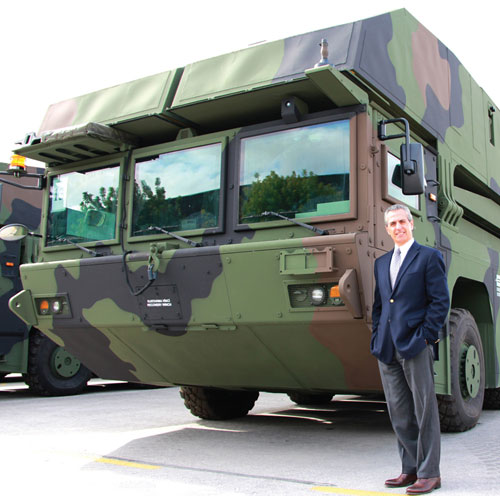
FNSS Increase its Power with Joint Production
Defence Turkey: FNSS has achieved important projects both in Turkey and international platform. Could you please inform us about FNSS capability, product and technologic improvements?
Although being a privately owned joint venture company, FNSS experienced a different performance record with a vision of serving the Turkish Armed Forces and becoming a global company by exporting its products.
The initial mission of the company was manufacturing land combat systems through technology transfer. Immediately after its establishment, FNSS had focused on product development and export activities as well as investing an important portion of its budget to R&D. Enhancing the engineering capabilities in a short time, FNSS had also invested to the local suppliers and took active part on their training. Today, FNSS has the capability, know-how and experience to design, develop and produce tracked and wheeled armoured vehicles as well as integrating the most complicated sub-systems to land platforms.
Since its foundation, FNSS has been a pioneer in many areas in Turkish Defence industry such as:
First private defence company
First complete system export
United Arab Emirates
Top exporter in overall defence export
First in operating a facility abroad
First technology transfer in defence industry
Malaysia ACV project
The largest defence export in a single contract
Malaysia 8x8 Wheeled Armoured Vehicle project
The first indigenous development project of Turkish Armed Forces
Amphibious Assault Bridge
FNSS also possesses the AQAP-2110, the highest quality assurance system of NATO and certified by British Lloyd’s ISO 9001-2000.
FNSS has also considered vendor base development important and within a very short period of its establishment, it has made training, system, apparatus and machinery investments in over 100 companies to enable them to achieve NATO military specifications’ quality level requirements. As a result, FNSS has achieved a local content rate above 80%, excelling its commitment and making a great contribution to the development of Turkish defence industry.
Defence Turkey: Could you please inform us about FNSS activities and on-going programme?
FNSS started its activities by manufacturing 1698 Armoured Combat Vehicles to Turkish Armed Forces with 81% local content. The vehicles produced by FNSS were used by the Turkish Forces serving under United Nations Peace Force through Somalia, Bosnia-Herzegovina and Kosovo for miles and gained the appreciation of Turkish soldiers.
In 1997, FNSS realized the first defence system export of Turkey to UAE by selling Armoured Combat Vehicles. We have been providing technical assistance to UAE army regarding the ACVs since that time.
FNSS made an agreement in 2000 for the 2nd package of Armoured Combat Vehicle project composing of the production of Advanced Armoured Personnel Carriers in collaboration with Undersecretariat for Defence Industries (SSM). All the production and delivery of the vehicles were completed.
Through years, FNSS, realized an export to Malaysia by ACV sale. In addition with this contract, FNSS become the first Turkish defence company that realized technology transfer to outside of the borders of Turkey.
In 2000s, we started developing our own wheeled vehicles and in a very short time we completed the development of our Pars Family of Vehicles. We are providing our wheeled armoured vehicles in 6x6 and 8x8 variants. Pars vehicles are the new generation of Wheeled Armoured Combat Vehicles with special emphasis on Mobility, Protection, Payload and Growth Potential. The vehicles employ the latest design and technologies from commercial off–the-shelf (COTS) which have been Militarized (MCOTS) to meet the performance and durability of modern military operational requirements. In 2007, we signed our first wheeled vehicle program with Turkish Armed Forces, the Amphibious Assault Bridge (AAB) project. AAB project is the first indigenous design and development land vehicle of Turkey. The first 16 vehicles were delivered to Turkish Armed Forces and the serial production is on-going.
Another on-going project for Turkish Armed Forces is Armoured Amphibious Combat Earthmover that we are working in collaboration with SSM. FNSS shall design and develop amphibious tracked dozers and produce the vehicles for Turkish Armed Forces. The acceptance tests are on-going for the project.
Last year, we signed 2 important contracts; the contract with Aselsan for Low Level Air Defence System project, a 30 tones tracked vehicle, which Aselsan is the main contractor, and the contract signed with Malaysia regarding 8x8 Wheeled Armoured Vehicle. Both projects are carrying on in accordance with the schedule.
Defence Turkey: Could you please make an evaluation on FNSS’ last three years performance in terms of production, capacity use, export, employment and market share?
The most significant development during the last three years within the Company structure occurred in indigenous design aspect and the number of engineers working at this field has reached over 125. On the other hand, the total number of employees has reached over 600 from 150. If we add the number of personnel working at foreign countries then the number is over 800. These figures proven that the number of employees grew fivefold within the last three years.
We have been making the production of our products through our Company capabilities; however we have also been making subcontracts with sub-industry companies. Roughly, the generated employment will reach to 4,000-5,000 when involved the sub-industry.
We have been using our full capacity in production however we have been outsourcing the part of the production to the countries from where we have undertaken liabilities as well. For this reason, we have been giving importance to the high utilisation of our production capacity; supporting the sub-industry development of the countries where we operate as per the requirements of our customers and we have been capable of making production even at the countries of our customers by operating facilities. Recently, joint productions in defence field at international market have become an important factor.
Over 2000 armoured tracked vehicles produced by FNSS within the country have taken part in the inventory of Turkish Land Forces. Within this context, FNSS dominates the market. Since the Turkish Land Forces has not realized any procurement of 6x6 and 8x8 armoured wheeled vehicles, yet there is no market created. However, I could affirm that we would become one and only in the field of heavy tactical vehicles through SYHK that we have developed. In terms of defence industry export, FNSS is the export champion of our country. Being leader in the defence platform export from Turkey since 1997, FNSS has also been exporting most of its products for the recent four years. FNSS has also encountered significant changes on its way to become a major export company. In the first years of its establishment, FNSS was performing activities under a licence as sole customer and sole product. The personnel formation was mainly based on blue-collar workforce and supported by a small design engineering department. Today, with its certified R&D Centre, FNSS has become prominent in the international market through its Pars Wheeled Armoured Vehicle with the design engineering capability comprising over a hundred design engineers and it has developed indigenous designs such as Armoured Amphibious Assault Bridge (AAAB) and Azmim (AAC) in domestic market. Both products have high export potentials.
Defence Turkey: Could you please enlighten us about your activities on weapon systems?
FNSS is a highly experienced company in land combat systems in designing and developing tracked and wheeled armoured vehicles. FNSS also design and produce weapon stations. In this content, FNSS developed one man Sharpshooter Turret, which is fitted with a 25-mm Bushmaster cannon and a co-axially mounted 7.62 mm MG. 40 mm / 7.62 mm and 12.7mm / 7.62mm variants of the turret are also available. The weapons are fully stabilized providing full "shoot on the move" capability and incorporate modern high performance sighting systems. Exporting of those products to various countries still continues.
With advancing technology and customer needs, we are developing an unmanned turret with a 25/30mm machine gun named "Claw" in collaboration with Aselsan. We completed the first prototype and the tests will be conducted within this year. We believe there will be high demand to Claw both in the domestic and international markets.
Within this scope, FNSS will continue to develop and market manned and unmanned turrets in line with the market requirements.
Defence Turkey: We consider that behind your successful export trend is a sound sub-industry network. Could you please let us know your supply chain approach?
FNSS has dealt with the concept of sub-industry strategically since its establishment. As per this strategy, the sub-industry is one of the key elements of FNSS’ production potential and the part of FNSS organization.
The sub-industry activities in FNSS should be classified in two phases: The first phase is between 1992 and 2010 for the development of sub-industry and part production with many local producers. The second phase is the period starting from 2010. During this new period, FNSS plans to establish Solution Partnerships with a few number of competent and strong sub-industry companies. The details and objectives of both phases are summarized below.
The first supply phase was initiated by a study in 1992; a broad participation team called A-Team initiated strategic activities in terms of supply. The objective of this phase was to find and develop companies that are able to make production of parts needed by the Company in-time and of good quality. It is notable that the local contribution share was zero when first launched out. At the very first step, the companies making large-scaled production and having sound quality culture were communicated. However, it was not easy to attract producers making part production to automotive industry mainly, through mass production technique to our limited number of needs. For this reason, small-scaled producing companies were reviewed and the investment on bench and machine tools for the selected companies was made; the personnel were trained and a financial support was given. Within a short period of time, many producers were developed for different product categories and the outcome of such study was achieved as 73% from zero local contribution within two years. In those years, FNSS was proud of the number of sub-industry companies amounting nearly to 250 and announced such pride to all marketing network by various means.
Working with local industrialists has multiple advantages; before anything else, it is easy to work with people of the same mother tongue and having the same culture. The physical proximity is also very important. Access to any sub-industry company located in Ankara takes a maximum of 30 minutes. There is no foreign country restriction on parts procured from local industrialists and thus a strategic advantage is achieved. Such supply method was beneficial in the first years while we were working with licensed and unique/single product.
FNSS, as time passed by, started to develop indigenous products, the licensed products were relinquished and production facilities were commenced to be operated for multiple projects on various geographical locations. Due to the changing conditions, the need for change in our supply strategies became essential as well in mid-2000. Within this frame, a conference on Solution Partnership was held by FNSS on January 7th, 2010 and many sub-industry companies attended this conference as a proof of such aspiration. The substantial output of the conference was that "the flexible policies are needed based on collaboration as well as sharing liabilities and risks in order to be competitive in defence industry"; and "the need for performing activities as a partner between smart, and skilful sub-industry companies making also designs and prime contractors". Within this framework, FNSS internally initiated transformation studies on supply process. Firstly, the supply process was redefined and in-house production was also included in the supply chain definition; suppliers were re-classified and a special emphasis was given to supply expertise. The studies were launched with one of our companies selected as a pilot company and the net outcomes to be obtained will be implemented rapidly thus the Solution Partners will be the key element of FNSS in its daily supply practices.
Defence Turkey: How do you evaluate the performance of Turkey in the field of defence industry?
I can easily say that the defence sector is the twinkling star of our country. I did not say this only in terms of turnover and export volume. I do say it because the defence sector has become the driving force for our country in terms of technological aspect by virtue of further development of coordination amongst universities, industrial and governmental organizations. In current situation, TAF has procuring lots of products and services from local companies instead of procuring from foreign countries as in the past. Besides the advantages of using our own products and being supported by our own companies, there has been an employment increase as well as decrease in the outflow of foreign currency. Thanks to this development, the Turkish defence industry focused on production until mid-2000 has turned towards design focused business model, thus it plays an effective role on significant value-add creation. The Turkish defence industry has substantially become self-sufficient. At the same time, many export projects have been brought in our country through the special emphasis of Turkish defence companies on export activities; and export activities have become a sine qua non for companies by virtue of incentives, assistances and objectives of mainly of our government, SSM and other related governmental organizations.
Defence Turkey: Could you please tell us the future of FNSS?
We planned to capture about 2.5 billion dollars of defence business over the next 10 years. While realizing this amount, we designed our system such a way: to be the local company and preferred supplier by transferring the technology to international customers. As FNSS, we will continue to be respectful, honest and trustworthy to our customers, and feed from these moral qualities. For the next 5 years the operational excellence is our target. To manage highly complex contracts; multi-projects, multi-product and multi-locations successfully, we believe the information basis shall be vital, and projects shall be managed with a harmony and the supply chain management shall be in its most effective structure. On the other hand, we would like to differentiate in our business development activities over the next 10 years. Therefore we are focusing on large-scale projects that will guarantee the future of FNSS. The biggest pillar of our business development activities is new products. FNSS will invest more and more in research and new product development that will lead us to provide new land platforms to our customers.





