Generation Wars in Skies: Fifth Generation Fighter Aircraft Development Programs
The end of the Cold War meant that the risk of an all-out global armed conflict became a history. Following decades, especially the period after the 9/11 attacks brought forwards a new era of asymmetric warfare, operations other than war (OOTW) and counter terrorism operations. These concepts require new technologies and systems for the modern warfighter.
Combat aircraft design is no exception. The importance of network enabled capability, high speed and robust information sharing through advanced data link systems and precision-guided strike capabilities are at the top of requirement lists. Tomorrow’s fighter aircraft will not just be platforms to counter adversaries’ equivalent platforms. Instead, they will be integrated elements of a network-centric war fighting organism.
In the 20th century, especially after the Second World War, combat aircraft were designed for specific requirements, often resulting with dedicated platforms. Performance requirements of fighters were often determined with regards to those of enemy aircraft. This was especially the case of aircraft tasked primarily with air superiority and interception missions. Capability and performance of secondary missions such as air to ground or reconnaissance of such aircraft were limited, if not none.
This trend began to change in the last quarter of the past century, due to a combination of both developments in technology and the need to achieve the most cost effective combat capability. Single mission dedicated platforms have become more difficult to sustain. Budget cuts and the cost of technology, combined with the cost to develop, manufacture and maintain the platforms resulted with even less number of aircraft to be procured. Training and infrastructure also has become challenging factors for planners and decision makers.
Advanced in technology provided new capabilities to fighter aircraft like multi spectrum sensors, information fusion, advanced data sharing and various forms of kinetic effect with high levels of precision. These factors have become de facto standards of fighters of a new generation.
A look at the ongoing fighter development programs reveal such converging trends in combat aircraft design.
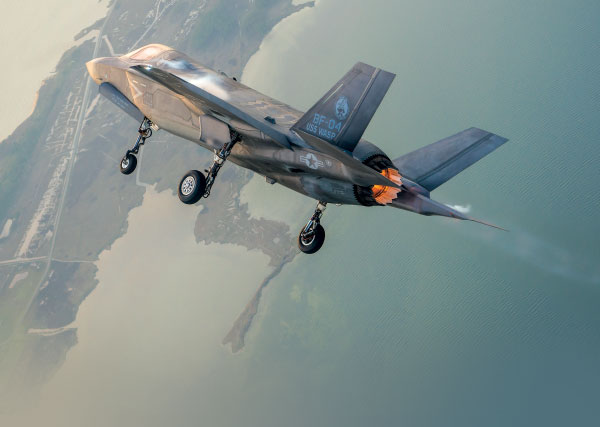
F-35 Lightning-II
One of the most ambitious development programs of modern military history, the F-35 Joint Strike Fighter is also a controversial program. The aircraft itself can be considered as the symbol of fifth generation fighter aircraft. On the other hand, the development program has suffered significant budget overruns and delays. The political and strategic dimension of the program also is another topic of tempered debates.
The F-35 is envisaged as replacement of many different fighter aircraft of three armed services of the United States military: The Air Force, Navy and Marine Corps. The development program also has a multinational aspect, as the development and testing efforts are being supported by partner nations, namely United Kingdom, Italy, Australia, Canada, Norway, Denmark, the Netherlands, and Turkey.
One of the distinctive features of F-35 is its ability to conduct non-traditional ISR missions. The fighter, thanks to its advanced sensor, data link and computer systems, acts both as an intelligence gathering and command & control platform. The F-35 is designed to be self-sufficient or part of a multisystem and multiservice operation, and to rapidly transition between air-to-surface and air-to-air missions while still airborne.
The program has gone through challenging times. The criticism is focused on the development cost, performance of the aircraft especially in air-to-air combat missions and safety issues. The United States Air Force (USAF) plans to achieve initial operation capability (IOC) in 2016 with the introduction of Block 3I software. More than 3,000 F-35’s will be procured by United States and program partner nations until 2035.
PAK FA
Designed by Sukhoi, the PAK FA is going to be the first Russian combat aircraft to have stealth characteristics. The prototype of the program, T-50 made its maiden flight in January 2010 and tests are still underway, with service entry planned for 2017. The PAK FA will be the successor of MiG-29 Fulcrum and Su-27 Flanker jets. It is also the basis for the FGFA (Fifth Generation Fighter Aircraft) project, a joint program with India.
PAK FA also symbolizes the revival of Russian aerospace industry. All current Russian fighter aircraft in service and available for export are designs of late Cold War period. PAK FA, on the other hand is the first major combat aircraft program that is started by Russian Federation.
In addition to application of stealth technology, PAK FA has other characteristics of fifth generation fighter aircraft such as super cruise, increased maneuverability and advanced sensor systems.
The fate of the PAK FA program relies heavily on budget. With the current slowdown of Russian economy, development and maturing of many of the critical subsystems and associated technologies are facing challenges, radar and engines being at the top of the list. Successful completion of testing period and commence of serial production is therefore vital for the future of the program. Output rate and sustainment of production line will be next issues.
J-20
Having made its first flight in January 2011, the Chinese J-20 is designed by Chengdu. J-20 is another controversial fighter program, due to its several features and the secrecy that surrounds it. The project was previously known as J-XX and even its existence was known by aviation circles throughout the world in late 1990’s, first photos of a prototype surfaced in 2010.
The J-20 is a large aircraft with size similar to Lockheed Martin F-22 Raptor. The wide fuselage indicates a primary strike role, because of the presence large internal weapon bays. On the other hand aerodynamic characteristics point to a maneuverable, high performance fighter like the Raptor.
The prototype of the J-20 is reported to be powered by Russian made AL-31F turbofan engines. Chinese aerospace industry is believed to be working on advanced turbofan engines for the aircraft. The outcome of these results may define J-20’s fate as a successful fifth generation fighter capable to counter Western design jets.
KFX
KFX program is being led by Korean Aerospace Industries (KAI) and it is the second combat aircraft project of South Korea, after FA-50 which is a derivative of the KAI T-50 Golden Eagle trainer jet. The program is partnered by Indonesia.
The main objective of South Korea in developing the KFX is to replace the F-4 Phantom II and F-5 Tiger fleet in ROKAF (Republic of Korea Air Force) inventory, to supplement the Boeing F-15K Slam Eagle. F-16 is determined as a benchmark for the performance requirements of KFX: It is expected to have 50% greater combat radius and 34% longer airframe service than the F-16. The KFX will incorporate next generation avionics systems such as active electronically scanned array (AESA) radar, infrared search and track (IRST) system and advanced data links.
South Korea announced the selection of Lockheed Martin as technology provider. The same company also assisted KAI in developing the T-50 / FA-50 family. Service entry is planned for early 2020’s. It should be noted that South Korea is also going to acquire 40 Lockheed Martin F-35 Lightning II under F-X III program.
F-3
Japan’s F-3 project is based on the Advanced Technology Demonstrator - X (ATD-X) program. The first prototype made its maiden flight in April 2016. The aircraft is planned to replace F-15J Eagle and F-2 fighters in Japanese Air Self Defense Force (JASDF).
One of the distinctive features of the F-3 is its fly-by-optics flight control system. All flight control surfaces of the aircraft are connected to the flight computer through fiber optic cables, eliminating the risk of electromagnetic interference. It is also reported that flight control systems will have a so-called self-repairing capability.
Development work of the F-3 is not expected to be completed before early 2020’s. Japan is in the process of acquiring 42 F-35’s, which will work together with the F-3 in the second half of the following decade.
TFX
The TFX, or “Milli Muharip Ucak” (National Combat Aircraft) is one of the most ambitious programs of Turkish aerospace industry. The program was started with a conceptual design phase that took place between 2011 and 2013 by Turkish Aerospace Industries (TAI) with the assistance of SAAB of Sweden. The program is currently at preliminary design stage, with the maiden flight planned to take place in 2023.
The TFX is planned to replace F-16’s in Turkish Air Force inventory and serve together with 100 F-35A’s from 2030’s. The program incorporates a large number of R&D projects, to be led by Turkish industry and mobilization of academy – industry partnership.
Conclusion
Frontline combat aircraft design has never been an easy task. In today’s world, the main challenge is to predict the threat environment of tomorrow as well as the technologies available. The F-16, for example, was introduced in mid 1970’s. The latest versions of the F-16 are only similar to the first ones visually: Almost all subsystems and technologies have evolved since then. It is those parts such as engines, avionics and weapons systems that make the difference. The processing power of a mission computer or the range of a radar defines the combat performance of the fighter. It is therefore of critical importance to design a fighter that is capable to deploy technology of not today but tomorrow.