Meteksan Defence Develops High-Tech Products for Naval Forces
The Turkish company Meteksan Defence Industry Inc. was established in 2006 to develop and produce high technology products and subsystems for the Turkish Armed Forces and friendly countries. The systems and subsystems produced by Meteksan are used for command control, communication, reconnaissance, surveillance, intelligence and training purposes and they take part on many platforms such as surface and underwater platforms, helicopters, unmanned autonomous aerial/surface vehicles, missile systems and land-based training centers.
One of Meteksan’s main areas is high technology products for naval forces. In this area, Meteksan develops hull mounted sonars, underwater acoustic sensors, live naval training simulators, electronic warfare systems, radar systems which all fulfill the cost, schedule and performance expectations of their customers.
YAKAMOS 2020 Hull Mounted Sonar
Meteksan Defence, appointed with the approach of being the "Underwater Acoustics Excellence Center of Turkey" in the field of underwater acoustic systems, adds significant value to naval platforms with their advanced technologies.
Meteksan Defence’s YAKAMOS 2020 Hull Mounted Sonar System is a new generation medium frequency, surface ship Anti-Submarine Warfare (ASW) and obstacle avoidance sonar, which is designed for the surveillance of the underwater environment to automatically detect and track underwater targets such as submarines, submersibles, torpedoes and mine-like objects. YAKAMOS 2020 has over 10 years of field experience and sea proven performance acquired by MILGEM Sonar YAKAMOS. These increased capabilities with innovative hardware infrastructure compatible with current technology make it a well-positioned system for the future.
YAKAMOS 2020 is easily adaptable to developing technology and changing acoustic environmental conditions with a more compact, more capable, modular, scalable, innovative hardware and configurable software architecture. YAKAMOS 2020 stands out with its ability to outperform its competitors on the international market. The system provides high performance for longer periods due to the increased efficiency of its improved power modules and system architecture. It can also detect potential threats from longer distances with its updated sensor (transducer) architecture.
With the common use of configurable and scalable modules for the sonar systems designed for platform configurations of operationally different type and dimension, it is targeted to save on integrated logistic support (ILS), lifetime management and spare part costs.
The system has been used in MILGEM corvettes since 2011 and it was selected as the sonar system for the Pakistan Navy Corvette Program in 2019. Meteksan’s sonar is being upgraded to successfully operate in the Pakistan Navy’s operational environment in accordance with the Pakistan Navy’s expectations.
In addition to the PN MILGEM project, the YAKAMOS 2020 sonar system was contracted within the scope of different projects to be delivered to another Navy and for another platform. As of today, YAKAMOS 2020 has international references other than the Turkish Navy and it has diversified onboard platforms that are different from the MILGEM Ship. The user experience of new Navies, platforms and operational environmental conditions are strengthening the capabilities of YAKAMOS 2020 Sonar and increasing the competitiveness of the system on the international market.
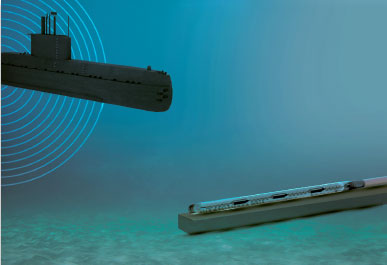
FOAS Fiber Optic Acoustic Sensor
Fiber optic underwater acoustic sensors provide high sensitivity detection across long distances. These sensors are small, light-weight and designed with a structure that is not affected by electromagnetic interference. FOAS are a new type of acoustic sensor technology developed by Meteksan Defence, based on the modulation of laser light that travels through a fiber by acoustic wave instead of conventional piezoelectric ceramic technology. One of the most important advantages of the technology used is that the sensors can be easily multiplexed over the same fiber line. In addition, the system can operate in the 10-5000 Hz band, underwater up to a depth of 450 meters and has high sensitivity and low noise detection capability. Another important advantage is that sensor information can be transmitted over long distances with negligible loss. With its modular design, it can find application in many operational concepts, like thin line towed array sonars, F/O flank array sonars, harbor protection systems, underwater early detection sensor network systems, etc.
ALACA Ka Band RCS Measurement System
Naval vessels need to reduce their visibility and maximize their survivability by ensuring that their RCS (radar cross section) signature is as small as possible. Decreasing the RCS signature is necessary to ensure that a ship can successfully perform its mission while maintaining its level of survivability and ensuring that the crew remains safe.
Another project that Meteksan Defence successfully delivered recently to the Turkish Navy, named ALACA, is used to measure the Radar Cross Section (RCS) of surface ships. The RCS is an important parameter to attain in protection of the Naval Forces Command combat platforms, from fire control radars and guided missile seeker radars that can be found in hostile platforms. ALACA performs high accuracy RCS measurements so that the relevant EW measures can be applied to improve the millimeter wave Radar Cross Sectional Areas of existing or newly designed platforms and to determine the operational scenario of electronic warfare counter measures like chaff and decoys.
The ALACA Radar Cross Section Measurement System is a solid-state based, pulse-doppler radar and operates in Ka-Band frequency. Radar Instantaneous Bandwidth is 50MHz and range resolution can be adjusted as 3m, 6m and 9m. ALACA displays the images of the target platform to the operator during measurement with a High-Resolution Day / Night Camera and automatically records them at the same time.
NAZAR Laser Electronic Warfare System
Electro-optical (EO) and Infrared (IR) guided missiles are becoming more and more threatening for military bases, ammunition storage areas and civilian strategic facilities due to emerging technologies. This system offers broadband state-of-the-art laser electronic attack capabilities against EO/IR guided missile threats to protect critical civilian or military buildings and facilities as its primary goal.
NAZAR detects EO and IR guided missiles and applies directed laser dazzling and soft-kill techniques to counteract such threats. So, EO/IR guided missiles can be neutralized from far away distances. Laser dazzling or deceptive jamming of EO and IR guided missiles is possible by using either pre-loaded generic jamming techniques or special techniques defined by the user. The system is not only effective against well-known EO/IR guided missiles but also has reconnaissance and surveillance features to offer an advantage against asymmetric threats by its broadband operating capability. The system can be integrated with other sensors and systems to improve overall effectiveness. Installed on a mobile platform, the system may be transferred and deployed to desired locations easily upon operational requirements. The system has its own generator, so no external power source is needed. The system can be installed on navy ships by applying required modifications to enhance the Anti-Ship Missile Defense (ASMD) capabilities of naval ships. Also, the system can be used for laser soft-kill techniques development, and it is an asset for trial and evaluation activities.
Naval Training Simulators
Meteksan Defence also develops training simulators such as the Damage Control Simulator, the Fire Training Simulator, and the Helicopter Escape Training Simulator for the Naval Forces. Especially the Damage Control Simulator has been winning almost all open tenders in recent years around the world and has become the Number 1 system in its class.
DCSIM Damage Control Simulator
The Damage Control Simulator (DCSIM) provides a realistic training environment to develop and conduct damage control exercises to provide shipboard personnel damage control readiness preparation at internationally recognized commercial and naval standards. DCSIM has unique features that increase the effectiveness of training, operational efficiency and maintainability. The system provides standardized means to train the crew from basic up to advanced levels with corresponding evaluation reports.
FTSIM Firefighting Training Simulator
Fire Training Simulators are used for the purpose of reinforcing theoretical firefighting training and actual training will be carried out using a fire training simulator. Firefighting Training Simulator (FTSIM) provides effective and safe training in a realistic environment where Fire Fighting team members can take the role of a firefighter, practice tactics and procedures through interaction with fixed and portable fire extinguishing equipment in simulated conditions and locations without risking lives or property. The increased exposure and opportunities to up-train provided by this simulator directly contribute to the effectiveness of the team and safety onboard the ship.
HUET Helicopter Underwater Escape Training Simulator
The HUET Facility is designed based on the international standards & OPITO criterion for personnel who regularly travel by helicopter. This simulation provides/ensures that personnel have the skills and knowledge to handle emergency situations where there is a need to exit a ditched helicopter and survive at sea. For the purpose built, contemporary facility includes various distinct training capabilities to enable discrete training including Helicopter Underwater Escape Trainer, Portable SWET chairs for Shallow Water Egress Training (SWET), Simulated Rescue Helicopter to enable rescue activity and Simulated Landing with Parachute.
PELIKAN RF Missile Seeker Simulator
The PELIKAN Missile Seeker Simulator (MSS) is a Naval EW test and evaluation asset designed to evaluate the effectiveness of Onboard Electronic Defense and Electronic Attack Systems. The PELIKAN MSS can be used for evaluating the effectiveness of a ship's electronic warfare techniques (ESM, ECM, RF Chaffs/ decoys, etc.), simulation for Radar ECM development and evaluation, radar ECM testing & verification and electronic warfare equipment testing and evaluation. Once the emulated attack commences, real-time information is available regarding the emulated missile’s behavior so that live evaluation of the effectiveness of the countermeasures employed by the target ship can be assessed. In addition, the PELIKAN Missile Seeker Simulator records all relevant data to enable a further analysis to be undertaken once the simulation phase of the trial is complete.
The PELIKAN Missile Seeker Simulator provides ship personnel to be trained in the use of EW equipment and in the development of avoidance and distraction tactics against simulated threats. PELIKAN can accurately emulate the behavior of a specific anti-ship missile RF seeker so that the system appears to be a real example of the missile in question from the target’s (ship’s) perspective.
In addition, PELIKAN also reacts to electronic warfare counter measures that are carried out by the target ship. The system can be configurable so it can be programmed to emulate a wide variety of anti-ship missile RF seekers across a range of guidance techniques. PELIKAN can simulate a number of different missile types, by varying parameters such as frequency, pulse width, pulse repetition frequency, gate size, pulse modulation, polarization, and detection criteria.
ULAQ Unmanned Surface Vehicle
ULAQ is the name of the Unmanned Surface Vehicle (USV) product family developed by the strong alliance between ARES Shipyard and Meteksan Defence, which includes different platform types, capabilities and functions such as Armed Unmanned Surface Vehicles (AUSV), Anti-Submarine Warfare Vehicles, Anti-Surface Warfare Vehicles, Mine Countermeasure Vehicles, Fire Fighting Vehicles, Intelligence, Surveillance, Reconnaissance and Electronic Warfare Vehicles. ULAQ eliminates human factors either by its remote-control capability or by its sophisticated software to execute predetermined autonomous missions and COLREGS.
ULAQ AUSV was built from advanced composites and has a range of 450 NM and speed of 70 kts, with day & night vision capabilities, a secure communication infrastructure and it can include guided missile systems or machine guns. The Surface Vehicle has a unique telescopic mast to utilize the E/O System for 360° enhanced day & night vision capability as well as increased target acquisition and designation range for laser guidance. With its modular structure, different payloads can easily be integrated into the Surface Vehicle.
The CRPA GNSS Anti-Jam System is a part of the ULAQ AUSV navigation system to obtain geographical information in case of a GNSS jamming attack. The Class-B AIS Transponder, INS, Radar and O/B Sensor System are part of the collision avoidance system of ULAQ AUSV, providing safe navigation with sense-and-avoid functions





