Havelsan Expanding its Market on Cyber Security and Critical Facility Security
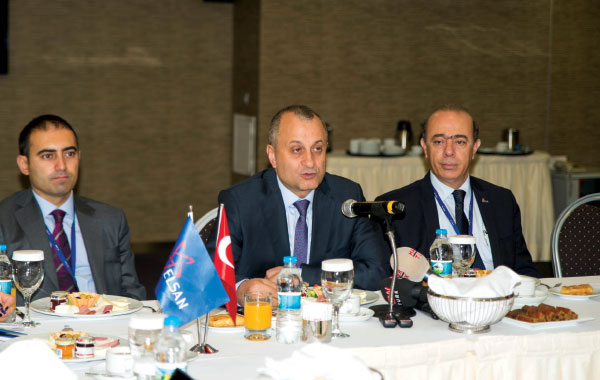
Stating that they closely followed the numerous institutions to which they provided service through the SISATEM cyber security center of excellence, Havelsan General Manager and CEO Mr. Ahmet Hamdi Atalay cleared the air on the speculations regarding the increase of cyber-attacks that frequently came onto the agenda following the coup attempt on 15 July 2016. Mr. Atalay said, “Despite the allegations, Turkey did not encounter any special attacks after July 15th. No extraordinary attacks occurred. We closely follow all the institutions to which we provide services. Contrary to speculations, a severe attack has not occurred. Still, attacks always exist. As a result of its geo-political location, Turkey has been at the very center of the attacks for years. We had many deficiencies concerning this issue in the past years, yet we made great progress in the last 4 – 5 years. We unfortunately did not have an addressee in the government or in the state on cyber security issues. Upon a decree of the Council of Ministers, the Ministry of Transport, Maritime Affairs and Communication has been authorized as an addressee in respect to this issue. With the crucial contributions of the Information Security Association - of which I have previously been the president – a document on Turkey’s cyber security strategy was signed in 2012. A Cyber security action plan was signed right after and the new version of that action plan has now been draw up and published. Important ground was covered on creating awareness regarding this issue and this made Turkey more cautious compared to the past. We could now claim that we are more reliable today. Then again, we must underline the rapid growth of threats and dangers; so no matter how great the measures adopted are, they are almost insufficient most of the time. According to the research on the mobile devices we daily use, there are 2 million types of harmful software. Mobile devices turned out to be an important type of cyber threat. Virus protection or other measures are not being sufficiently utilized for these devices. Therefore, each mobile device becomes a potential source of threat. We are using these devices as a routine part of our activities and thus we avail a back door to the cyber - attacks. Despite all the measures adopted by the institutions, if a mobile phone is connected through such networks and if a weakness exists on your mobile device, then you automatically create a weakness at that institution’s network as well. On the other hand, an increase is being observed in ransomware during recent years. 1.3 million different types of ransomware are active throughout the internet. Maybe a single computer is affected in the ransomware software and the damaged users are trying to get rid of the threat by paying thousands of dollars but the open doors at that computer also indicate that new and greater threats are on their way. You get informed about the existence of the ransomware or other harmful software only when your computer is affected by them. Then again, it is not quite easy to detect the threats in which advanced technologies named as Advanced Persistent Threat (APT) beforehand. Information Security Association conducted a Key Study on this issue and we examined an APT attack that enabled a data leak between America and China. This data leak, carried out by a group in China against America, lasted for 8 years and the Americans noticed this incident 8 years later. It may be too late when you notice these types of attacks after the fact. These attacks and ransomware oriented attacks are becoming widespread and I can say that this danger is quite crucial.”
SISATEM Provides Cyber Security Services to Governmental Institutions and Enterprises
Mentioning that they were providing various training to create awareness against such threats, as Havelsan through the SİSATEM center, they developed a model for filling the cyber security expert gap Mr. Atalay continued: “In our center, we suggest providing the cyber security services required by the institutions within the framework of a manageable service approach and in a way to establish a guarantee of a certain level of service. At this point we propose the following to the companies. It is not easy to provide cyber security service to staff subject to public personnel management, as 24/7 monitoring and supply of services is required. The companies do not need to employ the staff or make technologic infrastructural investments as we provide the cost-efficient service. Our greatest advantage is that we are capable of providing the same service simultaneously to multiple institutions, that is to say we are able to offer our services with 100 people to more than 50 institutions. In this way, we can maintain the security of numerous institutions with fewer experts.”
Answering the question on whether they will be providing the services benefitting public institutions and enterprises to the private companies, Mr. Atalay said, “We do not have the chance to expand this service too much. Yet, various applications for the banks have been received and our contacts and negotiations with them continue. Still, our initial target is to extend our services to more public institutions. The public sector is enduring a shortage of experts competent on this issue and it also has difficulty in investing in this issue. Therefore, public institutions are our priority.”
Turkey’s Share in Cyber Security Market is $ 300 Million
With respect to the question on the share, Havelsan, with its resources of approximately $ 150 billion, indigenous products and solutions and its shareholders within the eco-system, yearly allocates to the cyber-attacks worldwide, Mr. Atalay said, “Turkey’s share in the world is 1%, our population, geography and GNP corresponds with this 1%. If our share in the breakdown in the world goes below this 1%, we will feel a deficiency in all cases. If we achieve to go above this rate, then we will be able to get the share we wish. When we take a 1% share from the Cyber Security market, a market of $ 1.5 billion market will be created. The cyber security market in Turkey is $ 300 million as of now, so we are quite far away from the share we have to obtain. We need to immediately tend towards the indigenous and national solutions. When the size of the market reaches $ 1.5 billion, we have to take around 20-30% share as Havelsan. We are currently behind this figure and we are not estimating such figures as well. We are reinforcing our infrastructure, training staff and developing technologies. We rely on the fact that we will have a return on these investments in the upcoming period.”
Havelsan Aspiring for the Physical and Infrastructural Security of the 3rd Airport
Mr. Ahmet Hamdi Atalay stated that they were on the short list of the tender initiated for the procurement of solutions for the physical security, facility security and infrastructural security of the third airport and continued, “We prepared a proposal composed of indigenous solutions. If we win this tender, then we will be providing the security for the world’s greatest airport and it will be an important reference for us”.
Mr. Atalay also mentioned that a project for providing the security of BOTAS’ pipeline facilities extending to Yumurtalık, Adana from Northern Iraq, the filling facilities and all the pipelines was on the agenda and added that they wish to take part in that project as Havelsan, “We are working on a security project that will sound an alarm in the case of a physical intervention in the sections within our borders, within the scope of the pipeline extending from Northern Iraq to Yumurtalık, and which will automatically launch the defense systems if required. We wish to take part in this program with our indigenous solutions as Aselsan and Havelsan, under the leadership of Aselsan. We are exerting efforts to develop a solution to this end. Soon we will be starting the implementation of this in the field”.