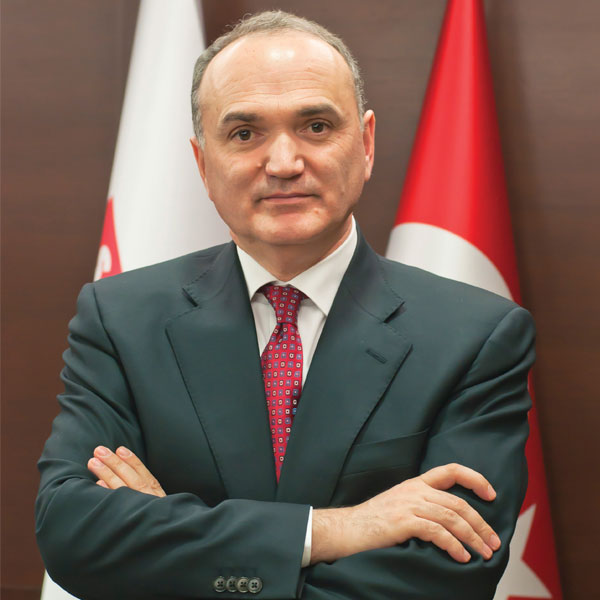
In Defence Industry Two Themes will stand out in the 21st Century “Drones” and “Cyber Warfare”

Defence Turkey: Mr. Özlü, firstly I would like to thank you for your time. More than twenty years passed since the very first unmanned air vehicles entered into Turkish Armed Forces’ inventory. Could you briefly inform us on the steps taken since those days and assess the current UAV’s at Turkish Armed Forces’ inventory and the on-going UAV projects? Will there be new UAV projects in your 2013 agenda?
Compared to its status 20 years ago, Turkey is now amongst the countries that develop and produce their own UAV systems. 164 Mini UAVs, 4 Mini Rotorcraft UAVs and 10 Herons within the framework of UAV projects conducted by our Undersecretariat are in Turkish Armed Forces’ inventory.

"Next Two Years are Very Critical"
In addition to the aforesaid, we are expecting the MALE class Anka unmanned air vehicle of which the design, development studies and acceptance tests are almost accomplished and UAV systems to be produced within the scope of tactical class that are still under design and development phases within UAV projects to enter in the Turkish Armed Forces’ inventory within the next two years.
On the other hand, the signature of the project’s agreement for mass production of 10 Anka unmanned air vehicles and design and production agreement on the strategic level armed unmanned air vehicle and agreement on the project for Rotorcraft UAV mounted on Ship are in our work plan for 2013.
Defence Turkey: In the Defence Industry Executive Committee’s (SSİK) meeting of last July, the launch of the talks for the agreement on preliminary design activities for a turbo-probe engine Anka unmanned air vehicle with a longer range and higher load capacity with TAI was decided. Which capabilities will Turkey have with this developed armed version of Anka? Has the project schedule been started? Could you assess the current status for us?
This is an unmanned air vehicle of a strategic level that is beyond the MALE class. It shall hold capabilities beyond Anka, for example it shall weigh almost 5 tones, armed and over 30.000 feet of altitude.
"Strategic and Armed Ankas are on the way"
With this decision, we have taken the first steps for developing a UAV system equivalent to U.S. origin Predator/Reaper. Talks on the contract for the preliminary design activities have been started; I expect the signature to take place and the project schedule to start within the first half of 2013. We aim to reach the SATCOM infrastructure with these and even with the mass production of our Anka project. We shall provide a satellite communication that enables longer ranged operations without the dependence on the ground antennas.
Defence Turkey: Mr. Özlü, it is known that UAVs procured from foreign countries could not be used sufficiently due to several reasons. Besides there is still a process for Anka’s entry into Turkish Armed Forces’ inventory. Could you briefly assess this process and the point reached? Also is there any possibility of leasing or procuring the manned/ unmanned air vehicles demanded by the Turkish Armed Forces or other related governmental institutions together with the sub-systems in the short run?
Herons are currently in our inventory, still being used and are considered as beneficial systems. Unfortunately we did not get the desired efficiency from Aerostars. The Contractor has not found a solution yet for the problems that make these systems impossible to use even though it is stipulated in the agreement. So, the User was not pleased with these systems.

"Herons are Actively Operating", "Aerostars Failed"
Anka’s first product acceptance process has started and we expect the completion of the tests shortly. On the other hand, the talks of an agreement on the mass production are on-going and we intend to sign the agreement soon.
"Hired Manned Reconnaissance Aircraft is Successful"
For meeting our demands on "ISR-Intelligence/ Surveillance/ Reconnaissance" for the period until our on-going UAV development projects enter in the Turkish Armed Forces’ inventory, a study for hiring a manned aircraft was carried out and an agreement was signed to this end. The very first aircraft brought to Turkey within this scope is operating successfully and approximately 600 hours of flight has been accomplished to date. We expect the remaining four aircrafts within the framework of the agreement to start operating at the beginning of 2013. As you mentioned, we have launched the studies for covering the intelligence/reconnaissance/surveillance demands of the related public institutions besides Turkish Armed Forces.
Studies for improving the performance of existing useful loads and gaining additional capacity through alternative useful loads are continuing within the scope of Unmanned Air Vehicle (UAV) and other ISR Projects (Manned Intelligence/Reconnaissance/Surveillance Air Vehicle Systems).
Defence Turkey: We are observing that Turkey’s capabilities in unmanned air vehicles are starting to mature. Is there any intention for the participation to multinational consortiums such as Talarion under Turkey’s leadership, for the strategic and combatant UAV systems? If so, which model should be established for Turkey’s participation in such a consortium?
"International Cooperation is amongst our Strategic Goals"
Turkey started acting in UAV field first with direct procurement projects and initiated the development projects in parallel. A certain level in the development projects was reached while using the existing systems. After our Mini UAV systems that have been indigenously developed and brought into the inventory since 2008, our tactical and MALE class UAV systems will start to be used by our Armed Forces within two years at the latest. On the other hand, we are keeping a close watch of the multinational programmes for taking part in global international projects and also benefiting their experience. We encourage Turkish defence industry’s participation to the multinational projects in line with "equal partner" principle.
Defence Turkey: Mr. Özlü , the test infrastructure requirement will change depending on the UAV system/subsystems and infrastructural task systems on these systems. In light of these developments, requirements for avionic testing environment, wind tunnels, scenario generator, navigation test environments, etc. will arise. Does Turkey have such an infrastructure for the UAVs that could cover these requirements? What are our capabilities? Moreover, as the Undersecretariat for Defence Industries what is your roadmap on the establishment of functional, modern accreditation facilities and testing fields that could meet all kinds of requirements of military and civilian UAVs that would be used by Turkey and her allies in the future? What would you like to convey to our defence companies that are capable of dealing with such issues and interested in investing?
"Testing Centres are the Most Vital Need of the Sector"
The issue you mentioned is in our agenda. Since the "research", "development", "testing" and "assessment" are inseparable. You cannot accept a product obtained as a result of research and development studies without testing it. Meaning you cannot obtain a product. This is not only applicable for UAVs; we consider the testing centres also for all platforms and systems we developed. In Turkey, there is an urgent need for a basic infrastructure for the tests and flights of all types of air vehicles (aircrafts, helicopters and UAVs). We have taken some steps regarding this issue and after they mature a bit, we would share the developments with you.
Defence Turkey: What are your approaches regarding the logistic support for UAV systems? Especially on Herons, which studies are conducted for the maintenance support assumed by TAI for the duration of the life cycle?
"We Started Pilot Implementation Projects in Logistics"
We have been working very carefully on the logistics as the Undersecretariat since last year. We negotiated with all related institutions and organizations, organized a workshop and prepared a detailed report on this issue. For this end, we established a Logistic Planning and Coordination Directorate within our Undersecretariat.

With the agreement signed with TAI, the logistic support for Heron system in the inventory will be provided by TAI for 3 years in an efficient and continuous manner and the activities thereof started in March 2012. At the moment, the logistic support activities are smoothly carried out by TAI.
It is fair to claim that users are satisfied with these support activities. At this point, the performance of critical sub-contractors such as Aselsan also affects the system’s total performance.
Defence Turkey: What is your strategy as the Undersecretariat for an exportation version study of UAVs during the development phase? Also, do you have international cooperation on the export of UAV systems to third countries in your agenda?
"We Accomplished the First Export of UAV System to Qatar"
As in every project, the exportation of UAV development projects’ products is one of our priorities. To this end, we could mention the exportation of 10 Mini UAVs to Qatar Armed Forces in February 2012 as our first UAV exportation. Moreover, tactical class UAVs of Vestel and Kale-Baykar companies and TAI’s MALE class Anka are the systems with great export potential. Their entrance into the Turkish Armed Forces’ inventory will take place after a while but there are a number of potential clients for them. As you know, we exported each and every product we produced until today.
Defence Turkey: What sort of a legislative regulation will the Undersecretariat for Defence Industries make for the unmanned air vehicle requirements of the General Directorate of Security and National Intelligence Organization?
"The authority for use of UAVs is in Turkish Armed Forces’ and National Intelligence Organization’s Disposal"
In accordance with regulation made in 2011 in the Article 10 of the Law No. 3238, intelligence and security requirements of the National Intelligence Organization and General Directorate of Security shall be provided by the Undersecretariat for Defence Industries, with the Undersecretary’s proposal, National Defence Minister’s assent and Prime Minister’s approval. We are working on several projects to this end.
Lastly, I would like to recommend your readers to read the UAV Road Map document prepared by our Undersecretariat. It is a very important reference guide covering studies foreseen for 20 years (2011-2030) for the UAV Systems. "SSM UAV ROAD MAP (2011-2030)".
Defence Turkey: Mr. Özlü would you like to make a final remark?
"We shall Work More, Achieve Better Works"
I participated in an executive training programme at the Harvard University in USA in December. The topic of the training programme was "National and International Security". There were 73 executives from 27 various countries in that programme and "Drones" and "Usage of Drones in the Future" have been the issues of vital importance of the programme.
Most significant and primary issues of defence and security will be "drones" and "cyber warfare" in the 21st century.
Miss Akalın, I wish you a continued success and thank you very much.
We thank you as Defence Turkey.
.jpg)





