Turkish UAV Programmes by TAI
The Pioneer - UAV-X1
Under a contract with SSM, UAV-X1 demonstrator program began in July 1989, and two prototypes along with the ground systems were completed by March 1992. After a series of taxi and crow-hop tests, the first flight was made on October 18, 1992 (Figure-1).
Lacking solid user requirements and funding, there were no production orders ensued. Hence, the program could not progress into the planned subsequent phases.
The air vehicle had a maximum take-off weight of 320 kg and wing span of 6 m, as well as a 3-axis analog autopilot system. Being peculiar to most UAV systems of that era, take-off and landings were executed by an external pilot, and in between the control was transferred to the GCS operator.
The First Product - Turna
In mid 1990s, Turkish Armed Forces were using Banshee (UK) target drones for AAA and SAM training of its air defence units. Receiving support and encouragement from the end users and having UAV-X1 under its belt, TAI felt confident for developing its own target drone. A contract was signed with MoD R&D (MSB-ARGE) in August 1995 for the development of a prototype system, having equivalent performance level with the existing systems in the inventory.
Within one year, the prototype system consisting of Turna (Crane bird) target drone, launcher and control system were developed and the first flight was accomplished on September 10, 1996.
After a successful series of acceptance operational tests, the Army and the Air Force had decided to go-ahead with the initial production contract, also requesting autonomous flight capability for subsequent acquisitions. With the deliveries made in 2001, Turna became the first national unmanned aircraft product to enter the inventory of Turkish Armed Forces (Figure-3).
Subsequently, automatic flight control system development were pursued, adding functionalities such as waypoint navigation and link loss/return home modes that enabled beyond visual range operations. Two more production contract awards were received afterwards and the new systems were delivered on time, meeting all the performance objectives.
Similar to other UAV systems, Turna system consists various ground systems and payloads, besides air vehicles (Figure-4).
With its high power to weight ratio, Turna is capable of towing the Miss Distance Indicator (MDI) acoustic sensor along with a target sleeve (banner). This gives users the option of shooting at the sleeve and monitor the miss distances from the ground station for shooter performance evaluation, without risking the air vehicle. Air vehicle reuse enables more cost-effective AAA training (Figure-5).
Turna has served as a testbed for TEI’s engine development programs as well
First Operational UAV System - Gözcü
In response to an urgent need, TAI had launced the development of a short range tactical UAV system called Gözcü (Observer) in December 2006, using company funds.
To reduce costs and time, the infrastructure and technologies gained during Turna target system development program was utilized to develop the prototype system (Figure-8).
First flight of Gözcü was accomplished in just three months from project start, on March 6, 2007 (Figure-9).
Typical mission profile and basic system characteristics are given in Figure-10 and Figure-11 respectively.
Within 2007, more than 50 flights were accomplished with the Gözcü system, including EO payloads tests. The system was operationally tested in Diyarbakır, demonstrating basic air vehicle performance, data link range and EO payload (Figure-12).
After the evaluations, several areas of improvement were determined and a second development phase was already planned. However the program was terminated in 2008.
Moving Into High Speed With Şimşek
Anticipating the upcoming needs of the Navy and the Air Force, TAI had started a project called Şimşek (Lightning) in 2008, jointly funded by TAI and TÜBİTAK/TEYDEB. The project aims to develop a high speed target system that can simulate modern emerging air threats with more realism and in a cost-effective manner.
In the Defence Industry Implementation Committee (SSİK) meeting of January 2010, a decision was taken to start contract negotiations with TAI for the high speed target drone acquisition to fulfill Navy and Air Force needs. However, the user requirements were too far apart to cast into one solution and this caused delays in contract effectivity.
TAI moved on with the Şimşek program, considering the market potential for foreign customers as well, along with the potential for spin-offs into new products such as decoys.
The first phase development was completed by the end 2011 and involved the system design and integration. Subsystem and system tests were completed by mid 2012, yielding into a successful first flight on August 4, 2012 (Figure-8).
During the second phase of the project, which will also be funded by TAI and TEYDEB, the development flight tests will be completed along with the integration of new generation Miss Distance ındicator (MD) system and Countermeasure Dispensing System (CMDS). One imprtant goal is to increase the local content especially for the critical subsystems and components.
TEI had already started with the jet engine development in parallel with Phase-1 and the integration of TEI’s engine with Şimşek is targeted for the end of 2012. A separate subproject has also been launched again with TEYDEB support, for the development of an hydraulic launcher with local partners. Low cost navigation sensor development alternatives are being evaluated.
Going Vertical
There is a growing number of military and civilian UAV users that does not have immediate access to landing strips. Fixed wing UAVs can be launched from catapult launchers as in the target systems, but this launcher also adds to the logistics footprint of the system. The launchers can be very big with the growing sie of the air vehicle. Also the recovery of the system needs to be done either by the parachute (with certain level of uncertainty o landing spot) or prepared/semi-prepared landing strip, which offsets the advantages of using launcher. Hence vertical take-off and landing (VTOL) UAV systems may offer a better alternative in space limited launch/recovery environments (such as in-city building tops or ship decks). However, one has to keep in mind that VTOL systems by law of nature can not offer the same level of endurance with the fixed wing systems.
There has been a number of different VTOL concepts over time, but none has been as efficient and reliable as the classical main rotor/tail rotor classical helicopter. One can observe this fact just by surveying through the existing VTOL UAV products in the market.
Realizing the market potential, TAI has been developing its own VTOL UAV system family since 2010, using internal funding.
R-10E
R-10E is based on COTS electric helicopter with a maximum take-off weight of 10 kg. TAI outfitted the basic helicopter with suitable size avionics and sensors, and developed in-house flight control software that enables autonomous flight, take-off and landing without any manual pilot stick control.
Algorithms and software developed on R-10E is reusable to a great percentage for applying on bigger size helicopters, such as the R-300.
R-300
Conversion of manned helicopters into UAVs is often the most direct and fast alternative. R-300 is also based on a manned helicopter with a maximum takeoff weight of 300kg. The basic system characteristics are given in Figure-11.
R-300 prototype #1 had its first flight on December 23, 2010. However, it was lost after a mishap. Due to the unstable nature of helicopters, remote control by external pilot is a very challenging task, and hence it was decided to mature the flight control software on R-10E first and then adapt to R-300. Also an extensive dynamic ground test process is defined before first free flight is attempted.
The second prototype is ready for the dynamic ground tests and is expected to have its first autonomous flight before the end of 2012.
An RFI for a VTOL UAV system to be operated from Turkish Navy frigates (in short GİHA) was issued at the beginning of 2012. The basic payload and endurance requirements in GİHA RFI can be met by a helicopter of roughly 1500 kg MTOW. RFI also defines an early demonstration to be made for downselection. R-300 is anticipated to be a candidate for the demo.
Potential mission roles for R-300 include; battle damage assessment, NBC detection, artillery adjustment, perimeter security, coastal surveillance, mine detection, search&rescue support and border patrol.
Turning Point - Anka
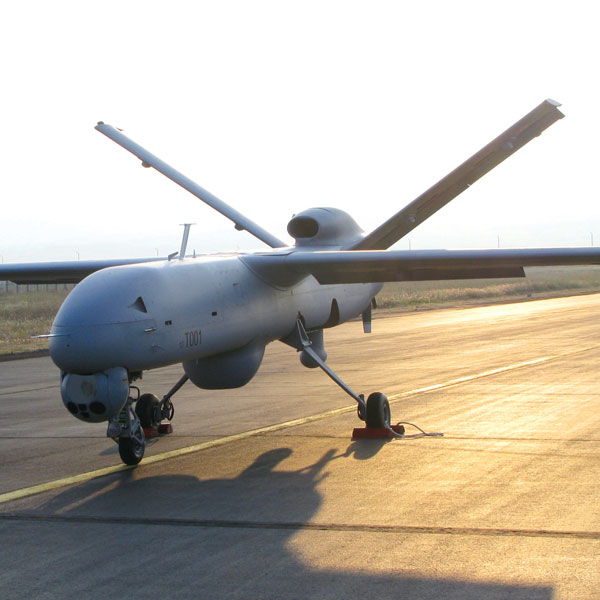
Anka (Phoenix) development program has been the high point for TAI’s two decade long UAV related activities.
The contract was signed with SSM on December 24, 2004 for the development of a Medium Altitude Long Endurance (MALE) class UAV system, including industrialization of all critical subsystems.
During the first two years, feasibility studies and impact analyses were accomplished for some major requirement changes (such as payload capacity of 500 vs 200 kg; airworthiness certification etc). Mutually agreed requirements were finally frozen in a SRR meeting in February 2007.
The "roll-out" ceremony of the Anka system was made on August 2010. After completion of the ground tests and taxi tests, the first flight was accomplished on December 30, 2010, only 1.5 years after the CDR meeting.
The Anka system size and level of complexity placed Turkey among the three nations in the world, along with U.S. and Israel. In addition, TAI has joined a very limited number of prestigious global UAV companies which have MALE UAV product.
The subsystems of Anka is given in Figure-13.
Anka’s avionics system is capable of performing full autonomous flights based on mission plan and automatic takeoff and landing with a dual thread (radar and DGS) ATOLS system. The avionics system includes dual redundant Flight Control Computers, dual/triple redundant flight control sensors (GPS/INS and air data), dual redundant control surfaces, dual redundant communications, identification unit, mission computer, data recorder and other auxiliary control and interface units.
In order to conduct its day/night RSTA missions, Anka is equipped with Aselsan’s 300T EO/IR camera as basic payload in Block-A configuration, and it will simultaneously carry Aselsan’s SAR/ISAR-GMTI radar payload in Block-B configuration that enables all-weather mission capability.
Anka Avionics Architecture
Anka avionics system comprises of two architecturally independent but functionally integrated segments with components serving flight and mission critical functions. This segregated architecture, connected via dual redundant auxiliary control units (ACUs), allows better fault isolation and also demands less regression effort for upgrades/changes to either segment. These ACUs are system interfacing hubs routing data link and storage ports of the Anka avionics architecture with a specific hard coded prioritization scheme for data traffic control (Figure-13).
Anka Flight Control System consists of dual redundant sensors, actuators and flight control computers (FCCs) integrated through a federated architecture serving better reliability and fault tolerance. State-of-the-art, dual redundant FCCs, utilizing ARINC-653 compliant real time operating system, can also support future extensions based on the integrated modular architecture (IMA) standards. The dual redundant flight sensors provide accurate flight data to optimize flight performance, support persistent and reliable operation of the UAV. Different sensor types forflight critical functions are used to avoid common failure modes. The FCS also includes pilot cameras located at the nose and on the tail to increase platform situation awareness especially during manual flight modes. Fully autonomous operation is achieved by utilizing a mission planning application that is hosted in the GCS and upon uploading the mission plan, Anka FCS can perform the mission from take-offrun to landing and coming to a full stop on the runway. The mission plan is created, reviewed and validated on the ground before it is loaded on the platform to make sure the plan is safe (including the planned emergency procedure) and optimized for the mission needs. External communication and identification system consists of Air Traffic Control (ATC) VHF/UHF radio in GCS and identification system (XPDR or IFF) systems aboard the air vehicle.
The software developed for Anka UAV System is designed to support piloting and managing flight operations, planning and executing missions and controlling the payloads, to meet the operational requirements. Air Vehicle Software Components are the Operational Flight Program and the Mission Computer Software.
The Flight Control Computer (FCC) is the central computer and the core of the Air Vehicle avionics system and it controls all the flight critical operations. The operational Flight Program (OFP) is the real-time embedded software which runs on the FCC and controls all the flight operations of the aircraft; supports Controlling and Management of Flight Critical Subsystems, Autonomous Flight through Auto-pilot Function and Flight Management, Fault Management and Sensor Data Collection, Filtering, Calibrating and Voting.
Anka mission suite shares the data link system of flight management to connect airborne and ground mission components. The Mission Computer, interfacing with the FCC, manages the mission equipment and converts the data streams to the formats acceptable to the datalink and C4I interfaces on the ground.
The mission computer compresses the video and audio in real time, mission suite command and control application that is deployed in the GCS. Anka allows other C4I entities to access this data through its external interfaces. All mission data as well asflight data can be recorded onboard or on the ground via storage devices that can handle digital data formats.
Anka System is designed to perform realtime intelligence missions, which enables commanders the shortest time of reaction. Therefore it has strong connectivity to the military network backbone from mission planning to intelligence dissemination.
Anka Ground Control Station systems and functions are given in Figure-14.
Anka Flight Control Software
Anka avionics system comprises of two architecturally independent but functionally integrated segments with components serving flight and mission critical functions. This segregated architecture, connected via dual redundant auxiliary control units (ACUs), allows better fault isolation and also demands less regression effort for upgrades/changes to either segment. These ACUs are system interfacing hubs routing data link and storage ports of the Anka avionics architecture with a specific hard coded prioritization scheme for data traffic control (Figure-13).
Anka Flight Control System consists of dual redundant sensors, actuators and flight control computers (FCCs) integrated through a federated architecture serving better reliability and fault tolerance. State-of-the-art, dual redundant FCCs, utilizing ARINC-653 compliant real time operating system, can also support future extensions based on the integrated modular architecture (IMA) standards. The dual redundant flight sensors provide accurate flight data to optimize flight performance, support persistent and reliable operation of the UAV. Different sensor types forflight critical functions are used to avoid common failure modes. The FCS also includes pilot cameras located at the nose and on the tail to increase platform situation awareness especially during manual flight modes. Fully autonomous operation is achieved by utilizing a mission planning application that is hosted in the GCS and upon uploading the mission plan, Anka FCS can perform the mission from take-offrun to landing and coming to a full stop on the runway. The mission plan is created, reviewed and validated on the ground before it is loaded on the platform to make sure the plan is safe (including the planned emergency procedure) and optimized for the mission needs. External communication and identification system consists of Air Traffic Control (ATC) VHF/UHF radio in GCS and identification system (XPDR or IFF) systems aboard the air vehicle.
The software developed for Anka UAV System is designed to support piloting and managing flight operations, planning and executing missions and controlling the payloads, to meet the operational requirements. Air Vehicle Software Components are the Operational Flight Program and the Mission Computer Software.
The Flight Control Computer (FCC) is the central computer and the core of the Air Vehicle avionics system and it controls all the flight critical operations. The operational Flight Program (OFP) is the real-time embedded software which runs on the FCC and controls all the flight operations of the aircraft; supports Controlling and Management of Flight Critical Subsystems, Autonomous Flight through Auto-pilot Function and Flight Management, Fault Management and Sensor Data Collection, Filtering, Calibrating and Voting.
Anka mission suite shares the data link system of flight management to connect airborne and ground mission components. The Mission Computer, interfacing with the FCC, manages the mission equipment and converts the data streams to the formats acceptable to the datalink and C4I interfaces on the ground.
The mission computer compresses the video and audio in real time, mission suite command and control application that is deployed in the GCS. Anka allows other C4I entities to access this data through its external interfaces. All mission data as well asflight data can be recorded onboard or on the ground via storage devices that can handle digital data formats.
Anka System is designed to perform realtime intelligence missions, which enables commanders the shortest time of reaction. Therefore it has strong connectivity to the military network backbone from mission planning to intelligence dissemination.
Anka Ground Control Station systems and functions are given in Figure-14.
MALE UAVs In Turkey
Turkey had purchased Gnat-750/I-Gnat so-called "tactical endurance" UAV systems from U.S. in 1993, and then Heron MALE class UAV systems from Israel in 2005. These systems enabled end users better understand the capabilities and natural limitations of the UAV systems, as well as develop operational concepts which are proven over time.
Currently only Herons are operational, the prototype Anka systems are already planned for operational tests after the completion of the acceptance tests within 2012.
With its complete software developed in-house at TAI and its software subcontractors such as MilSOFT and STM, Anka will bring great flexibility in integration of new payloads and communications such as SIGINT and SATCOM, bringing new capabilities for end users and enabling continuous product improvement.
Anka has also some superiorities to existing systems, such as heavy fuel engine (bringing logistics and safety benefits) and continuous ice protection capability of its electro - expulsive system (alcohol based systems have inherent usage time limitations due to tank capacity).
Being slightly faster, Anka will also enable shorter transit times to mission area and larger coverage per unit time.
The STANAG compliant Ku-band link, which is developed by SAVRONİK, provides a much higher downlink data rate than the existing systems, which will enable simultaneous real time transmission of multiple payloads. The link also relays ATC radio (VHF/UHF) communication back and forth to Ground Control Station, facilitating airspace sharing with other manned-unmanned assets.
Electrical power available for future payloads is also higher than the existing Heron systems.
Anka’s automatic take-off and landing system (ATOLS) backup positioning sensor is radar based, which is considered to be superior to laser based systems which has inherent weather limitations.
Being aware of growing trends in the market and emerging customer demands, STANAG 4671 and DO-178B were used as a guideline during Anka’s design.
Anka has been the center of attention in major aerospace and defense exhibitions. There has been quite a few countries in our region that expressed interest and proposals have been submitted to at least two countries. With its historical and cultural influence, TAI has a distinctive advantage against its competitors from U.S. and Israel, which will eventually reflect itself in increased market share.
Open Road
TAI is currently focused on Target drones, VTOL and MALE/HALE class UAV system development (Figure-15).
Keklik, Turna and Şimşek show a good complement, covering low cost solutions for speeds from 80 to 400 kts, altitudes of up to 15000+ft (Figure-16). There might be emerging requirements in the future for supersonic target systems, as well as more sophisticated (hence expensive) high subsonic target systems (such as towing targets at high speeds).
There is a good potential spinoff products from Şimşek as decoy (e.g. MALD) and/or close in jammer (r.g. MALD-J), which has a lot of similarities in flight regimes and engine types, but also requires foldable wing designs, thermal battery usage and store certification/checkout processes since they are air launched from cargo aircraft and fighters.
As for VTOLs, R-10E, R-300 and upcoming GİHA more or less form the mini, tactical and operative classes, hence over the whole array except the super heavy unmanned helicopters that are already in use as cargo carriers. However, any VTOL development bigger than the size of R-300 could perhaps only be realized with a solid contract in hand, and this covers both GİHA and unmanned cargo helicopter.
Anka’s next missions will be most probably related to SIGINT (COM DF in particular) and Comms Relay, as well as N/B or W/B BLOS capability increase. Other potential payloads might include multispectral cameras, foliage penetration radars and CBRN payloads.
Attack MALE UAV
Anka MALE class UAV System’s basic missions are RSTA, with SIGINT and Comms Relay options. The targets that are acquired by Anka are cued to armed air or ground units (ground troops/artillery, fighters, attack helicopters) and neutralized.
The Air Force had expressed interest in bigger payload capacity and weapons carrying capability since 2006, which calls for Attack MALE UAV System which is considerably bigger and more capable than Anka conceptual studies and preliminary feasibility studies are underway.
The "2011-2030 UAV Roadmap" that was prepared in coordination of
SSM, with contributions from Turkish Armed Forces and defence industries already addresses requirement under the "Homeland Security/COIN" and "Close Air Support" headings.
Attack MALE UAV System will enable a combined hunter/killer capability that will extend the basic RSTA role into direct kill, close air support and air interdiction on a single platform. Due to having endurance as a key enabler and probable unit cost limits, Attack MALE UAV System is anticipated to have a turboprop engine, rather than a turbofan engine. The turboprop engine will deliver much higher power than a piston engine of similar size, and hence will enable flights at relatively higher speeds and altitudes, carrying more payloads including a considerable weapons load in comparison to a MALE or operative system (e.g. Anka).
The increased performance and possible longer range missions into enemy terrain might require that the high bandwidth LOS datalinks to be complemented by relaively lower bandwidth SATCOM links (based on availability).
Two such examples of such large strategic systems are MQ-9 Reaper/Predator-B (in production) and Heron-TP (in development) UAV sytems. U.S. and UK forces have been operating Reaper with apparent success in Afghanistan.
Table-1 compares a notional SİHA system with the existing Anka system to give a better idea.
The system architecture for SİHA will be established on the already proven Anka hardware and software foundation and gathered experiences. Risk reduction and schedule advantages might be possible by maximizing the commonality between Anka and SİHA architectures and reusable software.
The technological gains such as weapons integration and SATCOM, will add more steps towards establishing the required technologies for the Turkish Unmanned Fighter (TİSU) which is already envisaged in aforementioned UAV Roadmap.
With new acquisitons to be acquired by SİHA system such as weapon integration and satellite communication, another significant step would be taken for the development of technologies required for "Turkish Unmanned Combat Aircraft (TİSU)", which is identified in UAV roadmap.