Integrated and Autonomous (Robotic) System Technologies Under the Concept of Digital Forces
In today's world, technology continues to evolve at a stunning clip. While computers have grown into minimized forms, their calculation speed has immensely increased. The way information and communication technologies are utilized has diversified. "Digitalization" has been internalized by individuals, communities, organizations, states, and the international system in a way to steer our lives. Given where technology currently stands, unmanned aerial vehicles and autonomous (robotic) systems developed over the past 10 years have morphed into a part of daily life in industrial, transportation, and medical aspects.
In theaters of operation that now tend to go digital, it is a fact that the conventional nature of warfare has transformed, and countries are almost forced to improve their Defense Industries, and autonomous and robotic systems in line with the ever-changing requirements. This article offers insight into integrated autonomous and robotic platform technologies kicked off under the concept of Digital Forces by HAVELSAN.
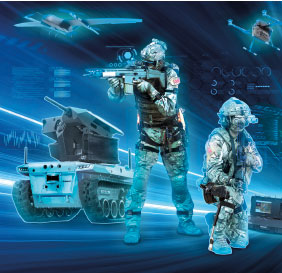
Based on HAVELSAN's vision to adapt to the future, the Concept of Digital Forces is intended to develop technologies that would make operations in battlefields more effective and take a shorter period of time, and create synergy among functional areas, and provide an upper hand over enemies.
In modern conflicts, Unmanned Aerial Vehicles (UAV), and Autonomous and Robotic Systems have grown into indispensable elements in any battlefield thanks to their multiplier effect and impact on the outcome of any warfare. Autonomous and Robotic Systems can be billed as unmanned systems that operate in half or full autonomous modes equipped with sensors, an operating system, effectors, control system architecture, command-control and communication systems, and human/machine interfaces, and adapt to ever-changing conditions on their own, and perform previously-designated missions (and missions that they designate on their own at an advanced stage).
As part of R&D efforts kicked off in 2019 based on its own resources to achieve the Concept of Digital Forces, HAVELSAN designed and developed a mid-level Unmanned Ground System and tactical Unmanned Aerial System prototypes over a short span of time. Developed by HAVELSAN, the Unmanned Ground Vehicle is 150 centimeters in length, 100 centimeters in width, 60 centimeters in height, and 350 kilograms in weight. Powered by an electric engine, the vehicle can fly at speeds of up to 7 kilometers an hour, and operate for over 2 hours. The driving/flight and ground tests for the prototypes are now in the final phase.
The tests to gain autonomous driving capabilities over an unmanned ground vehicle are ongoing successfully. The UGV prototype has been developed as a decisive and robust unit in harmony with the physical environment along with many elements ranging from the autonomous vehicle control unit, engine control system, battery monitoring system, environmental sensors such as LIDA and RADAR, and data fusion unit to artificial intelligence module, health status monitoring system, video and imaging systems, and remote control unit.
The development of the autonomous aerial and ground systems also involves the development of testing and development instruments for models, software, hardware, and vehicles that are essential (MIL, SIL, HIL, VIL). Based on our know-how and experience over modeling, control, and autonomous operations carried out in our simulators, we try to convey data from simulators of avionic systems, sensors (RADAR, INS/GPS), electronic warfare, weapon, and data transfer systems into real autonomous and unmanned platforms to improve the capabilities of the systems to respond to operational needs. Dr. Mehmet Akif NACAR, the General Manager of HAVELSAN, addressed the efforts exerted for autonomous systems under the concept of Digital Forces as part of an interview: "We intend to develop an unmanned system on 4 different platforms. So, we are talking about swarm intelligence that enables aerial, ground, surface, and underwater platforms to act in unison. We're going to do so phase by phase. It is a major technological breakthrough. It takes a developmental course involving R&D, trials, and development of prototypes etc. We have started it all with an unmanned ground vehicle and we will proceed with aerial and surface vehicles. Since all of them will rely on the same protocol, algorithm, and systems, we can design them as one single swarm that can communicate with and provide coordination among one another."
In the short turn, the autonomous systems are intended to be developed in a way to respond to needs of joint operations, operate in autonomous teams (swarm) equipped with Joint Mission Intelligence, and interact with aerial, ground, marine, and other platforms.
In the long run, the concept of Digital Forces by HAVELSAN and ground and aerial platforms and marine autonomous platform technologies are intended to respond to tactical, operational, and strategic requirements in functional areas of battlefields (maneuvering, intelligence, fire support, command-control, survival etc.) and be sustained through the development of integrated software based on artificial intelligence.
When it comes to Integrated Autonomous (Robotic) systems, we deem the following actions essential to be incorporated into the Concept of Digital Forces in cooperation with our partners:
Use of civilian autonomous systems for military purposes (dual use strategy),
Improvement of autonomous capabilities of existing conventional ground, aerial, and marine platforms,
Sustaining R&D efforts to make functional areas of battlefields autonomous,
Kicking off organizational, doctrine, and concept building efforts to use autonomous platform technologies in consideration of their impact on battlefields,
Adaptation of the use of autonomous systems for international law,
Setting ethical rules in line with the development of autonomous systems,
Establishing training needs arising from autonomous systems, and providing training technologies that may be required in line with the development of platform technologies.
In conclusion, it is evident that the gap between states equipped with the aforementioned capabilities and those deprived of them is likely to become too large to be closed given the ever-changing nature of warfare and developments in autonomous (robotic) system technologies. Artificial intelligence and autonomous system technologies are considered to be capable of closing the gap, making a breakthrough, and leading to a paradigm shift in our defense industry. Relying on its experience and engineering capabilities, HAVELSAN is set to contribute to the paradigm shift through the development of integrated and autonomous (robotic) platform technologies under the Concept of Digital Forces. Stay tuned.