Notes on Our Visit to the 2nd AMFD and Aircraft FASBAT Directorate
The 2nd Air Maintenance Factory Directorate (AFMD) was established as Turkey's first aircraft factory (Kayseri Aircraft Factory) by "Turkish Aircraft & Motor Incorporated Company (TOMTAŞ)," which was formed jointly by the Turkish Aeroplane League and the German company Junkers Aircraft & Motor Works under the agreement signed on August 15, 1925, and the factory was officially inaugurated with a ceremony held on October 6, 1926. However, due to the disagreement between the company and the government over financing issues, the company had to go bankrupt on May 3, 1928, and the factory was closed. In 1930, the company was liquidated, and the facility was transferred to the Ministry of National Defense. After 1933, multiple agreements were signed with the USA, Germany, Poland, and England, and with the outstanding efforts of Turkish engineers and workers, the production of Curtiss Hawk, Curtiss Fledgling, Gotha Go 145, Peletel PZL 24A, and Miles Magister aircraft was started under license. Since 1950, the name of the facility was changed to the "Air Supply Maintenance and Maintenance Center," and in 1970, it was included in the "Reorganization and Modernization (REMO)" Project and became an "Air Supply and Maintenance Center." On July 1, 1975, its name was changed to the 'Supply and Maintenance Center Command,' and on February 19, 1986, the name of the facility was changed to the '2nd Air Supply and Maintenance Center Command'.
In 2016, the General Directorate of Military Factories was established under the Ministry of National Defense to ensure the effective management of the Military Factories of the Turkish Armed Forces (TAF) under a single financial and administrative authority. The 2nd Air Supply and Maintenance Center, one of the 3 Air Supply Maintenance Centers that were previously part of the Turkish Air Force, started to operate as the 2nd Air Maintenance Factory Directorate under the General Directorate of Military Factories after an organizational change in 2017.
Maintenance Concept in Military Aviation
In military aviation, the three-level maintenance concept is the most common method preferred worldwide. The TAF also applies a three-level maintenance concept called Organizational Level (O-Level/A-Check), Intermediate Level (I-Level/B-Check), and Depot Level (D-Level/C-Check) for the aircraft in its inventory. For example, according to Airbus Defense & Space (ADS), the downtime period for maintenance, defined under the three-level maintenance concept for the A400M Aircraft, is only 84 days. Accordingly, the A400M Aircraft is required to undergo Organizational Level (A-Check) maintenance every 150 days or 500 hours after flight, Intermediate Level (B-Check) every 24 months, and Depot Level (C-Check) maintenance every 72 months. At the Kayseri 2nd Air Maintenance Factory Directorate (AMFD), C-Check light maintenance takes 45 workdays, and C-Check heavy maintenance takes 75 workdays. "Organizational Level Maintenance," which includes line operations and periodic inspections of aircraft and equipment in preparation for flight, is performed by permanently assigned personnel in facilities assigned to the operating units of the relevant Force Command. The "Depot Level Maintenance," which covers other maintenance services than O and I-Levels, and fuselage/equipment overhaul operations, is generally carried out by military factories/factory directorates of the relevant Force Commands, the facilities of the General Directorate of Military Factories, or by authorized companies.
Location and Hangars of the 2nd AMFD
The Kayseri 2nd Air Maintenance Factory Directorate headquarters is in the Melihgazi district of Kayseri (Approximately 10km from Erkilet). The Aircraft Depot-Level Maintenance and Overhaul Directorate (FASBAT) is established on a total area of 216,000 m2 (20,000 m2 closed area and a 30,000 m2 open area) located within the premises of the 12th Air Transport Main Base Command, located right next to Erkilet Airport. Established on October 6, 1926, the 2nd Air Maintenance Factory Directorate is the first aircraft factory in our country and will celebrate its 95th anniversary on October 6 this year. During our visit to the Aircraft Depot-Level Maintenance and Overhaul Directorate (FASBAT), which can carry out the maintenance, repair, and overhaul activities of approximately 30 aircraft and 8 engines per year, the maintenance, repair, and retrofit operations were carried out for 17 different aircraft, including KC-135R, A400M, C-130B/E, CN235-100M, CN235 ELINT/SIGINT Aircraft, and SF-260D Trainer Aircraft.
2nd AMFD Hangars and Ongoing Operations:
Hangar No. 1: D-Level Maintenance Hangar.
Hangar No. 2: Leased to TUSAŞ for ERCIYES Project.
Hangar No. 3: CN235, T-41D, SF-260D maintenance and modernization hangar. It can provide maintenance and modernization services to 3 x SF-260D, 3 x T-41D, and 3 x CN235 Aircraft at the same time. During our visit, 1 MILSIS-23U CN235 ELINT/SIGINT Aircraft (tail number 136), 1 CN235 Avionics Modernization Guide (Prototype) Aircraft, and 1 CN235 Transport Aircraft were undergoing D-Level Maintenance and modernization processes. The ESM antenna on top of the CN235 MILSIS-23U Aircraft was exposed, while the ESM pods under the wing had not been removed yet. The aircraft has MWS and RWR antennas. An additional MFD screen has been added to the right side of the cockpit to display the information from the RWR and MWS systems.
Hangar No. 4: ERCIYES Project Hangar.
Hangar No. 5: Painting Hangar.
New Painting Hangar: It will be built to replace Painting Hangar No. 5. Both the A400M and the A330 MRTT with a 60m wingspan are expected to be painted here. It is scheduled to be built by 2025.
New A400M Overhaul Hangar No. 6: 2-bay hangar. A400M C-Check Overhaul/D-Level Maintenance operations will be performed in one bay of the hangar and Retrofit operations in the other. If the A330 MRTT Project is finalized, it is planned to build a new hangar for this plane within the 2nd AMFD.
The Aircraft Depot-Level Maintenance and Overhaul Directorate (FASBAT), which has the capability to carry out special maintenance that only a few countries in the world can perform, has 4 active hangars and 8 maintenance workshops. The inauguration ceremony of the newly built 2-bay hangar for the A400M Aircraft (A400M Overhaul Hangar) was held on July 8, 2021, with the participation of Minister of National Defense Hulusi AKAR, Chief of General Staff General Yaşar GÜLER, Land Forces Commander General Ümit DÜNDAR (Retired on August 30), Air Force Commander General Hasan KÜÇÜKAKYÜZ, Naval Forces Commander Admiral Adnan ÖZBAL, Deputy Minister Muhsin DERE and ASFAT General Manager Esad AKGÜN. One of the Directorate's hangars (number 2) was leased to TUSAŞ as part of the ERCIYES Project. Thus, TUSAŞ carries out the ERCIYES Modernizations of the C-130B/E Hercules Transport Aircraft under its responsibility in the leased hangar number 2 and delivers them to the TurAF. On the other hand, the 2nd AMFD carries out the ERCIYES Modernizations of C-130B/E Aircraft under its responsibility in hangar number 4 of FASBAT Directorate. The manufacturing workshops of the 2nd Air Maintenance Factory Directorate produce 300,000 parts for approximately 2,000 different items per year with domestic capabilities.
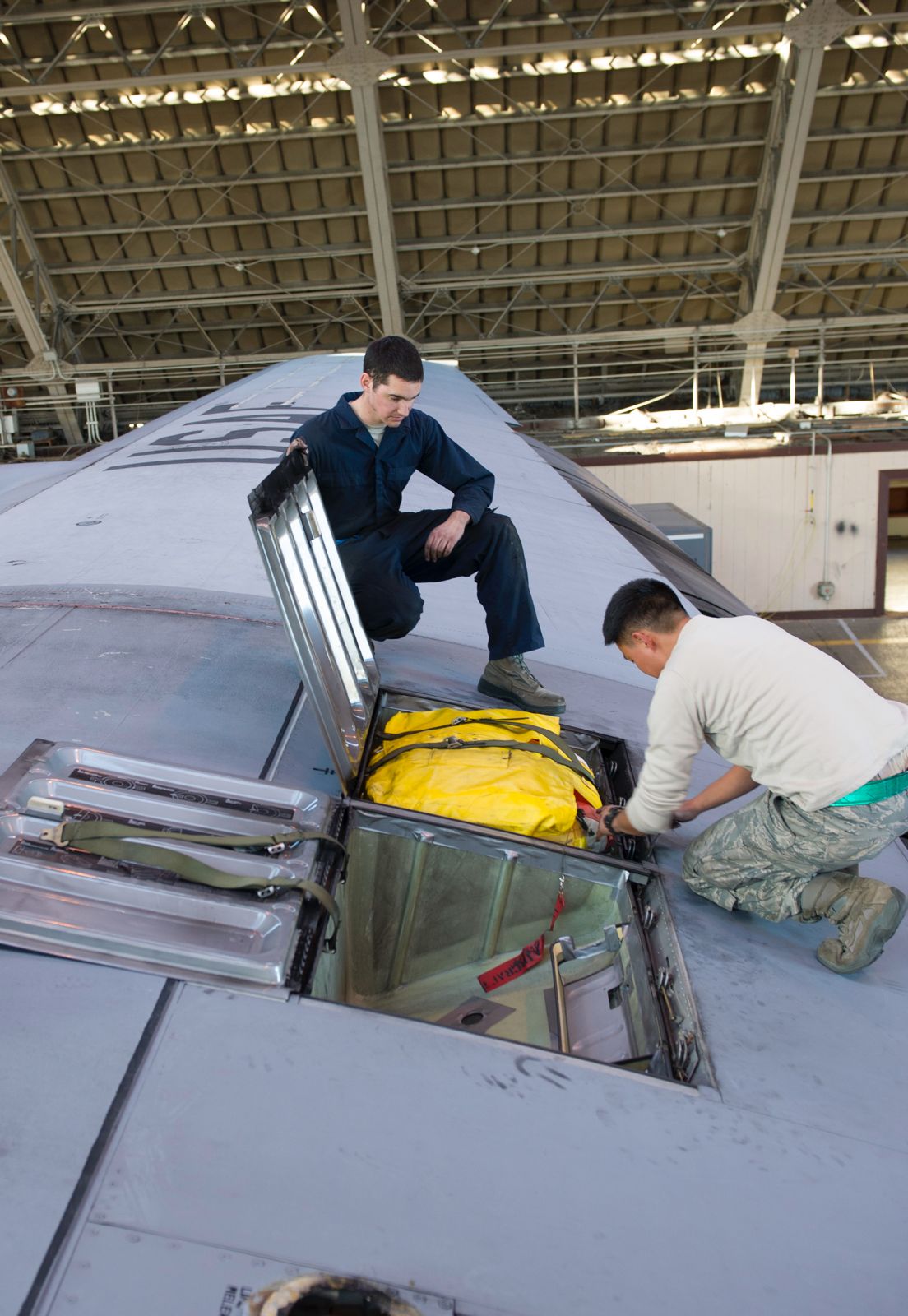
During our visit, 1 KC-135R Stratotanker Aircraft and 2 C-130 Hercules Aircraft (63-13188 and 61-2634) were undergoing D-Level maintenance operations in hangar number 1. The D-Level maintenance process of the KC-135R Stratotanker Aircraft takes 7 months, and the planes undergo D-Level maintenance every 5 years. As part of the KC-135R Depot-Level Maintenance process, hot fault inspections are carried out before the maintenance process to check the status of the aircraft. Afterward, the aircraft is moved to Hangar No. 1, and pre-washing preparations are made by removing the large horizontal and vertical control surfaces. Then, the aircraft is washed with a high-pressure jet, and the paint is completely removed. After the aircraft paint is stripped, detailed controls of the aircraft, called cold fault inspections, are carried out according to the relevant work cards. As a result of these checks, detected problems are fixed. In parallel with these checks, maintenance and repair operations are also carried out. After the maintenance and repair operations are carried out, and all the detected problems are eliminated, the assembly process of the aircraft begins. First, functional checks of the assembled aircraft are carried out in the hangar, and if a problem is not encountered, the aircraft is sent to the paint hangar to be painted. After the painting and marking processes are completed, the engine start-up and flight line avionics checks are conducted, and the maintenance of the aircraft is completed.
Following the completion of D-Level Maintenance, the Air Force flight crew performs a test flight with aircraft, and if no problems are encountered, the aircraft is handed over to its unit. The 7 aircraft TurAF KC-135R Fleet consists of 1957 and 1962 model Stratotankers. The Turkish Air Force also continues its modernization activities to keep the venerable KC-135Rs up to date. According to the information I received, the Stratotankers, which had previously received Pacer-CRAG (Compass Radar and GPS) upgrade in the early 2000s, are currently undergoing Pacer CRAG Block 45.1 modernization. In this context, a KC-135R Stratotanker Aircraft is being modernized in the USA as of June 2021, and after the completion of the first aircraft (this aircraft was later delivered to the TurAF in September), the other 6 aircraft in the fleet will also receive the Pacer CRAG Block 45.1 upgrade.
The C-130B/E Hercules Aircraft also undergo D-Level maintenance every 5 years. During our visit, 2 C-130B/E Hercules Aircraft (63-13188 and 61-2634) were undergoing D-Level maintenance, and 2 C-130B/E Aircraft were being upgraded in hangars 1 and 4 within the scope of the ERCIYES Project (73-0991 and the second C-130 without a tail number, the tail number of the second plane was not visible because the paint on it was completely removed). Since we could not tour hangar number 2, which TUSAŞ rented, we did not have the opportunity to see how many aircraft went through ERCIYES Modernization at that time. The C-130E aircraft with tail number 63-13188 was the first aircraft upgraded under the ERCIYES Project (Avionics Modernization of C-130E/B Aircraft) and was officially delivered to the Turkish Air Force with a ceremony held at TUSAŞ facilities on August 8, 2014. The C-130B Aircraft with tail number 61-2634 is the second and last prototype aircraft of the Project, and since the acceptance process took longer than planned, it was delivered to TurAF with the acceptance flight conducted in Kayseri in the second half of 2016. The avionics upgrade kit integration and installation on each C-130 aircraft take about 6 months, while the D-Level maintenance process takes around 6-7 months. Thus, the aircraft undergo both D-Level maintenance and avionics modernization at the same time.
Between 1964 and 1973, a total of 8 new production C-130E Hercules aircraft entered the TurAF inventory. One of these planes, the C-130E with serial number 64-17949, crashed while landing at Akhisar Airport on the evening of October 19, 1968, and 7 crew members were killed in the accident. Later in 1991, 7 C-130B Hercules from the US Air National Guard inventory were donated to the Turkish Air Force. To support the fleet, 6 second-hand C-130E Transport Aircraft were purchased from the Royal Saudi Air Force (RSAF) for US$26.3 Million in 2010, and the planes arrived from Prince Sultan Air Base in Saudi Arabia to Erkilet Air Base in Kayseri between November 20, 2011, and January 21, 2012. After the flights, which varied between 4 hours, 15 minutes, and 5 hours, the planes were brought to the 12th Air Transport Main Base Command. The tail numbers of the aircraft in the order of arrival are as follows; 70-1610, 68-1608, 68-1606, 67-455, 65-451, and 68-1609. Unlike the C-130Es in the TurAF service, C-130E Hercules Aircraft purchased from the RSAF are not equipped with AN/AAR-47(V)1 Missile Warning System (MWS) sensors and Chaff/Flare launchers (Countermeasure Dispensing System/CMDS) in the nose and tail section. During the visit, which took place on June 24, 2021, I noticed that 1 C-130E Aircraft with RSAF camouflage was still waiting in the aircraft parking area at the 12th Air Transport Main Base.
In a statement to Anadolu Agency regarding the ERCIYES Project in April 2020, the 2nd Air Maintenance Factory Directorate Depot Level Maintenance Manager Lieutenant Colonel Süleyman ERBIL stated that the maintenance operations of the C-130B/E Hercules Aircraft are carried out at the 2nd AMFD facilities every six years and pointed out that the maintenance activities, which are normally completed in 120 workdays, can take between 6 months to 1 year depending on the condition of the aircraft. In the photographs published by Anadolu Agency, the C-130 Hercules Military Transport Aircraft with tail numbers 608, 609, and 991, which were painted in the colors of the Turkish Stars (i.e., the plane has been at the Factory since April 2020), were among the aircraft undergoing maintenance in the hangar.
According to the information I received during my previous visit to the 12th Air Transport Main Base Command in October 2015, C-130B/E Hercules Aircraft undergo Home Station Check (HSC) inspections every 7 months and Periodic Maintenance every 14 months. Periodic Maintenance consists of four separate phases: The 1st Phase, 2nd Phase, 3rd Phase, and 4th Phase. Each Periodic Maintenance takes approximately 2 months (25 workdays), while HSC inspections are completed within 3 workdays.
As part of the C-130B/E ERCIYES Avionics Modernization Project, the overhaul work continues as planned in two separate hangars (hangers 4 and 2) at the 2nd AMFD/FASBAT Directorate. As of June 2021, 8 C-130B/E Hercules aircraft have been upgraded, and the delivery of 2 aircraft, which are still in progress, will be completed in 2021. President of Defense Industries Ismail DEMİR announced on February 12, 2021, that the 8th aircraft was delivered to the Turkish Air Force. If everything goes according to plan, 10 of the 19 C-130B/E Aircraft that will receive avionics upgrades within the scope of the ERCIYES Project will have been completed by the end of 2021. Pre-delivery test/acceptance flights of C-130B/E Aircraft undergoing ERCIYES modernization are carried out by pilots from the 401st Test Squadron in Eskişehir, and if no problem is encountered during the flight, the aircraft is accepted.
As far as I know, the 2nd AMFD/FASBAT Directorate is the only facility outside the USA with D-Level Maintenance capability for KC-135R aircraft. In this context, it is one of the few facilities in the world that has the capability for both C-130 Aircraft maintenance & repair and avionics modernization. For A400M Aircraft, it is the second source in the world, apart from Airbus Defense & Space (ADS), which has final assembly, D-Level Maintenance, and Overhaul/Retrofit facilities in Seville and Getafe.
Turkey operates the largest CN235-100M fleet in the world. So far, the 2nd AMFD/FASBAT Directorate has carried out the Depot-Level Maintenance of 58 aircrafts in the inventory at least 120 times. Currently, the 2nd AMFD/FASBAT Directorate completes D-Level maintenance, which is carried out every six years, within an average of 60 workdays, and can perform D-Level maintenance of 8 CN235 Aircraft per year. According to the information we received, the indigenous, more affordable solution developed by the 2nd AMFD/FASBAT Directorate within the scope of the CN235 Avionics Modernization Project was found very successful by ADS. In this context, it was stated that ADS offered the CN235 avionics modernization solution of the 2nd AMFD to France and South Korea.
The 2nd AMFD/FASBAT Directorate provides maintenance and repair services not only for CN235s in the TurAF inventory but also for CN235/P235 aircraft in the Turkish Naval Forces and Coast Guard inventory. Landing gear malfunctions, frequently experienced in these aircraft, are also repaired by national capabilities thanks to the landing gear maintenance and repair infrastructure in the 2nd AMFD/FASBAT Directorate. In addition to the landing gear maintenance, propeller and LRU maintenance and repairs are also carried out at the facility. The 2nd AMFD, which was certified by Airbus D&S, was granted the "Regional Support Maintenance Center" certificate for CN-235 Aircraft with a ceremony held on July 1, 2015. As of June 24, 2021, significant progress has been made in the work carried out in Hangar No. 3 on the CN235 Avionics Modernization 'Guide' Aircraft, and the final testing phase has been started. In the meantime, flight tests have been completed, and work has begun to begin the Serial Modernization Phase. Within the scope of the CN235 Avionics Modernization Project, a more affordable solution was preferred compared to the ERCIYES Project. Because for such an aircraft, the integration of an expensive US$5 Million avionics package, as in the ERCIYES Project, would not be a cost-effective solution. The prototype aircraft, which has undergone an Avionics Upgrade and is also known as the 'Guide,' has gained new capabilities such as TCAS, IFF Mod 5S, ADS-B (Automatic Dependent Surveillance-Broadcast), GPS Based Navigation, and Auto-Pilot (integration continues). Since Garmin hardware/LRUs are already certified products (products with flight certification), the CN235 Avionics Modernization developed by the 2nd AMFD/FASBAT Directorate is considered a certified solution. Currently, joint marketing and promotion activities with the company ADS for other countries continue.
The veteran C-160D Transall Medium Transport Aircraft in the TurAF inventory will be completely retired shortly. In this context, the dismantling process of the decommissioned aircraft has already begun. While landing at Erkilet Airport, I saw 9 C-160Ds parked in the aircraft parking area at the 12th Air Transport Main Base. The engines of some of the planes were stripped. Currently, 1 C-160D Aircraft is due for D-Level Maintenance, but as of June 24, no decision has been made on whether this aircraft will undergo the process, as the A400M Maintenance and Overhaul operations continue intensively, and the aircraft will be retired soon. In this context, the C-160D GOREN ISR Aircraft and MILKAR-2U Aircraft (Equipped with the JAMINT-2U Electronic Jamming and Blanking System) are also expected to be retired this year. As of the end of 2020, I believe that the number of active (flying with special permission/order) C-160Ds in the inventory is 3 GOREN ISR, 2 MILKAR-2U, and 1 Transportation.
Approximately 400 personnel still work in the 2nd AMFD/FASBAT Directorate, but it has an intense workload that will require 800 workers. Therefore, with the support of ASFAT, they are working on recruiting additional personnel. The civilian recruitment process takes quite a long time. We have been told that the new workers from the recruitment process two years ago have just started to work. It was also stated that the number of personnel was well below what was demanded. Another issue is the quality/qualification of the workers. Now that the A400M Overhaul and Retrofit projects are being carried out, the civilian staff who will start working at the Factory must have a specific English level. However, this requirement is ignored during the recruitment process, and personnel are selected by interview among candidates who have a certain KPSS score (Civil Servant Selection Examination). English speaking and writing skills are required for future worker recruitment. It was stated that ASFAT provides significant support in the recruitment process and that more efficient results can be obtained thanks to ASFAT in the future. In parallel with the increasing workload, I have learned that significant infrastructure modernization and additional personnel recruitment are planned for 2021. ASFAT supports the 2nd AMFD/FASBAT Directorate in this regard (ASFAT is expected to play a role in the supply of certified personnel in the future). New workers are trained for one year, and within 3-5 years, the personnel become fully qualified. In this process, the personnel also undergo different certification training. Training services are also outsourced from the private sector.
Aiming to become a Regional Aircraft Maintenance Center, the 2nd AMFD/FASBAT Directorate wants to carry out both kit production and structural modification/modernization for the A330 MRTT Aircraft that the TurAF is expected to procure in the near future. The 2nd AMFD/FASBAT Directorate also wants to be a maintenance center alternative for A400M users with a small number of aircraft and plans to commission the A400M Paint Hangar by 2025. If the awaited Retrofit orders for the A400M Aircraft are realized, the 2nd AMFD/FASBAT Directorate intends to switch to a 24-hour double shift system.
A400M D-Level Maintenance and Retrofit Procedures
Located at the 12th Air Transport Main Base, the 2nd AMFD was certified by ADS to provide C-Check Overhaul service for A400M Aircraft after a year-long inspection and was granted a certificate at a ceremony held in February 2018. The A400M Aircraft Maintenance-Repair-Retrofit Contract was signed between ADS and ASFAT at a ceremony held on October 3, 2019. With the contract, the 2nd AMFD gained the capability to provide retrofit services not only for the A400M Aircraft in the Turkish Air Force inventory but also for the A400M Aircraft in the service of friendly and allied countries in the region. The 2nd AMFD is the only maintenance center outside Airbus facilities that can perform the retrofit process. The 2nd AMFD/FASBAT Directorate has established a significant infrastructure for this aircraft with the A400M D-Level Maintenance and Retrofit Projects. According to the information we received, this capability will be offered to both European countries and friendly and allied nations in the region in cooperation with ADS (for countries that do not plan to invest in expensive infrastructure for D-Level Maintenance/Overhaul and Retrofit operations. The Republic of Kazakhstan ordered two Airbus A400M aircraft on September 1).
Currently, the 2nd AMFD/FASBAT Directorate prioritizes the A400M Maintenance-Repair-Retrofit procedures. In this context, it is aimed to localize the components and manuals currently supplied from abroad in the near future. The localization work is expected to prioritize the Propellers and Landing Gears. We have learned that every seven years, the propellers of the TP400-D6 Turboprop Engines are removed and undergo a detailed inspection and maintenance & repair process. This process has a very high cost and currently takes six months to complete. The propeller inspection capability has significant importance to both reduce the cost and shorten the duration of the aircraft on the ground. In this context, additional personnel training and testing equipment investment is required. A technical delegation from Airbus came to the 2nd AMFD/FASBAT Directorate as part of the A400M Aircraft Maintenance-Repair-Retrofit Project and made inspections there. A team from the FASBAT Directorate also visited ADS facilities in Getafe, Spain, and learned about the studies/capabilities. By improving the number and quality of its personnel (new certification programs are ongoing) and its infrastructure with the support of Airbus, today the 2nd AMFD/FASBAT Directorate can perform A400M D-Level Overhaul & Retrofit operations much cheaper and in a much shorter time compared to ADS. In this framework, C-Check Light Overhauls (CL), which cost approximately €900,000 abroad, can be performed at much lower costs in 45 workdays at the 2nd AMFD facilities. Thanks to the A400M Retrofit operations carried out at the 2nd AMFD/FASBAT Directorate, Turkey saved approximately €1 Million per aircraft.
As of June 24, 2021, A400M C-Check Overhaul and Maintenance-Repair-Retrofit operations were carried out in the rented one-bay hangar at the 12th Air Transport Main Base Command. The construction of this hangar took four years and was commissioned five years ago in 2016, while the new two-bay A400M Overhaul Hangar was officially inaugurated on July 8, 2021. The distance between the two hangars is approximately 4km. The new A400M Overhaul Hangar construction started in March 2020 and was completed in 14 months by a team of 250 people working double shifts, despite the pandemic conditions. The total cost of the hangar was announced as TL135 Million. As of June 24, the acceptance process of the new hangar was ongoing. Named Hangar No. 6, the new A400M Overhaul Hangar will hold MSN-013 (recently completed C-Check Overhaul/D-Level Maintenance for Retrofit operations) in one bay and MSN-093 (will undergo C-Check Overhaul/D-Level Maintenance) in the other. To start the Retrofit process of MSN-013, it was planned that a team from the Quality Department of ADS would come to the 2nd AMFD/FASBAT Directorate on July 12 to inspect the new hangar and certify whether it is suitable for retrofit. When the inspection is completed, the retrofit of MSN-013, the second A400M Aircraft, will be started. The required interior equipment of Hangar No. 6, which can accommodate A330 MRTT Aircraft with a 60m wingspan, will either be re-purchased or the equipment in the one-bay hangar at the 12th Air Transport Main Base will be installed here. Although the 2nd AMFD/FASBAT Directorate wants to purchase and install new equipment for doubled infrastructure and capabilities (A400M Retrofit and C-Check Overhaul), there is a financing issue that needs to be resolved. Depending on the decision of ASFAT and the Turkish Air Force, one of these two options will be selected.
During our visit, the Maintenance-Repair-Retrofit operations on the MSN-009 A400M Aircraft, which was the first A400M Retrofit activity of the 2nd AMFD (upgrading the previously delivered aircraft with the latest avionics hardware and software versions), were continuing in the leased hangar at the 12th Air Transport Main Base. MSN-009/13-009 was expected to be delivered in July or in the first week of August, following the completion of the 8-month retrofit work, which started on December 7, 2020. The plane was scheduled to start the Runway Tests on Monday, June 28. It was planned that the Runway Tests would be carried out by the 2nd AMFD/FASBAT Directorate personnel, and the first flight test would be carried out by the ADS Flight Crew from Spain; and if necessary, further corrections/adjustments would be made to the aircraft based on the ADS Flight Crew's feedback. Afterward, the TurAF will conduct flight tests with its own flight crew for a week. After this process called "Hand Back," MSN-009 will be accepted and delivered to the 12th Air Transport Command if no problem is encountered. Retrofit activity on the A400M MSN-009/13-009 was completed on July 30, 2021.
The retrofit operations carried out in the rented hangar are monitored and supervised by both Airbus (Quality Manager) and the SSB representative. The F2 (Step 2) Retrofit Package, which directly comes from Airbus, is implemented to the aircraft by the 2nd AMFD/FASBAT Directorate personnel there. The 2nd AMFD/FASBAT Directorate manages the work processes with the help of the "Logo Netsis Wings" software, which was purchased from a local software company, Logo Yazılım. The Wings enables the FASBAT Directorate to easily manage all the activities planned under the A400M retrofit program from a single point (i.e., tracking each part installed to or removed from the aircraft, workflow, personnel training). We have been told that the Wings authorizes the personnel to create work cards based on their training and is controlled via a kiosk (Maintenance Module) located in the hangar. For the Retrofit activities, around 3,500 work cards have been defined for the MSN-009 Aircraft. Thanks to the Wings, both these work cards and man-hour labor can be tracked (such as which personnel completed which work card on which days and at what times). The Wings allows continuous tracking of workflow and ensures the proper management of working processes. It is an information system that enables certified personnel to work with appropriate materials within the scope of the Retrofit Program (without proper training, workers cannot validate their work cards at the kiosk). The Wings program is based on a maintenance module previously developed for THY by the company, and it is configured to meet TurAF requirements. We learned that Airbus was quite satisfied with the performance of the Wings program used by the 2nd AMFD/FASBAT Directorate and started negotiations with the company Logo Yazılım to purchase the Wings Program after seeing that it performed much more successfully than the Pelicano Program it uses. During the delivery process, Airbus officials will control the retrofit works through the Wings program and confirm that the retrofit process has been completed correctly by checking the work cards.
The Airbus Support Team has tightly supervised retrofit work on the MSN-009. The team also provides support to the Aircraft FASBAT Directorate personnel when needed. However, especially from the 3rd A400M Aircraft, the Turkish Air Force aims to carry out this retrofit work entirely on its own. Since Retrofit and Overhaul/D-Level Maintenance operations will be carried out periodically during the service life of the A400M Aircraft, the acquisition of this capability has significant importance both economically and strategically. We have learned that the MSN-009, the first A400M Aircraft to enter the Air Force inventory, had fewer flight hours than other aircraft since it did not fly much because of its older version avionics hardware and software. Since the MSN-009 and MSN-013 previously went through the F1 (Step 1) Retrofit process at Airbus Getafe facilities in 2015 and 2016, the F2 (Step 2) Retrofit Package is implemented to aircraft at the 2nd AMFD/FASBAT Directorate. It was noted that the Retrofit Package, which will be implemented to A400M Aircraft with more up-to-date hardware and software, will consist of fewer work cards compared to the MSN-009 and MSN-013. The 12 personnel who work in the Maintenance-Repair-Retrofit process of the A400M Aircraft had previously received Lean Manufacturing training from Airbus Defense & Space in Spain. The implementation Training was given by the Spanish team at the FASBAT Directorate in Kayseri. As of June 2021, a total of 20 blue-collar personnel were working in the Maintenance-Repair-Retrofit process of the A400M Aircraft. Twelve of them received Type Training in Spain, and it is planned that they will receive PART-66 Training at the FASBAT Directorate after a short time. The remaining eight personnel are expected to be sent to Spain by the end of 2021 for Type Training. These workers will receive a PART-66 License (Personnel Qualification Certificate) after completing the training. Therefore, in 2022, all of the personnel will have received both Type Training and PART-66 Training. The workers who have received PART-66 Training will also be able to work in the A330 MRTT Program, provided that they receive the Type Training. Under the Retrofit Program, the A400M Aircraft is fitted with new hardware (some LRUs are directly replaced) and hundreds of new avionics software is installed.
The first A400M Aircraft (13-009/MSN-009) was delivered to the Turkish Air Force in Initial Operational Clearance (IOC) configuration, and the second aircraft (14-0013/MSN-013) was delivered in Standard Operational Clearance-1 (SOC-1) configuration. These two aircraft were later upgraded to SOC-1.5/Batch 2 (Additional Tactical Capabilities) after undergoing the retrofit process at ADS facilities in Getafe, Spain, in 2015-2016. The third A400M Aircraft (MSN-028) was also retrofitted in Getafe. A400M Retrofit operations are considered a production-oriented activity rather than maintenance and are regarded 'service exports' as part of the production. While the EASA PART-145 standards would be sufficient for a maintenance-only operation, additional standards were needed for retrofit. Military aviation is a sector with a high added value, and the 2nd AMFD/FASBAT Directorate has a significant position in this sector as an integrated facility capable of both maintenance/repair, part/component production, and overhaul. The close cooperation with ASFAT, which serves as a gateway abroad, will provide numerous opportunities to use the existing capabilities to meet the needs of friendly and allied countries and become a significant source of foreign income for our country.
A400M Atlas Strategic Transport Aircraft and TurAF
Within the scope of the A400M Program, Turkey declared that 10 aircraft would be procured for the Turkish Air Force (TurAF) and signed a contract valued at €1.496 Billion in 2003 to this end. The project amount was mentioned as €1.496 Billion in the Activity Reports of 2009, and 2010 published by the SSB and stated as €1.332 Billion in the Activity Reports regarding the years 2011 and 2013. The cost of every A400M Atlas Strategic Transport Aircraft to Turkey was announced as €125 Million.
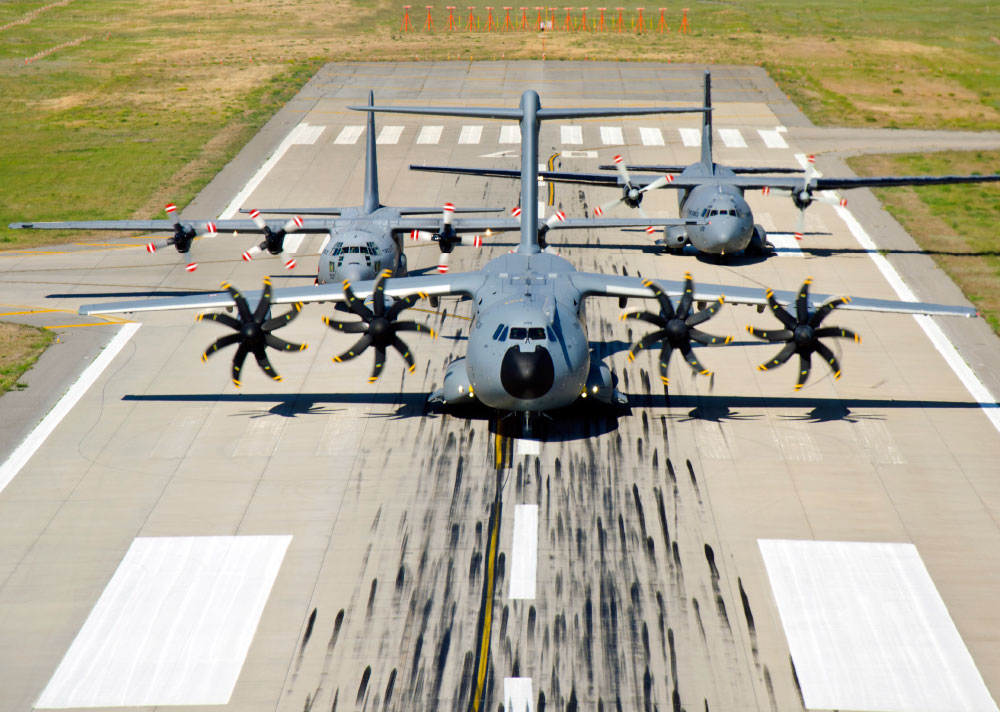
Operated by the 221st Air Transport Squadron at the 12th Air Transport Main Base Command located at Erkilet, Kayseri, the A400M Atlas is a new generation military transport aircraft capable of conducting long-range tactical and strategic transport missions.
The first A400M Atlas Strategic Transport Aircraft with the MSN-009 (Manufacturer Serial Number 009) serial number and 13-0009 tail number entered service with a ceremony held at the 12th Air Transport Main Base Command on May 12, 2014. The second A400M with the MSN-013 serial number and 14-0013 tail number landed at the 12th Air Transport Main Base Command on December 23, 2014. The MSN-009 and MSN-013 went through retrofit activity with an emphasis on software and hardware (including the engine) to enhance them to the highest capability standard, ready for utilization at the Prime Contractor of the A400M Program Airbus Defense & Space (ADS) 's Getafe facilities located 20km south of Spain's capital Madrid during 2015-2016. The third A400M Atlas aircraft with serial number MSN-023 manufactured for the TurAF crashed during the first test flight (Factory Acceptance Test) conducted in Seville/Spain on May 9, 2015. MSN-023 will be replaced with the 10th A400M in January 2022. The third A400M with serial number MSN-028 and tail number 14-0028 (the fourth aircraft manufactured for the TurAF yet it is the third delivered aircraft) arrived at the 12th Air Transport Main Base Command on November 25, 2016, while the fourth A400M with tail number 15-0051 was handed over on April 7, 2017. The initial flight test of the fifth A400M Atlas aircraft with tail number 16-0055 and serial number MSN-055 was executed at the San Pablo facilities of ADS in Seville, Spain, on April 18, 2017, and the acceptance of the aircraft was accomplished on July 13, 2017. The 6th A400M aircraft of the TurAF with serial number MSN-078 and tail number 18-0078 conducted its maiden flight on May 16, 2018 and arrived at the 12th Air Transport Main Base Command on June 22, 2018. The 7th A400M, serial number MSN-080 and 18-080 tail number landed at the 12th Air Transport Main Base Command on October 18, 2018, and the 8th A400M, serial number MSN-093 and 18-0093 tail number landed on June 21, 2019, following the completion of acceptance flight test performed at the San Pablo facilities of ADS in Seville, Spain on June 20, 2019. The acceptance test activities of the 9th A400M of the TurAF with tail number 18-0094 and serial number MSN-094 were executed at ADS' San Pablo facilities in Seville, Spain, on August 7, 2019. The 8th and 9th A400Ms were delivered with the latest standard, including tactical capabilities. The delivery of the 10th and the last A400M for the TurAF will take place in February 2022