INTERNATIONAL ANATOLIAN EAGLE 2025
The international edition of the Anadolu Kartalı (Anatolian Eagle) exercise took place from 23 June to 4 July at the Anatolian Eagle Training Center (AETC), located within the command of the Third Jet Air Base (3’üncü Ana Jet Üs Komutanlığı) in Konya.
The aim of establishing AETC is to prevent loss of pilots without experience in the beginning phase of possible future wars, prevent loss of aircraft during peace time, exchanging experience across nations and forces. To bring these aims into reality Turkish Armed Forces made researches, in 1997 6 F-16 aircrafts of Turkish Air Force with 57 personal joined Red Flag Exercise at Nellis AFB and begin to create the main structure of AETC. With infrastructural works between 2000-2001 and Anatolian flag exercise held at Incirlik Airbase on 1998, also with the works of Headquarters June 2001, Electronic Warfare Systems, additional working spaces, accommodation buildings completed and the center reached the capacity it has today.
Starting from this first edition, from 2001 to 2025, a total of 55 Anatolian Eagle training sessions were held in Konya, of which 30 international and 25 national sessions.
Overall, to date, the exercise has seen the participation of 16 countries (Saudi Arabia, Azerbaijan, Belgium, United Arab Emirates, France, Germany, Jordan, Israel, Italy, Holland, Pakistan, Qatar, United Kingdom, Spain, Hungary and the United States), with 41,264 personnel and 3,394 air assets, which have carried out 27,073 training missions.
The training activities have two very large spaces available, which cover an area of about 400x330 kilometres over central Turkey and about 260x140 kilometres over the Mediterranean, north of Cyprus, amounting to a total area of about 168,000 km2 (see below). The so-called 'salt area', the main airspace reserved for the exercise, is used from ground level up to 15,240 meters (50,000 feet).
From a training point of view, the exercise involves a "blue force", which has up to three headquarters at its disposal, a "red force", which has a headquarters at its disposal, and a "white" headquarters, which manages the exercise, defines and monitors the rules of engagement and procedures.
The blue force is composed of Turkish and international assets, supported by aircraft equipped with NATO AEW&C E-3A airborne early warning and control systems, operating from the Forward Operating Location of Konya, and Turkish E-7T belonging to resident 131.Filo. Its mission is to attack tactical and strategic targets located in "red territory" during COMAO missions.
The Red Force is uniquely Turkish and its task is to defend the red territory with the use of both air and land assets, the former provided by the resident 132.Filo "Hançer" (Dagger), the latter comprising a wide range of threat emitters and anti-aircraft systems such as ZSU-23-4, SA-6, SA-8, SA-11, Skyguard/Sparrow, and Hawk located in a specific Electronic Warfare Test and Training Range (EWTTR).
All the assets of the blue/red forces are controlled in real time by a "white" headquarters, which has the task of preparing the training scenario, issuing the Air Tasking Order, monitoring and directing the exercise. The white force is also tasked with developing scenarios, establishing different levels of training and composition of air assets according to the different scheduled missions CSAR (Combat Search and Rescue), CAS (Close Air Support), SEAD (Suppression of Enemy Air Defences, etc.) and, of course, analysing the results of the missions resulting in debriefing for the participating crews.
Finally, it has the task of evaluating and analysing the training, using an ACMI (Air Combat Manoeuvring Instrumentation) system and a post-mission analysis system. During the exercise, in fact, the position and flight information of the participating aircraft are transferred to a command-and-control centre (CCC) through an ACMI system positioned on the aircraft that records the flight parameters. Similarly, information relating to radar tracks from AEW&C aircraft and ground-based radar systems, and information from GBAD (Ground-Based Air Defences) systems, is also transferred to the CCC.
The exercise usually takes place over a period of two weeks, preceded by a week in which the participants arrive, who perform familiarization flights preceded by mass briefings.
In the first week of operations, two missions are carried out per day, called Eagle-1 (COMAO operations) and Eagle-2 (non-COMAO operations, such as interception, electronic warfare training and dissimilar air combat training). On Fridays, only one mission is carried out. The second week has the same daily schedule, however on Thursday only one mission is carried out, followed by a mass briefing that concludes the exercise. On Friday, participants return to their home bases. It should be noted that participants also have the opportunity to carry out missions during non-Eagle sorties according to their training needs such as, for example, tactical interception training or missions at the electronic warfare training range.
A typical day of flying begins at 07:30 with the briefing for Eagle-1, which lasts until approximately 09:00, while the first take-offs begin at 09:30, followed by landings between 12:00 and 13:00. While the participants in Eagle-1 are returning to Konya, the briefing of the crews participating in the Eagle-2 mission takes place; this is followed by the debriefing of the Eagle-1 mission, during which the Eagle-2 aircraft take off. Eagle-2 lasts from 2:30 p.m. to 5:30 p.m., followed by a debriefing. The training day ends at 20:30. In summary, each Eagle mission requires a total time of eight hours for briefings, flight and debriefing. A pilot spends nearly 13 hours a day preparing for a mission, including 5 hours of planning the next day.
Each Eagle mission involves at least 40 Blue Force aircraft. If a Red Force aircraft is shot down during a simulated air combat event, it can go to the area called "rebirth" and rejoin air combat; in this way, it is possible to keep more elements of the Red Force in the air, as well as save fuel and time that would be spent returning the plane to the runway and taking it off again.
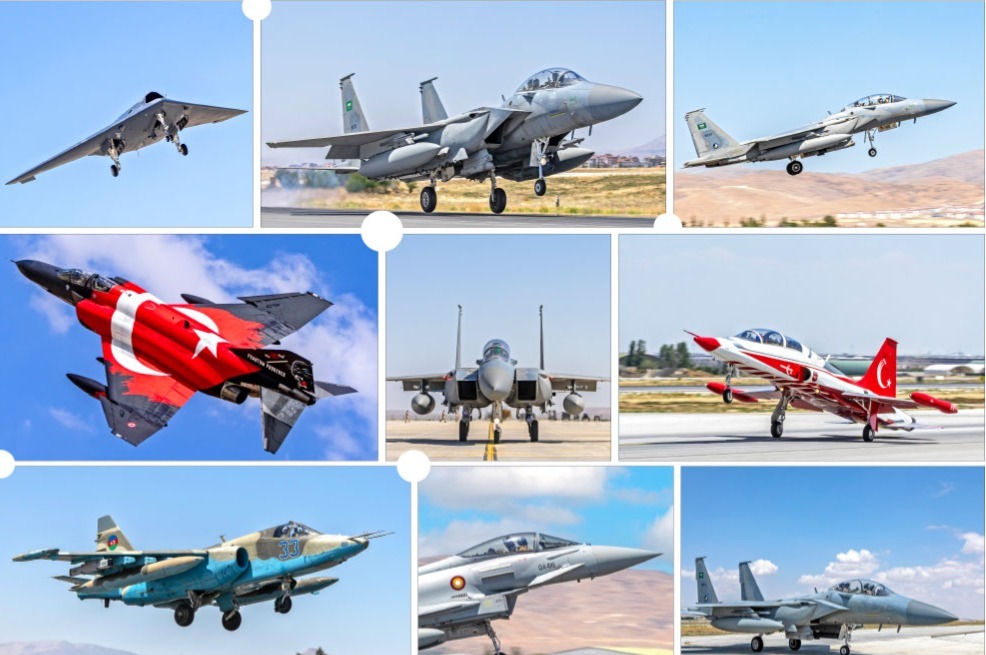
In his concluding remarks before the press, Maj. Ekrem ÇEKİN, Turkish air force Anatolian Eagle Training Command squadron commander, reminded that “during the training, 415 sorties were successfully conducted, totalling 786 hours of flight time - demonstrating not only the scale, but also the intensity and operational quality of the exercise”. In addition, for the first time since the first international edition of the exercise took place, in June 2001, “this year’s training was based on the realities of modern, dynamic, and multidimensional warfare. The scenarios reflected a high-threat environment, incorporating advanced air defence systems and asymmetric threats. One of the most prominent and the first scenarios ever involved was the interception of cruise missiles, emphasizing early detection, identification, and neutralization. Low radar cross-section cruise missiles were engaged through joint missions involving airborne and ground-based systems, requiring full coordination”. He finally highlighted how “this year’s exercise also showcased Turkey’s national defence industry on an international stage, which saw the use of indigenous systems employed during training such as Akıncı, Anka-S and Anka-3 UAVs, Şimşek and Süper Şimşek radar-deceiving decoys, KORAL (KARASOJ) electronic warfare systems, GPS jamming systems, and Storm mission analysis software”.
The 2025 edition saw the participation of seven countries (Azerbaijan, Hungary, Jordan, Qatar, Saudi Arabia, United States) and NATO. Malaysia, the Sultanate of Oman, the Republic of Singapore, and the United Arab Emirates participated as observers.
A Spotters Day was held for aviation photographers on July 2, while a press day was held for the press and media on July 3. 1059 photographers from 34 countries participated in Spotters Day.
In conclusion, it's safe to say that the Turkish Air Force has once again demonstrated its exceptional training and organizational capabilities, while also providing aviation enthusiasts from around the world with the opportunity to experience firsthand one of the world's finest exercises and, arguably, to take photographs in a way not permitted anywhere else in the world. I'd like to congratulate and thank the Turkish Air Force for this opportunity, their professionalism, and their hospitality. We look forward to seeing you again next year