Italy`s Naval Triumph: The Unrivaled CAVOUR

In a momentous ceremony at the Fincantieri Shipyards in Muggiano (La Spezia) on September 15, 2004, the Italian Navy celebrated a historic milestone as the aircraft carrier "Cavour" reached a significant juncture. The seamless conjunction of the bow section to the hull module marked the culmination of the laying down phase, a journey initiated with the steel-cutting ceremony on July 17, 2001. Proudly delivered to the Italian Navy on July 20, 2004, at the Fincantieri Shipyards in Riva Trigoso (province of Genoa), the carrier stands as an emblem of Italy's maritime technology prowess.
Sea trials commenced on December 18, 2006, leading to the official delivery to the Italian Navy on March 27, 2008 was a historic moment, accompanied by the prestigious presentation of the Combat Flag.
As the Italian Navy's flagship, the aircraft carrier Cavour stands not only as a symbol of technological prowess but as a testament to strategic versatility, showcasing Italy's commitment to safeguarding both national and international interests on the high seas.
The realization of the Cavour is the outcome of a collaborative effort between the Directorate-General of Naval Weaponry (NAVARM) and Fincantieri, a joint venture initiated in November 2000. The meticulous construction involved keel laying at the Riva Trigoso shipyards in Genoa, crafting the fore section in Muggiano, and the stern in Riva Trigoso, seamlessly sealed together to form this naval marvel.
ITS Cavour stands as the first Italian Navy unit classified as an aircraft carrier (CV) since its delivery, adapting to the evolving operational needs of the Navy. With dual-use capabilities, the Cavour excels in Command and Control for interforce and international operations, demonstrating prowess across various tasks within the Defense General Staff's extensive operations.
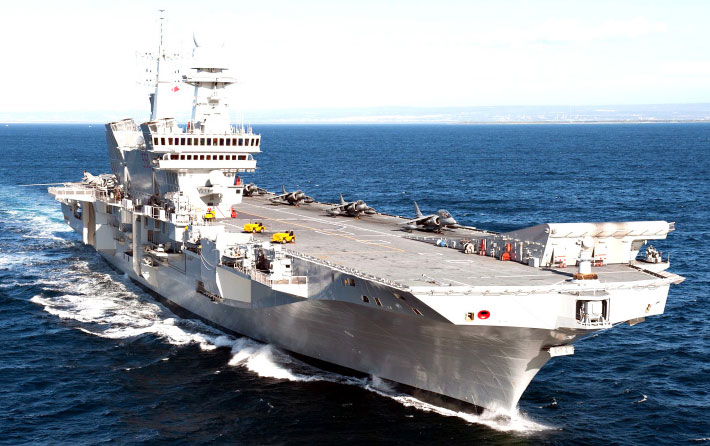
Designed as a versatile maritime platform, the aircraft carrier Cavour is poised for joint international maritime operations. Its flight deck hosts six spots for simultaneous operations and eight parking spots, complemented by a capacious hangar accommodating advanced helicopters like the EH101, SH90A, AB212. Initially the ship was designed for the operation of the AV-8B Harrier II planes already operated by the Italian Naval Forces. However, refit and modernization work to operate the F-35B took place from December 2018 to May 2020. ITS Cavour returned to service in September 2020.
According to a NATO press release published in May 2021, the upgraded Italian Navy flagship, ITS Cavour participated in sea trials, a series of tests and functional activities, following which the F-35 Joint Program Office has delivered a flight clearance recommendation to the Italian Navy for the safe operation of fifth-generation F-35B fighter aircraft.
During the sea trials, two F-35Bs were embarked aboard ITS Cavour and carried out more than 50 flight missions, around 120 vertical landings, 115 short take-offs, and two vertical take-offs. The Italian Navy Cavour aircraft carrier is now fully qualified to conduct operational deployment with the fifth-generation fighter F-35B.
ITS Cavour is not merely a vessel but a strategic entity with high Command and Control capabilities for joint and combined operations. It features advanced combat systems tailored for anti-air, anti-surface, and anti-submarine warfare, extending its operational range to an impressive 350 km. The Command center, housing over 150 workstations for 230 personnel, adeptly manages naval, air and amphibious operations of the Italian Navy. Augmenting its functionality, the vessel features four smaller elevators for ammunition and service purposes, along with a versatile hangar/garage capable of accommodating various combinations of aircraft, helicopters, or vehicles, including up to 24 MBT or 50 amphibious assault vehicles.
Accommodating 8 AV-8B Harrier II or F-35B JSF and supporting utility, anti-submarine, and airborne surveillance helicopters, the Cavour's flight deck, equipped with a sky-jump ramp, facilitates take-offs with a runway length of 183 meters. Operating up to sea state 6, the Cavour exhibits robust operational capabilities.
With a standard displacement of 22,290 tons and reaching a formidable 27,100 tons at full load, the ITS Cavour is a formidable presence on the high seas. Its flight deck, measuring 183m with a 12-degree ski jump, showcases the vessel's commitment to versatility and operational adaptability. Accommodating a crew of 451, an air group of 203, and a command group of 140, the ITS Cavour can also lift over 400 troops in austerity conditions. The vessel's total accommodation, boasting approximately 1,300 berths, ensures the well-being and functionality of its diverse crew and passengers.
Powered by four General Electric/Avio LM2500 gas turbines generating an impressive total of 88 MW, the ITS Cavour is a powerhouse at sea. These turbines drive two gear units, providing 60,000shp each and turning five-bladed shafts, enabling the vessel to achieve a maximum speed of over 28 knots. The vessel's fuel capacity of 2,500 tons allows for an impressive range of 7,000 nautical miles at 16 knots and a sustained autonomy of 18 days. Notably, the ITS Cavour 's economic efficiency is highlighted by its fuel consumption of merely 3 tons per hour at cruising speed, a stark contrast to the 25 tons consumed at full speed. Additional power is supplied by six Wärtsilä CW 12V200 diesel generators with a total output of 13.2 MW, complementing the vessel's robust propulsion system.
Armed with advanced weaponry, the ITS Cavour ensures robust defense capabilities. Equipped with a potent arsenal, including the Franco-Italian Eurosam SAAM-IT missile system, the vessel can engage at least twelve aircraft or missile targets simultaneously. The missile system comprises the Selix Sistemi Integrati SPY-790 EMPAR multifunction radar and four Sylver eight-cell vertical launchers for the Aster 15 missile. With a range of 30km and a speed of Mach 3, the Aster 15 is a formidable force in short-range engagements. The ship's armament also includes two Oto Melara 76mm/62 Super Rapid-fire guns and three 25mm Oerlikon Contraves KBA anti-aircraft guns.
Its countermeasures, featuring Breda SCLAR -H 20-barrel trainable chaff/decoy launchers and an anti-torpedo defense system, underscore its survivability.
Sensors aboard the ITS Cavour include the PS-798 RAN 40L 3D D-band long-range air search radar, SPS-791 RASS RAN 30X/I surface-search radar, and navigation and air-control arrays. The vessel is also equipped with a SIR-R interrogation friend-or-foe (IFF) system. To enhance its defensive capabilities, the ITS Cavour 's countermeasures suite incorporates two 20-barrel Oto Melara/Selex SCLAR-H decoy launchers, two SLAT torpedo defense systems, and a bow-mounted WASS mine avoidance sonar. Electronic countermeasures and electronic support measures are handled by the Elettronica SpA integrated ESM/Elint/ECM system.
ITS Cavour transcends military operations, emerging as a fourfold asset: an aircraft carrier, an amphibious and logistics platform, a command and control unit, and a hospital ship. It epitomizes Italy's unwavering commitment to national and international peacekeeping efforts and humanitarian missions.
Named after Camillo Benso, Count of Cavour, a prominent Italian statesman and founding father of the Italian Navy, the aircraft carrier's crest proudly displays its silhouette, symbolizing projection overseas. Enclosed by a circular ring, featuring the ship's motto ("In arduis servare mentem") and the international pennant (550), crowned with a towered crown with rostra, a symbol of maritime tradition, the crest pays homage to Italy's rich naval history.
Italy's naval forces have strategically positioned the Cavour as a linchpin in their operational concepts, aligning with the evolving nature of maritime challenges. The aircraft carrier's role extends beyond conventional warfare, embodying Italy's commitment to comprehensive security and global stability.
Strategic Integration:
In line with Italy's vision, the Cavour is strategically integrated into joint and combined operations, enhancing interoperability across naval, air, and amphibious forces. Its advanced Command and Control capabilities serve as a force multiplier, allowing seamless coordination in diverse operational scenarios. In 2022, the ship integrated with the French carrier Charles de Gaulle‘s Task Force 473 along with the USS Harry S. Truman Carrier Strike Group, highlighting the strength of maritime partnerships amongst the three nations and demonstrating high-end maritime strike capabilities.
Amphibious Operations:
The Cavour's versatility is underscored by its role as an amphibious and logistics platform. The vessel's ability to lift over 400 troops in austerity conditions, combined with its well-equipped hangar, positions it as a key asset in expeditionary missions. The integration of amphibious assault vehicles and the vessel's compatibility with diverse aircraft further enhance Italy's amphibious capabilities.
Humanitarian Assistance and Disaster Relief (HADR):
Italy's operational vision for the Cavour extends to humanitarian assistance and disaster relief efforts. The vessel's designation as a hospital ship amplifies its role in providing critical medical support during crises, showcasing Italy's commitment to international humanitarian endeavors. Indeed the very first operational deployment of ITS Cavour in January 2010 was Operation White Crane, the name of the Italy-led joint humanitarian operation to Haiti, when that country was struck by a magnitude 7.0 earthquake, on January 12, 2010.
Regional and Global Presence:
Italy envisions the Cavour as a symbol of its naval prowess, projecting a strong presence both regionally and globally. The vessel's strategic design, cutting-edge capabilities, and adaptability align with Italy's commitment to maritime excellence and the protection of its national and international interests on a global scale. This one of the important and natural roles for the flag ship of the Italian Naval Forces. To show the flag around. Rome is planning to deploy the Cavour Carrier Strike Group starting from June 2024 to the Indo-Pacific region for six months.
In navigating the complex and dynamic maritime landscape, Italy's operational concepts for ITS Cavour reflect a forward-looking approach. The aircraft carrier stands out not only as a technological marvel but as a strategic asset embodying Italy's vision for comprehensive maritime security and stability.
The ITS Cavour, with its strategic design and cutting-edge capabilities, underscores Italy's commitment to maritime excellence. A marvel on the open seas, the vessel seamlessly combines power, flexibility, and advanced technology, setting a new standard in naval prowess