USS Gerald R. Ford
On August 08th, 2023, a group of aviation reporters gathered in the departure lounge at NAS Sigonella (ICAO code: LICZ) on the island of Sicily (Italy). With a Grumman C-2A ‘Greyhound’ (used for Carrier Onboard Delivery, COD), the group flew in some 45 minutes towards the USS Ford, sailing between Sicily and Greece.
Near the USS Ford, the C-2 entered the landing pattern and made a ‘controlled crash’ in the arresting wire on the flightdeck.
After unboarding the C-2, the group went to the PAO office , where “Sage” the ship’s dog, was met for an ‘interview’.
Later the group got dressed for the flightdeck operations: wearing long sleeves, long trousers, a cranial with a visor, a white security vest, protective gloves.
During the first flightdeck session, 3 F/A-18s were launched as a ‘cycle 1 launch’ and the flightdeck was cleared. Every person of the group had a one-on-one flightdeck handler to prevent dangerous situations on deck
The hangar deck was visited shortly and then the second flightdeck session started with the launch of several F/A-18s and an E-2 from two catapults, ‘cycle 1 launch’.
After the launch, the flightdeck was prepared for the landing of the three F/A-18s that were launched earlier, ‘cycle 1 landing’.
That concluded the short trip onboard and the protective equipment was returned to the USS Ford PAO.
Everybody boarded the C-2 again and after half an hour, the C-2 was launched via the catapult for the 45 minute flight back to NAS Sigonella.
During this embankment, the USS Ford participated in the ‘Sage Wolverine’ exercise.
First Impressions Onboard
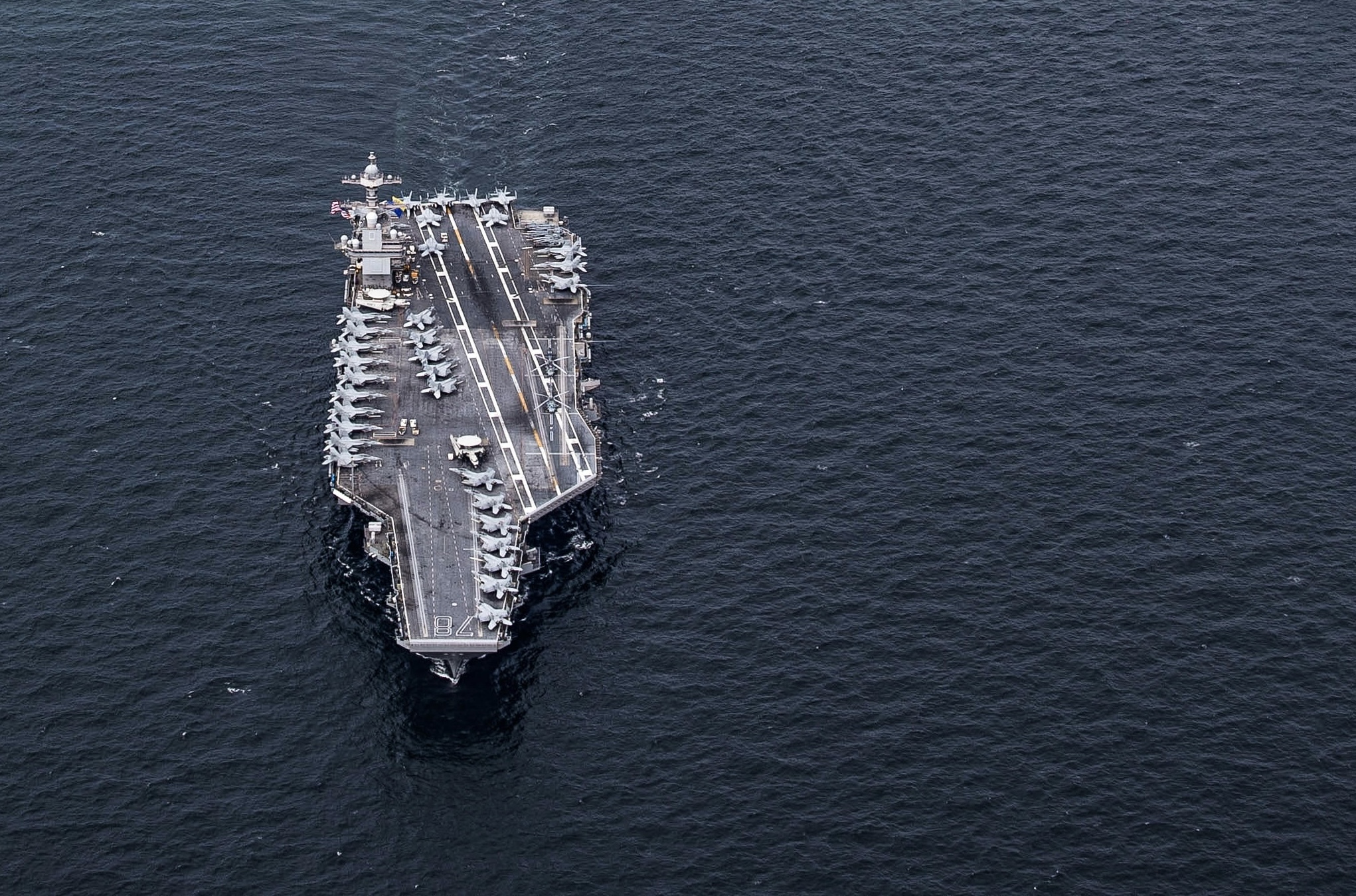
In comparison to the previous USS Nimitz aircraft-carrier class, the USS Ford class of aircraft-carriers has some visual differences.
The island is located further to the stern of the ship, giving a longer uninterrupted area to store helicopters and aircraft.
The deck is larger than the USS Nimitz-class decks, giving more opportunities to locate helicopters and aircraft. On the Nimitz-class carriers; the helicopters, the C-2s and the E-2s are normally located before or around the island. On the USS Ford these are located on other locations on the flightdeck.
There are only two arresting cables in use, with one spare arresting installation.
On most Nimitz-class carriers, there are four wires across the deck (‘pilots are aiming for the third wire during landing’). The last carrier of the Nimitz-class, the USS Bush, only had three arresting cables across the deck.
The flightdeck planning board (“the ouija board”) is computerized, but there is still a physical planning board present
No steam. All previous US Navy aircraft carriers used steam catapults to launch their aircraft, resulting in clouds of steam crossing the deck during these launches. With the electric launch system (EMALS), there is no more steam on the deck.
Carrier Strike Group 12
Carrier Strike Group Twelve (CSG-12 or COMCARSTRKGRU 12) is one of four U.S. Navy carrier strike groups currently assigned to the United States Fleet Forces Command. Carrier strike groups gain and maintain sea control as well as project naval airpower ashore. USS Gerald R. Ford is the aircraft carrier assigned as the Carrier Strike Group Twelve flagship. Units currently assigned to Carrier Strike Group Twelve included Carrier Air Wing Eight; the Ticonderoga-class cruisers Vicksburg and Normandy; and Destroyer Squadron 2.
Carrier Strike Group Twelve is lead by Rear Admiral Erik J. Eslich, who started his command on May 24th, 2023; while the USS Ford anchored outside of Oslo, Norway.
USS Gerald R. Ford
The USS Gerald R.Ford is the aircraft carrier of the United States Navy with number 78 and the nickname is ‘WARSHIP78’, which can be found on social media as ‘#WARSHIP78’ or ‘@WARSHIP_78’.
As all US Navy carriers have their own callsign, the USS Ford uses the callsign ‘WOLVERINE’.
The motto of the ship is “Integrity at the Helm”, which means “taking care of, and looking out for, our shipmates.”
The USS Gerald R. Ford adopted the 38th President’s name along with the words of the Ford Foundation’s motto, “Integrity at the Helm”.
After the delivery to the US Navy in 2017, the USS Ford suffered for some serious ‘teething problems’ with the armament elevators and the electric launching system (Electromagnetic Aircraft Launch System, EMALS). Using state-of-the-art new technologies meant that only rigorous testing in real-life environments would prove that the proposed solution could work and could be repaired.
This caused some delays until the ship was fully operational in September 2022. In order to weed-out the last details, a small shake-down cruise was held in October and November 2022, which brought the USS Ford to the Atlantic Ocean and European seas.
The first full-blown maiden cruise of the USS Ford started in May 2023 followed by a transfer to the US Navy 6th Fleet with headquarters in Napoli, Italy. The 6th Fleet has an Area Of Responsibility (AOR) of the European and African continents, servicing the U.S. European Command (USEUCOM) and U.S Africa Command (USAFRICOM).
During the maiden cruise, the ports of Oslo (Norway) and Split (Croatia) were visited for some Rest and Recreation of the crew onboard.
Background
The latest american aircraft carrier USS Ford (USS Gerald R. Ford, CVN-78) is named after the 38th president of the United States of America, who served in the US Navy during the Second World WarGerald R. Ford was the 38th president of the United States of America, from 1974 to 1976. He lived from 1913 until 2006 and during his service time in WorldWar 2, he served in the US Navy on an aircraft carrier in the Pacific Ocean.USS Gerald R. Ford (CVN 78) is the U.S. Navy’s newest aircraft carrier. As the first-in-class ship for the next generation of aircraft carriers, Ford introduces 23 technologies to deliver greater lethality, survivability and joint interoperability while reducing operating and maintenance costs. CVN 78 is the first new carrier designed in over 40 years, and it was designed to have the flexibility to operate with future generations of aircraft. The ship's systems and configuration are optimized to maximize the sortie generationrate (SGR) of embarked strike aircraft, resulting in a 33 percent increase in SGR over the Nimitz-class.
Sage, the onboard Labrador Retriever
Next to the fact that the USS Gerald R. Ford is used as a modern weapons platform; it also has a different crew member. The carrier has a service dog onboard with the name Sage. The dog is a three year female Labrador Retriever, and she is the first dog to deploy with a ship’s crew through a pilot program. This program is meant to address mental health and resiliency. The dog has been trained for at least 120 hours in the United States since Sage was just eight weeks old. The dog will comfort sailors onboard of the carrier and is trained to help them to reduce their operational stress. The dog is raised by the non-profit company Mutts. The company was founded in 2008 to train service dogs for wounded warriors with PTSD and mobility disabilities. The organization in 2019 expanded its mission to train dogs for law enforcement and first responders. In the summer of 2022, the group sent dogs to the George H.W. Bush carrier ahead of its deployment to Europe. The group has also sent dogs to visit crews in ship repair yards and other stressful environments as part of this morale-boosting effort. Before the deployment of the USS Ford was started, the dog was sent already to the ship several times to let the dog getting used to the life onboard of an aircraft carrier. The Navy will evaluate the effectiveness of this program during the USS Ford’s deployment and determine whether future carriers or other ships might deploy with dogs of their own. This evaluation will consider the number of interactions between sailors and Sage, whether she increases their morale and willingness to seek out help, and how well she adjusts to life at sea. The dog will be scheduled daily onboard to meet the sailors of the vessel. Also mental boosting sessions will be organized on the ship where Sage is present. The whole goal is to boost the mental health of the sailors at sea. Sage is already a beloved member of the crew since the ship left for the cruise on May 2, 2023.
CVW-8
A carrier air wing (the US Navy acronym is ‘CVW’) is an operational naval aviation organization composed of several aircraft squadrons and detachments of various types of fixed-wing and rotary-wing aircraft. Organized, equipped and trained to conduct modern US Navy carrier air operations while embarked aboard the aircraft carriers. The various squadrons in an air wing have different but complementary, and sometimes overlapping, missions and provide most of the striking power and electronic warfare capabilities of a Carrier Strike Group (CSG). Today's air wing composition is designed to allow for broad striking power hundreds of miles from the carrier's position, while providing defense in depth of the strike group through early warning and detection of airborne, surface and subsurface targets. The Carrier Air Wing onboard USS Gerald R. Ford is Carrier Air Wing Eight (CVW-8). The wing is normally based at Naval Air Station Oceana, Virginia. In the US Navy every CVW has its own letter code which is visible on the aircraft. The letter code is built up from two letters. The first letter is always the letter "A" or "N". The "A" stands here for assignment to the Atlantic Fleet and the "N" for assignment to the Pacific Fleet. The second letter in the letter code will identify the CVW. For CVW-8 the second letter is the letter "J" and therefore CVW-8 has the letter code "AJ".
CVW-8 is composed of a total of four fighter strike squadrons which are designated in the US Navy as VFA (Vessel, Fighter, Attack) squadrons. All squadrons onboard of the USS Gerald R. Ford are equipped with the Boeing F/A-18E/F Super Hornet. CVW-8 does not have F-35C Lightning II aircraft in its inventory. The first three squadron are all equipped with the F/A-18E. These units are all assigned in the role of air interdiction, close air support and reconnaissance. and The first unit is VFA-31 and is one of the ex F-14 Tomcat units aboard of the USS Ford. This unit is recognizable on the emblem of ‘Felix the cat’ on its tail. The famous nickname of this squadron is "Tomcatters". The second VFA of CVW-8 is VFA-37 also known as the "Ragin' Bulls". This unit has a badge with a bull on the tails of the Hornets. VFA-37 flew in the past with the A-7 Corsair II and the F/A-18C Hornet. Finally the third unit flying the Hornet is VFA-87 which are known as the "Golden Warriors". This unit is recognizable on the red badge with a golden warrior on a horse inside crest. The unit flew just like VFA-37 in the past with aircraft like the A-7 Corsair II and the F/A-18A/C Hornet. The fourth unit of the VFA squadron aboard the USS Ford, is VFA-213. Compared to the other three units, this one is equipped with the Boeing F/A-18F Super Hornet. There is one big difference between the the F/A-18E and F variants. The most notable is the presence of the second seat for a weapons systems operator or second pilot. The F/A-18F is used for both training and high-workload missions where the second crewmember can help to split the workload during a mission. The F/A-18F version replaced the F-14 Tomcat and performs on top of the task which are assigned to the F/A-18E also air intercept, Combat Air Patrols (CAP) and tanker missions. VFA-213 is like VFA-31 an ex F-14 Tomcat squadron. The unit is known as the "Blacklions". The insignia of the unit consists of a black lion in a blue Navy crest.
Airborne Command & Control Squadron 124 (VAW-124) is known as the "Bear Aces" and is the US Navy airborne early warning and control squadron at the USS Gerald R. Ford. VAW-124 is based at Naval Air Station Norfolk, Virginia. The unit flies the Northrop Grumman E-2D Advanced Hawkeye, with the refueling probe mounted on the nose of the aircraft. The unit is nicknamed "Bullseye Hummers” and has the bullseye clearly visible in the squadron insignia. The unit operates during an average carrier cruise with four to five aircraft onboard the USS Ford. For electronic warfare CVW-8 has a dedicated unit to this. The electronic warfare unit onboard the USS Ford is Electromagnetic Attack Squadron (VAQ) 142 (VAQ-142). The unit is equipped with the EA-18G Growler. This aircraft is derived from the F/A-18F and is fully dedicated to the electronic warfare role. The Nickname is this unit is "Gray Wolves". The unit has a total of five aircraft available. In the past VAQ-142 was equipped with the EA-6B Prowler for the same task. Helicopter Sea Combat Squadron 9 (HSC-9) "Tridents" is a US Navy helicopter squadron based at Naval Air Station Norfolk, Norfolk, Virginia (United States). The squadron is equipped with the Sikorsky MH-60S Seahawk. The main tasks of this unit are Anti-Surface Warfare (ASUW), Combat Search and Rescue CSAR, Search and Rescue (SAR), Special Operations (SpecOps) and Vertical Replenishment (VERTREP). The second helicopter squadron onboard USS Ford is Helicopter Maritime Strike Squadron 70 (HSM-70) "Spartans". This unit is a US Navy helicopter squadron based at NAS Jacksonville, Jacksonville, Florida, United States. The squadron is equipped with the Sikorsky MH-60R Seahawk. This unit is tasked with the anti-submarine role. The helicopters of this unit are recognizable on the radar dome at the bottom of the helicopter. In the past this unit was equipped with the S-3 Viking. The final squadron which belongs to CVW-8 is Fleet Logistics Support Squadron 40 (VRC-40), also known as the "Rawhides". This unit operates the Grumman C-2 Greyhound in the logistics role. The C-2 is currently the only transport plane available to land on a carrier like the USS Ford. The type will be replaced soon by a specific version of the V-22 Osprey for the logistics task.
EYES FROM F/A-18 PILOT
Q: Can you tell about your experiences of the new launching system (EMALS)? How does it compare to the previous steam-catapults?
A: From a pilot’s perspective, landing on USS Gerald R. Ford (CVN 78) is similar to landing on any other aircraft carrier in the fleet. The differences are entirely housed under the flight deck's surface, which are largely unnoticed by the aviators using the systems operationally. I execute my mission, tasking, takeoffs, and landings exactly the same way, whether we use steam or magnets to launch.
Q: How did you prepare for this cruise, can you elaborate on the preparations and the workup training program for a US Navy pilot before the cruise?
A: The Navy has a robust Operational Fleet Readiness Program managed by Naval Aviation Warfare Development Center and multiple Weapons Schools (commands focused on teaching tactical execution to the operational squadrons), which continually evolves to ensure aircrew are prepared for and training against simulations of real world scenarios. When we deploy, we have completed a lengthy workup process, which trains the aircrew tactically, the Carrier Strike Group strategically, and even the individual Sailors how to execute their specific jobs effectively.
Q: If you participated in AirDefender23, can you describe this exercise? And the lessons learned and how these lessons learned were added to the F-18 curriculum?
A: Participating in Air Defender 23 was an opportunity to rehearse and be exposed to a joint NATO planning process simulating planning from multiple locations instead of one combined arms task force headquarters. This has significant training value as it is how we would likely operate if we were to execute it as a real world scenario.
AirDefender 2023 Exercise
In June 2023, a large exercise was held in northern Germany, with many US Air National Guard fighter jets at the airbases of Hohn (ICAO: ETNH) and Schleswig-Jagel (ICAO: ETNS). A detachment of the USS Ford CVW-8 participated in this exercise from Hohn AB, with F/A-18 E/F/Gs.
Begun on 12 June, Air Defender involved some 250 aircraft and 10,000 troops from 25 countries, marking the largest deployment of air forces to Europe in NATO history. The goal was to improve the ability of allies to interact, especially in the face of potential threats from Russia.
"The exercise was a complete success, not only from a tactical point of view, but also from an organizational point of view", commented the Chief of Staff of the German Air Force, General Ingo Gerhartz, during a press conference organized at the Jagel Air Base.
"We have demonstrated -he added- that the Allies are capable of moving large quantities of military equipment in a few days and can therefore hold out for a two-week large-scale exercise. Furthermore, there have been no problems for regular air traffic: Thanks to the good planning of German air traffic control, there were no flight cancellations in civilian air traffic and the delays were only a few minutes".
Participating aircraft were mainly deployed at Schleswig-Jagel & Hohn, Wunstorf, Lechfeld, Spangdahlem, Volkel and Čáslav air bases. The three main hubs were Schleswig/Hohn, Wunstorf and Lechfeld.
The exercises were conducted mainly in three airspaces over Germany. The air operations took place over areas that have been used for decades by the German Air Force for routine training. However, they have been expanded for Air Defender 2023 and have been partially connected by corridors. The eastern training area was temporarily set aside for military use between 10:00 AM and 2:00 PM, the southern between 1:00 PM and 5:00 PM, and the northern between 4:00 PM and 8:00 PM.
It was remarcable to see so many American aircraft in a single exercise in Europe. The US portion of the exercise was led by the Air National Guard. A-10 Thunderbolt II, F-15 Eagle and F-16 Fighting Falcon fighter jets have arrived from various ANG units from the United States.
The US Navy also participated at Hohn airbase in Germany, with jets from the USS Ford:
EA-18G Super Hornet USN VAQ-142, Naval Air Station Whidbey, USA.
F/A-18F Super Hornet USN VFA-213, Naval Air Station Oceana, Virginia, USA.
F/A-18E Super Hornet USN VFA-31 og VFA-87, Naval Air Station Oceana, USA.
In addition, aircraft from Greece, Hungary, the Netherlands, Romania, the Czech Republic, Turkey and the United Kingdom were involved in addition to the German Luftwaffe.
The Germany-led joint military exercise Air Defender 2023 ended successfully on 23rd June.
Sage Wolverine Exercise
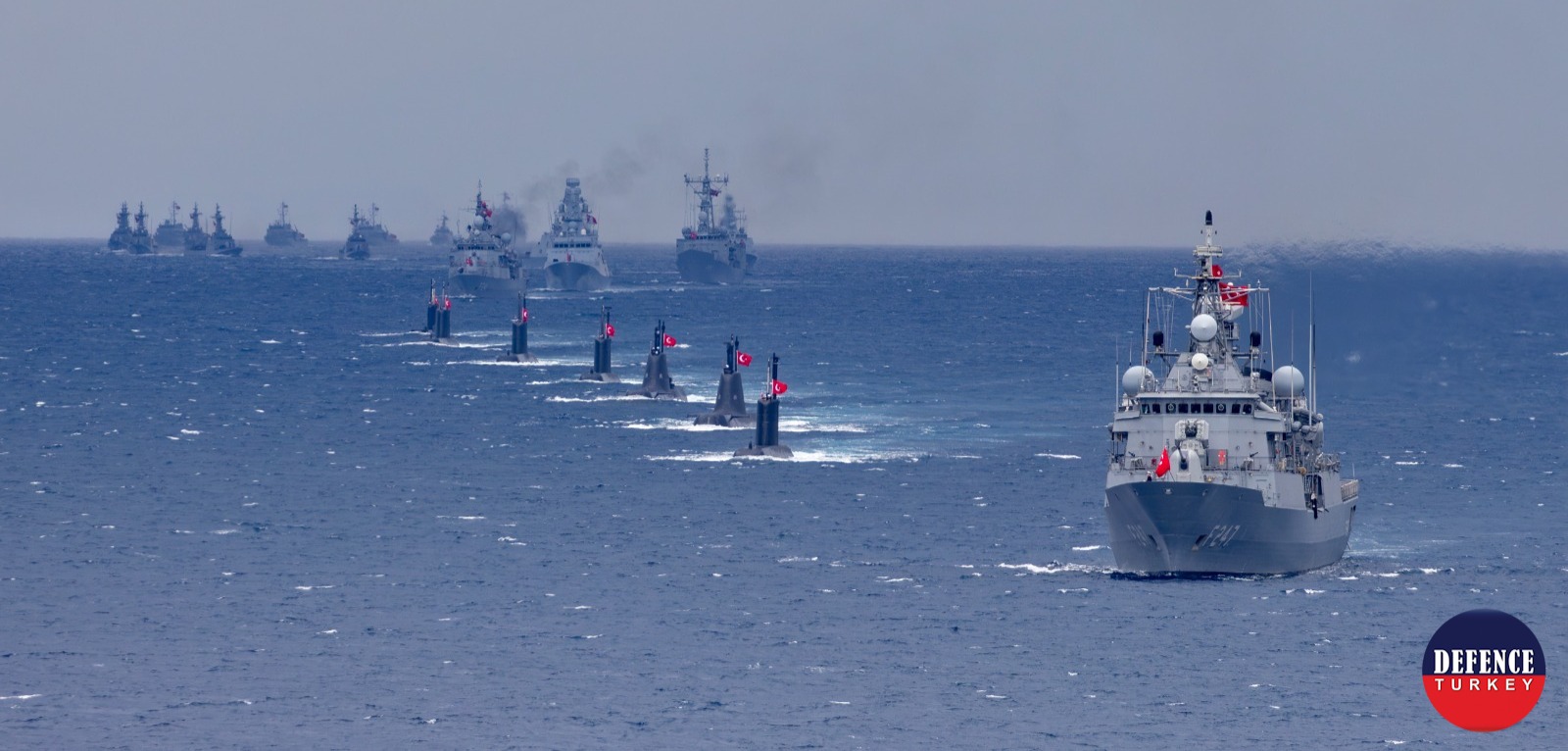
NATO ships train alongside world's largest warship, the USS Gerald R. Ford, in Mediterranean SeaCentral Mediterranean Sea – A NATO task group engaged in a series of dynamic maritime training exercises with the US Navy’s most advanced warship during Exercise Sage Wolverine in the central Mediterranean Sea, 2 – 11 August 23.The exercise was the perfect opportunity for Standing NATO Maritime Group 2 (SNMG2) and the US Navy’s Gerald R. Ford Carrier Strike Group to hone their advanced warfighting skills and interoperability. Reaffirming their shared commitment to collective defence and security in the region, several NATO nations contributed forces to the exercise, including Greece, Italy, Türkiye, the United Kingdom and the United States.NATO’s greatest strengths are its warfighting competence and interoperability, however these do not just occur automatically. They require constant, dedicated hard work and exercises of this nature to endlessly practice and refine a myriad of common tactics, techniques and procedures, and thus maintain readiness
Three of SNMG2’s ships participated - Turkish frigate TCG Gokceada (F-494), Hellenic Navy frigate HS Elli (F450), and British Royal Navy destroyer HMS Duncan (D37). The ships were joined by an Italian submarine, a US cruiser and a destroyer, Hellenic Air Force F-16 jets, US maritime patrol aircraft and a variety of maritime helicopters. At the heart of the exercise was the world’s largest and newest aircraft carrier, USS Gerald R. Ford, with its air wing of F/A-18 jets and airborne early warning aircraft. She demonstrated her formidable capability by launching up to 20 aircraft at a time at the height of the exercise.
All ships and aircraft went through rigorous testing via a diverse range of complex, multilayered tactical scenarios, proving the two different NATO task groups could operate seamlessly together. These included air defence, long-range maritime offensive strike, anti-submarine warfare, electronic warfare, communications, replenishment at sea and medical response scenarios.
Commander SNMG2, Royal Navy Commodore Paul Stroude, said, “NATO’s greatest strengths are its warfighting competence and interoperability, however these do not just occur automatically. They require constant, dedicated hard work and exercises of this nature to endlessly practice and refine a myriad of common tactics, techniques and procedures, and thus maintain readiness.
“Thanks to Exercise Sage Wolverine,” he added, “and the superb co-operation with the Gerald R. Ford Carrier Strike Group, we remain very well placed to perform our core mission of reassurance, deterrence and, if necessary, the defence of NATO.”
SNMG2 is one of four Standing Naval Forces that operate under NATO Allied Maritime Command, headquartered in Northwood, United Kingdom. SNMG2 is a multinational integrated task group that projects a constant and visible reminder of the Alliance's solidarity and cohesion afloat. This continuous maritime capability performs a wide range of tasks, including exercises and real-world operations in periods of crisis and conflict.