KARGI Unveiled at LENTATEK Booth During EFES-2022 Exercise

KARGI is in fact a very comprehensive development project. The first flight in the project was conducted in 2018 with a piston engine supplied from a foreign company, and KARGI proved its performance even in the first flight. Under the KARGI Project, all critical subsystems on the drone, especially the engine and propeller, have been indigenized. In that regard, the piston engine was supplied by TEI (PG50), while the propeller was specially designed by LENTATEK and manufactured by a domestic company. Other critical subsystems such as the RF Seeker was supplied from ASELSAN, and the warhead and solid-propellant rocket engine from TÜBİTAK SAGE. GPS communication antennas and data links, and the fuel tank are among the indigenized products on KARGI. According to the information we have received, the KARGI Project, in which the design and production of the Drone, Ground Systems, Navigation and Automatic Flight Control System, and the development of the System Software was carried out by Prime Contractor LENTATEK, has reached the acceptance stage after successful test flights. With this acceptance, which will pave the way for entry into the inventory, the activities under the Development and Prototype Production Phase will be completed, and the KARGI System will have been qualified. Following the completion of the prototype system deliveries, a separate contract is expected to be signed. The KARGI Systems to enter the inventory will initially replace the Harpy UAV Systems, which were ordered in 1998 (2 batteries of 108 aircraft) and put into service in 2002, a significant portion of which are in use and are now reaching the end of their service life.
KARGI Project Overview
Within the scope of the Public Institutions Research and Development Projects Support Program (1007), a project called “KARGI” was initiated by TUBITAK Defense and Security Technologies Research Support Group (SAVTAG) within the scope of the Public Institutions Research and Development Projects Support Program (1007) in order to develop a Combat UAV System with national critical components to replace the veteran Harpy UAV Systems in the inventory, and the contract was signed in 2015.
The system was intended to have similar technical features to the Harpy UAV, it was also anticipated to include several additional features (such as longer endurance, SATCOM communication capability and a more effective warhead) to increase flexibility of use and operational effectiveness. KARGI was planned to be carried on a tactical wheeled vehicle (12 on each vehicle) and launched from a launcher in a similar way as in the Harpy System.
The project model was designed as the development of a prototype system, its acceptance with its documentation, and the signing of a serial production contract. Like the Harpy and Harop UCAVs, KARGI was planned to be launched with the rocket-assisted takeoff (RATO) technique from a pressurized launcher.
Under the Development and Prototype Production Phase signed in 2015, the KARGI System prototypes, which were designed and produced with domestic capabilities, were initially equipped with a foreign-sourced piston engine, and then the TEI-PG50 Piston Engine developed by TEI under the Two-Stroke Engine Development Project was planned to be used.
The 50hp TEI-PG50 Engine, which was developed for use in KARGI, is a two-stroke, two-piston/cylinder (0.5L displacement), Boxer-type gasoline UAV engine with an extremely plain design. The first flight test of the TEI-PG50 Engine with the platform (TEI test platform) was carried out in May 2019. Designed for UAV platforms under 300kg, the PG50 Engine has a maximum power capacity of 50bg (±2) according to TEI data and can produce 30hp (±1) at an altitude of 16,000ft. The TEI-PG50 Engine, which has a dry weight of 19kg (±1) excluding accessories, has an injection type fuel feeding system controlled by the Electronic Engine Control Unit (ECU).
KARGI System
The KARGI System, which contains many firsts across the Turkish Defense Industry, is a Combat UAV System that can suppress and destroy the enemy's surface-to-air missile/weapon systems with air surveillance and early warning radars within the enemy's integrated air defense. Launched from ground-based launchers, it has a piston engine and a Passive RF Seeker on the nose and destroys the target RF emitting target with a fragmentation warhead.
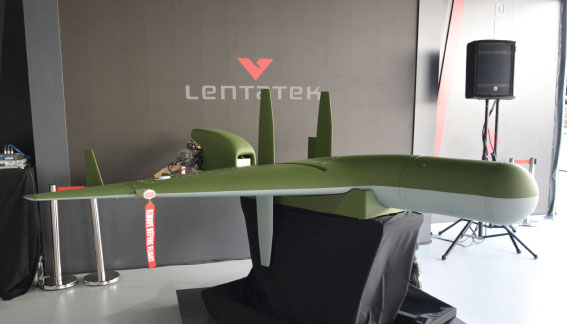
LENTATEK has not disclosed any information about KARGI's technical features. However, when we compare the prototype aircraft on display at the booth, which has a TEI PG50 piston engine and ASELSAN's dummy Passive RF Seeker, with the Harpy UAV in the inventory, KARGI appears to be a slightly bigger, longer, and heavier aircraft. While the Harpy-I, which has a wingspan of 2.1m, a height of 36cm and a length of 2.75m, weighs 135kg, I consider that KARGI is in the same weight class as the Harpy-I NG, which weighs 165kg.
Contrary to the predictions, KARGI does not have an optical seeker system (FLIR) payload like the Harop. However, as per the information I have received, the FLIR payload is one of the optional features being considered for the following stages. While only a limited target detection (it can lock onto only radar and other emitting targets/threats) and suppression (SEAD) function can be performed with the RF Seeker, the optical seeker system will increase the target detection and lock-on (by this way it can attack both emitting and non-emitting targets) capability of the system, thus providing operational flexibility. Since the air defense radar/system detected by the RF Seeker stops emitting, a safe air corridor is opened for friendly elements. However, since new generation air defense weapon and missile systems now have optical engagement and mobility capabilities, the use of optical seekers in the detection and destruction of such threats will result in a significant improvement in capability.
Considering the time that has elapsed since the start of the project, I believe that, depending on the demand of the Turkish Air Force, the Serial Production Phase can be initiated with a version of KARGI with optical seeker capability, as in the case of Harop, or with new functions added to the aircraft, with its complete main structure after the qualification process has been completed.
Powered by the TEI-PG50 Engine, the KARGI System is launched from a tactical wheeled vehicle. The domestic and national KARGI System, which is launched from the launcher with the help of a compact solid-fuel rocket, performs its cruise flight with a propeller piston engine that is activated after reaching a certain speed and altitude. KARGI’s wing tips, which are folded when placed in the launcher, open out when leaving the launcher.
Equipped with an RF Seeker, KARGI performs an autonomous flight after launch for predefined missions or for missions to be determined during the flight. With its low speed and fuel consumption, KARGI can loiter over the target area for hours. The anti-radiation seeker (RF Seeker) with wide RF coverage continuously scans the area throughout this time. When it detects a suspicious radar signal, the system first compares this signal with other hostile radar signals in its memory before prioritizing its target. Upon operator approval, KARGI switches to attack mode and begins a vertical dive/attack (to maximize lethality) towards the receiving signal if it originates from an enemy radar. In order to maintain the aircraft's flight stability during the vertical dive, two panels known as "Side Force Panels" come out of their slots and open. KARGI then approaches its target with stable flight at a high speed and detonates the warhead a few meters above the target for maximum destruction effect. If the hostile radar stops emitting an RF, KARGI ascends once more and resumes its autonomous flight over the patrol zone.
On KARGI, the TEI-PG50 piston engine in pusher configuration and driving a two-bladed propeller is seated at the extreme rear-center of the design. The fuselage is blended into the wing structure (in delta wing configuration) and wing extensions are fitted outboard of the twin vertical tail gins (control rudders). There are fuel tanks on the wings and at the center of the fuselage, Side Force Panels at the joints of the wings and the fuselage, a SATCOM antenna is embedded in the nacelle of the fuselage, a GPS antenna (white color) is located on the right wing, a Convergent Sensor on the right-wing folding point, a speed measurement sensor (gray color pitot tube) on the left-wing folding point and anti-radiation seeker (RF Seeker) on the nose. The nose section houses both the warhead and RF Seeker