Land Forces and Havelsan
Different types of Command and Control Systems at different levels are developed for the functional areas within the Turkish Armed Forces. For efficient utilisation of these systems besides their current capabilities, they inevitably exchange information with other systems. This will only be possible by bringing these systems, developed at different areas, for different requirements and by using different technologies, into a common understanding and language. From this point of view, the Turkish Land Forces Command has decided to participate in MIP (Multilateral Interoperability Programme) community, which is supported by NATO also. Havelsan has been participating in MIP working groups together with the technical personnel of Turkish Land Forces Command since 2001.
MIP defines a Generic Hub named JC3IEDM (Joint Consultation, Command and Control Information Exchange Data Model) to ensure international interoperability, as well as DEM (Data Exchange Mechanism) standards to provide information exchange between systems. The solution provided by MIP has been adopted and implemented for Turkish Land Forces Command to be as a base not only for the international interoperability but also for the national systems integration. Within this scope, the products of KKBDVM (Land Forces Information Exchange Data Model) and VDM (Data Exchange Mechanism) have been developed by Havelsan. KKBDVM is a relational data model and provides a common taxonomy for all systems by defining all battle-space objects that can be a part of an operation. VDM is an application developed according to MIP standards to provide information exchange amongst data repositories derived from KKBDVM. Through this application, data exchange is achieved from force level to troop level according to need-to-know principle.
The structuring of systems on logical concepts and data structures provided by joint data model may be an ideal case for the new developed systems; however it is not always the most appropriate solution in terms of cost and technical issues when considering the legacy systems. For this reason, the development of service oriented solutions for the integration of legacy systems is inevitable. Considering the current capabilities of the systems, the integration of two legacy systems over CORBA services has been successfully realized. Following this phase, which is considered as the first step, the works on the development of web services to include all possible information exchange requirements are on-going.
The specified products have been used successfully in national and international tests and exercises. We aim to enhance and improve our products by reflecting our experiences on system integration with the recent technological developments. In line with this aim, studies have been initiated for development of a new C2IS, Defence Out Of a Box (DOOB), to be used by armed forces for their core battle and resource management activities.
Below topics shall be dealt with DOOB:
Operational Planning and Management
Material and Asset Management
Order of Battle
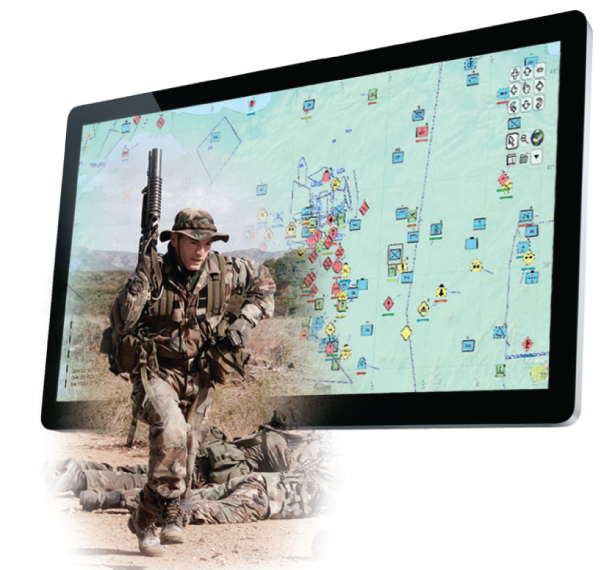
Common Operational Picture
The users will be able to fulfil basic command and control activities in national and international environments without any integration concerns by using DOOB. By means of the provided framework joint operations can be easily performed via MIP compatible systems also.
DOOB will be more user-friendly, expandable, easily manageable and high performance than the existing products in the market. We aim that the user having basic computer literacy is able to use the application without long-term training. DOOB will be ready to be released to the market at the end of 2012.