``Last Year, We Could Produce Two Engines Per Week; Now, We are Able to Produce Seven Engines Per Week``
Kale Arge, which has taken significant steps toward becoming a "Center of Excellence for Gas Turbine Systems" and achieved 100% growth in the past year, continues the serial production and delivery of KTJ-3200 Turbojet Engines, which have been developed entirely with domestic capabilities for the SOM Air-Launched Cruise Missile (ALCM, TÜBİTAK SAGE) and the ATMACA Anti-Ship Cruise Missile (ASCM, ROKETSAN).
The company has also developed the KTJ-3700 Turbojet Engine with a thrust capacity of 3,700N for the KARA ATMACA Land-Based Cruise Missile (SLCM) developed for the Turkish Land Forces Command (TLFC) and delivered the first engine for the initial test firing at the end of January. The KARA ATMACA SLCM (ATMACA UM), powered by the KTJ-3700 Turbojet Engine, measures 1 meter in length, 370mm in diameter, and weighs 910kg. During the live-fire test announced to the public on August 18, 2024, it hit its target with pinpoint accuracy, marking the longest-range and longest-duration flight ever achieved by an ATMACA series missile. Additionally, another engine developed by Kale Arge, the KTJ-1750 Turbojet Engine with a thrust capacity of 1,750N, was successfully used in the first live-fire test of the ÇAKIR Cruise Missile, conducted from the AKINCI Armed UCAV in May 2023.
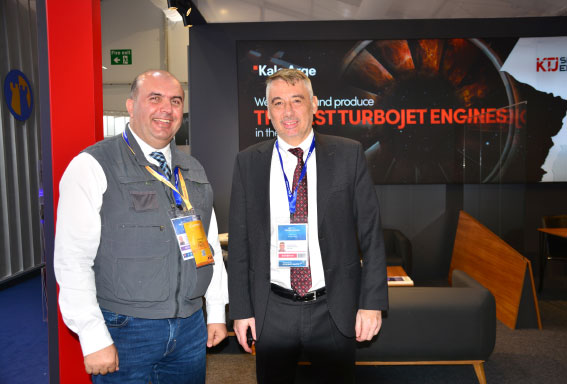
On the second day of the Farnborough 2024 International Airshow (FIA24), held in London, England, from July 22-26, 2024, we conducted a comprehensive interview with Cüneyt KENGER, General Manager of Kale Arge. The discussion covered several topics, including the latest updates on the renovation of the Kale Arge Tuzla Development and Test Center and the capacity expansion of the Altitude Test Rig, both of which were initiated last year. We also discussed the critical milestones planned for 2024 regarding ongoing engine projects, as well as the company’s goals and expectations for the export market and future roadmaps for engine development.
Defence Turkey: Can we begin our interview by discussing the reason for Kale Arge’s participation at Farnborough, your expectations, the feedback you’ve received from visitors during the first two days, and to what extent you have achieved your goals and objectives?
Cüneyt KENGER: As Kale Arge, we are a company that is continuously growing. As you know, we are on the verge of bringing our third engine, the KTJ-3700, into inventory. The KTJ-3700 will be used in the KARA ATMACA missile. In addition to this, we have the ARAT Engine Project currently under development, and it is progressing quite successfully as well.
Defence Turkey: Is there any delay in the project timeline?
Cüneyt KENGER: No, there is no delay in the timeline. We are not expecting any delays either. We aim to complete it within the regular schedule. However, the ongoing construction work to increase capacity does pose some challenges. On the other hand, our serial production efforts are also progressing, and while I cannot provide specific numbers, we are producing a significant number of engines this year.
Defence Turkey: You are producing a large number of engines, but for example, The test firing with the KTJ-3200 Turbojet Engine for the SOM missile has not yet been conducted.
Cüneyt KENGER: It will happen very soon.
Defence Turkey: It seems that priority is being given to ATMACA, correct?
Cüneyt KENGER: We aim to produce all our engines as quickly as possible.
Defence Turkey: Since it will be air-launched, is there a waiting period for the platform as well?
Cüneyt KENGER: The logistics timeline is a bit longer, but a test firing is expected to happen very soon. While waiting for the test processes, we continue to grow rapidly.
Defence Turkey: Are you referring to both personnel, capacity, and production speed?
Cüneyt KENGER: To increase capacity, we relocated our R&D engineers from the current facility to Teknopark. A year ago, we had 120 people, and now we have 240. We've doubled in size. Of this total, 120 are R&D personnel, and the other 120 are involved in production, quality, and supporting serial production. Those supporting production remained at the current facility. We have also undertaken construction work at the Tuzla facility.
Defence Turkey: Is it more R&D or product development? After all, you currently have three engines—what R&D is left to do? You once mentioned during a presentation at a university that "R&D is often misunderstood in Türkiye; in reality, we are doing product development."
Cüneyt KENGER: Sometimes, we fall into that misconception as well. We say R&D, but it's actually more product development. You’ve pointed out the right distinction. However, there is still a bit of R&D being done on smaller turbofan engines, with a small team working on that. But yes, we moved 120 personnel to Istanbul Teknopark.
Defence Turkey: As part of the renovation work at the Kale Arge Tuzla Development and Test Center, the goal was to increase the capacity of the Altitude Test Rig from 5,000m to 10,000m, along with the installation of an additional Test Rig and a significant investment to nearly double the facility's current capacity and covered area. What is the current status of these efforts?
Cüneyt KENGER: Yes, the work is ongoing. It will be completed in October or November. We've made considerable progress. Two weeks ago, we replaced our transformers. Since the electricity demand has doubled, the transformer capacity has also been doubled, as the power consumption of the additional vacuum pumps has increased twofold.
Defence Turkey: You've increased the capacity of the Altitude Test Rig/System, which simulates atmospheric conditions, to 10,000m. Will the system be able to simulate the conditions of both 5,000m and 10,000m in its new state?
Cüneyt KENGER: Absolutely, we’ll be able to. Previously, we had one test chamber, and now we are increasing it to two. There will be two separate test chambers running in parallel. One will be more suitable for smaller engines, such as those of the ÇAKIR missile, while the other will be for larger engines. This means that we will be able to test both small and large engines simultaneously.
Defence Turkey: The KTJ-1750 Turbojet Engine will also undergo a 10,000-meter altitude test, right?
Cüneyt KENGER: Yes, it will. Currently, it’s flying at higher altitudes, but other versions of the engine are also being considered, and for those, 10,000 meters will be necessary. Those tests will be conducted at the new facility which will be completed around October or November. So, those tests will be carried out by the end of this year.
Defence Turkey: If I am not mistaken, engine production was done at Kale Aviation because your Tuzla facility was insufficient. Once the renovation is complete, will all production be transferred to your facility, or will Kale Aviation continue to be involved in the production process?
Cüneyt KENGER: The reason we are increasing our capacity is to expand our assembly capacity. The component manufacturing is still done by Kale Aviation, as they are experts in that field, and it will continue to be done there. We only handle prototype manufacturing in our prototype workshop. The serial production of our engines is primarily carried out by Kale Aviation. However, it's not just Kale Aviation—FEMSAN, KAREL, and KAAN Makina in İzmir also contribute to production, but Kale Aviation does about 70% of it. That being said, we don’t give everything to Kale Aviation by default, even though they are part of the Kale Group. They still need to be competitive. We need a certain profit margin to keep our company sustainable, so we work with competitive suppliers. But Kale Aviation handles the majority of the production. In the past, when we exhibited an engine at fairs, our space was limited, and we didn’t attract much attention. But now, there’s tremendous interest. Here, we display three of our engines, and the fourth one is on the way.
Defence Turkey: Will you announce an export contract this year? Specifically, will there be direct exports from your side, apart from sales made indirectly through ROKETSAN? For instance, there were talks regarding the NSM and discussions about the MANSUP-ER anti-ship missile for the United Arab Emirates.
Cüneyt KENGER: There is significant interest in Kale Arge worldwide. We are receiving Requests for Quotation (RFQs) at that level. However, we are taking things slowly. Why are we taking it slow? Because this year, our primary goal is to deliver and manufacture a large number of engines. In parallel, we are gradually continuing with the RFQ processes, but it’s unlikely to happen this year. You will probably hear about it next year. Right now, there are official requests for price quotations. It has moved beyond mere discussions.
Defence Turkey: Do you have any data regarding the learning curve in your turbojet engine production process? After all, you are also manufacturing a machine. For example, two years ago, it might have taken 100 man-hours to produce a KTJ-3200 Turbojet Engine, but now, with improved production speed, experience, and infrastructure, you might be able to deliver an engine every week. Could you share any such data, considering the subcontractors you mentioned earlier? As you said, you handle assembly, but their capacity must also be aligned with this, correct?
Cüneyt KENGER: Of course, it’s in collaboration with them. You need to stockpile materials so that you can proceed with assembly. When you look at the process as a whole, including all the components, last year, we could produce two engines per week; now, we are able to produce seven engines per week.
Defence Turkey: For example, when TEI develops an engine, they say, "My engine has flown 4,000 hours on ANKA." It has been used on AKSUNGUR for a long time and then mounted on ANKA. To safely mount an engine on a platform in serial production, it must reach a certain number of operational hours. Is there a similar requirement for you? For instance, does the KTJ-3200 need to run for 1,000 hours in a test environment before it can be safely mounted on a missile?
Cüneyt KENGER:: There is a qualification requirement we establish with the customer. If it’s an SSB project, we work with the Secretariat of Defence Industries (SSB); for ATMACA, for instance, we worked directly with ROKETSAN. For example, if the engine is expected to operate for 15-20 minutes during its actual flight, we conduct a one-hour test. That means we perform a durability test in the test chamber that’s 3 or even 4 times longer than its actual operational time, and once it passes, we proceed. As you know, ATMACA successfully completed its launch last May (the ATMACA Surface-to-Surface National Guided Missile, powered by the KTJ-3200, was fired for the first time from the Mobile Guided Missile System to a sea target in March). In general, during tests, we push the engines to 3 or even 4 times the duration of their expected operational time.
Defence Turkey: At the moment, you are delivering products exclusively to the Turkish Armed Forces (TSK). You are also in talks with international clients. Are the demands similar? When comparing the qualification processes requested by TSK or SSB with those from foreign customers, are the requirements similar, or do they come to you with lower or higher expectations?
Cüneyt KENGER: In our experience, the requirements from our Turkish customers are much more stringent. We find it less challenging with foreign customers. These engines were designed according to very demanding specifications set by our Turkish clients, and in hindsight, it has been a good thing. As a result, we’ve developed excellent products. When we list the features of these engines in the international market, they are genuinely well-received and appreciated.
Defence Turkey: In commerce, the price of a product when producing 10 units is not the same as when producing 1,000 units. Given that you can now produce seven engines per week, has there been a decrease in the price of the engines? Or are the prices unchanged due to ongoing global challenges like parts shortages, raw material issues, and supply chain disruptions, which inevitably affect unit costs? Despite the increase in production volume and speed, have the engine prices remained the same? How competitive is the KTJ-3200 in terms of pricing in the market?
Cüneyt KENGER:: There are competing factors influencing the situation. On the positive side, as you mentioned, when you start producing in larger quantities, you gain speed, and producing parts faster helps reduce costs. However, fluctuating exchange rates increase our costs. This is a concern for all companies in Türkiye right now. It’s a cost-driving factor. Material prices are rising, too. When you look at it, these factors roughly balance out. If you ask whether the overall cost has decreased, I will say it hasn’t dropped significantly, but it hasn’t increased either. It has slightly reduced, thanks to the learning curve.
Defence Turkey: But the prices haven’t dropped as much as they could have due to the conditions in Türkiye and the global material shortages…
Cüneyt KENGER: Nevertheless, when we compare our prices with similar engines on the market, they are very close. We're not priced above the competition at the moment. There was a time when we were, but recently, those companies raised the prices of their engines, and now their sale prices have surpassed ours. In the case of the smaller engine (KTJ-1750), we are a bit more expensive. The reason is that it’s a more premium engine—like the Rolls-Royce of its class. However, we are working to reduce its costs as well.
Defence Turkey: Do international customers approach you saying, “I want this product for a specific platform,” or do they come to you saying, “I really like this engine; I have a missile program, let’s collaborate—perhaps even establish a joint venture or set up a factory here”?
Cüneyt KENGER: Both scenarios actually happen. In one case, as you mentioned, a foreign company had previously made an agreement with a different engine manufacturer and developed their missile around that engine. Later, the engine manufacturer told them, “Sorry, but I can no longer provide this engine in serial production.” It turns out that our engine has the exact same dimensions as that one, which creates an excellent opportunity for them.
Defence Turkey: When such demands arise, you'll also need to provide engineering support to the potential customer, correct?
Cüneyt KENGER: Of course. When they requested a price from us—this happened 1-2 months ago—they asked for it along with an integration package. So, it wasn’t just a unit price for the engine; the work included integrating the engines into their missile system.
Defence Turkey: For such collaboration, the product will also need to be tested. Will you use the test infrastructure at Kale Arge’s Tuzla facility for this?
Cüneyt KENGER: Yes, they requested a complete package. We are currently preparing that proposal. We may go there and potentially set up some test equipment as well. It’s not just about selling engines; we might also provide engineering services and perhaps even test equipment. We’ll likely see this come to fruition next year, and it seems to be a very serious project, so it’s likely to happen.
Defence Turkey: Have you ever had someone approach you with this scenario: "I’m not developing a new missile from scratch; I already have a stock of missiles, which have a turbojet engine similar to yours. However, I can no longer get support for the maintenance of these missiles, either because it's too expensive or due to an embargo. Let’s collaborate and replace the engines on these missiles with Kale Arge’s turbojet engines." I think this could be cost-effective if the customer has, for example, 1,000 missiles in stock. Have you received any requests like this, where instead of developing and integrating a new missile from scratch, the idea is to replace the existing engine with one from Kale Arge?
Cüneyt KENGER: It's possible. So far, no one has approached us specifically to replace an existing engine in that way. However, there have been cases where, due to war or other circumstances, they are unable to procure the original engine and want to use our engine instead. So, that has happened. Additionally, there are cases where they use an American engine but can’t export it everywhere, while our engine is exempt from export restrictions. That’s why they want to switch to our engine, as it’s free from such limitations.
Defence Turkey: During fairs, you meet with many foreign companies and potential customers. Do you see a need for a new type of engine in the market beyond what is already in your product lineup?
Cüneyt KENGER: We are seeing a significant demand for smaller engines, especially for drones. The difference with these engines is that they need to operate for a longer duration compared to our current engines, so they require a longer lifespan. We’ll likely develop such an engine as well. We haven’t done it yet, but we’ll probably create that engine. There is a strong demand for smaller engines.
Defence Turkey: But in the small engine market, there is also the reality of competition with China. Competing with them is not easy.
Cüneyt KENGER: Actually, our companies are trying to source these engines from Europe. We can compete with them as well.
Defence Turkey: TÜBİTAK SAGE has been searching for a turbojet engine for the KUZGUN project, and TUSAŞ for the Süper ŞİMŞEK for a few years now…
Cüneyt KENGER: Yes, exactly. Those are the ones. The most apparent difference between these engines compared to ours is the lifespan requirement. It requires a slightly different design—simpler, with much lower thrust requirements. So, they're not as demanding as our engines. Fuel consumption is also much lower than ours, but the lifespan needs to be much higher. We might have a project aimed at that.
Defence Turkey: Can you share any information about the thrust power of the turbofan engine you're working on? Will it be similar to the KTJ-3200 or the KTJ-1750?
Cüneyt KENGER: It will be more powerful than both.
Defence Turkey: Is there a plan to install the engine on unmanned aerial vehicles (UAVs) as well, apart from missiles?
Cüneyt KENGER: Yes, the roadmap for that is as follows: we started with single-use engines. After that, we are working on a turbofan, primarily for missile engines. However, since it will need to have a longer lifespan, its bearing lubrication technology and other features will be similar to those of larger engines. Once we complete the turbofan engine, where will we go next? After that, we might move into small turbofan engines for business jets, which would allow us to enter the civilian sector. That’s part of our roadmap.
Defence Turkey: Are you considering producing an Auxiliary Power Unit (APU) as well?
Cüneyt KENGER: APU is a possibility. However, APU is a slightly different field because auxiliary power units are different from engines. There are a lot of electrical and auxiliary components involved, more so than with the engine itself. You need to specialize more in those auxiliary electric units rather than the core engine. The gas turbine part is similar, but it requires different expertise. That’s why companies like GE and Rolls-Royce don’t make APUs—other companies specialize in that field. It’s a separate area of expertise.
Defence Turkey: For instance, as far as I know, companies like Ivchenko Progress and PBS produce both engines and APUs. They are involved in both fields.
Cüneyt KENGER: PBS was primarily an APU company; they weren’t initially focused on engines. They started producing turbojet (TJ) engines later. PBS started with APUs. Ivchenko is a bit different; they work on both engines and APUs. In Türkiye, TRMotor is working on APU development.
Defence Turkey: Your products have matured and are being used by the Turkish Armed Forces (TSK). In the near future, they will also be serving other friendly and allied nations through direct and indirect sales. What do you envision for Kale Arge in 10 years? Where do you want to be in the global market for small engines or turbojet engines?
Cüneyt KENGER: Of course, seeing 10 years ahead is not too difficult; it’s not such a long time. We want to move into dual-use engines gradually. As a company, it’s not wise to put all our eggs in one basket. Naturally, this will be shaped by global developments, but how long will the need for these engines continue? Will demand increase? It seems likely that it will. So, even if we decided to continue solely in this area, it wouldn’t pose a major risk. However, as I mentioned earlier, we are considering partnerships for small turbofan engines aimed at civil aviation. When we talk about civil aviation, the qualification and certification requirements are very different. Therefore, we might not do it alone, but through partnerships, we could start turbofan engine projects for civil use. We are also considering having international extensions—manufacturing facilities abroad. All of these are discussions we’re actively having. In the future, you might see Kale Arge as a company headquartered in Türkiye but with subsidiaries and production facilities in countries like the U.S. and other regions. To summarize, it seems that the demand for these engines will continue for quite some time. In addition, we have a vision of expanding into small turbofan engines and establishing not just sales but also production facilities globally. That’s something we are actively discussing.
Defence Turkey: At the IDEF '13 Fair, Kale displayed a turbojet engine solution called the Kale-3500, which was a turboprop engine with a power capacity of 900hp. In addition to turbofan engines, are you considering moving into turboprop engine production?
Cüneyt KENGER: Of course, it's definitely a possibility. We could move into turboprop as well.
Defence Turkey: There are many potential applications for an engine of this capacity, such as training aircraft or unmanned aerial vehicles.
Cüneyt KENGER: Absolutely. There are needs in that area. We have UAVs that use turboprop engines, as you know. We are, of course, in discussions about that, in line with the country's needs.
Defence Turkey: Because, as far as I know, the 750hp turboprop engines used on the AKINCI Armed UCAV do not fully meet the power requirements for some mission configurations, particularly in terms of alternator or electrical power. The engine's power generation is insufficient for sensors and equipment such as the HAVA SOJ or MURAD AESA Radar. According to open sources, the 750hp PT6A-135A Turboprop Engine used on the AKINCI UAV is equipped with a generator with a capacity of 12kVA (kilovolt-ampere). Therefore, since the electrical power is not sufficient for certain roles, an additional APU is being installed on the aircraft to meet the needs. If Kale Arge is to develop a domestic turboprop engine, I would suggest prioritizing electrical power capacity.
Cüneyt KENGER: Yes, it's interesting, for example, that our small engines provide 5 kVA to the alternator. We have a very powerful alternator, considering the size of the engine. What you mentioned is actually quite intriguing. Those engines are much larger than ours yet having only 12 kVA is somewhat disappointing.
Defence Turkey: Thank you, Mr. Cüneyt, for taking the time. On behalf of our readers, we wish you success in your work