Leonardo: Shaping the Future of Global Security & Aerospace
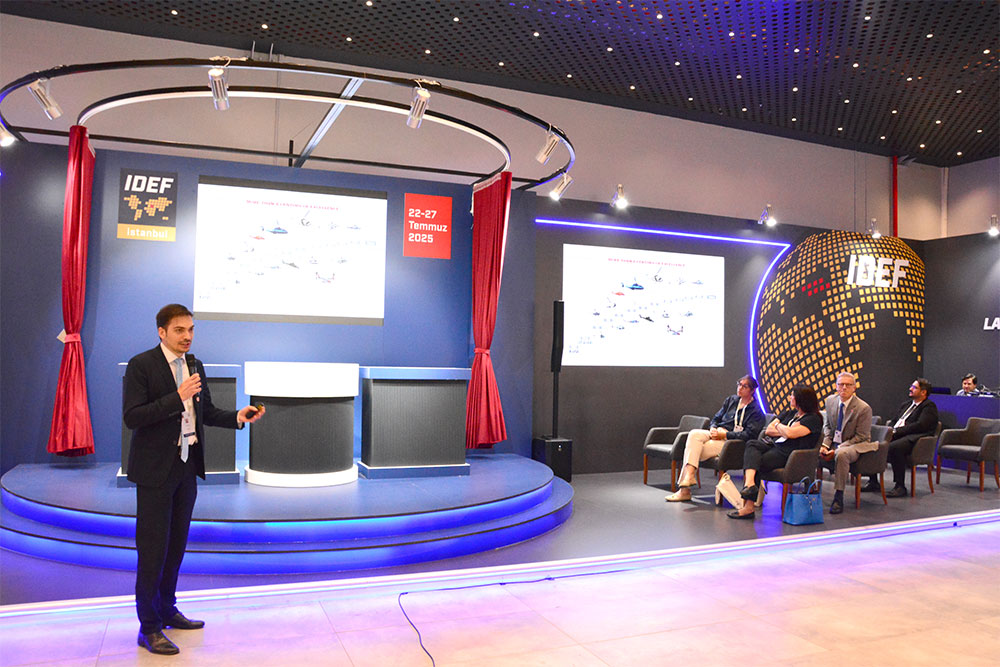
Having over 45 years of fruitful collaboration with the Turkish Government and Industry for maritime and air traffic management, helicopters, naval systems, and space services, Leonardo organized a press meeting at İstanbul Expo Center (IFM) on July 25, 2025 during IDEF ‘25 to provide first-hand information on Leonardo’s main performance and financial results, Leonardo Helicopters’ product portfolio including AW119, a benchmark for next generation pilots training, and AW189 Search & Rescue Helicopter as well as on Leonardo’s local subsidiary in Türkiye; Leonardo Türkiye Havacılık, Savunma ve Güvenlik Sistemleri A.Ş., which was established as Marconi in 1988 to manufacture secure and anti-jam HF/SSB radios for the Turkish Armed Forces (TAF).
Speaking at the event, Sergio SCODANIBBIO, Head of Region International Campaigns Türkiye at Leonardo Helicopters and a Member of the Board of Directors at Leonardo Türkiye, highlighted the scale and ambition of the company. With 129 sites worldwide, commercial presence in 150 countries, and a workforce of more than 60,000 employees, Leonardo stands as one of the largest players in the global defence and aerospace industry.
SCODANIBBIO underlined that Leonardo’s vision is firmly rooted in securing the future — not only in defence but also in aerospace innovation. “Leonardo is taking care of the future, the future of defence, the future of aerospace. This is our mission,” he emphasized. Reflecting this commitment, the company consistently reinvests between 12% and 14% of its annual revenues into research and development. In 2024 alone, Leonardo allocated €2,5 Billion to R&D and product engineering, ensuring that it remains ahead of the technological curve.
“We are a multi-domain company,” SCODANIBBIO explained. “That means we take care of aeronautics, rotary-wing platforms such as helicopters — which I personally represent — as well as unmanned systems, cyber, space, maritime, and land domains. Leonardo covers every sector central to aerospace and security.”
Through this comprehensive approach, Leonardo continues to strengthen its role as a leader in global defence and security, driving forward innovations that safeguard the future while meeting today’s operational challenges.
Taking the floor after SCODANIBBIO, Michele PERSIANI, Sales Engineer at Leonardo Helicopters, outlined the company’s product portfolio and vision for the future. With more than a century of aviation heritage, Leonardo Helicopters is today recognized as one of the leading players in the global rotorcraft industry. Over the years, working closely with partners such as Westland and Agusta, the company has designed and delivered the full spectrum of helicopters—ranging from the smallest light platforms to heavy models such as the AW101. To date, Leonardo has delivered over 5,000 helicopters worldwide, serving both civilian and military customers across every operational domain.
PERSIANI emphasized that Leonardo’s activities extend beyond conventional helicopters, with ongoing work in next-generation technologies such as the AW609 Tiltrotor and unmanned aerial systems. “We are proud to cover nearly every weight category and market segment, from light single-engine helicopters to multi-role heavy platforms,” he explained.
At the heart of the company’s current portfolio is the AW Family, including the popular AW139, AW169, and AW189, supported by lighter models such as the AW119 Koala and AW109. These versatile aircraft are designed for both civil and military applications, adaptable to missions ranging from emergency medical services (EMS) to surveillance and light attack roles.
The AW119 Koala, PERSIANI noted, has become a benchmark in the training segment. Featuring a powerful single engine, IFR and NVG certification, and advanced avionics, the Koala offers a cost-effective yet capable training solution. Its spacious cockpit allows instructors and students to share identical displays, with room for a second trainee, making it particularly effective as a training platform.
Also operated by the Turkish Army Aviation School Command the AW119Kx IFR variant Next Generation Basic Training Helicopter, with a maximum take-off weight (MTOW) of 2.850kg, assists pilot candidates in demonstrating their piloting abilities through its Digital Cockpit architecture and 3-Axis Automatic Flight Control System (AFCF). The AW119Kx IFR variant delivered to the Turkish Army Aviation School Command features the Genesys Aerosystems IDU680-IFR glass cockpit, enabling IFR flight. Among the avionics equipment used in the helicopter are additional auxiliary systems such as the 3D Synthetic Vision System (SVS), Sky View, Helicopter Terrain Awareness and Warning System (HTAWS), and Highway In The Sky (HITS) Traffic Alert & Collision Avoidance System, which significantly reduce the pilot's workload and contribute to situational awareness. Helicopter Terrain Awareness Warning System (HTAWS) is designed to reduce the risk of Controlled Flight Into Terrain (CFIT) accidents for rotary-wing aircraft during cruise in Visual Meteorological Conditions (VMC) and Instrument Meteorological Conditions (IMC) by enhancing situational awareness of surrounding terrain and obstacles. AW119Kx’s state-of-the-art glass cockpit is similar to advanced helicopters (such as UH-60M/T-70) making pilots transition easier thus lowering risks. The AW119 IFR is the benchmark as New Generation Multirole Trainer. Powered by a Pratt & Whitney PT6B-37A Turboshaft Engine, with a maximum continuous power of 872 shp and a take-off power of 1.002 shp, the AW119Kx is the largest single-engine light helicopter in its class. In the AW119Kx Helicopters, one Instructor Pilot and Student Pilot can sit in the front, and three Observer Student Pilots can sit in the back. This configuration allows for simultaneous training of a Student Pilot and an Instructor Pilot during a sortie, while the three Observer Student Pilots seated in the back can undergo observation-based training at the same time.
Another flagship is the AW189, the largest member of the AW Family and a rising benchmark in search and rescue (SAR) operations. With seating for 19 passengers plus crew, all-weather capability, and a unique 50-minute run-dry transmission—allowing safe operation even without oil in the gearbox—the AW189 has already been adopted by numerous coast guards and law enforcement agencies worldwide. The helicopter comes fully equipped with mission systems for SAR, including search radars, rescue hoists, and surveillance equipment, and has won multiple international tenders.
For heavier military applications, Leonardo fields the NH90, developed in partnership with Airbus and Fokker. This 11-ton, multi-role platform is available in both land and naval variants, with the latter known as the NFH (NATO Frigate Helicopter). Optimized for anti-submarine and anti-surface warfare, the NH90 combines advanced avionics, tactical systems, and flexible mission configurations. With the ability to transport up to 20 troops or 12 stretchers, the NH90 is widely regarded as one of the most versatile platforms in its class. More than 500 units have already been delivered, primarily within European navies and armies.
Looking toward the future, PERSIANI highlighted several key programs under development. The AW249, a next-generation combat helicopter, is being designed in close collaboration with the Italian Army to meet evolving battlefield requirements. The AW609 Tiltrotor represents a radical new concept in aviation, combining the vertical lift capability of a helicopter with the speed and range of a fixed-wing aircraft.
Leonardo is also investing heavily in unmanned systems. The AWHERO, a rotary-wing UAV, offers a payload capacity of up to 200 kg and can be fitted with EO/IR sensors and radar, enabling operations in challenging conditions where optical sensors alone may not suffice. Meanwhile, the Proteus demonstrator, developed with the UK Ministry of Defence, is exploring modular, autonomous solutions for missions such as at-sea replenishment and anti-submarine warfare, with its first flight scheduled by the end of the year.
A recurring theme in PERSIANI’s presentation was Leonardo’s expertise in naval integration. With decades of experience in marinization and helicopter–ship interface design, the company has ensured that nearly all of its platforms can be effectively operated by navies and coast guards in demanding maritime environments. “From training aircraft to advanced combat helicopters, from unmanned solutions to the world’s first civil tiltrotor, Leonardo’s portfolio demonstrates not only technological breadth but also a commitment to adaptability and operational relevance,” PERSIANI concluded.
Following PERSIANI’s remarks, Leonardo Türkiye’s Business Development & Programs Director, Uröz KETENCİ, took the floor to shed light on Leonardo’s growing footprint in Türkiye and the vital role of its Ankara-based facility, Leonardo Türkiye Havacılık, Savunma ve Güvenlik Sistemleri A.Ş.
KETENCİ began by offering a historical perspective: the company was established in 1988 to produce frequency-hopping anti-jam HF/SSB radios for the Turkish Armed Forces (TAF), addressing urgent communication needs of the time. Over the years, Leonardo Türkiye expanded its capabilities, supplying thousands of radios until 1997, and later diversifying into aerospace. By 2005, the company had embarked on lighting system production for air platforms, including internal and external lighting for the A400M Program in partnership with TUSAŞ. This marked Leonardo Türkiye’s first step into aviation manufacturing.
From 2009 onward, the company began developing cockpit control panels, and by 2010 expanded into data maintenance activities. In 2024, Leonardo Türkiye was appointed as a regional hub for Integrated Logistics Support (ILS), supporting not only Türkiye but neighboring regions as well.
“Our factory in Gölbaşı, Ankara, is more than just a manufacturing site — it’s a complete innovation center,” KETENCİ explained. “We handle electronics, mechanical and software design, including embedded software, as well as optical engineering. We have the laboratories, tools, and even specialized dark rooms for optical testing to ensure the highest standards.”
The facility holds prestigious certifications, including ISO 9100 and EASA Part 21 Subpart G Production Organization Approval, which are critical for participation in major international aerospace programs. Leonardo Türkiye has also been approved by NATO as a trusted source of aviation data, a testament to its global reliability. Today, the Ankara factory supports a wide array of programs. Leonardo Türkiye developed and now serially produces cockpit control panels for TUSAŞ’s T625 GÖKBEY Helicopter Program, making the company a key subcontractor. Past contributions include cockpit panels for the C-130B/E ERCİYES modernization program, the HÜRKUŞ Basic Trainer, and the A400M aircraft, fulfilling Türkiye’s industrial participation commitments in the multinational project.
While aerospace projects are at the forefront, KETENCİ emphasized that Leonardo Türkiye remains deeply rooted in communications — its founding expertise. The company has developed indigenous military computers and contributed high-power radio sets (including 400 W, 1 kW, 5 kW and 10 kW) as part of ASELSAN’s Software Defined Radio (SDR) program. Beyond manufacturing, integrated logistics services remain a cornerstone of the company’s strategy. “Producing a system is one thing, but ensuring its operational readiness throughout its life cycle is even more critical,” KETENCİ stressed. As a designated Leonardo ILS hub, the company now supports air traffic management systems, radar installations across Türkiye and abroad, and even maintains Leonardo radars in distant regions like Taiwan.
With approximately 100 employees, Leonardo Türkiye may be modest in size, but its impact is substantial. The company actively collaborates with Turkish defence industry leaders, delivers local content, and provides critical services in Qatar, Somalia, Turkmenistan, and beyond. “Integrated logistics support is the backbone of sustainability,” KETENCİ concluded. “Without it, no equipment can survive in service. Leonardo Türkiye is proud to deliver not just advanced systems, but also the long-term support that keeps them mission-ready”