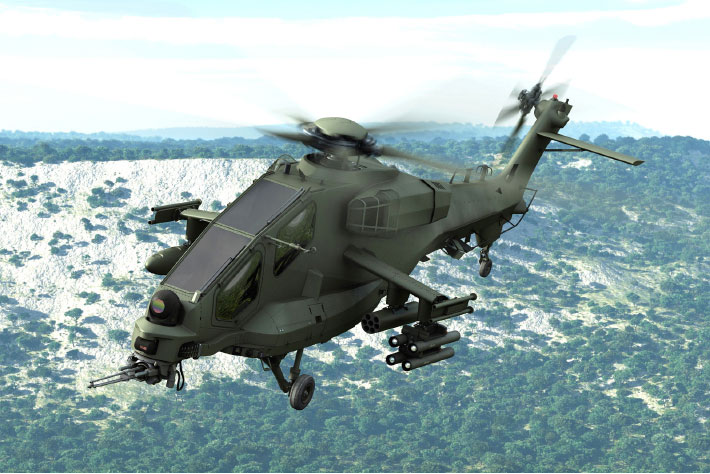
Leonardo Showcases AW249 “Fenice” Next Gen Design & Capabilities

The AW249 (designated AH-249A NEES - Nuovo Elicottero da Esplorazione e Scorta – known as the ‘Fenice’) is the only Western clean-sheet combat helicopter design, in development to meet stringent emerging operational requirements for the next 30+ years. It leverages capabilities and technologies not available elsewhere today, uniquely and ideally bridging a further gradual evolution of military vertical lift.
To manage a rapidly evolving scenario, the AW249 features a complete open architecture with significant further growth and system/capability adaptation to respond to the demanding market requirements. In addition to high performance (speed, range, power margin and payload, Hot & High conditions, maneuverability for unmatched nap-of-the-earth flight), core to the AW249 is its ability to be fully integrated and interoperable in the modern multi-domain battlefield (air-land-sea-space-cyber). AW249 is interoperable with all air and ground assets. It is net-centric within a digital network where single cooperating assets share their own tactical information (voice, data, video), resulting the ability to prosecute joint and complex operational scenarios. Being net-centric is thus vital for coordinated action in demanding environments. Assets involved range from command centers, to UAVs or other aircraft and satellites. Importantly it includes ground troops and their vehicles. The AW249 incorporates advanced “net-centric” capabilities such as COMSEC and TRANSEC communications either LOS or BLOS, trough SDR radios, New Generation IFF Tactical Data Link 16, Wide Band Datalink LOS and LTE gateway.
The AW249 features an advanced large area display human-machine-interface and touch screen/gesture recognition devices in the tandem-seating cockpit and a highly sophisticated Leonardo-developed Battle Management System. Displays and a modern pilot helmet enable the crew to rapidly access critical information on flight, navigation and the mission provided by multiple sensing and advanced connectivity.
The AW249 can perform a variety of missions including, fire supporter, aerial escort, close air support, close combat attack and air interdiction. The helicopter can also act as the information acquisition element of a C4 system (ISTAR), using the surveillance systems (either its own or the ones of cooperating units) to scan the territory, identify ground units (both friend and foe) for its own use or to disseminate the information through a secure channel to the Command & Control Centre. Therefore, the AW249 best leverages the advanced crewed-Un crewed teaming opportunities. The AW249 is powered by pair General Electric CT7-8E6 providing 2,503 shp maximum output at take-off and 2,274 shp maximum continuous power, transmission ratings being 3,148 hp All Engine Operating (AEO) take-off and 2,907 hp AEO maximum continuous power. The transmission can run dry for 50 minutes. Powerful engines enable operations in the most extreme conditions with shipboard operational capability designed in from the start.
With a maximum take-off weight of 8.3 tons, the AW249 combines high speed and endurance to operate missions including aerial escort, close air support, and air interdiction. The AW249 performs unmatched nap-of-the-earth-flight, due to improved agility and situational awareness. Sensor fusion provides a state-of-the-art degraded visual environment mode. The AW249 is equipped with a flexible weapon system that includes guided and unguided 70mm rockets, air-to-air infrared guided missiles, and air-to-ground radio frequency or fiber optic guided missiles in addition to a 20mm 3-barrell Gatling gun. Outstanding survivability leverages on an advanced Integrated Defensive Aids Suite (IDAS), together with armored seats and ballistic tolerant fuel tanks, crashworthiness and low detectability and in addition to the superior situational awareness delivered by its navigation and sensor-fusion ability.
The AW249 is being developed also with digital simulation capabilities and a state-of-the-art technical support and training service approach in mind, benefitting from high fidelity mission simulation and virtual reality and prescriptive maintenance via data gathering and analysis, among others.
Lorenzo MARIANI, Co-General Manager of Leonardo, said: “The AW249 epitomizes the key winning factors and enablers we’ve identified in our defense and security strategy: digital and with a strong use of AI technologies, connected in a multi-domain/net-centric scenario, cyber-protected, with great autonomy, and capable of collaborative operations with remotely piloted systems. All of this is fully embedded into an advanced system leveraging the very best of our competitive position in the rotorcraft and airborne electronics field. This is why we also believe this is a sector we can contribute to a stronger coordinated effort in Europe. We’re confident the AW249’s characteristics and possibilities represent a highly competitive value proposition also for the international market.”
Gian Piero CUTİLLO, Managing Director of Leonardo Helicopters, underlined: “With the AW249 we’ve reached the top, and possibly even pushed the boundaries beyond expectations, in our military rotorcraft know-how. We’ve demonstrated we can bring all new technologies and mission capabilities forward, making tomorrow possible today to the benefit of our military partner. The collaboration with the Italian Army, its forward-thinking guidance and clear requirements were fundamental for this endeavor. I’d like to thank the Italian Defense Authorities for their strong support.”
AW249 prototype made its maiden flight on 12 August 2022. Four prototypes have been built since then, with two flying aircraft involved in performance, system integration and payload testing and two more now completed and to start testing soon. The Italian Army plans to acquire 48 AW249 32 AW129 that it still has in active service as of 2025. The production contract is expected soon, with deliveries to the Italian Army to begin in 2027