Leonardo’s Falco Xplorer Completes Successful EUDAAS Demonstration
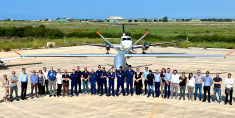
Leonardo announces the successful completion of a landmark demonstration with its Falco Xplorer uncrewed aerial system, which took off from Trapani Birgi (Italy) airport to validate the European Detect and Avoid (DAA) technological demonstrator, part of the European Defence Industrial Development Program (EDIDP) funded EUDAAS project.
The event, attended by high military and industry representatives from the five contributing member states (Sweden, Italy, Germany, France and Spain), marks a pivotal milestone for integrating large uncrewed aircraft into the European airspace alongside crewed aircraft, meeting critical needs in both civil and military sectors.
The in-flight demonstration concluded a technological development cycle that began four years ago in Europe under Saab’s coordination, with the involvement of aeronautical excellences supported by a highly qualified European ecosystem of 10 partners from the member states.
With Leonardo’s dedicated engineering support from Ronchi dei Legionari, the EUDAAS project has advanced cutting-edge technologies that enable uncrewed aircraft to operate in non-segregated airspace, an innovation expected to enhance air traffic safety and efficiency across Europe. The Falco Xplorer’s role as the European flying test bed underscores Leonardo’s dedication to the advancement of autonomous flight and artificial intelligence capabilities. With Leonardo’s dedicated engineering support from Ronchi dei Legionari, the EUDAAS project has advanced cutting-edge technologies that enable uncrewed aircraft to operate in non-segregated airspace, an innovation expected to enhance air traffic safety and efficiency across Europe. The Falco Xplorer’s role as the European flying test bed underscores Leonardo’s dedication to the advancement of autonomous flight and artificial intelligence capabilities.
The in-flight activities conducted at Trapani confirmed the effectiveness of the technical solutions developed for the DAA demonstrator, including advanced sensors, innovative digital flight control algorithms and smart systems. These systems provide traffic awareness, remain well clear, and collision avoidance capabilities, enabling the uncrewed aircraft to operate safely and efficiently in A-G class airspace. They achieve this by detecting and avoiding both cooperative and non-cooperative air traffic, performing necessary maneuvers to prevent conflicts while reducing the workload for operators.