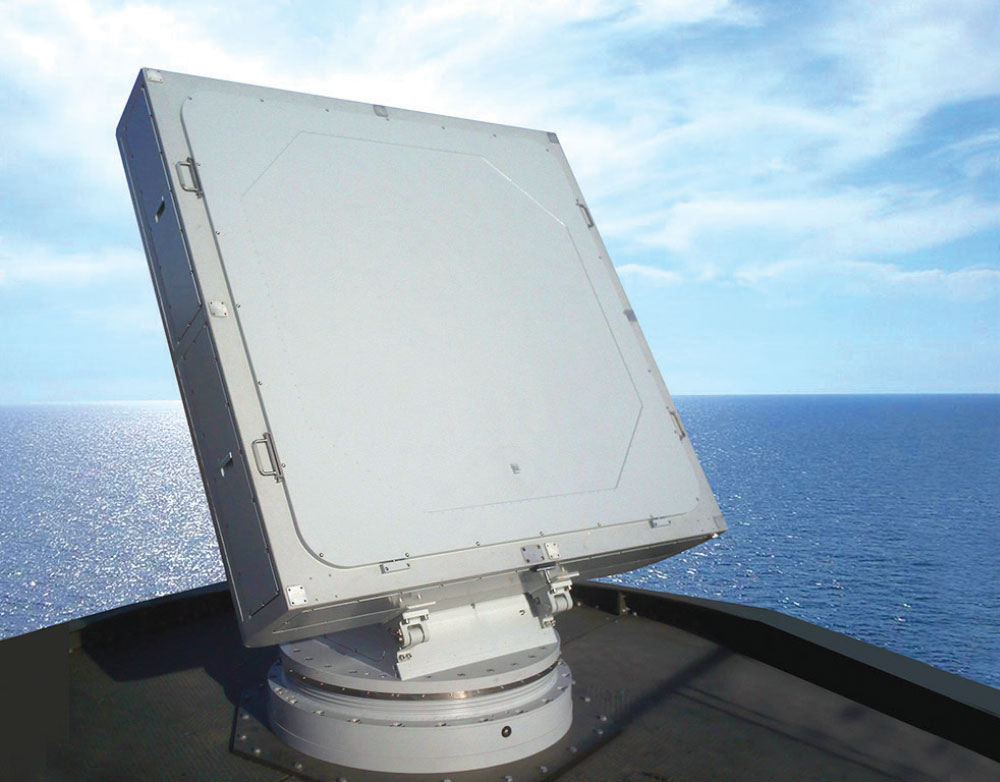
Leonardo’s KRONOS: A Total Capability System
Emerging threat scenarios and requirements for armed forces to exercise increased security with reduced manpower and improved response times demand easily deployable, high performance radars to support a range of challenging missions guaranteed by a high system reliability and graceful degradation as well. Leonardo’s answer to this new challenge has been the vanguard and truly multi-functional and multi-mission radar family KRONOS, which can simultaneously and independently perform surveillance and tracking of any flying target and the guidance of active and semi-active missiles.
Multi functionality and simultaneous capabilities can be achieved thanks to the Active Electronically Scanned Array (AESA) technology developed within the company in-house foundry and to the fully-owned GaAs and GaN manufacturing capability. Both land and naval operations have stubbornly benefited by the introduction of the fully active array antenna technology and Leonardo has been at the forefront of development of such an innovation from the very beginning.
Over 30 KRONOS are in use in the company’s domestic Italian market as well as to customers in South America, Middle East and Far East, while Leonardo’s KRONOS systems have recently performed important exercises.
One of them was accomplished within the Italian Air Force exercise, held in November 2017 at PISQ (Poligono Interforze di Salto di Quirra, Italy). The KRONOS Land radar, main part of Italian SPADA NG system demonstrated an outstanding capability to detect and maintain high maneuvering tracks, hovering tracks and low altitude tracks. The exercise involved the use of many cooperative targets, as Eurofighter Typhoon, AB 212 Helo, F-35, NH 101 Helo, CAEW and Mirach-100. During the exercise, the KRONOS Land demonstrated that its multi-functional capabilities allow performance of multiple operational missions: air surveillance and missile defense against traditional maneuvering air threats, flying at all altitudes, and against Hovering Targets.
This trial come just after the one made some months before in which the naval version of the system showed an exceptional performance. During the US-led multinational exercise Formidable Shield 2017, the KRONOS Grand Naval radar, installed on board of Italy’s “Luigi Rizzo” FREMM Frigate, demonstrated the ability to detect, classify and track with outstanding accuracy the tactical ballistic missiles (TBMs) launched during the live exercise. During the exercise, the KRONOS Grand Naval demonstrated that its multi-functional capabilities allow it to perform several types of operational missions. These include air surveillance and missile defence against traditional aerial threats, maneuvering at a variety of altitudes, and defence against tactical ballistic missiles, whose speed and trajectories are extremely challenging even for modern defensive systems. New operation capabilities are deemed necessary for shipborne radars. Anti-Tactical Ballistic Missile (ATBM), nowadays is, for instance, crucial due to the increasing use of these threats and considered a priority by potential users. Kronos Grand Naval and Kronos Power Shield and their equivalent ground-based versions, KRONOS Grand and KRONOS Ground Shield, are designed to cover the full spectrum of BMD capabilities that modern complex scenarios can require for defence against short and medium range ballistic missiles.
Both in the land and naval versions, the KRONOS systems can cover a wide range of applications, simultaneously perform surveillance, dedicated target tracking and ECCM, detecting and tracking any type of air and maritime threat and when integrated into a surface-to-air missile system, can provide multiple missile uplinks simultaneously. KRONOS radars can also be integrated into a defence surveillance network even composed by heterogeneous sensors contributing to the overall complete Recognised Air Picture (RAP) ensuring a life-saving timely response.