Turkish Military Rotary Wing Programs

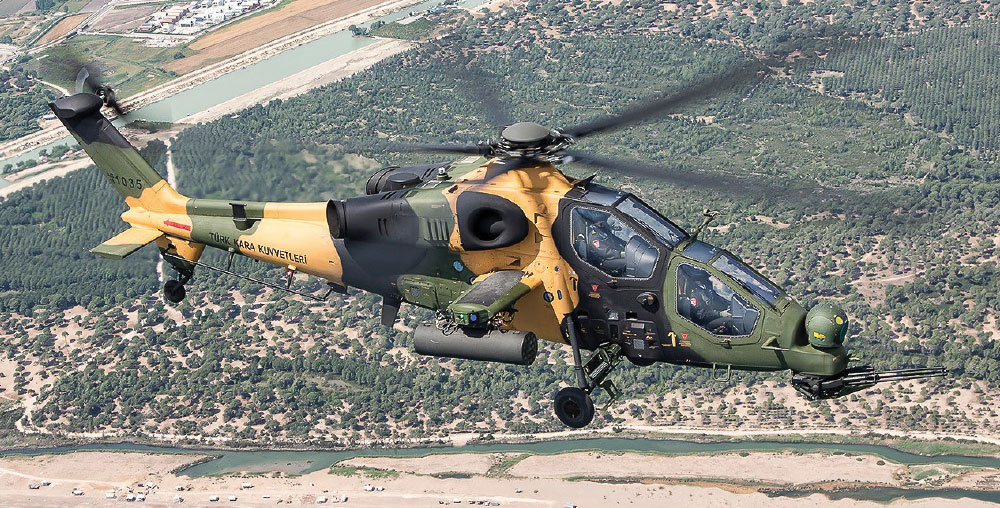
T129A/B Mk-I ATAK Multi-Role Light Combat Helicopter
Valued at US$3.3 billion, the ATAK Program of the Turkish Land Forces Command (TLFC) covers the procurement of 9 T129A EDHs (Early Delivery Helicopters) + 50 T129Bs (29 in Phase-I and 21 in Phase-II configurations +32 optional) tactical reconnaissance and attack helicopters. A prototype helicopter (P2) will be retained by the Presidency of Defence Industries (SSB) for use as a test-bed. Turkish Aerospace (TA) is the Prime Contractor of the T129 ATAK Program and has been contracted to deliver 27 further T129Bs to the Turkish Ministry of Interior (18 T129Bs to the Turkish Gendarmerie General Command and 9 T129Bs to the Turkish Police). TA manufactures (T129A/B helicopters) under license from the Italian-British AgustaWestland (rebranded as Leonardo Helicopters in 2016).
TA manufactures and delivers two T129s per month and as of July 2018, the company has completed the delivery of 36 T129A/Bs (9A and 27Bs) to the Turkish Land Forces and 3 T129Bs to the Gendarmerie General Command. Deliveries of the first three T129Bs to the Gendarmerie General Command took place on April 19, 2018.
The first prototype (T129 P1) based on the AgustaWestland owned AW129 helicopter with registration number CSX81723 performed its maiden flight on September 28, 2009. Delivery of the first of slightly less capable 9 T129A EDHs (for a combat support role) was carried out on April 22, 2014 and was completed on July 31, 2015. Since November 2014, T129A EDHs have been actively deployed in counter-terrorism operations against PKK terrorists in South Eastern Anatolia. The first T129B ATAK Helicopter (multi-role version) was delivered to the Turkish Land Forces Aviation Command on November 18, 2015 and the 27th T129B on July 14, 2018.
T129B ATAK helicopters will be delivered in two basic configurations; Phase-I (covers 29 helicopters) and Phase-II (covers 21 helicopters). Phase-II T129Bs, which incorporates 39 new equipment compared to T129B Phase-I helicopters, the major difference between these two configurations is with the EW Self-Protection Suit. While the T129As and T129B Phase-I helicopters are equipped with only AN/ALQ-144 IRCM, ÖzIşık CMDS and MWS-TU Missile Warning System (MWS) sensors the Phase-II T129Bs will also feature Radar Warning Receiver (RWR), Radio Frequency Jammer (RFJ), Laser Warning Receiver (LWR) and 9681 V/UHF Radio sets. The Phase-II T129Bs will also feature Aselsan’s new generation CATS (Common Aperture Targeting System) Reconnaissance, Surveillance and Targeting System which replaced the AselFLIR-300T EO/IR Targeting System. Although it is lighter and smaller than the second generation AselFLIR-300T used in T129A/B Helicopters and Heron and ANKA Unmanned Air Vehicles, it stands out with its superior features. The CATS, which weighs 60kg is lighter than the AselFLIR-300T weighing 120kg. Deliveries of the Phase-II T129Bs are scheduled to be launched by the end of 2018.
On July 13, 2018, The Presidency of Defence Industries (SSB) announced that Turkey and Pakistan have finalized a deal for Pakistan’s purchase of 30 T129 Advanced Attack and Tactical Reconnaissance Helicopters (ATAK). If the project would be realized it will be worth US$1.5 billion. It was awarded on July 13, 2018 but due to diplomatic crisis between the US and Turkey, export licenses for the US made parts on the T129 helicopter may not be obtained and this risk shall prevent Turkey to see the deal materialize. Pakistan Army’s T129 ATAK Helicopters will have a similar configuration with that of the Turkish Army’s T129Bs and the first batch of 10 helicopters would be delivered in T129B Phase-I configuration and the remaining 20 helicopters in T129B Phase-II configuration. At the final phase of the program the first batch 10 helicopters will be upgraded to Phase-II configuration.
On July 5, Aselsan received a contract worth US$254.725,195 million from Turkish Aerospace (TA). Deliveries under the contract will take place during 2018-2022. This order was probably made under the Pakistan Army T129 ATAK Helicopter Project.
The TA/Leonardo Helicopters T129 is a 3rd generation, twin-engine, tandem seat, multi-role, all-weather attack helicopter based on the AW129C Mangusta International platform. Since it had been extensively adapted to suit Turkish Land Forces Aviation Command’s requirements, the T129 design is significantly different from that of the A129C. While the key moving parts remain mostly similar, as does the fuselage, the mission computer, avionics suite and all the systems integration will be developed and produced by Turkish companies in accordance with Turkish Land Forces requirements. The agreement between Leonardo Helicopters and the Turkish government includes the transfer of the T129 production line from Italy to Turkey, with TA to be the airframe manufacturer for this variant of the helicopter.
The 5-ton class (empty weight is 2.900kg and MTOW is 5.065kg compared to 4.600kg at AW129) T129 ATAK Multi-Role Combat Helicopter is powered by a pair of Light Helicopter Turbine Engine Company (LHTEC)’s CTS800-4A turboshaft engines (each generating 1.361shp). The T129 is equipped with Aselsan-built mission computers, colored MFDs (two in each cockpit) and AselFLIR-300T multi-sensor electro-optical targeting and surveillance system as well as AVCI Helmet Mounted Cueing System, and a 20mm TM-197B Light Turreted Gun System. T129Bs can fire 70mm CIRIT Semi Active Laser Guided Missiles, MIZRAK-U/UMTAS IIR Guided ATGM & Laser-UMTAS/MIZRAK-L Laser Guided ATGM and AIM-92 Stinger (ATAS). Integration tests for the indigenous MilDaR Millimeter Wave Fire Control Radar are currently on-going. As part of integration activities dummy MilDaR pod has been integrated on a T129 Helicopter and vibration tests have been performed, the first flight with the dummy MilDaR pod took place during the first half of 2017.
According to Turkish President Recep Tayyip ERDOĞAN’s 100-day Action Plan, which was unveiled on August 3, 2018, during the next 100 days (by the end of 2018) TA will complete the delivery of 4 more T129Bs and on-going contractual negotiations under the T129 ATAK Helicopter National Nose-Mounted Gun Project would be finalized. The SSB launched the project in 2014 to replace the 20mm TM-197B Light Turreted Gun System (a license-built version of the Lockheed Martin M197 three-barreled Gatling-type gun) with a locally produced national 20mm gun system. In this context the first feasibility study was carried out by TA in 2014 and in June 2006 and the project was reevaluated with Aselsan. Under the project, Sarsılmaz will re-design and modernize the 20mm TM-197B Light Turreted Gun System for the T129 ATAK helicopters with domestic capabilities. There is also a plan to integrate TEI’s TS1400 turboshaft engine (with some minor modifications) on T129s to replace the existing LHTEC CTS-800-4A engines.
According to SSB figures 6.300 of the 6.500 components/parts on T129 helicopters have been manufactured locally and the local content share on each T129 helicopter has reached around 50-55% as of May 2018. Each T129 ATAK Attack & Tactical Reconnaissance Helicopter costs Turkey an estimated US$40 million.
T129 Mk-II (ATAK-II) Multi-Role Medium Combat Helicopter
Turkish Aerospace (TA) announced on October 31, 2017 that it has begun domestic development of the ATAK-II combat helicopter. The company began the project to domestically build the 8-Ton Class (with 8.000kg MTOW and around 6.000 empty weight) ATAK-II without foreign help based on technical knowledge and operational experience gained with the T129 attack helicopter currently produced under license from Leonardo Helicopters. The T129 Mk-II (ATAK-II) will be bigger and heavier than the T129A/B Mk-I.
Even though some of the sub-systems from the T625 TLUH will be used in the T129 Mk-II, nevertheless the helicopter still needs more powerful turboshaft engines because the TS1400 engine will not meet T129 Mk-II’s thrust requirement. TEI plans to meet the engine requirement via 2.000shp class T700-TEI-701D engines, being manufactured under GE license (with a 61% local content share) for the T70 Utility Helicopters.
T70 Turkish Utility Helicopter Program
Valued at approximately US$3.5 billion, the Turkish Utility Helicopter Program (TUHP) contract was signed on 21 February 2014 and became effective on June 15, 2016. Under the contract 109 T70 (S-70i International Black Hawk) Helicopters (+191 options) will be manufactured with a 63% local content rate over the next 10 years in Turkey at Turkish Aerospace (TA) facilities to meet requirements of six Turkish military and government agencies. The Turkish Land Forces will receive 22 Utility (UH)/SAR configured T70s, Special Forces will receive 11 T70s in the SAR/CSAR configuration, the Turkish Air Force will receive 6 in SAR/CSAR configuration, the Gendarmerie General Command will receive 30 in the SAR/CSAR/Armed Reconnaissance Helicopter (ARH)/UH configurations, the Security General Directorate (SGD, Turkish National Police) will receive 20 UH versions and the Directorate General of Forestry will get 20 T70s in the fire-fighting configuration.
The T70 helicopter has a capacity of three crews and 13 passengers with 22.000lb (9.980kg) Maximum Take-Off Weight (MTOW).
To facilitate the development and integration of the Integrated Modular Avionics System (IMAS), on February 25, 2017 Sikorsky transferred a S-70i™ helicopter from Sikorsky’s PZL Mielec aircraft factory in southern Poland to Aselsan. During the 930nm journey, the aircraft crossed Slovakia, Hungary, Romania, and Bulgaria with two fuel stops along the way. The Sikorsky-owned S-70i aircraft will become the engineering test bed for an IMAS avionics suite in co-development by Aselsan and Sikorsky for the Turkish-built T70 utility helicopter. TUSAŞ Engine Industries Inc. (TEI) will manufacture a total of 236 (218 engines for 109 aircraft + 18 spares) 2.000shp T700-TEI-701D turboshaft engines under license from General Electric (GE) in Turkey for the T70 helicopters.
Sikorsky will provide TA with the engineering data to establish an assembly line and begin manufacturing T70 aircraft. To launch the line, Sikorsky (PZL Mielec) will deliver the first five aircraft in kit form for assembly by TA starting in 2018. The manufacture of the first two T70s already started at TA facilities during the first half of 2018. In March 2018 TEI General manager Mahmut Faruk AKSIT disclosed that under the T70 TUHP, TEI would deliver four T700-TEI-701D engines to TA by the end of 2018. In March 2018 TA General Manager Temel KOTIL disclosed that the company would deliver around two T70s per month under the T70 TUHP.
TA will produce T70 aircraft in two configurations – 89 aircraft in common utility configuration and 20 aircraft in a fire-fighting configuration for the Directorate General of Forestry. Delivery of the first T70 will take place in 2021 and all 109 T70 aircraft are to be concluded by 2026. Meanwhile, to meet the urgent utility helicopter requirement of the Security General Directorate (SGD, Turkish National Police) in 2014 four S-70i™ helicopters, which were assembled at the PZL Mielec facility in Poland procured from Sikorsky. With DIEC’s decree dated January 31, 2018 in order to meet the Gendarmerie General Command’s urgent requirement, two second hand S-70 helicopters will be procured from Sikorsky, but before delivery the helicopters will be refurbished by the company.
T625 Turkish Light Utility Helicopter (TLUH) Program
The Turkish Light Utility Helicopter (TLUH) Program will be realized by Prime Contractor Turkish Aerospace (TA) under a US$687.3 million contract awarded on June 26, 2013 by the SSB.
Under the TLUH Program, TA has completed design, development and manufacture of an indigenous twin-engine 5-ton class light utility helicopter with a takeoff weight of 6 tons and powered by two CTS800-4T turboshaft engines. The TLUH, has received official designation of ‘T625’ (6-ton gross weight, 2 engines, 5 blades main rotor) in January 2017. The T625 TLUH can accommodate a maximum of two crew, namely a pilot and co-pilot, and up to 12 passengers. The T625 TLUH prototype performed its first flight on September 6, 2018 at 6:00am with the witness of the President of Defence Industries, Prof. Ismail DEMİR and many invitees.
The T625 TLUH is being developed for both domestic and international markets. The SSB primarily plans to meet the Turkish Army’s training helicopter requirement with the T625 TLUH, but it could also be utilized to meet the light twin helicopter requirements of the Turkish public and private sectors as well.
On August 19, 2018 Prof. Ismail DEMIR, President of the Defence Industries, announced with a tweet that the production of T625’s first prototype has been completed. On the same day Turkish Aerospace (TA) announced that the first prototype of the T625 has been rolled-out (came out of the production line) and shared some pictures on its official website.
On August 31, 2018 TA announced with a tweet that as part of the on-going ground test campaign the T625 TLUH has successfully completed the first engine ground run test with blades. The ground run test was carried out at TA’s recently established Rotary Wing Test Center at TA facilities in Ankara. According to sources, during the test, engines were tested separately, not started at the same time. The ground run tests are performed prior to gaining clearance for flight test and are conducted with the participation of nominated senior engineers/mechanics, who are trained and authorized to perform engine ground-runs.
The T625 TLUH will initially be certified by SHGM & EASA and then converted with mission equipment for Turkish military use to replace the aging UH-1H Hueys. Certification and qualification efforts will start in 2018 and are scheduled to be completed in 2021. Serial production is expected to start after 2021.
The T625 TLUH prototypes (additionally some of the series production aircraft) will be powered by a pair of LHTEC CTS800-4T turboshaft engines, 1.373shp each. On February 7, 2017 TEI was awarded a contract by the SSB under the Turboshaft Engine Development Project to develop Turkey’s first indigenous turboshaft engine to power the T625 TLUH. Under the eight-year schedule (2 years for the development of turbojet core + 4.5-years for prototype manufacture + 1.5 years for certification) TEI is to design, develop, produce and certify two 1.400shp turboshaft engines (TS1400, ITAR-free) prototypes with a team of 250 engineers. The preliminary prototype of the turbojet core to be used on the TS1400 engine was successfully tested for the first time on a test bench on June 11, 2018. The SSB announced this success on its official twitter account; “Under our Turboshaft Engine Development Project, production of preliminary prototype of the core motor which constitutes the main core of the TS1400 engine was completed and the first ignition test was successfully performed.”
With an output of 1.400shp (with a maximum single engine power of 1.660shp for a period of 30 seconds), TEI’s TS1400 turboshaft would have a power rating similar to the LHTEC CTS800-4A and 4T being used on the T129 ATAK and the T625 prototype. In addition to the T625 TLUH helicopters, there is a plan to install TEI TS1400 engines on T129 ATAK attack helicopters and HürKuş-B/C turboprop-powered trainers. According to TEI General Manager Mahmut AKSIT Ph. D., 50% of the TS1400 turboshaft engine will be manufactured via 3D printing technology under the YAKUT Project. According to President of Defence Industries Prof. DEMIR, the TS1400 engines can be integrated on the T625 during 2022 or 2023.
The T625 TLUH has a five-bladed main rotor and a four-bladed tail rotor to minimize vibration and noise. Both main and tail rotor hubs are fully articulated with elastomeric bearings. Both rotor systems are driven by a transmission system, which consists of the three-stage main gearbox, having the capability of operation for 30 minutes in the event of loss of lubrication. Within the scope of the TLUH Program, critical systems such as the transmission system, rotor system and landing gears as well as aero structures are designed from scratch at TA facilities in Ankara, Turkey.
The T625 TLUH has state-of-the art Aselsan avionics with a glass cockpit having two wide touchscreen (8x20 inches) Integrated Mission Displays and two touch screen (8x10 inches) data entry Touch Command Control Units. A 4-axis dual redundant automatic flight control system is developed to provide superior performance and handling quality.
10-Ton Class Utility Helicopter Program
Turkish Aerospace (TA) announced on October 31, 2017 that it has begun domestic development of the 10-ton class utility helicopter with military configuration suitable for search and rescue operations and offshore operations without foreign help based on technical knowledge and operational experience gained with the T70 TUHP and T625 TLUH Programs.
The 10-ton class utility helicopter will be designed to meet wide range of operational requirements and will have a large and high cabin, a rear down-ramp and retractable landing gear. The helicopter will be designed to carry 20+ personnel, with a maximum speed of 170 knots (315km/h) and have a range of 1.000km. The 10-ton class utility helicopter will accommodate advanced avionics and mission systems.
CH-47F Chinook Heavy Lift Helicopter
Under an FMS contract, that was signed on September 7, 2010 and which became effective on July 14, 2011, Turkey placed an ordered for 6 CH-47F Chinook Heavy Lift Helicopters (+ with an option for another 8). With a Defence Industry Executive Committee (DIEC) decree, the highest decision-making body in defence procurement in Turkey, dated January 7, 2015. The green light was given for the procurement of a further 5 CH-47Fs, of which one would be in VVIP configuration and to be utilized by the Turkish MoND (to provide VVIP transportation service for the Turkish Presidency) and the remaining four would be in Special Forces Command (OzKK) configuration.
The first three CH-47Fs of the first batch were delivered on July 13, 2016 and the remaining three helicopters were delivered on November 8, 2016. These 6 CH-47Fs entered the service of Turkish Land Forces (TLF). The first batch of 6 CH-47Fs cost Turkey US$419.5 million including training (both pilots and maintenance personnel) and spare parts.
Turkey started to receive the second batch of five CH-47F Chinook Heavy Lift Helicopters from the U.S. in July 2018, despite the ongoing crisis with the country regarding delivery of F-35A Lightning II jets. On July 25, 2018 the Presidency of Defence Industries (SSB) announced with a tweet that the first of five CH-47F Chinook Heavy Lift Helicopters, part of the second batch of CH-47F order, entered the inventory of the Turkish Armed Forces (TAF). This is the 7th CH-47F that has entered TAF service. Contrary to Turkish Land Forces CH-47Fs, the Special Forces Command CH-47Fs features some additional capabilities including Fast-Rope Insertion/Extraction System (FIRES).
The Boeing CH-47F Chinook is a versatile, twin-engine, tandem rotor heavy-lift helicopter. Its top speed of 170 knots (315km/h) is faster than many contemporary utility and attack helicopters. Its primary roles include troop movement, artillery emplacement and battlefield resupply. There is a wide loading ramp at the rear of the fuselage and three external-cargo hooks underneath. With more powerful engines, larger composite rotor blades and advanced avionics systems, the latest Chinook is faster than many attack helicopters.
The CH-47F Chinook has an overall length of 30.18m, overall height of 5.77m, rotor diameter of 18.29m and a wheelbase of 6.86m. The fuselage is 15.87m long and 3.78m wide. The maximum takeoff weight of the helicopter is 22.680kg. The forward and aft hooks can carry loads of up to 7,727kg each. The center hook can lift loads of around 11,818kg. The helicopter is powered by two Honeywell T55-L-714A turbine engines generating a takeoff power of 3,529kW (4.800shp) each. The power-plant offers exceptional performance under hot and high conditions. The CH-47F can accommodates 33 to 60 passengers (up to 8 tons of payload at sea level), depending on cargo area configuration. However usually it carries 33 passengers. Alternatively, it can carry up to 24 litters, plus medical attendants. It can carry up to 10.900kg of cargo internally and 12.700kg externally on a sling load. The helicopter has three external cargo hooks and can carry various loads, such as light vehicles, artillery pieces or shelters.
The Turkish Land Forces CH-47Fs are operated by a crew of five, including two pilots, two flight engineers, and a gunner. The CH-47F Chinook helicopter can be armed with up to three 7.62mm machine guns or miniguns. Two of them can be mounted in the doors and one on loading ramp.
Even though there was no self-protection equipment on them when delivered, excluding the a pair of AN/ALE-47 CMDS launchers located each side at the aft section, starting from 2017 the Turkish Land Forces CH-47F Chinooks have been equipped with IR Suppressors, an additional four CMDS launchers (two at each side) AN/APR-39A(V)1 Radar Signal Detecting Sets and AN/AAR-57A(V)8 Common Missile Warning Systems (CMWS) to increase their survivability.
The CH-47F has a range of 556km and endurance of 2 hours and 15 minutes with internal fuel (1.034 gallons/3.914 liters) and its range and endurance can be extended up to 1.100km and 4.5 hours with three ERFS II internal auxiliary fuel tanks. The Turkish CH-47F Chinooks will have similar configuration with US Army CH-47Fs, in this context they are equipped to operate Robertson’s Extended Range Fuel System II [ERFS II]. The ERFS II is a crashworthy, ballistically self-sealing, internal auxiliary fuel tank system designed to provide a safe and convenient means of increasing the range and endurance of the and transporting fuel for forward area refueling operations. The CH-47F can be installed up to three crashworthy ERFS II tanks, located in the cargo bay and each has a fuel capacity of 800 gallons [3.028 liters]. With the installation of Robertson’s Forward Area Refueling Equipment (FARE) kit the ERFS II equipped CH-47Fs can be deployed as a Forward Area Refueling Point (FARP) to refuel other helicopters (two helicopters simultaneously) or ground vehicles. In this configuration the CH-47F can refuel up to six helicopters with 2.400 gallons of fuel carried in ERFS II tanks.
Utility Naval Helicopter Procurement for the Naval Forces Command
The Turkish Naval Forces previously procured a total of 26 (8+17+1) S-70B-28D SeaHawk ASW/ASuW Helicopters within the scope of the First (Lot-1) and Second Package (Lot-II) SeaHawk Procurement Projects (one of them was delivered by Sikorsky Aircraft, free of charge, to compensate a delay penalty that occurred as a result of the delays experienced during the execution of Lot-II deliveries). To meet its Utility Naval Helicopter requirement, which can also be utilized in search and rescue tasks in the sea, the Turkish Naval Forces Command (TNFC) decided to procure 6 of the S-70B-28D SeaHawk platform. To this end the SeaHawk Lot-III and Coast Guard Command Helicopter Procurement Project was launched by the Presidency of Defence Industries (SSB). The project covers the procurement of a total of 12 S-70B SeaHawk Utility Naval Helicopters, 6 for the TNFC and 6 for the Turkish Coast Guard Command, and the related logistical support items. As part of the project in which the Direct Procurement model is implemented, a proposal was submitted by Sikorsky Aircraft on December 12, 2016. As a result of the evaluation of the proposal, the Proposal Evaluation Report was completed on January 18th, 2017 and Sikorsky’s proposal was rejected.
SeaHawk helicopters are operating under the 351st Naval Helicopter Fleet Command of the Naval Aviation Command. As one may recall, one of the Lot-I helicopters crashed into Sapanca Lake on December 3, 2002 during a training flight and two crew members were martyred in the accident. With the crash of one of the Lot-II helicopters on October 12th, 2014 at the Kartepe/Balaban Village region of Kocaeli, the number of S-70B SeaHawk helicopters in the inventory fell to 24. Four people from the crew of the helicopter were martyred in the aforesaid accident as well.
On the other hand, the Lot-I Helicopters in the inventory were upgraded to the same configuration as the Lot-II helicopters under the retrofit program started in October 2012.
According to the plans, the S-70B SeaHawk Utility Naval Helicopters were supposed to have the same hull with the S-70B-28D SeaHawk ASW/ASuW Helicopters, yet they would not be equipped with the Sonar, FLIR and ESM Systems. The Utility Naval Helicopters were aimed to be deployed easily at naval vessels thanks to their folding tail fins and blades. Particularly, for avoiding the territorial space and air space violations at the tasks to be performed over the Aegean Sea, the S-70B SeaHawk Utility Naval Helicopters were supposed to have either an AN/APS-143(V)3 radar that currently exists on the S-70B-28D SeaHawk ASW/ASuW Helicopters or another radar with less capabilities (a cost effective one) for navigational purposes. The S-70B SeaHawk Utility Naval Helicopters, which is stated as capable of carrying 10 passengers in the cabin, were also supposed to feature a rescue hoist and an ASIST helicopter landing and take-off support system.
Avionic Modernization of Gendarmerie Helicopters (JHM) and Mi-17 Helicopters DLM Project
For the modernization of 23 S-70, 13 AB-205 and 18 Mi-17 Helicopters in the Gendarmerie General Command’s inventory, the Gendarmerie Helicopter Modernization (JHM) Project was launched within the scope of the domestic development project model. Aselsan was assigned as the Main Contractor of the Project and a contract valued at US$42.652 million was signed with the company on June 13, 2008. As of May 16, 2014, the acceptance of 3 S-70 Black Hawk, 12 AB-205 and 7 Mi-17 Helicopters was accomplished.
Within the scope of the Project, following the launch of the contract, in order to maintain the helicopters’ execution of safe flights through more precise and secure navigation, providing the interoperability with the other forces (maintaining their compatibility with the S-70 and AB-205/UH-1H Helicopters modernized in the TLF’s inventory) and acquiring the encrypted combat capability for air-to-air and air-to-ground battles, the following systems are being integrated by Aselsan to the Gendarmerie helicopters:
Target acquisition and recognition in all weather conditions, automatic tracking of the intended target, air thermal camera enabling laser distance measurement and location identification (AselFLIR-200)
The GPS supported inertial navigation system (INS/ GPS) enabling precise navigation in helicopters
The main cockpit indicators of the helicopter and flight and navigation management system
Encrypted wireless system that enables secure air communication of the helicopters
Radio navigation system
Digital sliding map system
The Mi-17 Helicopters Depot Level Maintenance (DLM) Project covers the DLM of the 18 Mi-17IV/IV-A Utility and Ambulance Helicopters in the service of the Gendarmerie General Command and the spare parts used in these helicopters. As can be remembered, a total of 19 Mi-17IV/IVA Helicopters (2 of which are in ambulance, 2 in armed and 15 in utility helicopter configurations) were ordered as part of the contract valued at US$65 million signed with Kazan company in 1993 and the final acceptances were accomplished in 1996. In concern with the DLM requirement of the Helicopters, initially a contract worth US$13.5 million was signed with the Joint Stock Company (JSC) Kazan in December 2002 and in line with the aforesaid contract a decision was made for the Mi-17 helicopters to be sent to company facilities in the Russian Federation for maintenance purposes in batches, each containing four helicopters.
Meanwhile, one of the Mi-17 helicopters operated by the Diyarbakır Gendarmerie Air Group Command, carrying 14 passengers and 4 crews crash landed on the helipad of the Hakkari Mountain and Commando Brigade Command on October 1, 2003 while conducting a courier service and laid over onto its right-hand side. The fuel tank of the helicopter was punctured during the crash and the helicopter completely burned as a result of the fire. 11 personnel (four critically wounded) were injured in the incident. As a result of the helicopter getting burned and going out of service, the number of Mi-17s in the inventory fell to 18.
In order to be modernized by JSC Kazan Company, four helicopters (two in air ambulance configuration [Mi-17IV-A]) were sent to the factory of the company in St. Petersburg via the Antonov-124 Transport Plane from Esenboğa Airport in May 2004, yet as the company’s lack of license for applying DLM to the military helicopters was revealed and the helicopters were detached and began being kept in the factory. As the company failed to fulfill its commitments, the contract was terminated in May 2007 and the letter of guarantee given by the company was liquidated. On the other hand, the 18 Mi-17 helicopters in service were suspended from flying due to safety reasons as their time of DLM arrived and the Project was handed over to the Presidency of Defence Industries (SSB) upon the decision adopted at the meeting of the Defence Industry Executive Committee held on December 5, 2007. The Oboronprom United Industrial Corp from the Russian Federation that committed to bring four helicopters remaining at the factory at St. Petersburg was selected for the Project and following the negotiations, which lasted for nearly 14 months, the contract for the DSB Project of the Mi-17 Helicopters was signed on May 6, 2010 with Oboronprom. As part of the contract valued at US$42.168 million, the modernization and DLM operations on a total of 18 Mi-17IV/IV-A helicopters including the 14 helicopters in Turkey and 4 helicopters in Russia were completed 1.5 months before the schedule foreseen by the contract and the deliveries to the Gendarmerie General Command were accomplished in August 2012.
On August 30th, 2015, I had the opportunity to have an interview with an Mi-17 helicopter pilot at the exhibition hall, prior to the parade held at the Atatürk Cultural Center. The pilot was highly satisfied with the performance of the helicopter and he trusted it. He shared that it was a very secure helicopter though it was not much comfortable. From what I heard from the pilot, the engine of one of the helicopters that arrived from Russia after the DLM burned on the ground due to an unknown reason, but the helicopter was saved. The Mi-17 pilot informed me that the Mi-17 helicopter, which is capable of carrying 28 personnel under normal conditions, is also able to carry up to 40 personnel depending on its fuel status, internal load and mission range.
Within the scope of the ongoing Helicopter Electronic Warfare Project, the AB-205, S-70 Black Hawk and Mi-17 Helicopters are being equipped with Aselsan’s AN/AAR-60 MILDS Missile Warning System (MWS-TU), the ÖzIşık Counter Measure Distribution System (CMDS), Radar Warning Receiver (RWR), RF Jammer and Laser Warning Receiver (LWR) Systems.
In February 2018, the Turkish Aeronautical Association (THK) won the tender launched for the painting, maintenance and modification operations of the Mi-17 helicopters that went into its Second Maintenance Period with a bid price of approximately US$50 million. According to the news on Kokpit Aero, the Maintenance Repair & Overhaul (MRO) operations on 17 Mi-17 helicopters will be accomplished in the hangar of the THK at the Suleyman Demirel Airport in Isparta. The THK has committed to complete the maintenance and renewal activities on the Mi-17 helicopter in 16 months.
Meanwhile on September 5, 2018 the press service of the Ukrainian Ministry of Internal Affairs disclosed that Ukrainian companies (the Ukroboronprom SE Konotop Aircraft Repair Plant ‘Aviakon’ and aero-engine manufacturer ‘Motor Sich’) have won the US$40 million tender for the repair and upgrade of 17 Mi-17 helicopters in the Gendarmerie General Command service. Probably Ukrainian companies SE Aviakon and Motor Sich will take part as sub-contractors under the project already awarded to THK in February 2018 and they will provide support to THK for the fuselage and engine overhaul services within the scope of the Mi-17 Helicopters DLM Project. Motor Sich can manufacture and overhaul Mi-17 helicopter engines and gearboxes.
On the other hand, the Doğan Project through which the acquisition of more effective task capabilities is aimed by the modernization of six Sikorsky S-70A-28 Model Analog Helicopters (with analogue displays at the cockpit) in the inventory of the Special Forces Command (OzKK) and the four Helicopters in ‘YARASA’ configuration, was cancelled by the Defence Industry Executive Committee (DIEC) in 2016 and the work defined as part of the aforesaid project was decided to be included in the existing Avionic Modernization of Gendarmerie Helicopters (JHM) Project. To this end, the six Sikorsky S-70A-28 Model Analog Helicopters in the Special Forces Command’s inventory will be upgraded to the JHM configuration level





