Meteksan Defence Stands Out with Unique Products & Capabilities to Rivals
Established in 2006 to combine and coordinate the projects and activities of the high technology companies operating within the body of Bilkent Holding for the defense industry under a single roof, Meteksan Defence develops high-tech, national, independent, and indigenous products and subsystems for the Turkish Armed Forces and other security forces in line with the vision of the Defence Industry Agency (SSB), Türkiye.
Operating in 6 main fields, including radar systems, perimeter surveillance systems, laser & electro-optical systems, communication systems, underwater acoustics systems, and platform simulators, Meteksan Defence participates in many critical projects such as the development of anti-tank and air defense missile systems, radar systems, perimeter surveillance radars, altimeters, tactical and strategic missile systems data links, sonar systems, underwater early warning and communication systems, and training simulators.
Naval Training Simulators
Meteksan Defense develops training simulators such as Damage Control Simulators (DCSIM-Damage Control Simulator and M-DCSIM Mobile Damage Control Simulator), Firefighting Training Simulators (M-FTSIM Mobile Firefighting Training Simulator and H-FTSIM Helicopter Firefighting Training Simulator) and Helicopter Underwater Egress Training (HUET) Facility for Naval Forces. Especially the Damage Control Simulator has been winning almost all open tenders in recent years around the world and has become the Number 1 system in its class.
Damage Control Simulator (DCSIM) provides a realistic training environment to develop and conduct damage control exercises to provide the shipboard personnel as part of damage control readiness and the internationally recognized commercial and naval standards. DCSIM has unique features that are increasing the effectiveness of the training, operational efficiency and maintainability. The system provides standardized means to train the crew from basic up to advanced level with proper and comparable evaluation reports.
The FTSIM Firefighting Training Simulator is used for the purpose of reinforcing the theoretical fire fighting training and actual training these will be carried out at a fire training simulator increasing the affinity of the repair party or the fire team members which will participate in fighting the fires in relation to the issue of fire fighting for different locations and types of fires. The FTSIM provides effective and safe training in a realistic environment where members of Fire Fighting team can take role of a firefighter, practice tactics and procedures through interaction with fixed and portable fire extinguishing equipment in simulated conditions without risking lives or property.
The FITSIM and DCSIM Simulators were delivered to the Turkish Naval Forces in 2016.
HUET Project was Completed and Delivered the Turkish Naval Forces
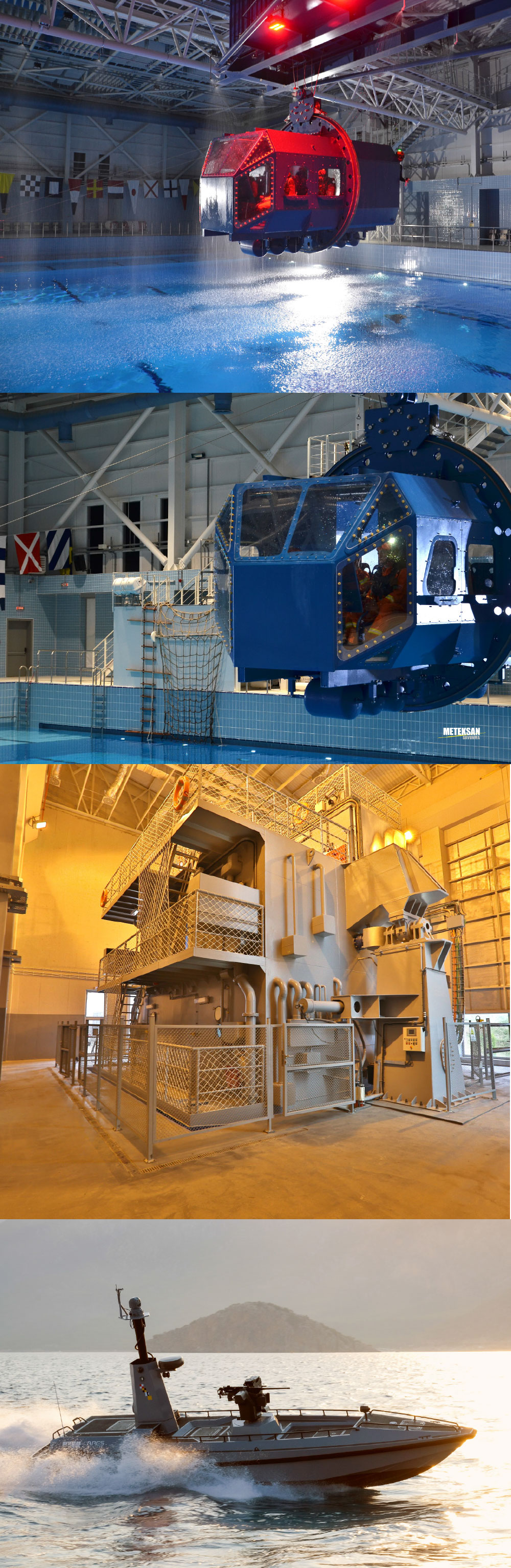
The Helicopter Underwater Egress Training (HUET) Facility is designed based on the international standards & OPITO criterion for the personnel who regularly travel by helicopter to provide/ensure the skills and knowledge of what to do in an emergency situation where there is a need to exit a ditched helicopter and survive at sea. For the purpose built, contemporary facility includes various distinct training capabilities to enable discrete trainings including Helicopter Underwater Escape Trainer, Portable SWET chairs for Shallow Water Egress Training (SWET), Simulated Search & Rescue Helicopter simulation to enable rescue activity, Simulated Landing on the water with Parachute.
Within the scope of HUET, the simulator system consists of crane(s), platforms, and ancillary systems. As a complementary component of this, there is the construction of a building consisting of a pool, pool installation and technical room, administrative and social spaces.
The pool has a wave generation and sprinkler system with adjustable intensity in order to reflect the environmental effects during the trainings, lighting that allows day/night separation, sound system, fans to simulate wind and helicopter blade effects.
The trainings are carried out by lowering the helicopter mock-up in a pool, rotating it up to 180 degrees in both directions in a controlled manner, and the personnel inside the helicopter exiting the helicopter in this state.
In addition, the following training programmes can be offered at HUET facility, either independently or in coordination with each other:
Rescue Helicopter: A simulation consisting of a platform simulating a helicopter performing a rescue operation equipped with a crane and rescue equipment to take the victim from the pool to the platform, where rescue training will be given.
Landing on the water with a parachute: A platform/system consisting of a tower and a rail system that simulates a parachute water landing, where parachute water landing and survival training will be provided.
A platform simulating the ship's deck: a platform consisting of a net ladder system, a closed liferaft and a throwing mechanism, where abandon ship trainings and casualty handling trainings will be given.
In line with the requirements of the Turkish Naval Forces Command, Helicopter Underwater Egress Training (HUET) Simulator Project, was completed and Delivered to the Turkish Naval Forces Command, according to the written statement made by Meteksan Defense on October 2, 2022.
MILSAR SAR/MTI Radar Enables UAV Platforms to Operate even Over-the-Cloud
As a long-endurance intelligence, surveillance, and reconnaissance system in the sky, Unmanned Aerial Vehicles (UAVs) will have an unblinded eye during adverse weather conditions where electro-optical sensors fall short. Having significantly small size, weight, and power consumption, even for the tactical UAVs, Meteksan Defense's MILSAR SAR/MTI Radar was on stage in IDEF ‘21.
MILSAR is a synthetic aperture (SAR) and moving target indicator (MTI) radar system. Radars having these two capabilities are indispensable sensors of ISR platforms as they could produce high-resolution imagery of stationary targets and position, speed, and direction information of moving targets where EO sensors are ineffective in adverse weathers. MTI feature comes up when the movements of vehicles on the ground, navigating warships' positions and routes at sea, or enemy aircraft flying in the air are important to be monitored.
One of the top features of MILSAR is easy integration and installation to a wide spectrum of UAVs from tactical level (such as Bayraktar TB2 and ANKA of Turkish Armed Forces) to strategic level (such as AKINCI and AKSUNGUR). Thanks to its cutting-edge technologies, and innovative architectural advantages, MILSAR has competitive SWaP characteristics. MILSAR, which is qualified on a MALE-class UAV in 2021, with its weight of less than 30kg, high-resolution imaging capability from stand-off ranges, and easy-to-integrate feature has become operational on AKSUNGUR UAV of the Turkish Naval Forces in June 2022.
Meteksan Defense Strengthens Submarine Platforms with Sonar Systems It Developed
Meteksan Defense also which was selected by the Defense Industry Agency (SSB) as "Turkey's Underwater Center of Excellence," transfers its know-how and skills in ship sonars to submarines.
Systems developed by Meteksan Defense for submarine platforms include hydrophones, side-scan sonar arrays, intercept passive sonar, intercept detection and ranging sonar, digital underwater acoustic modem, hardware and software for sonar systems pre-electronics, signal processing and beamforming, sonar operator interface software. While these domestically and nationally developed systems are being used for the modernization activities of existing submarines in the Turkish Naval Forces inventory, they are also of great importance for Turkey's MİLDEN National Submarine Project, where national design activities are ongoing.
MSH-01 Hydrophone, which is completely developed by Meteksan Defense with its own resources, is being used as sensors of passive sonar cylindrical hydrophone array (CHA), passive ranging sonar hydrophone array groups, wet-end side own noise analyses (ONA) systems, and cavitation indication (CI) systems of AY/PREVEZE class submarine ships. MSH-01 can be used in the said sonar systems of Type 209 Mod 1000 to Type 209 Mod 1400 class submarines, which are in service both in the Turkish Navy and worldwide Navies. Meteksan Defense also produces sensors, which are mounted along starboard and port sides of the submarine hull and form the wet-end side of the flank array sonar. The MSH-11 sensor is also intended to be used in flank array sonar systems of Type 209 Mod 1400 class submarines, which are in service both in the Turkish Navy and worldwide Navies.
Being Contractor of the Sonar Sub Systems of TÜBİTAK BİLGEM in the MUREN PREVEZE Indigenous Integrated Underwater Combat Management System Development Project, Meteksan Defence is assigned as responsible for the development of pre-electronic equipment that amplifies and converts the analog signals coming from sensors to digital, as well as the signal processing and beamforming hardware and software of these digital signals. In addition, the sonar developed by Meteksan within the scope of the Intercept Detection and Ranging Sonar (IDRS) Project will be integrated into our PREVEZE Class submarines within the scope of the Project.
ULAQ Unmanned Surface Vehicle
ULAQ is the name of the Unmanned Surface Vehicle (USV) product family developed by the Meteksan Defense and ARES Shipyard, which includes different platform types, capabilities and functions such as Port Security Vessel, Anti-Submarine Warfare Vessel, Anti-Surface Warfare Vessel, Mine Countermeasures Vessel, Electronic Warfare Vessel and Search&Rescue Vessel. ULAQ is eliminating human factors either by its remote control capability or by its sophisticated software to execute predetermined autonomous missions and COLREGS.
The armed version of ULAQ, that has been built from advanced composites, has up to 450nm range and 70kts speed, day & night vision capabilities, secure communication infrastructure and can include guided missile systems or machine guns. System has a unique telescopic mast to utilize the E/O System for 360° enhanced day & night vision capability as well as increased target acquisition and designation range for laser guidance. With its modular structure. ULAQ can also be equipped with different payloads, such as electronic warfare, jamming, and various communication and intelligence systems, to meet other operational requirements. Aside from being a remotely-controlled unmanned surface vehicle, the UCSVs will also feature superior and high-tech advanced capabilities such as artificial intelligence (AI), swarming technology, reconnaissance & surveillance, data link, network-centric communication, and data sharing capability. It will be able to serve as an element of Combat Management Systems (CMS). Following the prototype development, which is the first phase of a broader project initiated by ARES Shipyard and Meteksan Defense in the field of unmanned surface vehicles (USV), different UCSV versions for intelligence gathering, mine hunting, Anti-Submarine Warfare (ASW), Anti-Surface Warfare (ASuW), firefighting, Electronic Warfare (EW) and humanitarian aid/evacuation missions will also be ready for production thanks to its open architecture and scalable structure.
PELIKAN RF Missile Seeker Simulator
PELIKAN RF Missile Seeker Simulator is a Naval Electronic Warfare (EW) test and evaluation asset designed to evaluate Onboard Electronic Defense and Electronic Attack Systems’ effectiveness. PELIKAN can be used for evaluating the effectiveness of a ship's electronic warfare techniques (ESM, ECM, RF Chaffs/ decoys, etc.), simulation for Radar ECM development and evaluation, radar ECM testing & verification and electronic warfare equipment testing and evaluation. Once the emulated attack commences, real-time information is available regarding the emulated missile’s behavior so that live evaluation of the effectiveness of the countermeasures employed by the target ship can be assessed. In addition, PELIKAN records all relevant data to enable a further analysis to be undertaken once the simulation phase of the trial is complete.
PELIKAN provides ship personnel to be trained in the use of EW equipment and in the development of avoidance and distraction tactics against simulated threats. PELIKAN can accurately emulate the behavior of a specific anti-ship missile’s RF seeker so that the system appears to be a real example of the missile in question from the target’s (ship’s) perspective. In addition, PELIKAN also reacts to electronic warfare counter measures that are carried out by the target ship. The system can be configurable so it can be programmed to emulate a wide variety of anti-ship missile’s RF seekers across a range of guidance techniques. PELIKAN can simulate a number of different missile types by varying parameters such as frequency, pulse width, pulse repetition frequency, gate size, pulse modulation, polarization, and detection criteria.
KAPAN Counter Drone System Provides Complete Protection Against Mini/Micro UAV Threats
KAPAN Counter Drone System, developed by Meteksan Defense, was exhibited first time at IDEF ‘21 with its new subsystems and command control software. Radar Systems stands out as the most effective solution for detecting drones that have become an up-to-date and asymmetric threat in the critical facility and border security applications. Moving from this point, Meteksan Defense developed the KAPAN Counter Drone System using its own resources and launched it in 2018.
The Retinar FAR-AD Drone Detection Radar, which is included in the KAPAN Counter Drone System, results from the detailed studies of Meteksan Defense and the challenging field tests performed with the user. This version of Retinar has a new antenna customized for precise detection of mini/micro-UAVs, high-performance hardware, and special algorithms supported by artificial intelligence technologies. Thanks to its new structure, Retinar FAR-AD, which can detect air targets from a longer range and scan a wider area at a glance, makes KAPAN a more advanced counter-drone system. Apart from the Retinar FAR-AD Drone Detection Radar, the camera system for the classification and tracking of the drones detected and the jammer system for the neutralization of the drones are also included in KAPAN.
Besides all these subsystems, KAPAN Counter Drone System was also exhibited with the newly developed Command Control Software for the first time at IDEF ‘21. KAPAN Command Control Software, which collects information from all sensors and produces a common aerial picture, is shown as one of the most innovative command control software developed in the world with its artificial intelligence-supported algorithms, 3-dimensional interface, open, scalable, and modular architecture.
Retinar PTR Ground Surveillance Radar
Retinar PTR is a ground surveillance radar, designed for border and zone security. Retinar PTR has advance technological features such as human/animal detection and target classification, low size, low weight, low power consumption, mobility and rapid deployment. The system is designed to be carried by two personnel and easily operated by single personnel thanks to its user-friendly interface. Retinar PTR automatically scans large areas, eliminating the need for security personnel to constantly scan with cameras or binoculars, can be integrated with camera systems and various other sensors, and creates “Safe Zones” in the area.
Retinar PTR can detect humans and animals up to 4km, vehicles up to 8-10km depending on the size of the targets to enable perimeter security. Because of its high-frequency emission rates, it can detect very low-speed moving objects such as crawling or creeping humans. Retinar PTR is currently used by the Turkish Armed Forces, Gendarmerie General Command and friendly countries