HMS ALBION’S VISIT TO İZMİR
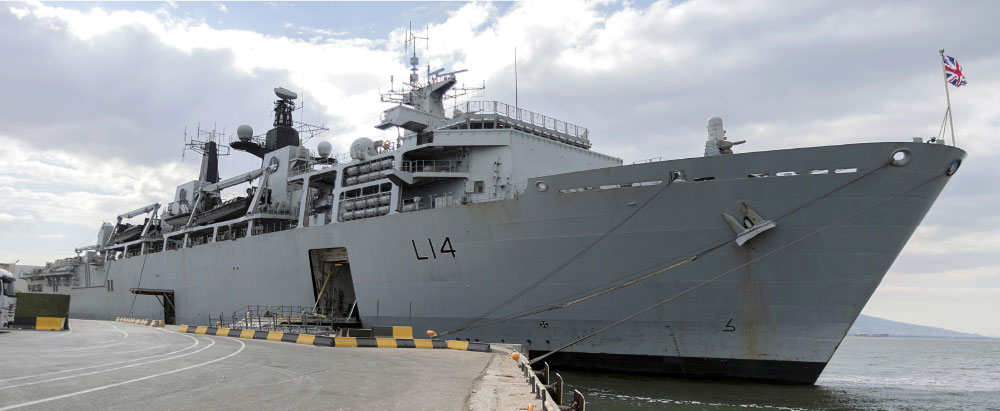
In mid October the landing platform dock type amphibious warship of the Royal Navy, HMS Albion arrived in Izmir for a 3 day port visit. During this visit members of the Turkish defense media were given a tour on board. I had the privilege to take part in this special tour.
HMS Albion is the UK’s high readiness assault ship providing an afloat command platform for the Royal Navy’s Commander Amphibious Force. Her deployment is part of Operation Achillean.
Operation Achillean is a large-scale operation which sees among HMS Albion, HMS Defender, RFA Argus and RFA Mounts Bay deployed to the Mediterranean. Merlin and Wildcat helicopters, Puma UAVs and personnel from 815, 845 847 and 700X naval air squadrons, 42 and 45 Commando Marines, 29 Commando Royal Artillery and 17 Port and Maritime Regiment of the Royal Logistic Corps are also deployed on board.
The aim of this operation is to train and operate alongside NATO allies and regional partners in a wide region that is vital to European security. With this deployment the Royal Navy is continuing to develop the Littoral Strike concept, ready to respond to any crisis through combat operations to humanitarian aid and disaster relief.
HMS Albion and her sister HMS Bulwark are the afloat command platform for the Royal Navy’s Amphibious Task Force and Landing Force Commanders. Usually, one ship is active while the other receives upgrades or is placed in extended readiness.
HMS Albion is 176 meters long and 28,9 meters wide. At 19,560 tons fully loaded she can transport 600 troops, 31 large trucks and 36 smaller vehicles as well as up to 6 main battle tanks such as Challenger 2. The ship has a large flight deck that allows up to two CH-47 Chinook or Merlin HM Mk 2 / Merlin iHC Mk3/HC Mk4 type helicopters to operate simultaneously. Merlin iHC Mk3/HC Mk4 is a troop carrier version with dipping sonar of the Merlin helicopters in the Royal Navy service and it has a rear ramp for faster entrance and exit, a feature that does not exist in the ASW version. Since there is no hangar on board, HMS Albion cannot maintain or repair helicopters or accommodate any helicopters for deployment. Her flight deck is used for loading and unloading, and can only accommodate organic aircraft for short durations.
Another important feature of the ship is her well dock that covers almost the half of the ship and is large enough to hold 4 Mk 10 class LCUs at the same time. These 29.8-meter long and 7.4-meter wide landing craft have interlocking bow and stern ramps. This allows an easy loading, unloading and if necessary, redistribution of vehicles and other equipment among the garage deck and the LCUs inside the comfort of the well dock. Furthermore, there 4 Mk5 B class smaller landing craft on davits outside of the ship. The MK5’s are primarily used to carry marines to land.
The ship, launched in March 2001, has been described as the Royal Navy’s ‘Swiss Army knife’ – and for good reason. This amphibious transport dock is capable of carrying 400 sailors and Royal Marines with a huge range of skills and experience, from technicians and engineers to medics and chefs.
For self defense the ship is equipped with two Mk 15 Phalanx Block 1B CIWS, four MK44 7.62mm miniguns and four 12.7mm machine guns. For passive defense there are eight 6 barrelled decoy launchers and additionally there is a Type 2170 torpedo counter measure made by Ultra. This system is similar to Sea Sentor used in some Ada class corvettes and Bayraktar class tank landing ships.
HMS Albion and her sister ship HMS Bulwark, are the Royal Navy's first Integrated Full Electric Propulsion ships. She is powered by two Wärtsilä Vasa 16V 32E diesel generators creating 12.5 MW of power and 2 Wärtsilä Vasa 4R 32LNE diesel generators. The ship has two motors for propulsion and one bow thruster for position keeping. The maximum speed is 18 knots. She has a range of 8,000 nautical miles at 15 knots.
The ship can provide ample space for the combined operations rooms, command planning areas equipped with an enhanced command and control communications suite to facilitate the complex communications required to deliver the Marines, their vehicles and other stuff from on board to the shore. She is equipped with a large array of different types of antennas including several for satellite communication. Both HMS Albion and her sister HMS Bulwark received the BOWMAN communication suite during their upgrades. The BOWMAN suite enables secure and reliable communication between the units taking part in the amphibious operation. When there are helicopters in the air, landing boats on the sea all moving from the ship to the shore it is vital to keep clear situational awareness and a clear picture of the things happening and dependable communication is the key.
In 2017 HMS Albion went through an overhaul period. Her incumbent Type 996 radar was replaced with the Type 997, already used on board Type 23 class frigates. This 3D radar operates in E/F bands and has a range of up to 200 kilometers. During the same refit her Goalkeeper close in weapon system was replaced by Phalanx Block 1B CIWS.
Under current plans HMS Albion will stay in the service of the Royal Navy until 2033 and her sister HMS Bulwark until 2034. The Littoral Response Group North, which HMS Albion leads, is the UK’s primary amphibious support to the Northern Flank of NATO. For the last 20 years the focus of operation for the Royal Marines were land operations in Iraq and Afghanistan, where they augmented the British Army and fought a land war. The increasing Russian assertiveness over the years, that culminated in to the Russian invasion of Ukraine caused a paradigm change. With Finland and Sweden joining NATO in the near future and the UK’s long-standing obligation to support Norway, the amphibious operations in the high north and in the Baltic has gained importance again