Meteksan’s Naval Training Solutions: DCSIM & NAWAS
Meteksan, a subsidiary of Bilkent Holding, is one of the biggest holdings in Turkey, and owned by Bilkent University. The company employs more than 150 personnel who are dedicated to invest in technology development to provide effective solutions in the following areas:
Simulation Systems
Sensor Systems
Communication Systems
Underwater Acoustic Systems
By the time, Meteksan became one of the well known companies in Turkish Defence Industry, focused on producing unique solutions for target customer profiles mainly for Navy and in terms of simulation solutions. Capabilities gained from the projects developed for Navy, extended to the Simulation Software and the Platform Simulators areas aiming to produce turnkey solutions based on R&D investments, focused and multi-component engineering works.
Simulators are becoming a major component of daily military training process. The combination of simulation capabilities and exercise is not only cost effective but also life saver. In this context, Meteksan’s Simulation System Group (SSG) produces national and international engineering solutions on simulation systems. Simulation is the main interest area of the group, and is one of the key working areas of Meteksan starting from the foundation of the company.
Simulation Software (SS) and Platform Simulators (PS) are the two divisions of Simulations Systems Group;
Simulation Software area focuses on different types of software applications on mainly constructive and virtual simulation solutions including strategic, operational and tactical level war games.
Platform Simulators area is focused on different types of hardware components such as electronics, mechanical and constructions together with integration activities on these areas.
Based on these facts Meteksan focused on two realistic training products: Damage Control Simulator (DCSIM) and Naval War Game Simulator (NAWAS).
Damage Control Simulator (DCSIM)
As we all may appreciate, working conditions at sea are inherently dangerous. The means of eliminating all risks of sea are limited; however, the actions of a well-trained crew can lead to survival in an emergency at sea. Preparation as well as knowledge is vital for survival.
Naval Damage Control (DC) capability is a particular point to preserve the integrity, stability and maneuverability of vessels as part of sea-readiness.
The main goal of damage control is to keep the ship floating, moving and fulfilling her mission. To achieve these goals, damage must be quickly confined and repaired. The key to enable these capacities is a realistic training environment for the crew to develop and conduct realistic damage control exercises.
Consistent and realistic training produces an optimal level of readiness that prepares members of repair party teams to react more efficiently and effectively to actual casualties.
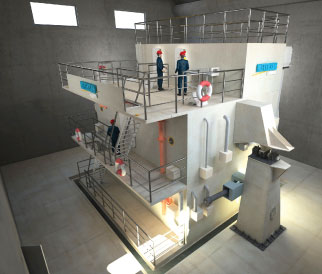
Meteksan’s DCSIM provides a realistic training environment to develop and conduct damage control exercises to provide the shipboard personnel as part of damage control readiness and the internationally recognized commercial and Naval standards. To build confidence in damage control parties, DCSIM simulates actual casualties as realistically possible.
DCSIM provides the trainers the means to train Naval personnel in control, fighting and repair of real shipboard damages in a controlled environment. This capability will result in an increased knowledge of specific damage control tactics and procedures that allows personnel to complete required tasks in a more expeditious manner.
This is accomplished through the following training features:
Train the crew in their real environment (smoke, flooding, rolling etc.) for damage control
Plan, execute and evaluate different scenarios under different conditions
Improve crew’s damage control, communication and reporting abilities through live trainings
Measure and decrease their response time under heavy (smoke, flooding, rolling etc.) conditions
Evaluate their individual and team performances by different live training scenarios
Evaluate the ability to set and maintain material condition ZEBRA
Develop the ability to brief, execute, debrief, and critique damage control exercises
Observe, record and replay trainings through CCTV system
Overview their previous performances to plan their next training period and to compare the results
DCSIM for Turkish Naval Forces Command is placed in Gölcük, Turkey as part of the Surface Training Centre of the Fleet. The project also includes fire fighting training simulator for basic trainings, submarine fires, advanced level ship trainer and crash on deck helicopter fire simulator.
Another contract was signed with Sultanate of Oman Ministry of Defence for DCSIM to provide a state-of-art capability for Royal Navy of Oman.
Naval Wargame Simulation System (NAWAS)
NAWAS (Naval Wargame Simulation System) is an interactive, realistic, multi-user, multi-resolution constructive simulation system that models a Naval wargame at sea, air and land warfare environments. Main goals of the NAWAS are to establish realistic and cost-effective training to provide an environment for assessing plans and to increase mission effectiveness/readiness of personnel.
NAWAS has a generic infrastructure so that user can add new types of platforms, sensors or weapons to the system while executing the wargame. It is also possible to update the parameters of the existing platforms, sensors or weapons. New maps, environmental conditions or inventory data can be added using the tools provided by the system.
NAWAS supports all types of Naval warfare such as Surface Warfare, Submarine and Anti-Submarine Warfare, Air Support for Maritime Operations, Anti-Air Warfare, Mine Warfare, Electronic Warfare, Logistics Operations, Amphibious Operations and CBRN Warfare.
Key features of NAWAS are as follows:
It has scalable, extensible and plugin-based system architecture.
It has an xml based generic infrastructure so that new types of models and behaviors can be added to the system easily.
It is compliant with HLA standard IEEE 1516. Interoperability with other simulation systems can be done using HLA interface.
Tactical symbols are displayed using international standards NTDS and APP-6A in addition to a custom tactical symbology.
Users, platforms and other models can be added, removed or modified during run-time.
It includes a flexible, integrated geographical information system.
It has some autonomous behaviors such as auto navigation, auto replenishment and auto counter measure functionalities.
It has a remote access capability so that users can access to the system remotely.
It has textual, audio and video communications capability.
It includes worldwide map, atmospheric, oceanographic and other environmental conditions data
It has multi language support, help manuals and catalog information.
Tools and functions of NAWAS are as follows:
Planning: Scenario Editor, Map and Environmental Conditions Editor, Inventory Editor
Execution: Game Control, Order of Battle Management, Platform Management, Record and Replay, Error/Information Messages, Multi-Level Tactical Picture Compilation, Intelligence Management, Online User Management
After Action Review: Online/Offline Debriefing, Analysis and Reporting
NAWAS has been successfully used by the Turkish Naval Forces Command in Gölcük, Turkey.
Meteksan will present Damage Control Simulator and Naval Wargame Simulation System to the visitors in IDEX 2013, Abu Dhabi at Turkish Pavilion / Stand No: 10-A09.