``MILGEM was actually a torch, a burning torch, we took that torch and carried it to another place!``
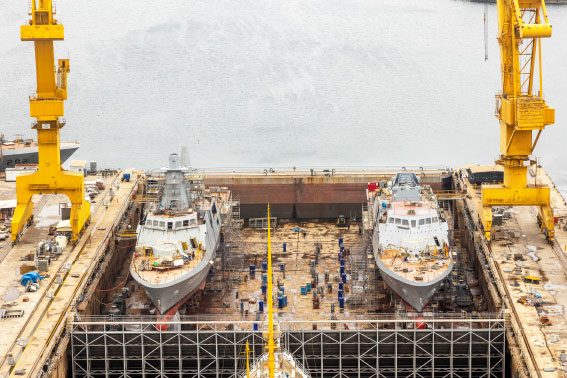
With its ship docking capacity consists of 77 different cranes with a lifting capacity of up to 450 tons and 2 Floating Docks, 1 Dry Dock with a length of 300 m and a width of 38 m and a Semi-Wet Dock with a length of 200 m and a width of 38 m, Istanbul Shipyard Command, established on a total area of 1 million m2, of which 140,000 m2 is a closed area, and has 32 separate factories/workshops within its campus, is responsible for the maintenance and maintenance of 168 ships and marine vessels and over 1000 systems on them, as well as the construction of new surface warfare ships in the inventory of the Turkish Naval Forces Command. Ministry of National Defense Istanbul Shipyard Command has two main job functions: building military ships and ensuring the maintenance and maintenance of those ships, regardless of their age. Istanbul Shipyard Command has the opportunity and ability to manufacture fixed wing angle propellers (casting and processing) for ships up to 3.5 tons and 3m diameter.
TCG Istanbul Frigate (F-515), the first ship of the MİLGEM İSTİF Class Frigate Project, designed by the Istanbul Shipyard Command operating within the General Directorate of Shipyards (TGM) of the Ministry of National Defense (MSB) and the Turkish Naval Forces Design Project Office (DPO) Directorate with local and national resources, was built with 80% local construction and delivered to the Turkish Naval Forces on January 19, 2024.
While the Ministry of National Defense Istanbul Shipyard Command is currently carrying out the TF-2000 Air Defense Warfare (HSH) Destroyer and National Aircraft Carrier Projects with the facilities and capabilities of the Naval Forces Command Design Project Office (DPO) Directorate, on the other hand, MSB Military Factory and Shipyard Enterprises Inc. (ASFAT) is assigned for ship building activities under HISAR Class Open Sea Post Ships (ADKG), of which it is the Main Contractor, as well as PAKISTAN Naval Forces MİLGEM (PN MİLGEM) Project, which is implemented under the main contractorship of ASFAT and is Turkey's largest single-item warship export.
The TF-2000 HSH Destroyer, which is planned to have an overall length of 149m, a width of 21.3m, a draft of 5.75m and a displacement of 8,300 tons, will be equipped with a Main Propulsion System in the CODOG configuration consisting of 2 LM 2500 Gas Turbines and 2 Diesel Engines. The Preliminary Design of the TF-2000 HSH Destroyer, which can perform unrestricted missions in Sea State-5 and reach a speed of 26 knots, has been completed. Due to the changes made in the design, remodel experiments are planned to be carried out together with ITU in the summer months this year. The National Aircraft Carrier, planned to have an overall length of 285m, a width of 72m, a draft of 10.1m and a displacement of 60,000 tons, will be equipped with a COGAG type Main Propulsion system consisting of 4 LM 2500 Series Gas Turbines. Our National Aircraft Carrier, which will have a STOBAR (Short Take-Off but Arrested Recovery) aircraft take-off/landing system, will be able to reach an unrestricted speed of 25 knots and have a cruising range of 10,000 nautical miles without refueling.
During our visit to the Istanbul Shipyard Command on April 22, 2024, we witnessed the successful completion of the integration of the 76/62 mm National Naval Gun, developed in cooperation with MKE and the Istanbul Shipyard Command, was added to AKHİSAR (P-1220), which was built within the scope of the ADKG Project and whose equipment activities were continuing at the dock at that time, on April 17, 2024. PNS BABUR (280) Corvette, which is the first ship of the PAKISTAN MILGEM Project and whose delivery ceremony was held on September 23, 2023, was continuing its training activities in the stern-to-shore position at the same pier on the starboard side of TCG İSTANBUL (F-515) in the dock area. PNS BABUR (280) successfully completed surface and air defense fires and land bombardment activities with the 76/62 mm Super Rapid bow gun during the week of April 15, 2024, and in addition to accurate surface and land bombardment, it also shot down the air target with the first shot.
KOÇHİSAR (P-1221), the second ship of the ADKG Project, whose construction and equipment activities are continuing in the Dry Dock (Stone Dock), and KHAIBAR (282), the second ship built at the Istanbul Shipyard Command under the PN MİLGEM Project, are planned to be launched soon.
As one of the firsts of the ADKG Project, the ships are being built with the "Fitted but not with" design concept, which will allow the subsequent integration of newly developed national weapon and sensor systems. AKHİSAR, whose equipment, integration and testing activities continue intensively, will be transferred to the Naval Forces Command in November 2024 and KOÇHİSAR in February 2025; KHAIBAR, which was launched on 25 November 2022, is planned to be delivered to the Pakistan Navy in May 2025.
Working with more than 300 companies within the scope of PN MİLGEM and ADKG Projects, Military Factory and Shipyard Management Inc. (ASFAT) invested approximately €15 Million in the Ministry of National Defence Istanbul Shipyard Command and it supported the establishment of a shipyard structure that can build 5 ships at the same time at different stages, including the İSTİF Class Frigate (TCG ISTANBUL), for the first time in Turkey.
We visited the ASFAT Office, located within the Istanbul Shipyard Command campus and also hosting the PAKISTAN MİLGEM Project Office, and had a special meeting with ASFAT Naval Programs Director Serdar Ümit TEZEREN to get first-hand information about ASFAT's ongoing naval programs. We had an interview.
Defence Turkey: Can we start our interview by getting information about ASFAT Istanbul Shipyard Command (ITK) Office and Naval Programs Directorate? How many personnel are working and how many projects are being carried out?
Serdar Ümit TEZEREN: The corvette and larger type ship construction projects that ASFAT has built within the scope of PN MİLGEM and ADKG projects, as well as the supply projects for the smaller type needs of institutions such as the Gendarmerie General Command, the General Directorate of Security, the Ministry of Transport and Infrastructure, BOTAŞ, are carried out by our Naval Programs Directorate under my responsibility. In addition to the relatively larger PN MILGEM and ADKG Projects, we have 2 Floating Dock projects that we have delivered and patrol boat projects that we have delivered in high numbers. There are 5 directorates within our directorate, where Design, Combat Systems, Planning and Configuration Management, Technical and Project Management functions are managed, and a total of 119 personnel work. The majority of our personnel work in the ASFAT ITK Campus, where we are located, our Design Directorate works in the Istanbul Technopark Campus, and a small number of our personnel work in our Head Office building in Ankara.
Defence Turkey: How many are engineers?
Serdar Ümit TEZEREN: Most of them are engineers. We have technician friends, and young engineer friends who have just graduated from universities within the scope of the specialist training program. Some of our team spends all their time on ships as part of construction, equipment, integration and testing activities. In terms of our duties, we have technician/technician level personnel in Shipbuilding, Electrical, Electronics, Mechanical, Industrial engineering and different fields. Additionally, a team of 15 people is constantly on duty in Karachi to monitor our ships under construction. We also go back and forth frequently.
Defence Turkey: Exactly what activities is your team involved in?
Serdar Ümit TEZEREN:We do not see ourselves as just a project management company and say, "I bought the material, I delivered it, the shipyard will do it." During your visit, you will see the friends on the field wearing overalls. So most of these 119 people are on the field. Therefore, these friends are actually in production, they are under control of production. In fact, we seem to be running a normal shipyard operation. Why so? Because there is a goal. This is partly due to needs. Speaking specifically about the PN MİLGEM Project, it is a special project and must be completed within a time constraint because it is an important export project. We see it as the prestige not only of us, but of our entire defense industry, and even of our country, and we feel the responsibility of it at all times. The ADKG Project started with an ambitious schedule, as it was an urgent need for our Naval Forces. Projects that need to be done with unusually high speed and precision. When you look at the current cyclical situation in the countries of the region, the Eastern Mediterranean and the Black Sea specifically, you can see the urgency of the need more clearly. A part of our team consists of experienced people who have worked in the Turkish Armed Forces and a larger part in the private sector for many years. Although we are a 6-year-old company, the average experience is over 15 years under our directorship.
Defence Turkey: This situation must have its advantages as well as difficulties?
Serdar Ümit TEZEREN: Of course, this has advantages and disadvantages. Because everyone gained that 15-20 years of experience in different places. The team is working together for the first time. The majority of the team consists of friends I met here for the first time. Therefore, the adaptation and integration of these personnel is not an easy task. Therefore, since you need to both control the field and speed up production, you need to work with a busy staff and penetrate every area.
Defence Turkey: Can we get information about the scope of the current cooperation between ASFAT, a joint stock company within the Ministry of National Defense, and the Istanbul Shipyard Command? What kind of work have you carried out and/or are currently carrying out in terms of improving both personnel and technological infrastructure for shipyards? For example, do you use the Shipyard's workers as well as its infrastructure in the PN MİLGEM Project? What kind of cooperation, what kind of process does it work?
Serdar Ümit TEZEREN: Normally, ASFAT is a subsidiary of the Ministry of National Defense, a Joint Stock Company. Our Chairman of the Board of Directors, Deputy Minister of National Defense. We work under the same organizational structure as the General Directorate of Shipyards. Therefore, there is actually a complicated relationship. The aim is to use state resources and the capabilities of military shipyards to build the projects we have undertaken. While doing this, of course, it is necessary to modernize the infrastructure that has been operating for many years and whose technology has become obsolete or has reached the end of its lifespan over time. How will you do this? Either resources will be allocated from the national budget and invested here, or as we did. In other words, you will take a project, while carrying out this project, you will realize the project by using both the technical and personnel infrastructure of the shipyards, and in return, you will allocate an amount for investment to modernize the shipyard infrastructure, and then you will use the shipyard capabilities.
As a joint stock company, of course, we should not forget that commercial concerns are something we always keep in mind. We have a very strict budget management. Every purchase goes through serious approval processes, we constantly look at cash flows, we constantly monitor what is being done, what is being carried out, and make future projections. We have very detailed planning and forward-looking forecasting methods we use. Therefore, if necessary within the scope of the shipyard's workload, if there is a resource we can find from outside, we support the production here by using it to the maximum extent, thus trying to speed up the time. If you ask how much has been invested so far, I can say that approximately €15 Million have been invested.
But when we look at the process on this issue, the aim here is to improve production and production method. While we continue our projects, we also constantly evaluate processes such as whether we need to do this or whether there is a method by which you can analyze and correct the system at hand, increase production, thus increasing capacity, or turn it into money by shortening the production time, and share it with the shipyard command.
Defence Turkey: So, for this, you must have learned the operation of the Shipyard or a comprehensive presentation must have been made to you about the Shipyard's capacity, its technical infrastructure and how much infrastructure and personnel can be allocated for your projects each year?
Serdar Ümit TEZEREN: Definitely. This was actually a very difficult task to achieve. However, we were supported by the fact that we had personnel who had worked at this shipyard before and knew the internal processes very well. More importantly, our Shipyard Commander, the planning of the shipyard, the military personnel working in the shipyard and the civilian friends working in the workshops perceived this event, understood what was done here, assimilated the target well and had an open mind, which contributed to this success. The aim here is to maximize the shipyard personnel and to get the job done and completed by outsourcing the necessary workforce in a way that will not be a burden on the state. Now this is a modular structure. We call this 'Hybrid Working Method'. Because time and budget are very limited, we have long and deep discussions on every subject. Look, you can see this board in many rooms. This is the Director's Office. We do, we discuss, we brainstorm here. This room is usually crowded, everyone comes and gives their opinion, we write it down here and take a look. I make my decision based on the experience of my staff.
Defence Turkey: How was 2023 as Programs Director? What milestones have you completed in 2023?
Serdar Ümit TEZEREN: I was working as the Combat Systems Manager in the initial phase of both projects. When PN MİLGEM started in 2019, we knew that our job would be difficult. When we put the calendar in front of us with the ADKG Project that started at the end of 2020, we evaluated that 2022 would be difficult and 2023 would be an even more difficult road.
In 2022, Istanbul Shipyard Command would be a shipyard that, for the first time in its history, and even for the first time in Turkey, would build 5 ships at the same time, including the STIF Class, at different stages. I am talking about 5 ships that continue at different levels, one in block construction, the other in equipment in the pool, the other in testing in the port, and the other one is cruising at the same time within the scope of navigation experiences. We have been able to come this far thanks to the open-mindedness of the shipyard management and staff. 2023 was indeed a difficult year, but there were goals both here and in Karachi. We achieved these goals!
Defence Turkey: You just mentioned that you are faced with a very tight budget and schedule. After both COVID and the Russia-Ukraine War, price stability in the market was disrupted and serious extensions in the delivery schedules of orders came to the fore. How did you overcome this?
Serdar Ümit TEZEREN: Well, we have a Risk Management System. This is not actually a mechanical system, it is something that is settled in the mind. There are some issues we consider when doing a job. For example, we already predicted that an incident in Pakistan was coming. We are watching what is happening. We have different organizations and experienced personnel in our company who support us in this regard. Our Business Development Directorate, our Strategy Directorate, our Country Manager in Pakistan, our Project Coordinator in Karachi, and the experts of our Procurement Directorate handle such issues carefully. We provide constant information flow. What impact can these have on our projects? Regarding procurement, for example, we made such a move that we looked at the available budget and examined what we needed to purchase. We challenged everyone we could direct to common interests. With proper planning, we have eliminated most of the problems arising from the situations you mentioned. Although not openly stated, we were also affected by the implicit embargoes implemented. We solved it with the efforts of both our Ministry of Foreign Affairs and our stakeholders such as STM. In this way, we were able to solve the problems we experienced in the supply of the Main Propulsion System (ATS) with adaptive planning and continuous evaluations.
Warships are complex platforms that include many different systems. Therefore, multiple disciplines need to work in harmony. Shipbuilding is not an optimization problem, it is necessary to understand it first. You need to meet on a common ground somehow. So if you optimize something, it doesn't work. You need to be able to keep all systems in optimum condition. For example, I am actually a Combat Systems expert from the Navy. If I say that the combat systems should be very good and focus on optimizing this part, I may miss other issues. Therefore, we proceed with this perspective. As for the ADKG Project, a selection method for ATS was used there. With the determined criteria, 4 alternatives were evaluated both scientifically and commercially and the machine configuration was decided accordingly.
Defence Turkey: While designing, the place where the Main Propulsion System (ATS) would fit was planned accordingly, right?
Serdar Ümit TEZEREN: Of course. The design process is a spiral process. We included alternatives in our concept design process. Afterwards, we carried out intensive studies, long discussions and meetings. We advanced the design with the decisions taken during the process and the data we received. At PN MİLGEM, since the system was clear from the very beginning, this process went faster and we had more accurate data. However, the unknowns and calendar congestion at ADKG made our job more difficult. We had to do this to get this long at ADKG. We came from the first sheet metal cutting to the launching phase in 17 months, and we didn't just come with steel. If you go inside the ship, you will see that almost 80% of the equipment is in place. So far, more than 40 electrical panels have been tested in such a short time. Because the electrical cables were connected and their labels were in place. As I say, we are planning the next step, we do our work accordingly.
Since we work this way, it is clear to us when the main machine should arrive, so there is an interval. It is clear to us when the gearbox should arrive. There are positive and negative periods that we can play with, but after a while, it causes changes that affect all other processes, are difficult to reverse, and make the calendar difficult. Therefore, we started the ADKG Project by changing our production method and saying that we would place everything in the design from the front and finish it from the front. I think there were more than 60 meetings just for the settlements. Settlement planning was done one by one, region by region, and when we started producing blocks, we started producing 'foundations'. When we turned the block upside down and took it out and brought it to the intermediate station, we equipped them at that intermediate station to finish the hot process before painting and to finish the curtain transitions. Then we took the block like this and put it into paint. We took the equipment inside before removing it from the paint and taking the sled. To put it in more detail, we took the vibration and shock absorbers in with their locations known, their holes drilled, and even placed on top. To prevent damage to the equipment, it was wrapped in cloth and a box was placed over it. Many of our blogs started this way. Therefore, it was clear to us when the machine should arrive. Therefore, this was also determined as a parameter. To put it bluntly, none of this could have been achieved if we had decided to buy all parts from the same company during our initial planning. The maturity of production came from good and detailed planning.
Additionally, the blocks were made in threes to save time. This is also important. We transferred all our experiences to this project. In subsequent projects, we want to do this even more. For example, a group could be made. Actually, we were going to clear the area in front of the intermediate station and build more blocks, triple blocks, and six blocks there. There would be six blocks and complete spaces with six on top, so we would build them one by one and, for example, we would lift the ship into its place in 4 pieces. That was actually our thought. We were able to make one triple block that way. We had to remove the rest in doubles and singles. As a result, we removed the triple block in front of our President, equipped with equipment, painted, cable routes in place, and certain parts isolated, and put it on the sled as a mega block equipped for the first time. That ceremony was like that. We can speed it up even more. We can make production even more efficient. Our infrastructure is suitable for this, our design experience is suitable for this, our production experience is suitable for this.
Perhaps one of the biggest successes of the ADKG Project was that we completed all purchasing contracts in 3 - 3.5 months. So the project started, when the advance was received, there was an hourglass, we turned the hourglass and said that the deadline is this date, everything will be completed by this date, otherwise we will be delayed. This process, of course is a total process, a process that includes functions such as contracts, logistics, purchasing and supply. We work with 310 companies per ship. Think of the equipment and materials they provide, testing, delivery, storage, shipping to the ship… It is a complex process…
Defence Turkey: Are 310 companies for ADKG?
Serdar Ümit TEZEREN: There are 310 companies for PN MİLGEM, probably around the same for ADKG. So the average is always the same. It usually does not fall below 300. Especially in Combat Systems, although we group the subsystems appropriately and work with our foundation companies, our number of subcontractors is generally around this level.
Defence Turkey: So, do you also integrate the Main Drive System in ADKGs?
Serdar Ümit TEZEREN: Regarding the integration, we made the entire design together with MAN. We made some changes in the design, compared to the situation in ADA class corvettes, to avoid problems such as flow-related problems, areas requiring excessive welding, vibration-related problems, shaft sagging and propeller sagging. For example, the tube angles are different, we have 2 A-brackets at the back instead of I-brackets. There are different lessons learned and some conclusions that we have drawn from those lessons in our own analysis. We made changes accordingly. We made the modeling, we made all the propellers here at ITU. We brought a sample propeller. For example, there is no such propeller in Turkey right now.
Defence Turkey: Composite or metal?
Serdar Ümit TEZEREN: Metal material. We took this and used it at ITU. None of the other companies offer this. We stipulated these. We made a separate contract for it so that it does not bind the main contract. For the materials we specified in the machine, we said that we can buy them from Turkey, so we exclude them from the scope of MAN. Therefore, ADKG's machines arrived early, but if we had purchased every part of the machine from that company, it would not have arrived early.
Defence Turkey: Are other changes in the ADKG design on the agenda? It was mentioned that design work was done for 4 different versions.
Serdar Ümit TEZEREN: In fact, since there were parts of the ship that we wanted to change, we discussed alternatives with our Navy. We suggested using another shell instead of the MİLGEM shell. We decided not to change the outer shell, but we changed everything inside, including the bulkhead placement. Its weight, infrastructure and machine system were changed. So when I say system, I'm not talking about the brand. These ships have electric propulsion. Our argument there was this. We examined the malfunctions, especially machine malfunctions due to low power operation, and mutually agreed with the Navy according to the operational range of the ship. We have proposed electric motor advancements to fit into this range. Studies were carried out to determine whether all alternatives would fit into the form we have.
We took out all the machine systems, 4-man machine, electric drive, fuel consumption, working hours, and presented all the details, including maintenance times, operating costs, weight distributions, and the ethics of weight, and asked them to decide. We even analyzed spare parts prices.
Therefore, a truly detailed study was carried out. We then demonstrated that we could add air defense missiles to a ship the size of the ADA Class. We removed the Gas Turbine and opened the gap. We installed a system there. Now we say we can do much more than this. We can calculate and verify Radar Cross Section Area. You can also check in practice what you have done theoretically, we can make this ship much more heavily armed by making certain changes to the building and changing its location. In other words, we can load a frigate weapons load onto a corvette-sized ship. We can put 16 air defense missiles. One version even has 32 air defense missiles. Of course, it causes huge changes. It would even make us more comfortable if we changed the form, but that's okay. We say we will keep the bottom the same, but we change the top part.
Defence Turkey: Doesn't the ship grow longer?
Serdar Ümit TEZEREN: No, we do not extend it, we do it without changing the form.
Defence Turkey: Installing an air defense missile without increasing the size?
Serdar Ümit TEZEREN: Yes, we do. This is one of the design examples we offer. Pretty heavy weapons.
Defence Turkey: Has a change to the ATS been planned as its weight has increased?
Serdar Ümit TEZEREN: Speed is considered. Stability, load distribution and strength are very important. All, that is, all preliminary calculations, were required for each version. That's why I say we move with our feet on the ground.
Defence Turkey: So, can you offer these designs for the export market as well?
Serdar Ümit TEZEREN: Of course, we offer. For example, there is already the 3600 Series (AS 3600 Escort Frigate) coming out of there. It's a bigger series. A design tailored to the needs of other countries. It is a design that comes from a definition of need sent to us by a country. We said that we can make this ship like this and put the weapons they want. Of course, they want to use weapons of foreign origin. We recommend these weapons. In fact, our offer is cheaper with these weapons. Our offer is more expensive with those weapons. And we undertake to provide all kinds of logistical support regarding this. In other words, just like the support we sell to Karachi and Pakistan, we take responsibility directly for those systems, even for the systems provided by our local companies, by making special contracts ourselves. In other words, when they actually look at it, what they see is a company that, although it is a Joint Stock Company, has state connections and therefore can make contracts from state to state. This situation also gives them confidence. We say we can provide this directly to you. Of course, there is a gun family, but if the other side buys 6 or 8 such ships, the family suddenly changes, don't worry. What you give matters. Our aim is to somehow sell our national products abroad. Therefore, we have to target this place as well. Our resources are limited, so we need to play the game properly.
Defence Turkey: ADKGs are being built with a "fitted-for but not with" design concept, allowing the subsequent integration of newly developed national weapon and sensor systems. So, in the on-site ready approach, is the Combat Operations Center of the ships prepared for future growth? In other words, have a sufficient number of Operator Consoles and data link infrastructure been planned?
Serdar Ümit TEZEREN: It's all up to that. We have all the technical data regarding the systems. All needs such as consoles, cable routes, power and cooling are met assuming the systems are on the ship. There will be Link-11, Link-16 and Link-22 data link systems. It will be easier for us to evolve into corvettes, frigates and similar types of ships through this ship.
Defence Turkey: What would you like to say about your goals and expectations for 2024?
Serdar Ümit TEZEREN: 2024 is also a busy year for us. The activities we have planned for PN MİLGEM will continue. It is very critical and important for us to follow the PNS BABUR we delivered. We'll be following it closely. We have started the Port Acceptance Test (HAT) of AKHİSAR within the scope of ADKG, sea tests will start soon, and we aim to deliver it at the end of the year. Testing activities will continue in KOÇHİSAR. In parallel, our export-oriented business development activities and related preliminary design and proposal preparations continue intensively.
Defence Turkey: Can we get information about the latest situation in the Pakistan Navy MİLGEM Corvette Project (PN MİLGEM) which was implemented by ASFAT Main Contractor with the contract signed between Pakistan and Turkey on September 6, 2018 and entered into force on March 11, 2019 with a financial size announced as US$ 1.5 Billion at that time? Will the milestones implemented in the past 5 years within the scope of the Project, which has a 7-year calendar and a total of 20 milestones, and the fourth of the Corvettes, called BABÜR Class by the Pakistan Navy, be delivered in 2025?
Serdar Ümit TEZEREN: There are 20 milestones in the PN MİLGEM Project, which has a 7-year calendar. 16 milestones have been completed by 2023, and 15 of these 16 have been completed on schedule. The 16th target in Karachi has a deviation of only 4 months. This is due to the problems that Pakistan is experiencing, which we do not want to express. There were political changes and natural disasters. Despite this, there is less delay than expected, meaning 16 milestones were completed on target dates. All of these were achieved in an environment where the COVID-19 Pandemic, the global sheet metal supply problem, stopping CuNiFe pipe manufacturing prevailed, and the factory suspended the production of stainless materials.
PN MİLGEM's fourth ship will be delivered in 2026.
Defence Turkey: Will you conduct shooting tests there?
Serdar Ümit TEZEREN: We shot cannon for BABUR here. We carried out accurate surface and land bombardment shots. We shot down the air target with the first shot. We will do similar cannon shots for KHAIBAR here. SAM and SSM firings and artillery firing of ships built in Pakistan will be carried out in Pakistan.
Defence Turkey: Both ADKGs have been launched, will the delivery of both take place in 2024?
Serdar Ümit TEZEREN: We will deliver AKHİSAR at the end of 2024. We plan to deliver KOÇHİSAR in the first half of 2025.
Defence Turkey: What are the main similarities and differences between the BABÜR Class Corvettes and the ADA Class Corvettes in Turkish Naval Forces service?
Serdar Ümit TEZEREN: First of all, I must state clearly that MİLGEM Project is actually a revolution. A revolution not only in terms of shipbuilding, but also in terms of self-confidence for the defense industry. The situation we are in today is not comparable to 1998, when I started working on ships. With the trust MİLGEM gives to our entire industry, today we have become a country that produces all its sensors, weapons and platforms on its own. Coming back to the ship, MİLGEM is a very special ship. A ship built under extraordinary conditions, with extraordinary labor and extraordinary efforts. We only see success in being able to achieve something for ourselves. MILGEM was actually a torch, a blazing torch, we took that torch and carried it to another place. How did we move it? We turned a ship we built for ourselves into something someone else could use. Sometimes we hear sentences that upset us. The project, which started as an ADA Class Corvette, grew by 9 meters and became a 108-meter ship, and the length and width of the ship changed. Our design process here was a process that required a lot of labour and effort due to the inclusion of weapon systems and new sensor systems that we were not familiar with and whose data were received very late. To be sure, it is a very different variant of the ADA Class Corvettes. In other words, all analyses, explosion calculations, model experiments, all engineering calculations, everything was done from scratch.
The difficult part was this. You can understand the needs of your own Force, but it takes time to understand the other party's system according to British standards and the concepts of their use of weapons that are not yours, which were first Chinese weapons, then we turned to MBDA and Leonardo. You take them and integrate them into this. Thus, we showed that we can integrate other weapons and other systems onto the ship. Not only us, but also many companies such as HAVELSAN, ASELSAN, METEKSAN Defence showed it. The capability here is huge. There is actually nothing that Turkey cannot achieve with good management and planning, when the pieces are placed in the right places, the game is set up correctly, the goals are defined and explained properly. Our weapon and sensor manufacturers, design companies, and the companies from which we supply platform systems are so talented, knowledgeable and experienced. More importantly, they are willing. It should be our duty to ensure their continuity. Therefore, we took that torch and brought it to the point of selling it abroad.
We aim not only to deliver the ship, but also to keep it operational among the US, European and Chinese ships they have. Since this ship will be named as the ship built by the Turks, not ASFAT, we feel the responsibility heavier on our shoulders. That's the mission, to keep that torch burning. In every meeting, we talk about it this way, we say that we cannot sacrifice quality and schedule. Therefore, we had to move forward by creating a solution to every problem. It's very tiring but the ending is very enjoyable. We were really proud the day the Pakistani flag was hoisted.
Defence Turkey: Then we can say that the PN MİLGEM Project, which started with the birth of ASFAT, is actually a steeled expression that ASFAT's corporate structure (Go-Co) has proven its maturity.
Serdar Ümit TEZEREN: Yes, that's true. Consider this, while we were doing this, we were installing ERP. Currently the whole system is in ERP. As soon as I turn on the screen and press "How is ADKG 2 doing this week?", the data is live. How is the design, how many paintings have they made? The data is live. How much have I spent so far, how much have I paid to which companies, how much has arrived late? The data is live. This data is here, and we pull it from here.
Defence Turkey: Could you tell us a little about the ERP System? Is the software native? What can you say about your network infrastructure?
Serdar Ümit TEZEREN: Native software. It was developed along with the process for our needs. We have our own internal secure red network. Our software and hardware infrastructure that will ensure operation has been established solidly.
Defence Turkey: So, what is your next target in terms of exports after PN MİLGEM?
Serdar Ümit TEZEREN: As I mentioned, we took the torch lit by our Naval Forces from MİLGEM and carried it to PN MİLGEM. That was the goal for us. Now we need to verify that this torch is lit. In this context, our business development activities continue. We are working intensively within the scope of the Saudi Arabian Frigate Project. We follow the needs of market countries, carry out our preliminary design studies and make our preparations accordingly. Today, countries that have strategic cooperation with Pakistan, friendly and brother countries, go and ask Pakistan. So, they are officially leaving. For example, the Saudis went to see whether the project was completed without our knowledge. They also met with the Commander of the Pakistan Navy. We learned this after the visit. There, they visited and saw whether ASFAT was actually doing business, whether all the materials and equipment arrived on time, and what was being done in Karachi. After seeing them, they already came here and visited this place. So, when you do business outside the country, other countries and friendly countries also see this. They go and investigate and check on the spot. They confirmed, is it really being done? Yes, it is being done. In fact, there are now design 'know how' transfers involved. Therefore, if you look at it from this perspective, the product is now starting to sell itself. But for this we have to keep the ship operational. In this way, new exports may occur.
Defence Turkey: What can you say about developing the infrastructure to maintain the BABÜR Class Corvettes in Pakistan within the scope of the PN MİLGEM Corvette Project, as ASFAT, training of Karachi Shipyard & Engineering Works (KSEW) personnel in Turkey to train personnel to produce new and modern ships and the works for technology transfer to Karachi Shipyard.
Serdar Ümit TEZEREN: As you know, the PN MİLGEM Project includes the construction of 2 ships here and 2 ships in Karachi. Our Pakistani brothers came here for education. We provided both theoretical and practical training. In other words, they received on-the-job training, known as OJT (on job training).
If we include design, user and maintenance training of the systems, I can say that more than 3,000 Pakistanis were sent for training in total. Also, a team went from here to do certain work there. The team here and the team there were combined so that they could see the application exactly there and continue there.
In addition, the PN MİLGEM Project also includes a common frigate design (JINNAH Class), for this purpose 2 personnel are constantly on duty in our office in Technopark.
Defence Turkey: JINNAH Class will also be Pakistan's first unique combat ship with Türkiye.
Serdar Ümit TEZEREN: Correct. In fact, its design is made under the control of the team here. Concept Design Phase is over; Preliminary Design Phase is over. We are currently in the Functional Design Phase of the Detail Design Phase, which means that work continues to complete all functional works before moving on to the production side.
The IP rights of the JİNNAH Class Frigate are shared. Therefore, we can sell it to someone, and we can do it with them. They want to see and apply our production experience in terms of project management. Because we were managing the project here, they did not have much input in that aspect.
As for the development of the infrastructure to maintain the BABÜR Class Corvettes in Pakistan, which you also drew attention to in your question, another offset project under the PN MİLGEM Project is what we call 'PN Repair Setup', that is, to provide them with the ability to perform the maintenance of the ships there, at a certain level of maintenance attitude. In this context, skills will be gained regarding the maintenance of electronic systems, the maintenance of the 76 mm gun and its overhole, the maintenance of diesel engines, the tests of the EH system, and the maintenance of the ship's own hull pipes and platform systems.
Defence Turkey: So, this is way beyond a standard ship sale?
Serdar Ümit TEZEREN: Of course. There are many different projects within the project.
Actually, there is one more stage, the last stage. It will be made as a separate contract, not within that contract. That's why we are waiting for the first ship to arrive there. We are currently meeting with each other. We are planning to establish a warehouse or a center there. This warehouse will contain the ships' long-term materials that need to be changed during periodic maintenance. The infrastructure for this has been built. We say we have 14 friends in our Pakistan team, but we also have 1-2 retired personnel from the Pakistan Navy. These guys provide input on both the warranty work and the establishment of the infrastructure for such work. Since they speak the same language, they understand the needs and the other party better. Because our first goal is to keep the ship operational. We are already laying the groundwork for the infrastructure that will enable this.
Defence Turkey: DH36 shipbuilding steel sheet was used in ADA Class. Is it the same material again?
Serdar Ümit TEZEREN: Yes, same again.
Defence Turkey: Is it the same in ADKG?
Serdar Ümit TEZEREN:Of course, AH and DH are used mixed. Now there are pluses and minuses about DH. But the same materials were used. In terms of supply, sheet metal was supplied both domestically and internationally. All of their shipments are made here. So, we have a lot of ship shipments there. We tried to send some materials by land, but you cannot send everything, there are some problems.
Defence Turkey: Mr. Serdar, we thank you for taking the time for this nice interview and wish you success in your work.
Serdar Ümit TEZEREN:Thank you





