My Impressions of the Ministry of National Defence (MoND) R&D Center Booth at the IDEF 2025 Fair: Seen & Heard
One of the most eye-catching innovations at the IDEF '25 Fair and even among the fair's surprises was the powerful entry onto the defence industry scene by the R&D Center of the Ministry of National Defence (MoND)—a unit that has been actively operational for 12 years—with a remarkably large booth, unlike anything we had seen or were accustomed to in previous fairs. Among the 44 patented products on exhibited at the MoND R&D Center booth for the first time, the ones that particularly caught my attention were: the 2,000 lb GAZAP (Wrath) and NEB-2 HAYALET (Penetrator Bomb-2 Ghost) Aircraft Bombs; the Kamikaze Unmanned Surface Vehicles (USV) capable of carrying 1 ton of explosives; the 155 mm Ramjet Artillery Ammunition with a 130 km range; the 533 mm Heavyweight Torpedo with a 60 km range; the Imaging Infrared (IIR)-guided Air-to-Air Missile with a 180 km range; the 122 mm MLRS (artillery rocket) with a 60 km range; the long-life, high-energy-density Silver Oxide Battery used in the displayed Heavyweight Torpedo; the Flexible Ammunition Chute made from stainless 304 and aluminum 6000 materials for 20 mm Gatling Guns; and the air-cooled, spark-ignition Wankel Engine developed for Kamikaze UAVs, with 38 HP capacity, operable at a maximum altitude of 4,500 m, consuming 45 cc of fuel at 1,000 RPM, and weighing 11.5 kg.
During the fair, I visited the MoND R&D Center booth twice on different days. On the first visit, I gathered information from the personnel about the products that had caught my eye. On the second visit, I had the opportunity for a short interview with Ms. Nilüfer KUZULU, the Head of the MoND R&D Center, regarding these products. Based on the insights I gained from my conversations with the personnel and Ms. KUZULU, it is possible to summarize the features of the products that caught my attention as follows:
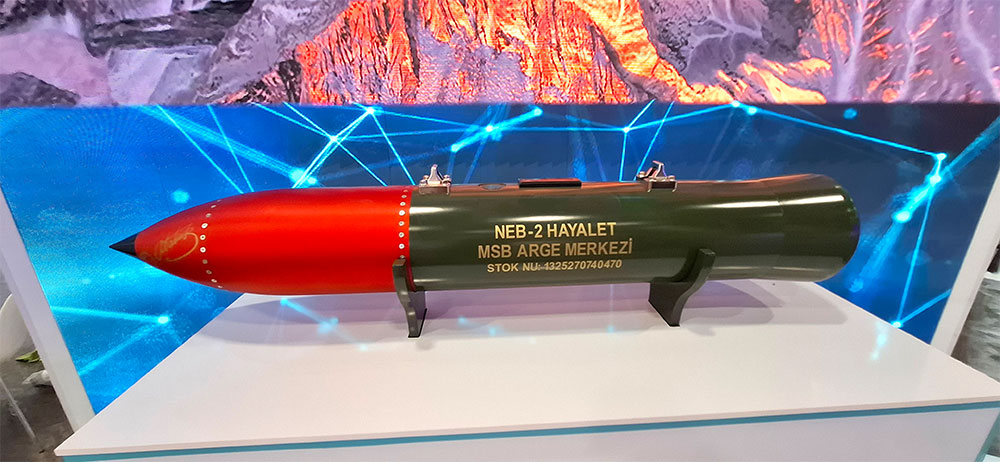
NEB-2 HAYALET (Penetrating Bomb-2 Ghost):
Type: A penetrating aircraft bomb based on a 2,000 lb Mk-84 body.
Features: Special alloy forged steel body. While NEB-1 has a tandem warhead with dual explosives and a double fuze with a 25-millisecond delay, NEB-2 has a single-piece penetrating warhead and a single fuze with a 240-millisecond delay. 500 lb Thermobaric PBX explosive. Recoil eliminator plug.
Status: Certification completed, tests successfully passed, entered serial production. Serial production is carried out at the MoND R&D Center.
Performance: A video of the Air-Drop Test conducted with an F-16 aircraft flying at 0.90 Mach speed at 30,000 ft altitude on May 21, 2025, was playing on an LCD screen at the booth. At the drop test, the NEB-2 HAYALET hit the designated target on the island at Mach 1.2 speed and proved its 10 times greater penetration capability compared to the NEB in rocky terrain thanks to its 240 ms delayed fuze and special alloy forged steel body. The HAYALET munition penetrated 90 m on initial entry into the island, detonated 160 m inside due to the distance from the impact side of the rocky island to the rear being 160 meters, creating a horizontal effect over 160 m and blasting the rocks on the rear side. Following the hit, thermal stress formed inside the island first, immediately followed by the explosion. In the firing test conducted against a 386-ton concrete target made of 7 m thick C-50 concrete reinforced with 25 mm ribbed steel rebar on November 3, 2023, the NEB-2 HAYALET penetrated the 7 m thick concrete, emerged without any damage or deformation, then pierced through the 50-meter sand pit placed behind it to cath and slow it down, and then was found approximately 400 m beyond the target.
GAZAP (Wrath) Fragmentation Bomb:
Type: A general-purpose aircraft bomb based on a 2,000 lb Mk-84 body, manufactured with an internally ribbed inner wall for fragmentation effect (in classic Mk-84s, the steel body scatters uncontrollably after explosion, whereas in GAZAP, thanks to the ribbed inner wall structure, it fragments into pieces after explosion, dispersing in a way that creates a complete fragmentation effect).
Features: Contains 10,000 fragments designed to deliver 10.16 fragments per square meter. 1,000 lb TBX (RDX-Metal Powder-Plasticizer) explosive. Recoil eliminator plug.
Status: Certification completed, tests successfully passed, in serial production.
Performance: With its 10,000 fragments inside, it can cause ssignificant destruction within a 1 km radius. The MoND R&D Center has also developed fragmentation aircraft bombs such as the 500 lb Mk-82 HASAR and the 1,000 lb Mk-83 HIRÇIN and begun their serial production. The 500 lb HASAR munition contains 250 lb TBX explosive and fragments designed to deliver 2.66 per square meter, while the 1,000 lb HIRÇIN munition contains 500 lb TBX explosive and fragments designed to deliver 2.99 per square meter.
Kamikaze Unmanned Surface Vehicle (USV):
Type: An unmanned surface vehicle (USV) capable of remote control or autonomous operations.
Features: 280 hours of endurance, 1,000 nm cruising range, 1,000 kg thermobaric explosive, total weight of 2,500 kg, maximum operating depth of 15 m.
Status: In the prototype stage.
Performance: Capable of communication and image transmission with ships.
155 mm Ramjet Artillery Munition:
Type: 155 mm hypersonic-speed, long-range artillery munition.
Features: Same caliber as standard 155 mm artillery round, with small folding fins at the front; achieves a 130 km range thanks to a solid-fuel ramjet engine; can be fired from howitzers such as the T-155 FIRTINA; features thermobaric filling to enhance blast effects.
Guidance system: INS/GPS is not currently available on the munition itself; accuracy is based on the firing howitzer's GPS data.
Status: Design completed, laboratory tests conducted, preparing for firing tests.
Performance: Like conventional 155 mm artillery rounds, the 155 mm Ramjet Artillery Munition uses the Modular Propellant System, with 3-4 modules loaded into the barrel prior to firing to achieve a 30 km range. The munition exits the barrel at 925 m/s (approximately Mach 3) and, 50 m later, its solid-fuel ramjet engine activates, reaching speeds up to Mach 8. It can achieve a total range of up to 130 km, with the initial 30 km provided by the Modular Propellant System modules. The Mond R&D Center has also developed the ASL-994 coded 155 mm artillery munition for FIRTINA howitzers, featuring a 30 kg body weight, nominal weight of 43 kg, and a 13 kg explosive charge consisting of 80% RDX + Thermobaric Alloy and 20% Plastic Binder.
533 mm Modern Heavyweight Torpedo:
Type: A Heavyweight Torpedo launchable from 533 mm (21-inch) torpedo tubes on submarines.
Features: The gyroscopic motor inside eliminates the possibility of wobbling in water. Equipped with a thermobaric warhead developed by the MoND R&D Center. Active/Passive Acoustic Sonar system. The guidance section includes the electronic compartment/control system housing the central computer that manages all torpedo functions. Long-life Silver Oxide Batteries developed by the MoND R&D Center. A dual coaxial propeller (like those in the DM2A4 and AKYA), and a fiber-optic guidance wire.
Status: Laboratory tests completed and reached the firing test phase. Firing tests are planned to begin within 6 months, initially from a test platform and subsequently from submarine platforms.
Performance: The 533 mm Modern Heavyweight Torpedo is designed to be launchable from the same tubes as the DM2A4 SeeHecht and AKYA Heavyweight Torpedoes and is software-compatible with combat management systems such as ADVENT and MÜREN on submarines in the Turkish Navy fleet. Thanks to its Silver Oxide Batteries, the Modern Heavyweight Torpedo has a 60 km range and is equipped with a thermobaric warhead (during my visits, I could not obtain information on the warhead's weight, though some sources claim it is 1 ton; however, this data does not align well with the torpedo's total weight of 1.5 tons). The thermobaric warhead, capable of generating high pressure in enclosed spaces (the sea being one such space), features adjustable detonation timing and explodes directly under the target's keel, breaking the ship's spine through the high-pressure blast effect post-detonation, thereby sinking it. Following the warhead’s detonation at a specific depth under the keel (such as 5-6 m), a massive double-layered air cavity ("bubble effect") forms, lifting the ship from its center and causing the keel—unable to withstand this force—to split in two. The Active/Passive Acoustic Sonar at the nose of the 533 mm Modern Heavyweight Torpedo employs a Conformal Array Sonar (located in the fiber-material parabolic bow section), similar to the AKYA and DM2A, with a preference for wide panoramic angles (as in the DM2A4: +/-100° horizontal and +/-24° elevation). While the AKYA and DM2A4 heavyweight torpedoes use Silver Oxide-Zinc type battery modules, the Modern Heavyweight Torpedo prefers the long-life, high-energy-density Silver Oxide Batteries developed by the MoND R&D Center, which are noted as a first in Türkiye. There have been claims from sources close to the project that the batteries in the AKYA heavyweight torpedo experienced issues, and that its training version had problems surfacing for recovery at the end of training missions. For the Silver Oxide Battery, the energy density is given as 130 Wh/kg, nominal voltage 1.60–1.80 V, operating temperature -20°C to +50°C, and charge-discharge cycle as 200.
IIR-Guided Air-to-Air Missile:
Type: Imaging Infrared (IIR) seeker air-to-air missile.
Features: IIR seeker, solid-propellant, capable of Mach 4 and 180 km range.
Status: Qualification process ongoing. Firing tests planned to be completed by the end of 2025. Tests will be conducted by the 401st Squadron Command.
Performance: It features solid propellant specially produced domestically by the MoND R&D Center, enabling the 180 km range, as stated. This special solid fuel is being used for the first time in this missile. TVC (Thrust Vector Control) is not included for maneuvering; instead, fins and control surfaces at the tail and nose sections are used.
122 mm Extended-Range Artillery Rocket:
Type: 122 mm unguided artillery rocket.
Features: Capable of supersonic speed, equipped with thermobaric explosive and solid propellant specially produced by the MoND R&D Center.
Status: Tests completed, in the firing test phase.
Performance: Thanks to the solid propellant specially produced by the MoND R&D Center, it achieves a 60 km range. The 122 mm caliber unguided artillery rockets produced by MKE and ROKETSAN come in two types—double-base solid propellant and composite solid propellant—and achieve an average range of 20 km to 40 km.
In our discussion at the booth, Nilüfer KUZULU, Head of the MoND R&D Center, emphasized that they bring their products to light only after completing their qualification and certification processes. "Our products are entirely domestic and national. Everything you see on this stand—from the chemicals to the explosives, from the mechanics to the designs—are patented products belonging to the Republic of Türkiye's Ministry of National Defence," she said. In response to my question about the fuze on the NEB-2 HAYALET munition, KUZULU stated, "All of our aircraft bombs in inventory have fuzes at the back. Normally, in our aircraft bombs—BLU-109 and NEB—the fuze delays are 25 milliseconds. In the NEB-2 HAYALET, we implemented a 240-millisecond fuze delay. That is, almost 10 times the delay. And it penetrated 10 times more." KUZULU summarized the difference between the NEB and the NEB-2 HAYALET as follows: "These two are not the same thing. They are completely different products. This one (NEB) is the product we displayed at the MKE stand. It is also a product belonging to the Ministry of National Defence. However, it has a tandem warhead, as we call it, with dual explosives. This one (HAYALET), on the other hand, is a single-block product. That is, it is entirely filled with explosive, and therefore we detonate it with a single fuze. NEB uses a double fuze. They first detonate the front explosive with the fuze during entry, then the rear fuze."
Emphasizing that the most important feature of the 533 mm Modern Heavyweight Torpedo is the "Silver Oxide Battery, which does not exist in Türkiye and is produced in only a few countries worldwide," KUZULU said, "This is a very important thing; it may seem small, but since it is the power source, it is actually the torpedo's most important component." In response to my question about the torpedo's performance data and guidance system, she said, "Its range is 60 kilometers. They (AKYA and DM2A4) are around 40 km. The long range of the torpedo stems from the lifespan of the battery we use. The battery is very long-lasting. Both the chemicals of the battery and its structural components were produced by us." When I asked whether the thermobaric warhead used in the torpedo could penetrate the steel plating on ships and submarines, KUZULU replied, "No, actually, a thermobaric warhead does not penetrate armor. Thermobaric is actually for enclosed spaces. The sea is an enclosed space, after all. The system is designed to generate high pressure in enclosed spaces and create a vacuum, thereby breaking the keel through pressure effects. Thermobaric warheads are also used in torpedoes like DM2A4." Regarding the size of the warhead in the torpedo, KUZULU stated, "The warhead is like the warhead that should normally be in torpedoes"





