“Navantia is Open to Collaborate with the Turkish Navy in the TF-2000 Destroyer Program in Everything that the Turkish Navy May Need!”
Defence Turkey: Can you elaborate on the current status of Spanish Navy’s F110 Frigate Program, which covers the construction of 5 state-of-the-art multi-purpose escort vessels with anti-aircraft, anti-surface and anti-submarine capabilities that will enable them to perform their force protection and naval projection functions. What can you tell us about the technological advances that F110 design will incorporate compared to existing frigate designs?
Eduardo DOBARRO: The F110 Program continues to advance ahead of schedule, with the main milestones of the construction program acceleration plan having been completed:
F111 keel laying on August 9, 2023 (planned in November 2023).
Start of production of the F112 on November 2, 2023 (planned in May 2024)
To date, twenty-eight (28) of the thirty-three (33) blocks of the first ship are already in different stages of manufacturing. Regarding the technological advances of the frigate, the ship has a multitude of innovative elements. Some of the most significant could be cited:
The incorporation of a Multi-mission Space that will allow the stowage and handling of mission modules, which will enhance the ship's capabilities in all war segments and will provide the ship with significant flexibility, integrating in a single space a second helicopter, units unmanned surface (USV), aerial (UAV) or underwater (UUV), organic embarked units (RHIB), specialized containers for the mission or humanitarian aid, all governed by a management system that allows these capabilities to be deployed both in the sea as with land.
The F110 frigate is designed with a CODELAG hybrid propulsion system, a system that combines electric propulsion with gas turbine propulsion, both propulsion being able to operate independently or together.
The Integrated Services System (SSI), which is a new development by Navantia that was born with the purpose of providing a common infrastructure that provides support and comprehensive coverage to the lighting, public address, wireless connectivity, monitoring and sensorization services of the platform, cameras, etc. However, it is its capacity as a backbone infrastructure for communications and integration of different user services, which represents an additional improvement to a reduction in volume and weight, as well as the optimization of cabling.
Integrated Mast. The development of the “Protec” F110 technological programs represents a leap forward for the ship in the design of the integrated mast, incorporating a greater number of sensors, antennas and actuators within the superstructure to improve overall performance in terms of reduction of the radar and infrared signature and to provide a protected environment for equipment (reducing the need for maintenance and vulnerability to damage).
The frigates will incorporate specific solutions for Additive Manufacturing in certain elements, incorporating into the ship the ability to autonomously manufacture said elements/spare parts using on-board 3D printers.
Defence Turkey: As you have pointed out the F110 Class Frigate Program represents not only a qualitative leap in terms of naval capabilities but also the industrial and technological potential of Navantia and all the industry that collaborates with it. Can you elaborate on the total value of investment that Navantia realized within the scope of the F110 Class Frigate Program to improve Ferrol Shipyard’s physical and digital infrastructure?
Eduardo DOBARRO: From 2021 to the current moment, significant investments have been made to improve the infrastructure of the Ferrol Shipyard for the development and execution of the F110 Program (2021-2023). Navantia, together with our shareholder SEPI, has approved additional investments in the Ferrol Shipyard for the next 3 years, directly related to the development of the F110 Program.
Defence Turkey: What is your vision of technology in the naval vessel construction sector? Where do you see this headed and how are you positioning Navantia in this journey? What kind of new products and technologies do you see a demand for in the coming years? What can the industry expect to see on the horizon as new products and technologies from Navantia?
Eduardo DOBARRO: In the context of digital transformation we can say that disruptive enabling technologies (KETs) are already here, so the vision is to land them intelligently to achieve more differentiating products and services adjusted to the needs of defense along with an improvement in the efficiency in their construction (more for less we would say). We have been customer-oriented and their needs for a long time, and we are aware of the current challenge where classic solutions are no longer sufficient, our focus is to position our products in a new digital architecture capable of implementing Cloud solutions and therefore collaborative, to understand the situation better and act collaboratively and in anticipation of new forms of threat, the word reaction has been left behind compared to taking initiative. In the coming years, very capable digitalized products integrated with their real component such as cyber-physical systems will be in demand, capable of providing services never seen before, in which the capacity for intelligent operation in an autonomous or semi-autonomous manner as well as with a level of high mission readiness. Navantia, as an integrator of naval systems, is already in demand from the industry for "smart" digitalized component solutions with advanced services towards our new portfolio of intelligent products and services. The F110 Class of frigates is an example of next-generation technological vanguard in the naval ecosystem.
Defence Turkey: It is stated that the F110 Program is the primary driver of Navantia’s Digital Transformation Plan in Ferrol Shipyard. What can you tell us about Navantia’s Digital Transformation Plan (NAVANTIA 5.0) and Shipyard 4.0. Concept and the efforts you have so far implemented to transform Ferrol Shipyard into a fully digitalized, automated and robotized plant to improve performance and minimize distortions?
Eduardo DOBARRO: Manufacturing the most technologically advanced frigate requires a change in the way of doing things through modernization and improvement of processes. The Digital Transformation plan traces the route to achieve operational efficiency and sustainability by incorporating the new enabling technologies identified in industry 4.0 to our products and activities that we offer to our clients and also to the production and management processes with a clear focus in the people who make them possible.
The new Digital Block Factory lands the application of these technologies. An automated factory that incorporates new manufacturing and dimensional control technologies, robotics, sensors for data collection and that feed the digital twin that will monitor all systems in real time, mobility technologies, simulations based on artificial intelligence with the aim of achieving a saving in terms and costs that will allow us to address the workload expected for the coming years and be more competitive.
Defence Turkey: The F110 Class Frigate Program includes the Digital Twin (a virtual replica), an innovative concept that will make the Ferrol Shipyard an international reference in frigate construction. Can we get your assessment of the benefits of using Digital Twin and the importance of this capability for both Navantia’s Ferrol Shipyard and the F110 Program?
Eduardo DOBARRO: The Digital Twin (GD) is one of the tools that will contribute to the digital transformation of the Navy and Navantia, a necessary engine for increasing the productivity and effectiveness of multiple organizational models, through the automated use of knowledge, information and the data that the organization produces or receives.
The F110 Frigate will be the first ship of the Spanish Navy that will have a GD, a software environment that uses the digital model of the ship as a basis for the virtual representation of the ship, which will take data in real time/useful from the sensors of the equipment of interest, along with other data, to understand, predict and improve mission readiness using advanced modeling and artificial intelligence.
Navantia will develop a GD for each F110 series vessel, which will reside on three platforms that will be synchronized in useful time:
Navantia’s GD platform that will provide support for the design, construction, testing, maintenance and improvement of the product during the complete life cycle of the series.
the GD platform of the Spanish Ministry of Defense which will store the F110 Class’ static and dynamic data of interest, and will provide support to operational, logistical and ground readiness applications; and
the ship’s GD platform that will accumulate the ship's static and dynamic data of interest and provide support to onboard operational, logistics and readiness applications.
The three platforms will be the first objective associated with obtaining the GD; The rest of the objectives will be associated with the functionalities or capabilities that it will provide with the only limitation of the existing technology and the limitation that costs impose.
Defence Turkey: As you have underlined above the F110 Class Frigate Program is running ahead of the schedule. Considering the supply chain problem being experienced in the European defense market since COVID 19 and the Russia-Ukraine War, can we hear your comments on how could Navantia managed to maintain/run the F110 Program ahead of schedule? How many Spanish and international companies taking part in the Program and how many people have been employed by the F110 Program?
Eduardo DOBARRO: Navantia’s extensive and consolidated chain of suppliers with extensive experience in the construction of military ships and mostly configured by manufacturers, has allowed us to proceed with the purchase of main equipment and long-term materials, with sufficient advance notice to be able to satisfy the demanding planning of the frigates.
500 companies from all over Spain are working on this project throughout the duration of the entire F110 Program, until 2032, with 9,000 jobs that include own personnel, subcontracted personnel, as well as jobs induced by the economic activity generated.
Defence Turkey: Considering the heightened cyber-threat, what kind of work and precautions does Navantia carry out on the F110 Class Frigates to assure information security and to protect the vessels against increasing cyber threats?
Eduardo DOBARRO: In recent years, cybersecurity has become another ship system considered a vital system by all the world's top navies in their requirements. Physically, in addition to specific designs and tests on the software and hardware of the equipment, the ship will have a cybersecurity system that will supervise and analyze all data traffic between the systems, as well as their health and their communications with the objective to guarantee their integrity.
Weapon systems with high technological complexity, such as the F110 Frigates, face threats mainly of state origin, such as cyber armies or organized criminal groups, which are sponsored by these same states. These actors have cutting-edge technological capacity, motivation and means, and among their objectives are the theft of national confidential information, ship design information and its weapons systems, or the development of disruption capabilities thereof. In recent years, for example, several cases of plagiarism of designs of advanced weapons platforms and systems have come to light, the origin of which comes from the theft, by these actors, of this very valuable information, in many cases directly from suppliers of the Defense Sector. Obviously, this can mean a significant loss to national interests, our companies, and the security of our society.
In the theater of operations, military ships are also a common target of cyberattacks on their communications systems or navigation sensors, either to deny these capabilities, generate false information that leads to poor command decisions, or steal tactical information that grants an advantage. the opponent in combat. Nor can we forget about the protection of the ship's systems, and the information they handle, not only against direct threats coming from cyberspace, but also from users or suppliers, either through negligence or maliciously, or because they may have previously been compromised. through extortion, or having economic motivations. It is our obligation to remain alert to these threats, because the cyber compromise of a warship and its command and control systems can have serious consequences for our Armed Forces.
Defence Turkey: Can you elaborate on Navantia’s approach to Turkish Navy’s TF-2000 Air Defense Warfare Destroyer Program? What kind of services and cutting-edge systems that could be fitted in those destroyers can Navantia offer to the Turkish Navy?
Eduardo DOBARRO: Navantia is open to collaborate with the Turkish Navy in the TF-2000 Destroyer Program in everything that the Turkish Navy may need. In that sense, Navantia could offer design support, supply of equipment and systems and the maintenance of said equipment and systems, or even through life support for the ship as a whole.
Our Services area can offer our portfolio of life cycle support services for the Turkish Navy, such as through life support management services, life cycle support engineering, training and simulation services, either traditional or with digital technologies such as virtual and augmented reality, IoT, Cloud Computing, AI, Digital Twin, Big Data, Data Analitycs, etc., with applications for condition and platform monitoring, modelling, simulation, training, etc., that the Turkish Navy could use to increase the efficiency of sustainment and asset management services.
In addition to corrective and preventive maintenance services, remote technical assistance, and technological refreshment, Navantia, as a company at the forefront of technological development, could put at disposal of the Turkish Navy a suite of smart connected products, which improve the operation of ships through the automation of processes and the interconnection between systems.
Based on data analysis, intelligent asset management is capable of:
Carry out integrated remote monitoring and control of equipment and systems of different nature
Monitor the health of the ship's equipment and systems (platform, combat, navigation, weapons...).
Offer energy efficiency solutions (optimization of fuel consumption).
Reduce emissions to the atmosphere.
Predict the behaviour of equipment and systems.
Manage the necessary support actions (resources, their movements...).
Provide training to the crew and simulation (equipment operation, ship navigation and coordination between units and people)
Defence Turkey: How would you assess the current level of Turkish naval vessel construction sector and the level of cooperation between the Navantia and Turkish Industry?
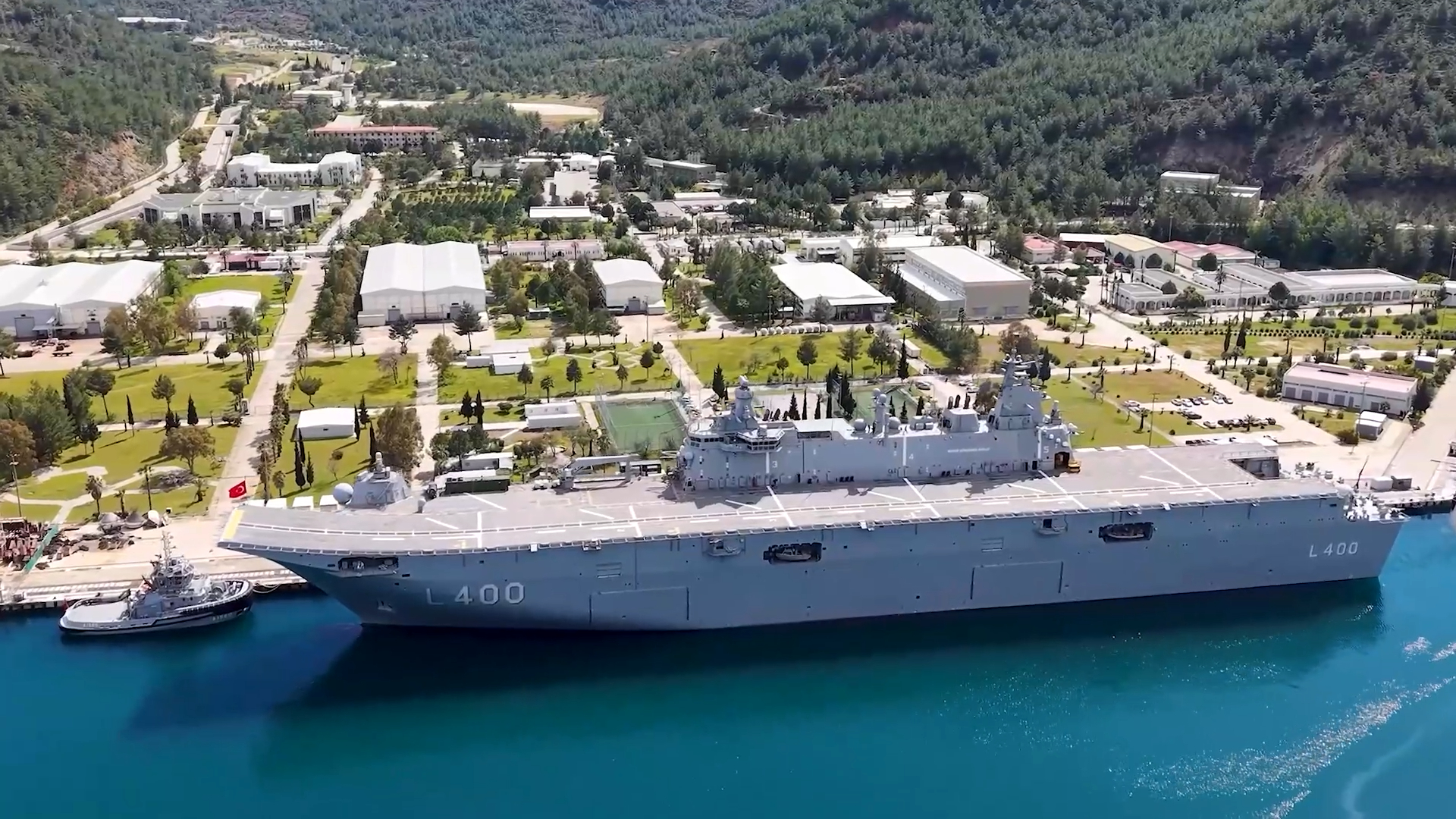
Eduardo DOBARRO: With the experience of the F110 Program, Navantia is positioned to provide engineering support in the development of the TF-2000 Program, as well as with the supply of IPMS (Integrated Platform Management System) and engines, as was done in the TCG Anadolu Program. Navantia’s intention is to collaborate with the Turkish Defense Industry in the transfer of technology (ToT) and experience in our military programs at an international level, for all these reasons, the objective is to increase the footprint of our company in the country by seeking collaborations with local companies.
Defence Turkey: What solution does Navantia plan to propose under the Turkish Navy’s New Generation Aircraft Carrier Program?
Eduardo DOBARRO:At this point, Navantia is waiting to know the requirements of the new Aircraft Carrier and has expressed to both SSB and TN its intention to collaborate in the conceptual, functional, and detailed development using a model like the TCG Anadolu Program.
Navantia is willing to provide its experience in this field and extend the good relationship with the Turkish Navy
Defence Turkey: Mr. DOBARRO thank you for sparing time for our readers and good luck