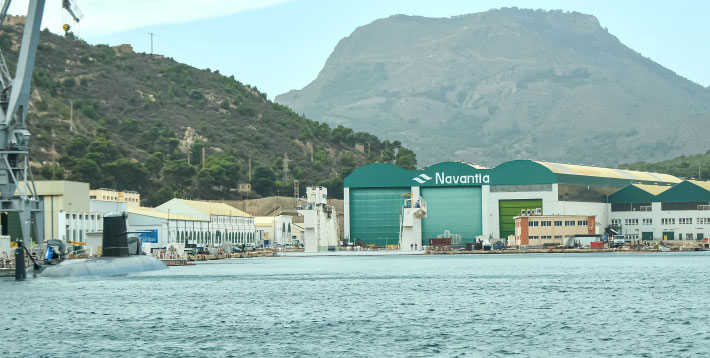
Navantia is Ready to Contribute Value to Turkish Navy’s MILDEN & TF-2000 Programs with the Knowledge and Capacities Acquired During S-80 and F110 Programs!
100% owned by the Sociedad Española de Participaciones Industriales (SEPI, attached to the Spanish Ministry of Finance and Public Function), Spanish shipbuilding company Navantia builds high technology vessels for both the military and civil sectors. It is the fifth-largest shipbuilder in Europe, the ninth-largest in the world. It is present in five countries (with Headquarters and offices in Spain, Saudi Arabia, Türkiye, India and Australia) and exporting more than 20.
Thanks to its immense technological capacity allowing it to design, build and maintain all types of vessels, Navantia is a strategic company for Spanish National Defense and Security and its main client is the Spanish Ministry of Defense and the Spanish Navy. With a team of more than 4,000 people, Navantia creates almost 80% of the sector jobs in Spain.
Indeed the history of Navantia Shipyard dates back to 1717, when Quartermaster General José PATIÑO ordered the construction of the first modern shipyard in Spain, the Real Arsenal de la Carraca, which was followed in 1731 by Cartagena and further on in 1750 by Ferrol. But Navantia, the Spanish public shipbuilding company, was born in March 2005, as heir of Bazan and IZAR. In 307 years of history, the company has proven its strength several times.
Today Navantia designs, builds, repairs & modernizes and supports all types of surface vessels, submarines and systems. It is also engaged in the design and manufacture of Integrated Platform Management Systems, Fire Control Systems, Combat Systems, Command and Control Systems, Propulsion Plants and Through Life Support for all its products. Even though its main line of activity is in the naval field, Navantia also designs and manufactures systems for the Army and the Air Force, and it is a first-class company in the development, fabrication and maintenance of engines, generator groups and turbines, as well.
Navantia provides the industrial and technological response to the Spanish Government to build the essential naval capabilities for National Defense and Security. The company has their own technological capacity to deliver solutions end to end in the shipbuilding and also in the Systems domain, providing sovereignty to the Spanish Ministry of Defense (MoD).
Navantia is making a great effort in offering the highest technology to improve its position as a key provider in the global maritime sector. The close relationship with crucial customers like the Spanish Navy and the Ministry of Defense has allowed Navantia to build excellent products like the F-100 & F-110 Frigates, Avante (Alpha 3000 design) Class Corvettes/Light Frigates, the Juan Carlos I LHD, or the S-80 Submarine. All of them leading to a great impact into the international market. In order to be competitive in that market, Navantia is currently implementing a Strategic Plan that led the company to maintain its excellent position in the international market.
Its experience has demonstrated that Navantia is also good as a “real” transfer of technology (ToT, Australia, Saudi Arabia and Türkiye are good examples) partner, having proven its value in very different industrial scenarios. Navantia’s experience as a main contractor and systems integrator provides a clear advantage to its partners and other defense institutions around the world. Having an intention to develop an industrial ecosystem, as they have done in the past for other programs and ready to satisfy the model selected by the customer, Navantia is very focused on developing the local industry in the respective countries to maximize the local content.
Nowadays, Navantia is sailing towards new horizons guided by a roadmap that will lead it to becoming a more global, technological and sustainable company.
Brief History of S-80 Submarine Program
Spain, the Spanish Navy and Navantia have a long tradition in designing, building and operating warships including submarines. Navantia is one of the international leaders supplying naval systems, a state-owned company devoted to national security and therefore it is not surprising that to meet the Spanish Navy’s new generation oceanic attack submarine requirement the Spanish Government decided to go ahead and support the development of the required capabilities in-house.
The Spanish Government approved the purchase of four S-80 Submarines in September 2003 and in March 2004 the Shipbuilding Order was signed between the Ministry of Defense/Spanish Navy and IZAR to build four S-80 Submarines. Compared to Scorpene the S-80 is designed, from the start, as an AIP Submarine.
The S-80 Program has suffered several problems (including serious deviation in the vessel’s overweight control, technical deficiencies of design and the AIP System) and surpassed many milestones since its launch in 2004. Navantia and its technological partners have succeeded to overcome the challenges.
The “Isaac Peral”, first submarine of the S-80 Program, which represents the greatest industrial and technological challenge ever faced by Spain’s defense industry, was laid down in 2007 at Navantia’s Cartagena shipyard. However, after more than five years of work, excessive weight issues necessitated reexamining the overall design. The S-80 Submarine (baseline version) originally had an overall length of 71.05 m, a diameter of 7.3 m, surface displacement of 2.200 tons and a submerged displacement of around 2.430 tons. Having the maximum operating depth of over 300 meters the S-80 Submarine can operate with a reduced crew of 32 (with eight berths for additional embarked personnel/special forces), and had a top speed of over 19 kts dived and more than 10 kts surfaced. The weight issue was solved using a System Engineering approach which led the Navantia to increase the displacement of the submarine by increasing its length. In 2013, the U.S. submarine manufacturer General Dynamics Electric Boat was brought in to provide technical assistance, helping Navantia get the program back on track. A complete re-design of the submarine has been carried out taking profit of the lengthening of the submarine and the opportunities it led. In all, the hull was lengthened by 10 meters (33 ft), and the displacement was increased by 100 tons. Each submarine has been stretched with a 10 meters ring to better distribute the weight of the submarine. In November 2014, Navantia reported having completed the redesign work to address the problem of overweight. The main issues related with possible obsolescence have also been catered to. An FMS cooperation agreement has been established between the Spanish Navy and the US Navy, in this frame, a Safety Certification Process has been developed for the program based on the US Navy Subsafe certification. Under the FMS case the Spanish Navy has the back-up of the US Navy/General Dynamics Electric Boat for Safety issues. Eventually, the S-80 Submarine design was enlarged, while its overall length has reached to 80.81 m, its surface displacement grew from 2.200 tons to 2.695 tons and its submerged displacement increased from 2.430 tons to the current 2.965 tons. The stretched version of the S-80 Submarine design was later dubbed as S-80 Plus (S-80P).
The Isaac Peral (S-81) Submarine, the first Spanish-designed and built submarine, was launched on May 7, 2021, conducted the initial sea trials and its first navigation in the Bay of Cartagena in May 2022, performed its first static dive in March 2023, successfully conducted a dive to her maximum operational test depth in October 2023 and commissioned on November 30, 2023. Since then, the S-81 Isaac Peral, the first submarine designed in Spain and the first of four boats on order under the S-80 Program, has been operated by the Submarine Flotilla at the Cartagena Arsenal. The first mission for the Isaac Peral (S-81) Submarine will be to cross the North Atlantic, expected to last around 45 days.
State-of-the-art S-80 Submarines & Their Unique Capabilities
With a length of 80.81 meters, a diameter of 7.3 meters and a displacement of almost 3.000 tons, the S-81 Isaac Peral is one of the largest non-nuclear submarines in the world and promises to be a major step up for the Spanish Navy (the Armada). The S-80 design represents a unique capability among NATO conventional submarines, specifically designed for expeditionary purposes and unique in her size and performance.
The main differential features are the Integrated Combat System Core (ICSC) and, the 3rd Generation BEST AIP System and the high level of automation including fly-by-wire. Besides that, signatures have been minimized and detection capabilities are of first class among conventional submarines. The ICSC integrates a sonar suite developed by Lockheed Martin and SAES (towed array sonar and its deployment system), all of them with a higher number of hydrophones and better performance compared to most conventional submarines. Use of Albacore-type teardrop and single-hull structure together with other local features developed and implemented in the submarine allow for a substantial reduction in broadband hydrodynamic noise. Combined with other improvements in the propeller an additional reduction of propeller tonal noise is obtained. These forms are also very beneficial for better performance of the forward sonar.
The S-80 Class Submarines are equipped with Integrated Combat System (ICSC). Developed by Navantia Sistemas the ICSC compromises 7 Multifunction Consoles for Combat Systems (MFCCS, CONAN SUB consoles), 1 Large Tactical Display (LTD), 2 Navigation and Network System Cabinets (NNSC), 2 Weapon Processor Units (WPU), 6 Weapon Interface (WIU) Units, 1 Sonar Array Suite (SAS) and 1 Own-Noise Monitoring System (ONMS). The ICSC allows the combat system’s weapons and sensors to be highly integrated to ensure optimal management of both information about operations and the command-and-control center. It enables all the necessary information to be gathered, assessed and displayed for offensive, defensive or intelligence actions that take place at any time. This includes using weapons and countermeasures and their launching devices. Thanks to this, the combat system is able to find and track multiple targets in different scenarios and simultaneously manage several components. Specifically, it can manage short, medium and long range active and passive sonars for exploration, attack and navigation tasks; electronic, optronic and electromagnetic detection systems for combat missions or intelligence operations; precise navigation aids; integrated communication systems, including satellite links and tactical data links with other naval vessels through ‘Link-11’ and ‘Link- 22’, and weapons systems for operations at sea.
Navantia Sistemas leaded the development of the Tactical Simulator (SIMTAC) for the training of the Spanish Navy crews. SIMTAC is a high-fidelity land-based simulator that recreates all sensors and weapons of the Combat System and coordinates the different stimuli to provide a complete training experience and an extensive catalof of multi- mission lessons. The education of the crews is completed by the Platform Simulator (SIMPLA). The development of this high- fidelity simulator was led by Navantia Sistema and provides training for piloting the platform.Lockheed Martin developed the Cylindrical Array Sonar (CAS) System for the S-80 Submarines. The CAS is the primary acoustic sensor for submerged operations. It consists of a special hydrophone configuration that is unique to every platform. Lockheed Martin designed and developed the S-80's new CAS under a 2005 contract from the Spanish Government to provide the S-80 Submarines’ Integrated Combat System. In addition to the CAS, the S-80's ICS also contain a Flank Array & Passive Ranging Sonar (FASLPRS, with a 27 m array), as well as Mine and Obstacle Detection Sonar. The ICSC on-board the S-80 Class leverages proven commercial technology used on the U.S. Navy's Virginia, Seawolf and Los Angeles Class Submarines, as well as Lockheed Martin's experience as the lead contractor for the U.S. Navy's Acoustic Rapid Commercial-Off-the-Shelf (COTS) Insertion program since its inception in 1996.
As the only Spanish company with sonar (design and production) and underwater acoustics capabilities, SAES integrates the S-80 Class Submarines with the SOLARSUB S-80 DTAS & TAHS (Digital Towed Array Sonar & Towed Array Handling System) and the own-noise and vibration monitoring system (ONMS), which detects cavitation and other potential noises, as well as the cancellation of its own noises, especially by the Flank Array Sonar. SAES also provides Acoustic Classification System (SICLA), the Sonar Performance Prediction System (SEAPROF), and the Acoustic Simulators for the Tactical Simulator (SIMTAC 80) and offers a complete line of technical assistance and engineering in underwater environments and ASW. SAES also will equip the S-80 Class with the state-of-the-art multi-influence smart mines.
The defense electronic systems on-board the S-80 Class Submarines are developed by Indra. The S-80 Class Submarine is equipped with Indra’s PEGASO RESM/CESM System, ARIES-S Low Probability of Intercept (LPI) Radar, TXP-255 Friend and Foe Identification System (IFF) Mode 5, TSUB X and Ka Band Satellite Communication System and PERCOSUB Multi-sensor Optronic Mast.
The S-80 Class Submarines are armed with 6 21-inch bow torpedo tubes (with Positive Water Discharge) and can carry up to 18 weapons including DM2A4 Heavyweight Torpedoes, naval mines, UGM-84 Sub-Harpoon Anti-ship Missiles (encapsulated version) and UGM-109E Block IV Tomahawk Cruise Missiles. The S-80 Submarines’ weapon system is fitted for Tactical Land Attack Missile (TLAM) like Tomahawk and there is margin for the weapon control units; next steps would require Spanish Government’s final decision. The S-80 Class is currently the only Western non-nuclear submarine capable of being equipped to launch UGM-109E Block IV Tomahawk Cruise Missiles. In fact, the capacity to launch submarine cruise missiles (SLCM) is unique for non-nuclear NATO submarines. The Combat Management System on-board can control/guide 6 HWTs simultaneously.
Featuring unique capabilities among NATO non-nuclear submarines the S-80 Class Submarine design is expected to generate significant interest on the export market. Navantia already offered the S-80 Class within the scopes of Poland’s ORKA (RFI Phase) and Indian P-75(I) Submarine (technical offer was submitted in response to RFP) Programs. Navantia has also offered S-80 Submarines to Philippines, the only Southeast Asian country embroiled in a territorial dispute with China that doesn’t operate a submarine. It is reported that Navantia has submitted a US$1.7 Billion offer to develop the country’s submarine force. The comprehensive offer covers delivery of two S-80 Isaac Peral Class Submarines, extensive training of the crew and staff of the Philippines Navy, transfer of technology in submarine operation and maintenance, and helping submarines build a military hardware manufacturing capability.
BEST
(Bio-Ethanol Stealth Technology) AIP System
Starting from the Cosme García (S-83), the S-80 Submarines will be equipped with the revolutionary 3rd Generation 300+ kW (400 hp) Bio-Ethanol Stealth Technology (BEST) AIP System, using fuel cells and an Ethanol Reformer that generates the required hydrogen from bio-ethanol. The Spanish Ministry of Defense (MoD) decided to go ahead with bio-ethanol instead of ethanol as bio-ethanol can be produce in country thus eliminating the dependence on international ethanol production.
The first two submarines, Issac Peral (S-81) and Narciso Monturiol (S-82), are built without the BEST AIP Systems but will receive their 3rd Generation BEST AIP Systems in the first major overhaul, which planned for 2028 for the S-81. The last submarine, Mateo García de los Reyes (S-84), will also receive it during construction. Representing one of the major innovations incorporated in the S-80 Class Submarines, Navantia’s 3rd Generation BEST AIP System combine the expertise the Spanish company Abengoa Innovación for the fuel processor, and the American company Collins Aerospace, for the fuel cell. Navantia has run AIP equipment for thousands of hours and in 2018 demonstrated technology integration through full power endurance tests (> 300 kW gross power) using prototypes (full scale, naval qualified equipment). This success in the full power production milestone enabled Navantia to move forward to the System Verification Review scheduled in July 2021, as critical risks to meet the S-80 Program deadline for system installation onboard the S-83 submarine were properly mitigated. The BEST AIP System successfully passed the Factory Acceptance Test (FAT) in 2023. As a proven solution, the BEST AIP System is now available and ready to embark in the section 3 of the S-83 Submarine during summer of 2024. Once operational, the BEST AIP System on the S-80s will reportedly permit quiet underwater cruising for three weeks.
The S-80 Class’ main propulsion system is based on 3.500 kW Electric Motor. The diesel-electric propulsion on-board the submarines incorporate three 1.200 kW high performance diesel generators (MTU), that produce the power needed to power Electric Motor and charge batteries on-board and can provide a top speed of more than 19 knots submerged or 12 knots on the surface. The S-80 Class Submarines have two battery compartments each of which composed of 180 elements.
Status Report of Turkish Navy’s MILDEN and TF-2000 Air Defense Warfare Destroyer Programs
MILDEN National Submarine Program
In order to meet Turkish Naval Forces’ next generation attack submarine requirement, that will operate in the 2030s and beyond, through indigenously designed and constructed submarines, MILDEN (short for Milli Denizaltı, which translates to ‘National Submarine’) Project was launched and first design activities started on April 14, 2010. The MILDEN Program is coordinated by the Turkish Naval Research Center Command (ARMERKOM - TNRCC) since March 2012. Within the scope of the MILDEN Program, which will open a new page in the history of Turkish Submarine, the infrastructure established for the construction of REIS Class Submarines and the know-how developed during the NTSP will be utilized.
The MILDEN Design Project Office, which plays an important role in the design and construction of national submarines, was established on April 19, 2019, and the new office building was opened on March 22, 2021 at Golcuk Naval Shipyard. The Concept Design of MILDEN, that prepared by the MILDEN Design Project Office, was submitted to the Turkish Naval Forces Command (TNFC) on October 25, 2021 and approved by the TNFC in January 2022 from technical aspect. With this approval Conceptual Design Phase completed and Preliminary Design Phase started. According to MoND 2021 Annual Report, the protocol regarding the preparation of the design of MILDEN submarines was signed on December 22, 2021 between the General Directorate of Shipyards and ASFAT AŞ. Within the scope of the MILDEN Program, that covers the construction of 6 submarines, the Preliminary Design Phase, in which the main and auxiliary systems are elaborated in detail, is currently ongoing.
The MILDEN scale model, built in accordance with the Concept Design prepared by MILDEN Design Project Office and exhibited during IDEF ‘23 Fair, provides valuable insights into current design of the Submarine. According to new design, contrary to the one revealed at the MILDEN Workshop in June 2017, MILDEN features traditional cross-shaped rudder rather than X-form rudder preferred at the first design and does not have shrouded screw. Designed as a diesel-electric submarine, MİLDEN will have an overall length of 80+ meters, a surface displacement of approximately 2.700 tons, feature eight 533mm torpedo tubes for AKYA National HWT, Sub-ATMACA ASCM and GEZGIN submarine-launched cruise missiles (SLCMs) and to be powered by an air-independent propulsion (AIP) system. Compared to current submarines in Turkish Submarine Fleet Command’s inventory, MILDEN will stay submerged longer, have a heavier weapons load and be able to operate at greater depths, MILDEN is also expected to be fitted with Vertical Launch System (VLS) modules for both cruise missiles and air defense missiles. MILDEN will be equipped with indigenous navigation or surface search radar, optronic masts as well as the sonar suite, which will integrate low-frequency flank array, a bow-array, and towed array sonars.
Along with two diesel engines, MILDEN will be the first made-in-Türkiye submarine to be equipped with indigenously developed 300kW (400hp) AIP System, featuring 6 PEM Fuel Cell modules, at least one Methanol Reformer System, and Lithium-Ion Battery (LIB) sets, which are currently under development within the scope of the Submarine Propulsion System Components Development Project.
The AY Class Submarines (six of them constructed at HDW [3x] and Golcuk Naval Shipyard [3x] and inducted into TNF service during March 1976 and July 1990, 4 of them are currently in the service) in TNF Submarine Fleet will be replaced with MILDEN Submarines starting from late 2031, or early 2032.
TF-2000 Air Defense Warfare (ADW) Destroyer
TNFC has initiated a project called TF-2000 to construct a total of four (+2 optional) destroyers fitted with enhanced anti-air weapon and sensor systems. The main aim of this project is to acquire fleet area air defense capability. The TF-2000 Air Defense Warfare (ADW) Destroyer is expected to have an overall length of 149 m, displacement of 8.300 tons, an overall beam of 21.3 m and draught of 5.75m. To be powered by two diesel engines (driving two shafts) and two gas turbines (in combined diesel or gas [CODOG] configuration) the TF-2000 ADW Destroyer will have a maximum speed of 26 knots+ (with full load displacement), an economical speed of 18 knots and endurance of 5.000nm at 18 knots. Under the TF-2000 ADW Destroyer Program, which is expected to cost around US$4 Billion construction of the first ship of the class, will take place at Istanbul Naval Shipyard while the remaining three sister ships planned to be constructed in private shipyards.
The main sensor of the TF-2000 ADW Destroyers called CAFRAD, of which prototype has been under development since 2013. Under the Phase-I of the Multifunctional Phased Array Radar (CAFRAD) Program a US$79 Million (TL200 Million) contract was signed between the Secretariat of Defense Industries (SSB) and Prime Contractor ASELSAN on August 1, 2013. Completed in December 2018, Phase-I covered the design, development manufacture and testing of the CAFRAD Radar System Technology Demonstrator Prototype. Originally the CAFRAD Suite was comprising three separate new generation radars (CFR, AYR and UMR) based on the most advanced Gallium Nitride (GaN) Active Electronically Scanned Array (AESA) sensor technology with multiple digitally formed beams, fully solid state Transmit/Receive (T/R) modules and digital signal processing, 12 fixed-panel radar antennas and a non-rotating AESA type IFF antenna subsystem. The CFR (multifunctional radar) and AYR (illumination radar) are in X-Band configuration, whereas the long-range (450km+) search radar UMR is operating in S-Band. Each fixed-panel of the CFR and AYR consists of around 5.000 T/R modules.
As a result of both the advancement in technology and the launch of the SAPAN Project, which covers the integration and installation of RF guided HISAR-D RF Block-I and SIPER-D Block-I Air Defense Missiles MIDLAS National Vertical Launching System (VLS) and SAPAN National Air Defense Fire Control System, on the TF-2000 ADW Destroyers, in order to create a more cost-effective solution a configuration change has been made in CAFRAD’s Series Production model. In this configuration there are only CFR, focusing on surface engagements, and UMR, to provide not only long-range target detection for early warning purpose but also to guide both HISAR-D RF Block-I and SIPER-D Block-I Missiles, systems. While the 4 fixed-panel radar antennas of the CFR are placed on the integrated mast, the UMR’s fixed-panel radar antennas will be positioned on the right, left and rear of the ship’s superstructure. Primary armament of the TF-2000 ADW Destroyers includes 96 MIDLAS VLS cells 32 of which located on the bow (behind MKE’s 127mm main gun) and 64-cells located amidships.
Navantia’s Approach to the TF-2000 ADW Destroyer and MILDEN National Submarine Programs?
With a history of more than 300 years linked to the construction of ships for the Navy, Navantia has a long tradition in the design and construction of surface combatant vessels with 13 Anti Air Warfare (AAW) Frigates (F100 series) built in the last 20 years for Spanish (5 x the Álvaro de Bazán Class, also known as the F100 Class), Norwegian (5x Fridtjof Nansen Class) and Australian Navies (3x Hobart Class), and two important projects under construction at the moment: 5 F110 Class Frigates (multipurpose escort ships, with anti-aircraft, anti-surface and anti-submarine capabilities) for Spain and 5 Avante 2200 Corvettes/Light Frigates for Saudi Arabia. Let’s not forget that in addition to supplying ships to the Spanish Navy, Navantia has also worked with foreign Navies such as the Norwegian Navy and Australian Navy in AAW Frigates.
The TF-2000 ADW Destroyer Program is a very ambitious project where experience matters. In the past, Navantia built ships with the engineering provided by others, mostly from North American shipyards. Nowadays, Navantia is the one providing the design to other shipyards, including North American ones and everything started with the company’s successful AAW Frigate, the F100 series. This experience could be of great value for Türkiye in the TF-2000 Program to follow the same path as Navantia did in the past.
Navantia would like to play an important role on the TF-2000 ADW Destroyer Program. With the experience gain with the TCG Anadolu LHD Program and considering the fact that Navantia has so far constructed and delivered a total of 13 Anti-Air Warfare Frigates, Türkiye could benefit from this experience by involving Navantia in the TF-2000 ADW Destroyer Program. Right now, Navantia and Türkiye know each other very well and this cooperation could turn out in developing the most complex of Navy ships, such an AAW Frigates/Destroyers and new generation oceanic attack submarines.
In reference to the MILDEN Program, the development of a submarine is a great challenge, one that Navantia has gone through in recent years, and Navantia is willing to share what it has learned under the S-80 submarine Program. There are many similarities between the MILDEN and the S-80 Submarines. Not only in the specifications of the vessel (similar size, capabilities, and propulsion system) but also in the Program itself. A very ambitious and powerful program, with a high level of risk, being the MILDEN the first submarine design and built in Türkiye. Navantia has walked this path before and, thus, Navantia is in a good position to offer its expertise to assist Turkish Navy and Turkish Industry in the MILDEN Program, to help and avoid those difficulties the company hit when they began the construction of the S-80 Submarines. At the end, a delay in a Program means cost overruns and delays that will not allow the unit to be in service for the country in the expected schedule. In Naval field Türkiye is always aiming for the best. And to be the best we need to work with the best.
Current Level of Cooperation Between Navantia and Turkish Naval Shipbuilding Industry
Navantia has been present in Turkish market for more than twenty years, confirming its commitment with the country with the opening of Navantia Turkey Branch Office in Istanbul, in 2013. Since then, Navantia has become a close partner of Turkish Naval Shipbuilding Industry. The level of cooperation between Navantia and Turkish Industry is very good as can be seen from the successfully completed TCG Anadolu LHD Program.
As the largest ship built in Türkiye, TCG Anadolu (L-400) Multi-Purpose Amphibious Assault Ship is based on the Navantia’s Atlas LHD 26,000 design like the Juan Carlos-I (L-61) in service of the Spanish Navy and the Canberra Class LHDs, HMAS Canberra (L-02) and the HMAS Adelaide (L-01) in the service of the Royal Australian Navy. Constructed at SEDEF Shipyard with Navantia’s technical assistance and inducted into the Turkish Navy service on April 10, 2023, the TCG Anadolu, has transformed the regional force projection (transfer) capability of the Turkish Navy into a medium-scale global force projection capability,
TCG Anadolu LHD Program had a very ambitious local content objective higher than 65% (she was constructed with a 68% local content rate). In order to achieve this high local content rate Navantia established agreements with technological and strategy partners, as well as with local partners. In this context, apart from its partnership with SEDEF for the construction of TCG Anadolu LHD ship and four LCM-1Es, Navantia also cooperated with ASELSAN and HAVELSAN for the combat system, the Türk Loydu for the Class Certification (TCG Anadolu was build according to Türk Loydu Naval Ship Classification Rules), AYESAS for the Integrated Platform Management System (IPMS), and DELTAMARINE, which deeply involved in the design of the ship. Navantia provided technical assistance and support to SEDEF during both the procurement activities as well as the construction of the vessel until the final delivery. Consists of engineers and experienced technicians Navantia Resident Team (NRT, reached up to 8 members in the busiest time of the schedule) in SEDEF supported shipyard’s technical team with technical assistance. With these partnerships, not only Türkiye’s local value of supply for the TCG Anadolu has been increased, but in addition, Navantia has become stronger, being able to improve the quality of its products and therefore, provided better value to its clients. Navantia has worked with its local partner SEDEF not only for the TCG Anadolu LHD Program but also for other opportunities that may arise in the international market that could be supplied from Turkey. For this purpose, Navantia worked very closely at the Turkish Naval suppliers in order to include them into its usual list of homologated vendors, therefore every time the company issue a tender for any equipment or material the Turkish suppliers will be able to participate.
Working side by side with Turkish companies, Navantia is in a position to assist the Turkish Navy and the Turkish Naval Shipbuilding Industry and, what is more important, it can be done locally due to the to the existence of Navantia Turkey. Navantia underlines that they are here to support Turkish Navy with its experience, knowledge and know-how, and this would go all the way from the concept design and detail engineering of a ship to the Through Life Support. The successful completion of the TCG Anadolu Multi-Purpose Amphibious Assault Ship Program and the ship's entry into Naval Forces service also proves the success of the partnership between Navantia, SEDEF Shipyard and Turkish Naval Shipbuilding Industry. The cooperation and partnership established between the Navantia and Turkish Industry within the scope of TCG Anadolu LHD Program and can be shifted into Strategic Partnership with the second ship, TCG Trakya. This means that the second ship, TCG Trakya, could be built even faster, reducing the delivery time compared with the first one.
Turkish Navy’s New Generation Aircraft Carrier Programs and Potential Candidates
Turkish Navy, which has become the most significant naval power in its region, has gained a global dimension with the TCG Anadolu (L-400) Multi-Purpose Amphibious Assault Ship (LHD) Project carried out by the Secretariat of Defense Industries (SSB). With the LHD Trakya and New Generation Aircraft Carrier Projects, which are expected to be inducted into Turkish Navy service in the coming years, the Turkish Navy will also achieve carrier-capable multirole manned and unmanned fighter jets and fulfill all kinds of duties that will be entrusted to it in the protection of our maritime rights and interests in the Blue Homeland.
Türkiye is a big country, with a big coastline and surrounded by two seas. Having two Multi-Purpose Amphibious Assault Ships and a New Generation Aircraft Carrier not only makes sense but it will also provide a huge capability to the Turkish Navy and therefore to the country and its population. Embracing a naval air power with fighter jets is one of Turkish Navy’s primary goals. The Naval Forces with fighter jets to be included in its inventory such as the LHD Anadolu, LHD Trakya and New Generation Aircraft Carrier will be fulfilling all its assignments at the utmost level.
During his official visit to Spain on November 17, 2021 at a joint news conference with visiting Spanish Prime Minister Pedro SANCHEZ, Turkish President Recep Tayyip ERDOĞAN said that his country hopes to increase defense cooperation with NATO ally Spain through the purchase of a second aircraft carrier and possibly a submarine. ERDOĞAN said Türkiye and Spain had already cooperated on the construction of a Spanish assault ship (TCG Anadolu). “The first aircraft carrier was not a large-scale one. We have agreed on the construction of a large scale (carrier, And perhaps, we will also enter (cooperation) for a submarine.” ERDOĞAN said.
During the Defense Industry Executive Committee (DIEC, the highest decision-making body on defense procurement in Türkiye)’s meeting held on January 3, 2024 a total of 20 new naval ship programs were launched within the scope of the Turkish Navy’s modernization efforts. Turkish Navy’s New Generation Aircraft Carrier Program was among them. According to DIEC Decree, STM in cooperation with ARMERKOM of the Turkish Naval Forces Command, will carry out conceptual design of the Turkish Navy’s New Generation Aircraft Carrier. Within the scope of the Program necessary technical assistance/support for the design and construction of an aircraft carrier will be acquired from a foreign Technical Support and Assistance Provider (TSAP) Company, which has experience in aircraft carrier design and construction.
On February 16, 2024 Turkish MoND has shared a rendered image of the Turkish Navy’s future New Generation Aircraft Carrier’s conceptual design on its official social media account with some technical specifications. According to the shared technical specs the New Generation Aircraft Carrier will have displacement of 60.000 tons, an overall length of 285 meters, beam of 72 meters and a draught of 10.1 meters. Turkish Navy’s future New Generation Aircraft Carrier will have more than twice the displacement of TCG Anadolu (L-400) Multi-Purpose Amphibious Assault Ship, which is currently the largest warship in Turkish Navy inventory.
Conclusion
Türkiye is an important and valuable partner for Navantia, and having a long tradition in designing, building and operating warships including submarines Navantia is ready to enhance its collaboration in the way that best suits the Turkish Ministry of National Defense (MoND), the Secretariat of Defense Industries (SSB), the Turkish Navy and the Turkish Industry. In that sense, Navantia is ready to contribute value to Turkish Navy’s MILDEN & TF-2000 Programs with the knowledge and capacities acquired during S-80 and F-110 Programs either through delivering the complete Submarines and Frigates (either built in Spain or through a transfer of technology program) or own developed cutting-edge mission critical systems, Integrated Combat System Core (ISCS), Integrated Platform Management System (IPMS), Integrated Communications System and the BEST AIP System that could be fitted in MILDEN Submarines & TF-2000 ADW Frigates. The knowledge and capacities acquired during S-80 and F-110 Programs could be of great value for Türkiye both in the MILDEN and TF-2000 Programs to follow the same path as Navantia did in the past





