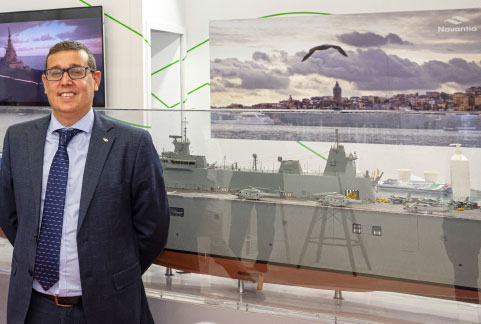
NAVANTIA: ` Turkey is an Important and Valuable partner for NAVANTIA, and We are Ready to Enhance Our Collaboration`
Defence Turkey: How do you see the global conventional submarine market developing into the near future? How does Navantia plan to continue its technological journey in the face of shrinking budgets at home and in the world?
Jose Manuel MONDEJAR: According to recent studies published by GlobalData, the global market for submarines will grow up to US$31.9 Billion within the next 10 years. Although a big part of this belongs to nuclear submarines, the conventional market is very interesting to continue investing some efforts in this business. It is remarkable how multiple countries have decided to create their submarine flotilla, others are in the process of renewing their boats or performing extensive upgrades and life extensions. Navantia is capable of delivering either the complete submarine (either built in Spain or through a transfer of technology program) or cutting-edge systems that could be fitted in those submarines. We can deliver our own developed mission critical systems, Integrated Combat System Core (ISCS), Integrated Platform Management System (IPMS), Integrated Communications System and of course the BEST AIP.
In the meanwhile, concerning our national market, Navantia and the Spanish Navy have started the exploration of design features for future submarines, such as the S-90, besides that, some other projects like autonomous vehicles have been discussed. Navantia has defined a roadmap including several innovation projects in order to evaluate the integration of certain technologies and systems that could be part of future S-80 upgrades, evolutions for other customers or additional units in the class. One of these projects is the so called BALIT (Lithium-ion batteries) that is described later in this interview.
As a follow up to the S-80 Program, the next step with the Spanish MoD is the first phase of Through Life Support for these submarines. The new sustainment model is the result of an intensive collaboration between the MoD, the Navy and Navantia, that will be demonstrated with the creation of a Through Life Support Technical Office (Oficina Técnica de Apoyo al Ciclo de Vida or OTACV) where the different organizations will work together in Navantia’s premises. This contract represents a new approach for the Spanish Navy, choosing a holistic lifecycle model adequate for highly complex systems and is comparable to those used by our MoD in other systems like the military airplane A400M.
Precisely, one of the strengths of the S-80 in the international market is the future existence of a submarine fleet in the Spanish Navy (first user) that will serve as a reference, to learn from them and to share experiences.
Defence Turkey: Could you provide a capsule summary of the S-80 Program from Navantia’s point of view? Until 2008 Navantia was part of the Scorpene Consortium but in 2008 Navantia suspended the agreement with DCNS for the Scorpene Class to concentrate on a new submarine concept designed to meet the requirements of future Spanish Navy submarines. Can you elaborate on the facts and reasons that led Navantia to concentrate on its own submarine concept? What can you tell us about the advantages and challenges of building a domestically designed submarine?
Jose M. MONDEJAR: Spain, the Spanish Navy and Navantia have a long tradition in designing, building and operating warships including submarines. Navantia is one of the international leaders supplying naval systems, a state-owned company devoted to national security and therefore it is not surprising that at some point the Spanish Government decided to go ahead and support the development of the required capabilities in-house. The S-80 Program had a set of unique requirements and it was a good opportunity to develop our own solution.
The road to where we are was not an easy one. We have faced several challenges, the most obvious one was the achievement of a successful design meeting the Spanish Navy requirements, but behind this there was a need to create a complete industrial ecosystem for submarine services. The required investments in physical and digital infrastructure were huge and this is something that just can be done after a strategic decision for the whole country.
On the other side, the advantages are an increased strategic autonomy and the impact on our own industry. This is not only beneficial for the defense industry but the whole national economy. The S-80 Program adds €250 Million a year to the GNP and has created around 7,000 highly qualified jobs in Spain.
Defence Turkey: Can you elaborate on the current status of the much delayed (due to weight and balance problems) AIP powered S-80 Plus (Isaac Peral Class) Submarine Program, covering the construction of 4 submarines for the Spanish Navy?
Jose M. MONDEJAR: Navantia and its technological partners have succeeded to overcome the challenges and the S-81 is now afloat and undergoing the installation of its different systems at the Cartagena Shipyard.
Defence Turkey: The S-81 Isaac Peral, the first and biggest ever submarine built solely by Spain, is expected to begin its sea trials next year. Can you elaborate on the current status of the ESPS Isaac Peral (S-81) submarine? When do you expect to complete the currently ongoing outfitting efforts and start sea trials?
Jose M. MONDEJAR: The S-81 started Harbour Acceptance Trials (HAT) after setting afloat. At the same time, we are finishing some external outfitting work. During 2021 different safety milestones will be performed, being the most relevant ones, the propulsion test and battery charging using the diesel generators. Sea trials are planned to start during the first quarter of 2022 and delivery is scheduled by 2023.
Defence Turkey: Featuring the Albacore-type hull forms, normally used in nuclear submarines and is implemented for the first time in a conventional submarine, the S-80 Plus (S-80P) Class Submarines, according to Navantia is the most modern conventional submarine in the world. How is it different from other conventional submarines in the market?
Jose M. MONDEJAR: The S-80 design represents a unique capability among NATO conventional submarines, specifically designed for expeditionary purposes and unique in her size and performance. The main differential features are the Integrated Combat System (ICS) and land attack cruise missiles launching capabilities, the AIP system and the high level of automation including fly-by-wire. Besides that, signatures have been minimized and detection capabilities are of first class among conventional submarines. The ICS integrates a sonar suite developed by Lockheed Martin and SAES (towed array sonar and its deployment system), all of them with a higher number of hydrophones and better performance compared to most conventional submarines.
Use of Albacore-type hull forms together with other local features developed and implemented in the submarine allow for a substantial reduction in broadband hydrodynamic noise. Combined with other improvements in the propeller an additional reduction of propeller tonal noise is obtained. These forms are also very beneficial for better performance of the forward sonar.
Defence Turkey: What could you tell us about the international presence of Navantia in the conventional submarine sector, and the international submarine programs/tenders that you are undertaking for the S-80P Class? What key geographical markets do you have your sights on in the near future? What do you see as the strong points of Navantia in these program/tenders?
Jose M. MONDEJAR: In relation to the export opportunities, the S-80 has exceptional features, beyond the classical requirements of many navies. Her expeditionary capacity, latest generation AIP, powerful attack capacity with heavy weight torpedoes, anti-ship and land attack cruise missiles, etc., make her a high-performance submarine with a unique capacity among the non-nuclear submarines in NATO.
For these reasons, we consider the S-80 to be the existing solution which is closer for the Indian P-75(I) Program. But besides India, we have started a marketing campaign whose purpose is to show our product in all markets, as the S-80 Submarine could also be of interest to countries like Canada, Poland or Colombia in the future.
Another strength of Navantia is our demonstrated capability to deliver “real” transfer of technology (Australia, Saudi Arabia and Turkey are good examples), we are ready to satisfy the model selected by the customer. We are very focused on developing the local industry in the respective countries to maximize the local content. Our product is the result of collaboration with multiple international partners. As an example, last year we started an active campaign in India to get to know as many companies as possible and to reach agreements in advance of the RFP release of this tender. Our intention is to develop an industrial ecosystem, as we have done in the past for other programs.
Defence Turkey: Can you elaborate on the current status of the F-110 Frigate Program for the Spanish Navy? What can you tell us about the technological advances that the F-110 design will incorporate compared to the existing frigate designs?
Jose M. MONDEJAR: The F-110 is, together with S-80, one of our major projects for the Spanish Navy and MoD and is already a leverage of innovation and digital transformation of Navantia into Shipyard 4.0. One of the most notable advances of the F-110 is the Digital Twin that will enable smart operation and maintenance.
Defence Turkey: The Anadolu Multipurpose Amphibious Assault Ship (LHD) was launched in May 2019 and Harbor Acceptance Tests were performed in 2020. The outfitting efforts on the ship are currently on-going. The vessel was originally planned to be inducted into Turkish Naval Forces (TNF) service in the last quarter of 2020, but this deadline was then extended to the end of 2022. On March 24, 2021, the SSB’s DEMIR disclosed that the ship would carry Unmanned Aerial Vehicles (UAVs) and Unmanned Combat Aerial Vehicles (UCAVs), along with helicopters and armoured land vehicles. For this purpose, necessary structural modifications (on the flight deck and the ski-jump ramp in front) and upgrades are being performed (to allow take-off, landing and hangar operation) on the ship for the operation of UAVs and UCAVs. Are Navantia engineers also taking part in these efforts? What is Navantia’s approach on handling Turkey’s last-minute decision to convert the Anadolu LHD into UAV/UCAV carrier?
Jose M. MONDEJAR: To this day, Navantia continues to work with the contractual requirements of the program. However, if any modification is officially received for the incorporation of UAV/UCUAV, it will be evaluated, and we will collaborate to meet the needs expressed by the final client.
Defence Turkey: The Anadolu LHD was originally designed to be able to operate the F-35B STOVL aircraft, however since Turkey was removed from the F-35 JSF Program in July 2019 it was then decided to deploy UAVs and UCAVs on the ship. What kind of effects will the conversion work to a UAV/UCAV carrier ship have on the Anadolu LHD’s warranty process? Will structural changes being made on the ship and interior layout be covered by the ship's warranty?
Jose M. MONDEJAR: We are sure that we can find a satisfactory solution together with our partner SEDEF.
Defence Turkey: Can you elaborate on Navantia’s approach to the Turkish Navy’s TF-2000 Air Defense Warfare Destroyer and MILDEN Programs?
Jose M. MONDEJAR: In the case of the TF-2000 Air Defense Warfare Destroyer Navantia has extensive experience in similar programs both the Spanish Navy and for export, being at the disposal of both the Ministry of Defense and the Turkish industry for the collaboration that best suits their needs. In the case of the MILDEN Program, we have carried out a similar process with the S-80 and which Turkey now wants to carry out with the MILDEN Program and therefore we believe that we can contribute value from this process and obviously with the knowledge and capacities acquired during this process.
Defence Turkey: How would you assess the current level of cooperation between Navantia and the Turkish Industry? Do you believe Navantia, and the Turkish Naval Industry can establish cooperation, at least at the Technologic Support Provider (TSP) level, under the MILDEN Program?
Jose M. MONDEJAR: I think the level of cooperation with the Turkish Industry is very good as can be seen from the TCG Anadolu LHD Program. In reference to the MILDEN Program, the development of a submarine is a great challenge, one that Navantia has gone through in recent years, and Navantia is willing to share what it has learned.
Defence Turkey: Would you like to add anything as a message to our readers?
Jose M. MONDEJAR: Turkey is an important and valuable partner for Navantia, and we are ready to enhance our collaboration in the way that best suits the Ministry of Defense, the Turkish Navy and the Turkish Industry





